Converting a wood-burning fireplace to gas or electric in Phoenix means picking one of four options and it starts around $900 for a plug-in log set and a sealed damper. An electric insert slides into the firebox and plugs in. Vented gas logs keep the look and need a gas line. A direct-vent gas insert is a sealed unit with real heat and the most work. A sealed electric conversion closes the firebox for good. Which one your house can take depends on what's behind the fire screen: a masonry firebox or a factory-built metal one. That's the first thing we look at. Here are the four rungs, what happens to the chimney on each, the Phoenix code that closes the door on going back to wood, and what each costs in 2026.
We're Norem Contracting, a licensed Class B general contractor, Arizona ROC #365090. Most fireplace conversions in the Valley get sold by hearth showrooms, which sell the appliance and stop at the building side. The building side is where the decision gets made: the firebox, the damper, the gas run, the circuit, the permit, and the wall the whole thing lands in. That's what this guide covers.
Why Do Phoenix Homeowners Convert a Wood Fireplace?
Two reasons, and the second one is the honest one. The first is Maricopa County's No Burn Days. Under county Ordinance P-26, on a declared day you may not burn anything but gaseous fuel in a fireplace, wood stove, or chimenea, and the ordinance excludes devices designed and used to burn natural gas or propane exclusively. A permanently installed gas log set or a sealed gas insert is the exception; a firebox you could still throw a log into is not. A first violation gets a warning notice; after that the fines step up, $50 for a second, $100 for a third, and $250 for a fourth or any later one. The days get declared one at a time through the winter, concentrated in December and January, which is when you'd want a fire. A converted fireplace works on those nights. A wood one doesn't.
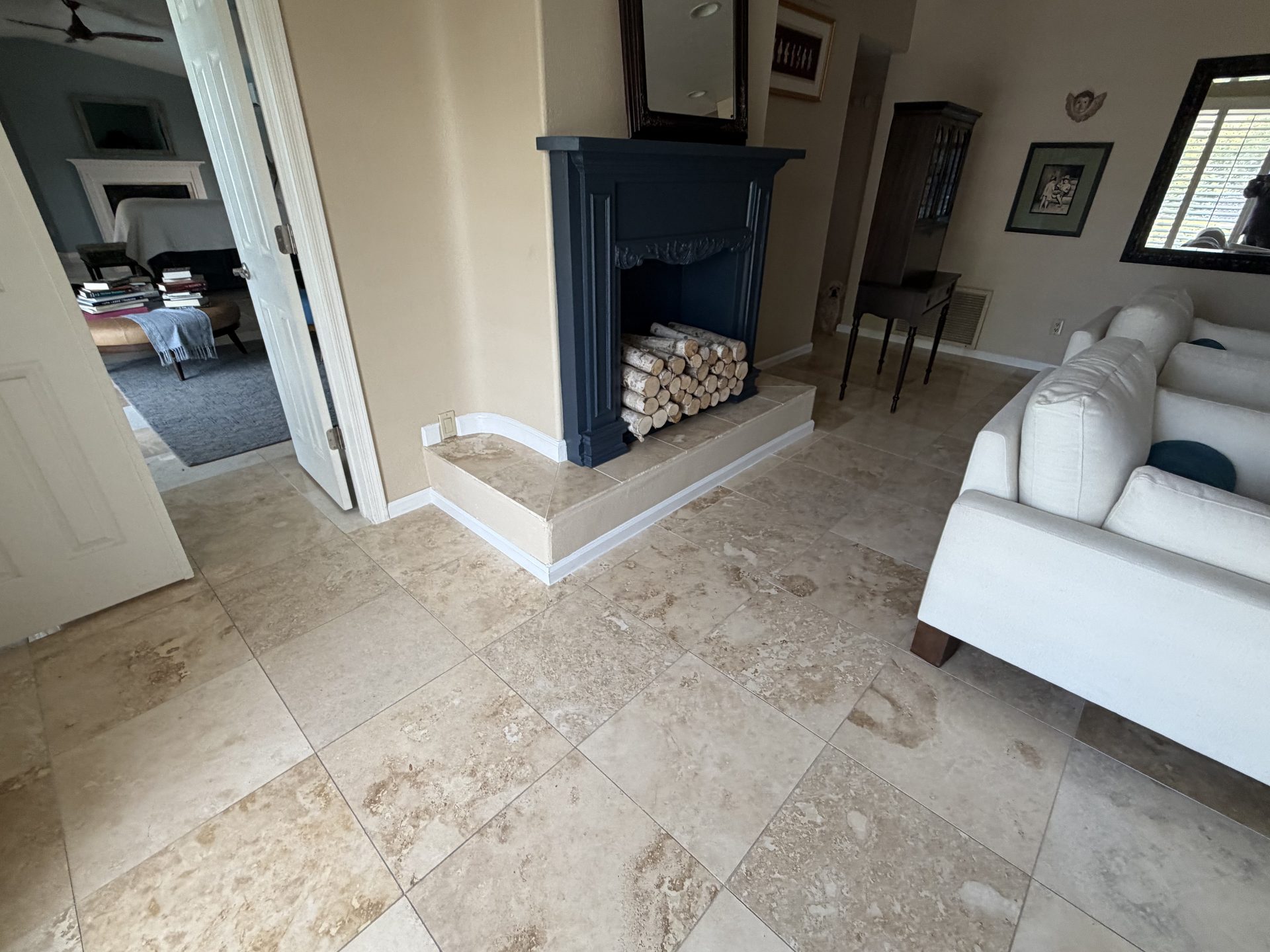
The second reason is that in a Valley house the fireplace is decorative. It gets lit two or three times a winter, and the other 362 days a wood firebox is a dirty open hole in the wall with a damper that leaks conditioned air all summer. Most 1970s to 1990s Phoenix, Mesa, Scottsdale, and Glendale homes have one, and most of them are candidates for something better than a firebox full of old ash.
The sole-source-of-heat exemption from No Burn Days closed to new applicants at the end of 1995. If you've read that your fireplace is exempt because it's your only heat, that exemption cannot be applied for today. The only live exemptions are temporary ones, capped at 150 days and means-tested, and emergency ones for a house whose heat has failed. An EPA-certified stove is not exempt from a declared day either; certification governs what may be installed, not what may burn on a No Burn Day.
What You Have: Masonry vs. Factory-Built
Everything downstream depends on whether the firebox is masonry or a factory-built metal unit, and you can tell in thirty seconds with a flashlight. A masonry fireplace has a firebrick box with real mortar joints, a clay-tile flue, and usually a brick or block chimney outside. A factory-built fireplace, also called zero-clearance, is a steel box with refractory panels inside, an air gap around it, and a metal chase or a framed chimney outside. The label with the model number is inside the opening or on the wrapper, and that label decides the whole ladder.
The masonry firebox
Masonry takes every option. Vented gas logs sit in it as built. A direct-vent insert slides in with a liner kit up the flue. Electric drops in. The masonry chimney is also the one most likely to need work found on inspection, because 1970s and 80s Valley chimneys are due for crown and cap repair by now.
The factory-built metal firebox
A factory-built fireplace is a listed assembly, tested as a whole. Putting an unlisted insert into it voids the listing and can overheat the chase and the framing around it, because the original test never accounted for the insert's weight or heat. So: vented gas logs only if the unit carries a solid-fuel listing under UL 127, a gas insert only if that fireplace's manufacturer lists it for that model, and vent-free almost never, because very few factory-built units were tested for it. That leaves electric, usually the right answer for a zero-clearance box. We say so on a walkthrough rather than selling a gas insert into a firebox that was never built for one.
Before any gas work: a Level 2 chimney inspection
NFPA 211 requires a Level 2 inspection, which includes a camera scan of the whole flue, on any change of fuel type, any appliance change, or any reline. That's every option on this page except plug-in electric. It finds the cracked flue tiles and missing mortar that otherwise become a change order halfway through the job. It runs $250 to $600, often credited toward the work.
The Options Ladder, Cheapest to Most Involved
Most Phoenix homeowners land on rung one or rung three. Rung one because it's cheap and reversible and the fireplace was never about heat. Rung three because they want the sealed glass look and real warmth in one room. Rung two is for people who want a flame behind the existing screen and already have gas nearby. Rung four is for people building a new feature wall in front of the old fireplace.
- 1Electric insert or electric log set
Slides into the firebox, sits on the hearth or a bracket. No combustion, no vent, no gas. A plug-in log set runs on an existing outlet if the load fits; most built-in inserts draw 1,500 watts on heat and want their own 15 or 20 amp circuit. The damper gets closed and sealed with a fitted plug, and the chimney top gets capped against rain, birds, and roof rats. Fully reversible. Nothing is destroyed.
- 2Vented gas logs in the existing firebox
A burner pan and ceramic logs in the masonry firebox, exhaust up the existing chimney. Needs a gas line to the firebox with a sediment trap and a shutoff, and the damper permanently fixed open with a damper clamp, or removed entirely, to hold the minimum free opening the log set's listing calls for. That is a manufacturer and fuel gas code requirement, it is what the inspector looks for, and it is what keeps combustion byproducts out of the room. With the damper locked open, this is a decorative appliance, not a heater: most of the heat goes up the flue and the open damper leaks conditioned air year-round. People choose it for the look and for No Burn Day legality.
- 3Direct-vent gas insert
A sealed glass-front firebox slides into the old opening. Combustion air comes in and exhaust goes out through a co-linear liner kit, two flexible liners run up the chimney to a new cap. The old damper is removed or cut to pass the liners and a block-off plate seals the throat. The blower needs power, usually a dedicated circuit to a receptacle in the cavity. Sealed combustion means no room air used, no carbon monoxide in the room, and real usable heat. The only rung on the ladder that heats the room.
- 4Sealed electric conversion
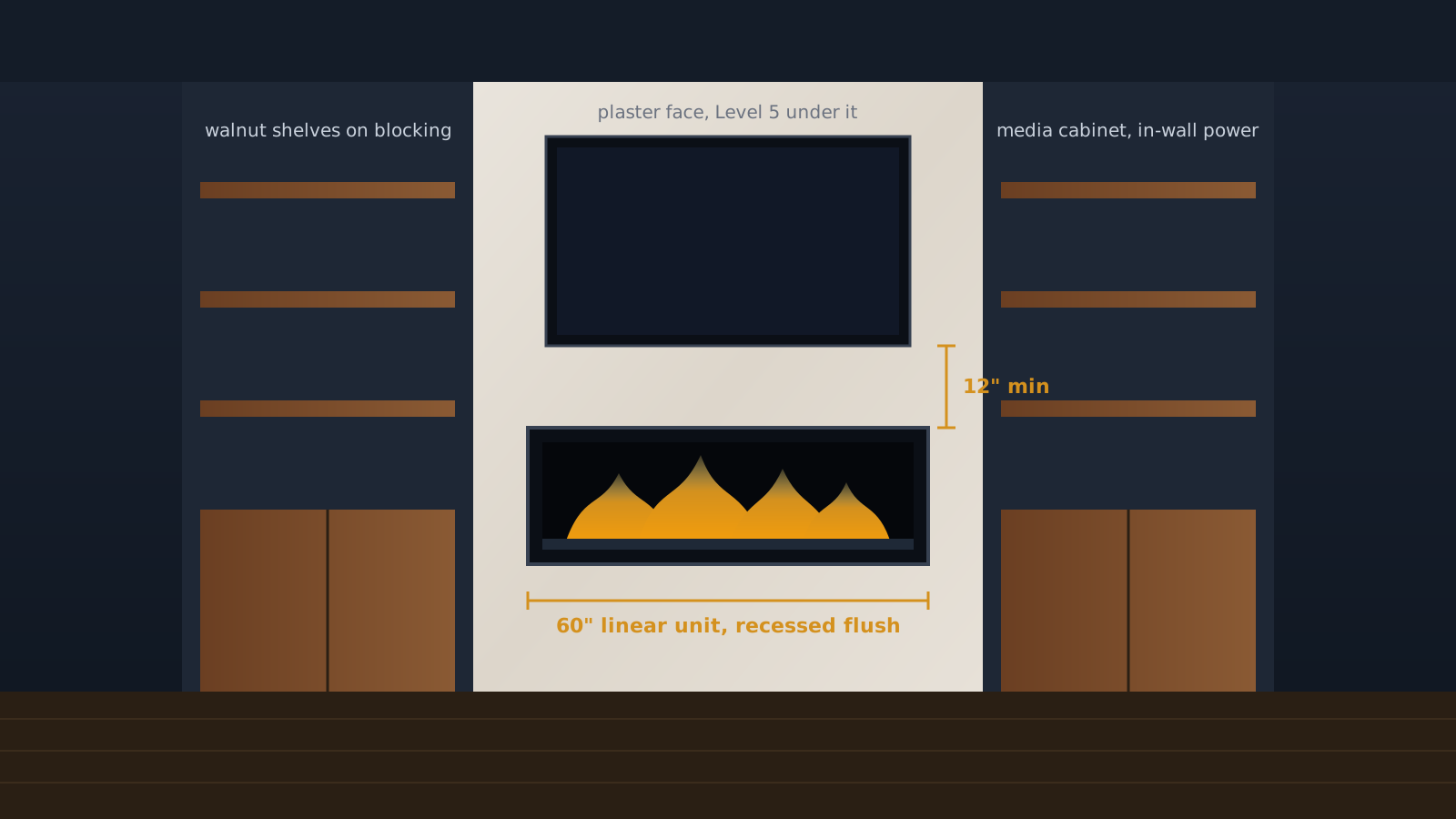
The damper assembly comes out, a rigid insulated block-off plate goes in at the throat, the smoke chamber gets insulated, the flue gets capped, and the firebox is framed and closed with a recessed electric unit set in the new wall. It removes the biggest energy leak in most Phoenix houses with a fireplace. It is not easily reversed, and in Phoenix there is no permit path to a new wood-only firebox, so going back is not a realistic plan. This is the rung for the modern flush look, and installing a recessed linear electric fireplace in a feature wall is the build guide for it.
What Happens to the Damper, the Flue, and the Chimney
The damper is the part of this job that homeowners get wrong most, in both directions. With vented gas logs it has to be clamped permanently open, because a gas log set running behind a closed or half-closed damper puts carbon monoxide into the room. With an electric insert it has to be closed and sealed, because there's no combustion and an open damper is a hole in the house. Same part, opposite instructions. "Just close the damper" is right for one of them and wrong for the other.
The liner run for a direct-vent insert
A direct-vent insert breathes through its own pipes: one flexible aluminum or stainless liner brings combustion air in, another takes exhaust out, both run up the existing chimney to a co-linear termination cap at the top. Sizes are typically three inches each; the unit's listing governs, and aluminum is fine on the exhaust leg of a listed Category I gas insert while anything hotter, and some manufacturers regardless, calls for stainless. The old damper gets cut or removed to pass them, a block-off plate seals the throat so the chimney no longer draws room air, and the old flue tile is only a chase for the liners at that point. That's why the Level 2 inspection matters: a liner run up a flue with a collapsed tile is a job that stops halfway.
Capping and sealing a chimney you're done using
An electric conversion leaves a chimney with nothing to do, and an uncapped chimney in Phoenix takes in monsoon rain and whatever nests in it, usually birds or roof rats. The top gets a cap or a chase cover, the damper gets a fitted seal, and on a sealed conversion the smoke chamber gets insulated and the throat plated. Skip the cap and the first August storm puts water in the firebox and a smell in the living room.
The damper is also an energy leak
An open or warped damper on a 1980s house is a hole in the envelope in July as much as in January, and most Valley dampers haven't sealed in decades. The biggest energy win on this whole page is the sealed conversion, because it closes that hole permanently. The second biggest is a properly sealed damper on an electric insert. Vented gas logs, with the damper locked open, make the leak permanent. That's the trade for the look.
The Gas Line: The Part That Moves the Price Most
Distance from the meter to the firebox is the biggest variable in a gas conversion. A Phoenix house is slab-on-grade, so the run almost never goes under the floor; it goes through the attic and down a wall, or along the exterior. Ten to thirty feet of new line runs about $600 to $2,200 installed depending on the route, at roughly $15 to $25 a foot for a simple run and $35 to $50 or more per foot through the attic or a finished wall. The line gets a sediment trap and an accessible shutoff at the appliance, and it gets pressure-tested and inspected before it's covered.
A house with no gas service at all is a different conversation. Southwest Gas charges a monthly basic service charge whether or not you burn a therm, and a new service line has its own cost and timeline. Without gas already at the house, that alone usually decides the job for electric, and we'll say so before anyone prices a log set. Gas piping is permitted work, performed by licensed trades, and it sits inside our Class B license on a residential job.
Do You Need a Permit in Phoenix?
Yes for gas piping, in every Valley city, with a pressure test and an inspection before the line is covered. Yes, generally, for a gas insert or log set, which is a mechanical permit. Yes for a new electrical circuit for an insert or a blower. No, usually, for a plug-in electric log set on an existing outlet. What Phoenix adds is on the other end: under 40-4 the city will not issue a permit for a new wood-only fireplace, and under 40-5 a post-1998 fireplace with an insert cannot be altered back to solid fuel. The conversion permits themselves come from the mechanical, fuel gas, and electrical codes. We pull the permits in our name, which is a real difference from a cash gas line by someone who doesn't.
Phoenix City Code, Chapter 40, in plain English
40-4. Since December 31, 1998, no new fireplace or wood stove may be built or permitted in Phoenix unless it has a permanently installed gas or electric log insert, is EPA-certified under the federal residential wood heater rule, or is listed by a recognized testing agency to an equivalent standard. Converting to gas or electric is the direction the code already points.
40-5. A fireplace installed on or after December 31, 1998 that has a gas or electric log insert may not be altered to burn wood again. Older fireboxes are outside that section, but 40-4 closes the door on a new wood-only fireplace regardless.
Mesa has a parallel ordinance requiring EPA-certified inserts on new installs. Scottsdale, Tempe, Chandler, Gilbert, Glendale, and Peoria each run their own permit desks, and the specific permit type for an insert varies by city; we confirm it with the building department before the work is scheduled.
The permit calendar, not the labor, is what sets the schedule on a gas conversion. Phoenix gas permits commonly run weeks, not days, and the inspection lands before the line can be covered. Adding any gas appliance is also the moment to confirm working carbon monoxide alarms outside the sleeping areas and on every level; we check them on a gas conversion whether or not the permit asks. For the broader picture on what needs a permit in a Valley remodel, see when a Phoenix remodel needs a permit.
What a Fireplace Conversion Costs in Phoenix
A conversion runs from about $900 for an electric log set on an existing outlet to $12,000 for a complete direct-vent gas insert with a liner kit, a blower circuit, and the permit, with most direct-vent jobs landing between $7,000 and $10,000. The four rungs price differently because they are different amounts of work. Two variables move a gas job the most: the length of the gas run, and what the Level 2 inspection finds in the chimney.
| Option | Typical Phoenix range, installed | Site days |
|---|---|---|
| Level 2 chimney inspection with camera scan | $250 to $600 | Half a day; often credited toward the job |
| Chimney cap, installed | $300 to $800 | Half a day |
| Electric log set or insert, existing outlet | $900 to $2,500 | 1 day; unit $400 to $1,500; the low end assumes an existing outlet, an existing cap, and no chimney work |
| Electric insert plus a dedicated circuit | $1,800 to $4,500 | 1 to 2 days; the circuit run drives the spread |
| Vented gas logs, gas already at the firebox | $1,200 to $3,000 | 1 day; log set $500 to $1,800 |
| Vented gas logs with a 10 to 30 foot gas run | $1,800 to $5,200 | 2 days plus the permit calendar; permit $150 to $400 |
| Direct-vent gas insert, complete | $5,500 to $12,000 | 2 to 4 days; unit $2,500 to $4,500, liner kit $1,500 to $4,000 |
| Sealed electric conversion, firebox closed | $2,500 to $6,000 | 2 to 3 days; the new feature wall is a separate line |
Phoenix market ranges for 2026 from published cost data and the work we quote. Exterior masonry chimneys on 1970s and 80s Valley homes frequently need crown or cap repair found during the inspection, which is its own line.
The Maricopa County Fireplace Retrofit Program offers a voucher of up to $2,000 toward a natural gas log set, currently boosted to $2,500 for the first 17 eligible participants, on a house that already has a gas meter. The boundary is tight: roughly 67th Avenue on the west, Dunlap Avenue on the north, 16th and 24th Streets stepping down the east side, and Carver Road and South Mountain Park on the south. It requires a working firebox, an existing cap, an operating damper, and the owner on site for the pressure test. Most of the Valley is outside that box, amounts and the boundary change, and funds run out, so we check the county page before we tell anyone they qualify.
What it costs to run
Per hour of actual warmth in the room, electric is the cheapest of the four and vented gas logs are the most expensive, which surprises people. At Phoenix rates of roughly 12 to 14 cents per kilowatt-hour and about $1.59 per therm of gas, a 1,500 watt electric insert on heat costs about 18 to 21 cents an hour, more in a 4 to 7 p.m. on-peak window, and all of it lands in the room. A direct-vent insert at 25,000 BTU runs about 40 cents an hour and most of it stays in the room. Vented gas logs at 60,000 BTU run close to a dollar an hour, and most of that goes up the open flue. Flame-only on an electric unit is about a penny an hour. Rates move. These use Southwest Gas residential of about $1.59 a therm and APS and SRP residential of roughly 12 to 14 cents a kilowatt-hour as of September 2026, and APS has a rate case pending.
Running cost per hour, Phoenix rates
| Appliance | Input | Cost per hour | Where the heat goes |
|---|---|---|---|
| Electric insert, flame only | About 0.05 kWh | About 1 cent | No heat; this is how it runs 10 months a year |
| Electric insert, heat on | 1.5 kWh | 18 to 21 cents | All of it into the room; a space heater |
| Direct-vent gas insert | About 0.25 therm | About 40 cents | Sealed combustion; most current models rate around 70 percent or better; heats the room |
| Vented gas logs | About 0.6 therm | About 95 cents | Mostly up the open flue |
How Long a Conversion Takes
An electric log set goes in during an afternoon. A gas log set is a day once the gas is at the firebox, and two days with a line run, plus the weeks the permit takes. A direct-vent insert is two to four site days across the permit calendar, with the inspection landing before the line is covered. A sealed conversion with a new finished wall is a week or more of site days and the calendar of the wall's finish. On every gas option the permit wait sets the calendar, not the crew. We give you that number before you order an appliance.
Which Option Fits Which House
If the firebox is factory-built and the label doesn't list a gas insert for it, go electric, rung one or rung four. If the house has no gas service, go electric. If you want a flame behind the existing screen and gas is already at the wall, vented logs. If you want the room warm on a January night and the firebox is masonry, a direct-vent insert. If you're building a new feature wall in front of a dated fireplace anyway, the sealed conversion, and the feature wall guide covers the rest.
Let Us Read the Firebox
We'll open the screen, find the label, check the chimney, and tell you which of the four options your fireplace can take and what each would run. Send a photo of the fireplace and the label if you can find it, or book a walkthrough.
Get a Conversion EstimateCommon Questions About Fireplace Conversions in Phoenix
Can I use a gas fireplace on a No Burn Day in Phoenix?
Yes. Maricopa County's no-burn rule, Ordinance P-26, prohibits burning anything other than gaseous fuel on a declared day and excludes devices designed and used to burn gas exclusively, which a permanently installed gas log set or a sealed insert is. An electric fireplace has no combustion at all and is never restricted. Burning wood on a No Burn Day gets a warning the first time, then fines of $50, $100, and $250 as violations stack up.
Do I need a permit to convert my fireplace to gas in Phoenix?
Yes for the gas piping, which needs a permit, a pressure test, and an inspection in every Valley city, and generally a mechanical permit for a gas insert or log set. A plug-in electric log set on an existing outlet usually needs no permit; a new dedicated circuit for an electric insert is permitted electrical work. Phoenix's own fireplace chapter adds that no new wood-only fireplace can be permitted at all. We pull the permits in our name.
Can I convert my fireplace back to wood later?
In Phoenix, generally not. City Code 40-5 bars altering a fireplace installed on or after December 31, 1998 that has a gas or electric log insert so it burns wood again. Older fireboxes, which is most of the Valley's housing stock, are not covered by that section, but 40-4 means a new wood-only fireplace cannot be permitted either way, so there is no path back to a new wood-burning firebox. Treat a conversion as a one-way door and decide with that in mind.
What happens to my chimney after the conversion?
It depends on the option. Vented gas logs keep the chimney working and the damper is clamped permanently open. A direct-vent gas insert gets a pair of flexible liners run up the existing flue to a new cap. An electric insert gets the damper closed and sealed and the top capped against rain and pests. A sealed electric conversion removes the damper, insulates the smoke chamber, and caps the flue for good.
What Else Makes Sense to Do at the Same Time
A conversion opens the firebox, puts an electrician at the panel, and often opens the wall around the surround, which means the trades for the work next to it are already standing in the room. Add-ons agreed up front ride the same trip at 25 to 50 percent under what they cost as their own job. On a fireplace, these are the ones that make sense:
- Refinish the surround. Dated 1980s brick or tile takes plaster, lime wash, or Roman clay well, and the wall is already masked. Roman clay stays away from a gas insert's heat; Venetian or lime wash handle it. See plaster finishes for a fireplace surround.
- Mount the TV above it properly. The electrician is already running a circuit, so in-wall power and HDMI go in the same pass. A direct-vent insert throws real heat up the face, so the unit's listed clearance to a TV gets checked and a mantel shelf or a recessed box goes in as a heat break. Our Phoenix handyman and installation services handle the mount.
- Built-ins or floating shelves either side. Blocking goes in while the wall is open. Our framing and structural work covers the closed firebox and the new wall.
- The hearth and the mantel. A new appliance changes the clearance to combustibles, so a mantel often has to move anyway, and a raised hearth can be taken flush to the floor while the firebox is open.
- Chimney cap and crown repair. The inspection usually finds it, and the roof access is already set up.
- A hearth-side outlet or sconce circuit. The panel cover is off and the wall is open; a second circuit is cheap on the same day and expensive on its own.
The saving comes from the shared permit and the wall being open once. Add these mid-job and none of that is shared anymore, so they cost full price.

Written by Harrison Norem, owner of Norem Contracting and a licensed Class B general contractor, Arizona ROC #365090. Fifteen years across the trades, from framing and electrical to finish work, across the Phoenix metro. More about Harrison.