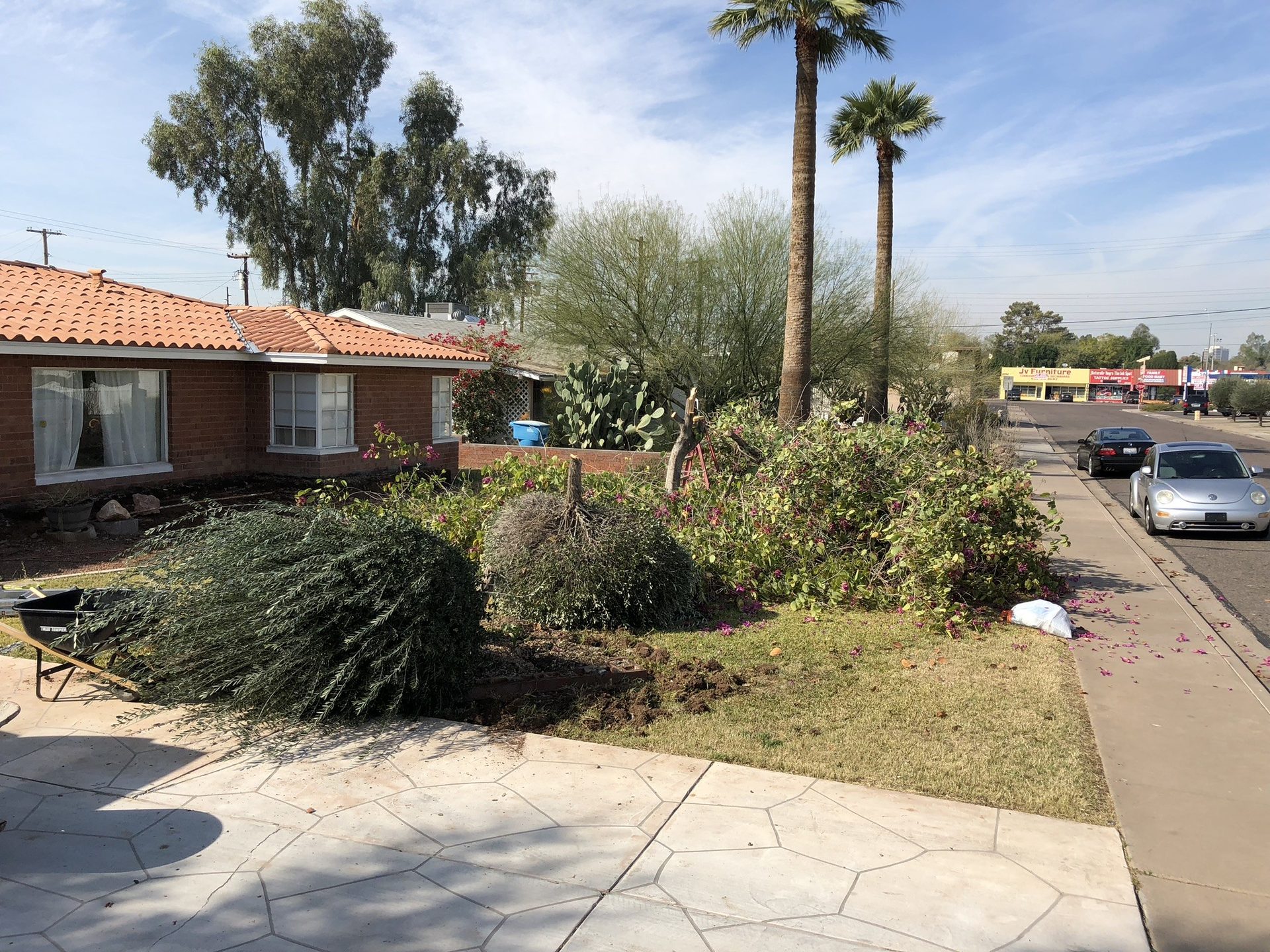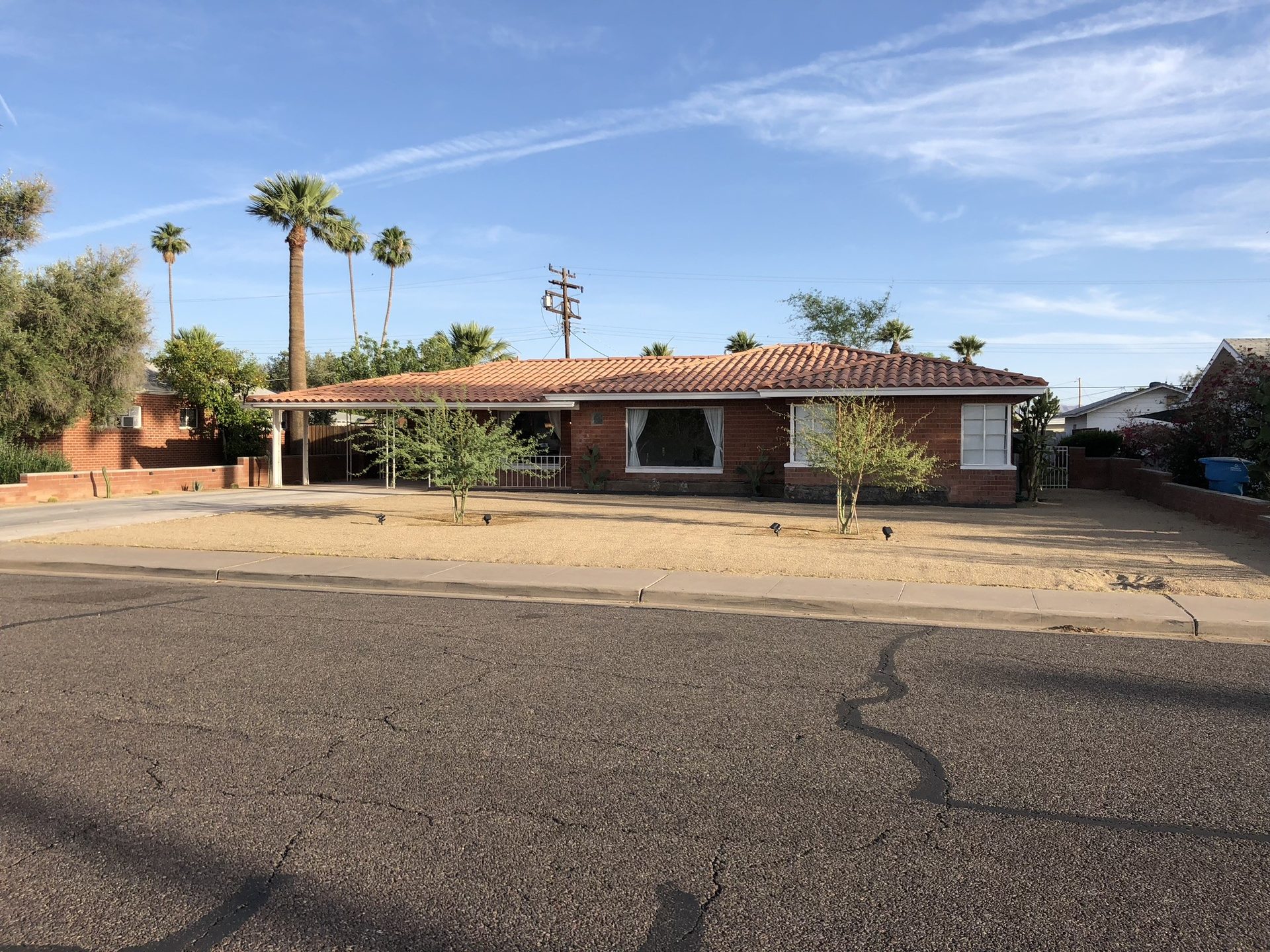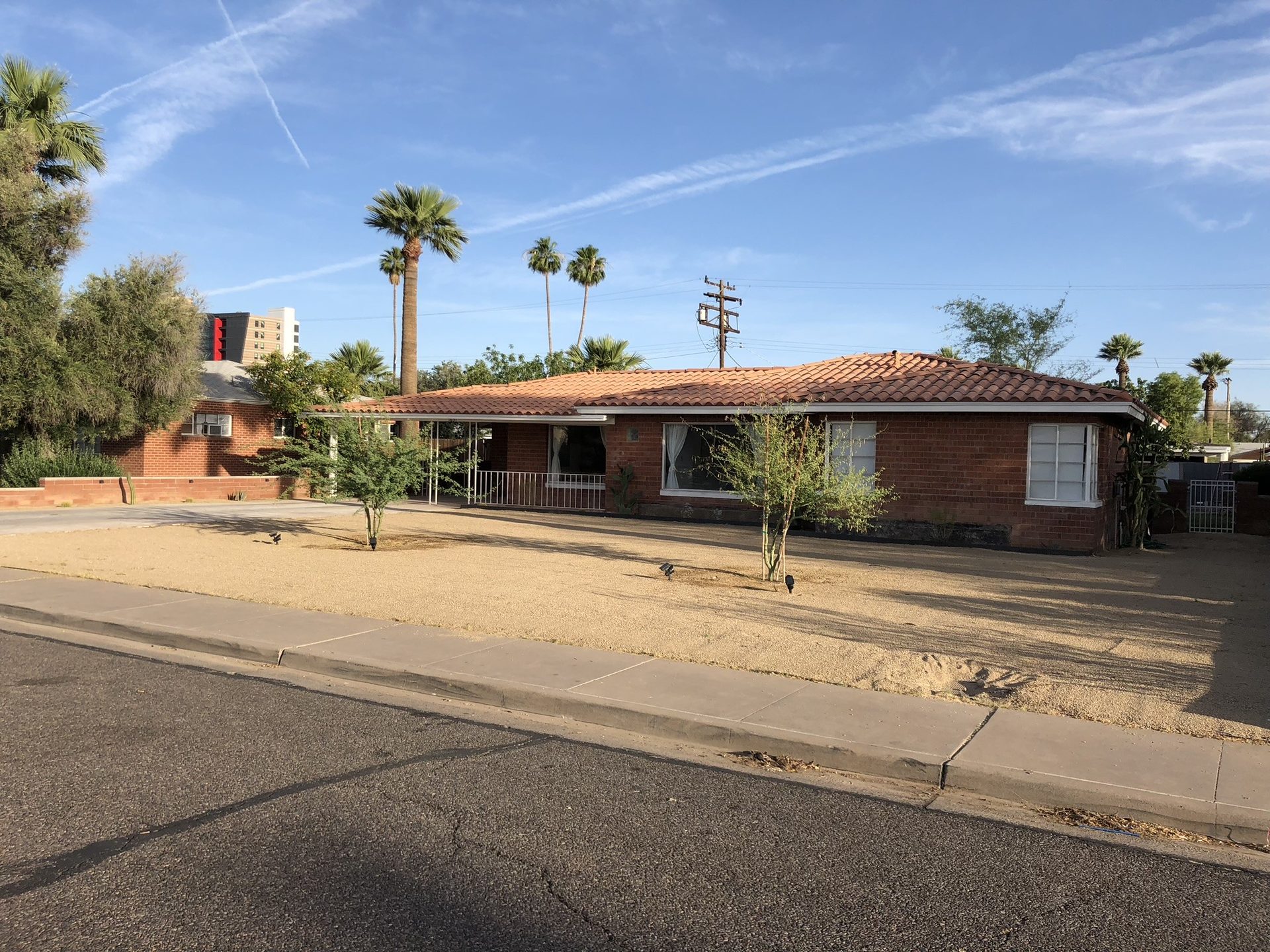
If your yard fills with water every couple of weeks, you're on flood irrigation, and converting to desert landscaping works differently than it does for a house on city water. Three things change. The water right belongs to the land rather than to you, so "turning it off" means declining delivery, not cancelling a utility. Your city's grass rebate probably won't pay for it. And the mature trees the flood water has been feeding are the part of the job most likely to go wrong.
Here is how the system got here, which parts of the Valley still run it, and what a conversion actually involves when the yard was built to hold water on purpose.
Why parts of the Valley still flood their yards
Flood irrigation in the Salt River Valley is older than the city. The Hohokam dug canals across this floodplain centuries before anyone platted a subdivision, and the modern system follows a lot of the same ground. SRP has been delivering water here since 1903, after Valley farmers pledged 200,000 acres of their own land as collateral for the federal loan that built Roosevelt Dam. The dam gave a farming community a way through the cycle of flood and drought that had nearly finished it.
So the yards came second. The delivery network was built to water fields, and the neighborhoods were laid out on top of it. When the orange groves and alfalfa became lots, the water rights stayed attached to the dirt. That is why a 1950s ranch house in Arcadia gets the same kind of delivery a cotton field did.
It has held on this long for an unglamorous reason: raw canal water is cheap. The infrastructure was paid off decades ago and the cost is offset by SRP's power business, so a homeowner with irrigated acreage pays far less to soak a yard than a neighbor pays to sprinkle treated drinking water on the same grass.
Which parts of the Valley still have it
Roughly 20,000 properties across the metro still take flood delivery. That sounds like a lot until you set it against the original service area of 240,000 acres spanning Maricopa, Gila and Pinal counties. Residential flood irrigation is now about five percent of SRP lands, and around 85 percent of the water SRP delivers goes to municipal providers instead.
Where it survives tends to track the canals. The Arizona Canal starts at Granite Reef Diversion Dam northeast of Mesa and runs west across the Salt River Pima-Maricopa Indian Community, through Scottsdale, into the Arcadia and Sunnyslope neighborhoods of Phoenix, then on through Glendale and Peoria before it ends at New River. Irrigated blocks sit along that line the whole way.
- Arcadia is the one people picture. The Arcadia Water Company was formed in 1919 and had pumping stations and about 15 miles of concrete pipe in the ground by 1924. The citrus is the tell. Those grapefruit and orange trees are what the groves left behind.
- Tempe runs urban irrigation to 17 city parks and roughly 850 residential customers, which is why irrigated blocks there sit next to blocks that never had it.
- Mesa keeps it in a small pocket near downtown, close to the oldest platted ground in the city.
- Glendale, Peoria and Scottsdale have irrigated stretches where the canal and its laterals run, generally in the older neighborhoods rather than the newer ones.
- Gilbert, Chandler and Queen Creek carry the farm version more than the yard version, on larger parcels and horse properties where the field layout survived subdivision.
Newer construction almost never has it. If your house went up after the farms were gone, the developer put in city water and a sprinkler system, and none of this applies to you.
Where flood irrigation is heading
The direction is not really in doubt. In the 1980s something between 70 and 90 percent of residential properties in the city of Phoenix had turf. It's around 15 percent now. Every year fewer households want to be home at 2 a.m. to open a gate, and fewer want to maintain the ditch and berms that make the delivery work.
We'll give the other side its due, because the usual "flood irrigation wastes water" line is lazier than the facts. A deep infrequent soak pushes salts down past the root zone instead of concentrating them near the surface, which is a real agronomic advantage in our soil. It grows deeper roots than a daily sprinkle does. It keeps big canopy trees alive that no drip system would support. And for a city watering ball fields, untreated canal water is a lot cheaper than running treated water through the meter.
What it is not is optional at the household level. You take the delivery your land is entitled to, on the schedule the system runs, whether or not your yard needs it that week. The homes converting now are mostly doing it because the landscape no longer justifies the water, not because someone shamed them into it. A lawn that gets walked on twice a year is a lot of water for a view.
Can you actually turn it off?
You can stop taking deliveries. You cannot get rid of the water right, because in Arizona the water belongs to the land and not to the owner. The allotment can't be transferred, bought or sold. It came with the parcel and it stays with the parcel after you sell.
Practically, that means calling SRP at (602) 236-3333 and asking two questions rather than one. The first is how to discontinue delivery. The second, and the one people skip, is exactly which annual charges continue if you do. The annual basic charge pays for water storage and for building and maintaining the canals and laterals, which are costs that don't disappear because one yard stopped irrigating. Get that answer in writing before you plan around it, because it decides whether the conversion pays for itself in four years or fourteen.
The physical side is more work than people expect, and it's where a flood lot stops resembling a normal grass-to-desert job. The yard was graded to hold water. There are berms around the perimeter, a valve or gate at the property line, and often a concrete ditch or buried lateral crossing the lot. Leave that grading alone and the first real monsoon storm will pond exactly where it always did, except now there's decomposed granite floating in it instead of grass holding it. Regrading the lot to shed water toward the street, and doing it before the granite goes down, is the single biggest line item that a non-irrigated yard doesn't have.
The rebate most flood-irrigated homes don't qualify for
Valley cities pay homeowners to take out grass, and the marketing around those programs is everywhere. Chandler, Mesa, Gilbert, Tempe, Phoenix, Scottsdale, Glendale, Peoria and others all run some version. If you're on flood irrigation, read the eligibility language before you count on any of it.
Chandler's single family grass removal policy is the clearest example, and it says so directly: "Areas served by flood irrigation are not eligible." The program pays $1.50 per square foot up to $2,000, it requires an active Chandler water utility account, and it requires written pre-approval before you pull a single square foot of turf.
The logic is consistent even where the wording is softer. These programs exist to cut the amount of treated municipal water a city sells and then has to replace. If your grass is drinking canal water, the city isn't saving anything by paying you to remove it. Some municipalities treat partially irrigated properties differently, and amounts and rules change every year, so call your own water conservation office and ask about your parcel specifically. What you should not do is tear out the lawn first and apply afterward. Pre-approval is a condition in most of these programs, and removing the grass before you have it disqualifies you even where you would otherwise have been eligible.
What happens to your trees when the water stops
This is the part that costs people real money, and it's the reason we won't quote a flood conversion off a photo.
A tree that has spent twenty years on flood irrigation has built a root system around a flood schedule. Plenty of desert species respond to heavy water by putting on top growth faster than they put on root. The canopy gets big, the trunk gets tall, and underneath it there's a root plate that never had to go looking for anything. Those are the trees that come down in a July storm, and if you've driven Arcadia after a real haboob you've seen them lying across the street with a shallow disc of roots standing on edge.
Cut the water off all at once and you get the other failure. The canopy the tree is carrying was sized for the water it was getting. Take it away in one step and the tree drops limbs, thins out, or dies back over the next two summers, usually well after everyone has stopped connecting it to the landscaping job.
The way through is to wean rather than cut. Put in deep drip on the trees you intend to keep and run it before the flood deliveries stop, with emitters out at the canopy edge rather than against the trunk, on long infrequent cycles that imitate the soak the tree is used to. Give it a season if you can. Then have an arborist look at the ones you're unsure about, because a large ficus or a mature non-native shade tree that has never been water-stressed is a different risk than a velvet mesquite that will shrug and carry on. Some of these trees are the most valuable thing in the yard and some are a liability standing over your roof, and it is worth knowing which is which before the granite goes down.
Native or not: mesquite, palo verde, and what you're really choosing
Once the lawn is gone, the tree list is the decision that sets how the yard looks in fifteen years. The native versus non-native argument gets framed as an environmental one, and it is, but there's a structural argument underneath it that matters more to a homeowner.
Mesquite
Velvet mesquite is the one that actually grows here. Soft gray-green leaves, small thorns at the leaf bases, dark fissured bark as it ages, and a slow steady habit. The mesquites you see most in Valley landscapes are usually Chilean or Argentine instead, brought in because they grow faster, come in thornless forms and throw a wider crown sooner.
The tradeoff is in the wood and the roots. The regional species is stronger wooded and roots better, with less tendency to split or blow down. The South American mesquites, especially when they've been pushed with water, are the ones that fail in wind. On a lot coming off flood irrigation that difference isn't academic, because whatever is already out there has been pushed with water for its whole life.
Palo verde
Blue palo verde and foothill palo verde are the natives. Blue wants more water and grows faster with a looser open habit. Foothill is smaller, tighter, slower and tougher, and it is the one that looks like the desert outside town.
Most palo verde sold now is the Desert Museum hybrid, and there are good reasons for that. No thorns, a strong yellow bloom, a reasonable growth rate and a canopy that gets big enough to shade something. It also has a well documented habit of getting top heavy and toppling when it's overwatered, because the foliage outruns the root system. Planted on a modest drip schedule it is an excellent tree. Planted where a flood lot is still soaking, or watered like the lawn it replaced, it is a tree that ends up on your car.
The honest summary is that non-native gets you shade faster and native gets you a tree that is still standing in twenty years. Most yards we do end up with some of each, with the natives where the tree has to survive on its own and the faster growers where someone wants shade over a patio this decade.
Two looks: architectural and natural
Almost every desert yard in the Valley leans one of two directions, and the split has more to do with the age of the neighborhood than with anyone's taste.
Linear and architectural
Straight steel or concrete edges, rectangular planting beds, a single screened granite in a consistent size and color, plants placed in repeats and given room, and a lot of deliberate empty ground. The plant list runs to shapes that hold a line: agave, ocotillo, golden barrel, hesperaloe, clipped hedges of Baja ruellia or myrtle.
It reads as intentional immediately, which is why it dominates newer construction in Chandler, Gilbert and North Scottsdale, and why it is the default for the minimalist remodels you see in Paradise Valley. It also punishes sloppiness. A crooked edge or a granite color that doesn't match the second delivery is visible from the street forever. And it looks sparse for the first two years until the plants size up, which is the most common reason a homeowner calls us back unhappy about a yard that was actually installed correctly.
Rough and natural
Curved or unedged transitions, boulders set low and grouped the way they sit on a hillside, mixed rock sizes, plants in odd numbers and uneven spacing, and species chosen for how they look untrimmed. Brittlebush, creosote, bursage, wolfberry, native grasses, a palo verde allowed to keep its low branches.
It suits older neighborhoods with irregular lots and mature trees already in place, which is why it works so well in Arcadia, Coronado and the older parts of Tempe and central Phoenix. It is more forgiving to install and much harder to maintain well, because the line between "naturalistic" and "nobody has been out here in a year" is thinner than people think. It needs editing rather than mowing, a couple of times a year, by someone who knows what to take out.
What we're seeing more of lately is people mixing them on purpose: architectural geometry close to the house where the lines of the building can carry it, loosening into natural planting toward the property edge. Done carelessly that reads as two yards that met in the middle. Done with one clear transition line it gives you a front yard that looks designed and a back yard you can actually live in.
What the conversion actually costs
Front yard conversions in the Valley generally run $5 to $15 per square foot installed. A flood-irrigated lot tends to sit toward the upper half of that, and occasionally above it, for reasons that are specific to this kind of property: the berms and ditch have to come out and the lot has to be regraded to drain, there are usually mature trees to protect and transition rather than a blank lawn to scrape, and a drip system has to go in for the trees whether or not you wanted irrigation at all.
Against that, you have no city rebate in most cases, and a delivery charge that may or may not stop. Which is the honest reason to get the SRP answer first. The conversion is usually worth doing on maintenance and on what the yard looks like for the other fifty weeks a year. Selling it purely on the water bill is how people end up disappointed.
What else makes sense to do at the same time?
The yard is open, the equipment is on site and the grading is already being touched. A few things cost a fraction now of what they cost as their own job later.
- Drainage and grading away from the house. If the lot has been holding water for decades, this is the moment to fix where it goes. Doing it after the granite is down means pulling the granite back up.
- Drip irrigation for everything you keep. Not optional on a flood lot, since it is what keeps the mature trees alive through the transition.
- Low-voltage lighting. The trenching is open. Path lights and a couple of uplights into a mesquite or palo verde do more for the front of a house at night than anything else at the price.
- A block planter, seat wall or low garden wall. Easiest to build before the finished surface goes in, and it gives an architectural yard the structure it needs to not look empty in year one.
- Sleeves under any hardscape. Cheap now, and it means you are not cutting a walkway in five years to run a wire or a line.
Thinking about converting a flood-irrigated yard?
We handle the whole thing under one contract: the SRP-side questions, regrading the lot to drain, tree transition and drip, the plant palette, and the lighting. Free in-home consultation, evenings and weekends included. Arizona ROC #365090.
Get a Free EstimateCommon Questions About Converting a Flood-Irrigated Yard
Can I cancel SRP flood irrigation on my property?
You can stop taking deliveries by contacting SRP at (602) 236-3333, but you cannot remove the water right itself. In Arizona the irrigation allotment belongs to the land rather than the owner, and it cannot be transferred, bought or sold. Ask SRP specifically which annual charges continue after you discontinue delivery, because the basic charge covers water storage and canal maintenance and that does not necessarily stop when one yard stops irrigating.
Does the city grass removal rebate apply to a flood-irrigated yard?
Usually not. Chandler's single family grass removal policy states directly that areas served by flood irrigation are not eligible, and it requires an active city water account. The programs exist to reduce the treated municipal water a city sells, so a lawn drinking canal water does not save the city anything. Rules differ by city and change each year, so check with your own water conservation office before you plan around a rebate, and never remove grass before you have written pre-approval.
Will my mature trees die if I turn off the flood irrigation?
They can, and the damage often shows up a year or two later. A tree grown on flood water has a canopy sized for that water and frequently a shallower root plate than it looks like it should have. Install deep drip at the canopy edge and run it before the flood deliveries stop, on long infrequent cycles, so the tree transitions instead of being cut off. Have an arborist assess anything large or non-native before you commit.
Which Phoenix-area neighborhoods still have flood irrigation?
Roughly 20,000 properties across the metro still take flood delivery, mostly along the canal system. Arcadia and Sunnyslope in Phoenix are the best known, and irrigated blocks also run through Scottsdale, Glendale and Peoria where the Arizona Canal and its laterals pass. Tempe delivers to 17 city parks and about 850 residential customers, Mesa keeps a small area near downtown, and Gilbert, Chandler and Queen Creek carry it mostly on larger former farm parcels.
Should I plant native mesquite and palo verde or the faster-growing varieties?
Native velvet mesquite and the native palo verdes are stronger wooded, root better and are less likely to split or blow down than the Chilean and Argentine mesquites or an overwatered Desert Museum palo verde. The non-natives give you shade several years sooner. Most yards end up with both: natives where the tree has to look after itself, faster growers where someone wants shade over a patio this decade.
What does it cost to convert a flood-irrigated lot to desert landscaping?
Valley front yard conversions generally run $5 to $15 per square foot installed. Flood lots tend toward the upper half of that range because the berms and ditch have to be removed, the lot has to be regraded to drain instead of to hold water, and drip has to go in for the existing trees. There is usually no city rebate to offset it.