Desert landscape lighting in Phoenix comes down to one choice and one climate. The choice is solar fixtures you stake in the granite or a low-voltage wired system on a transformer, and for anything you want to look designed, the wired system wins, because a solar fixture cooks its battery in two Phoenix summers and never had the output to reach the top of a saguaro anyway. The climate is 115-degree surface heat, ultraviolet that yellows plastic in a few seasons, haboob dust on every lens, and monsoon water in every bad gasket. A professionally installed low-voltage system runs about $150 to $350 per fixture, with a front yard of eight to fourteen fixtures at $1,800 to $4,500 including the transformer. Below is what survives out here, how to light the plants a desert yard has, and the rules that apply.
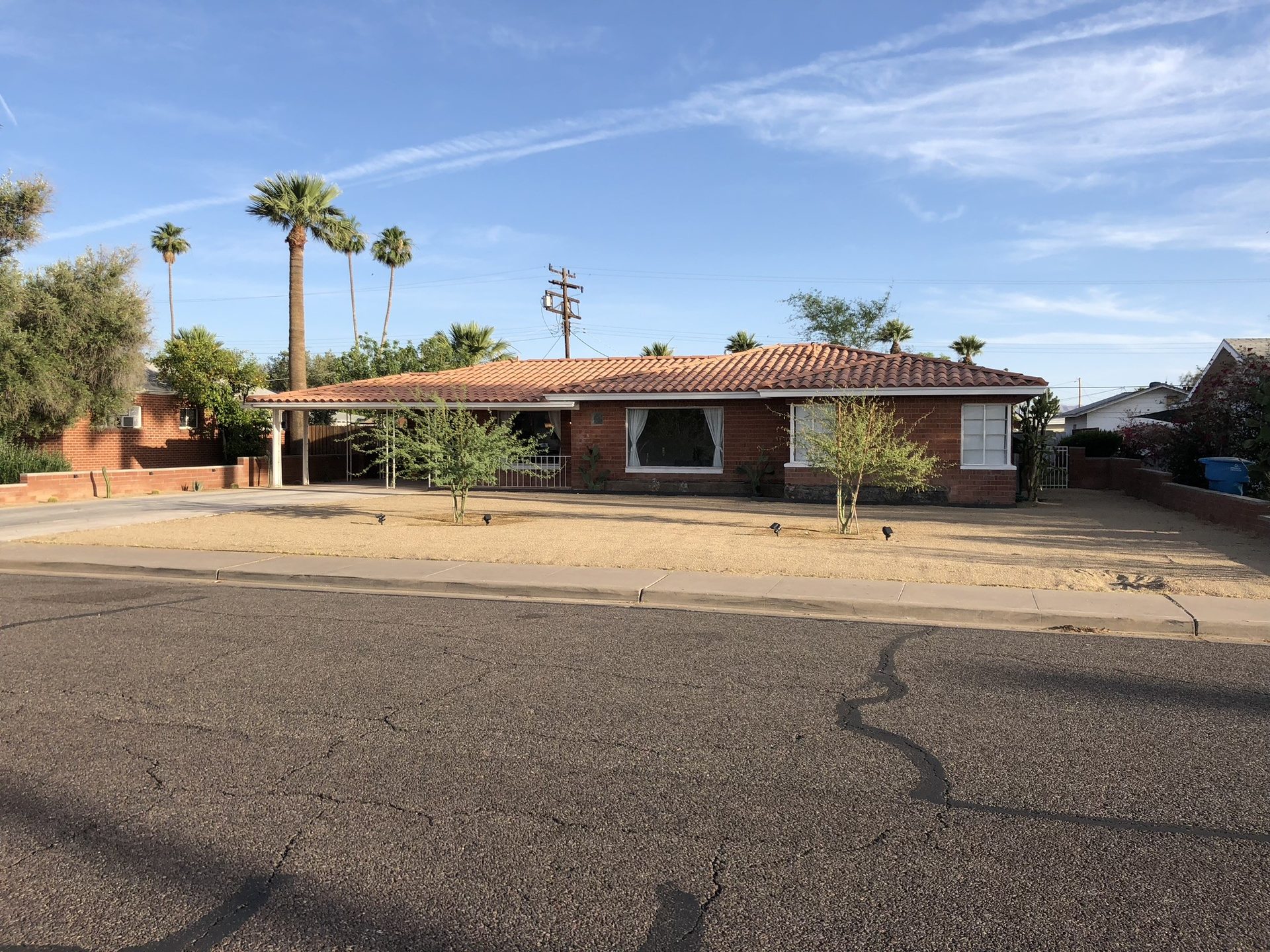
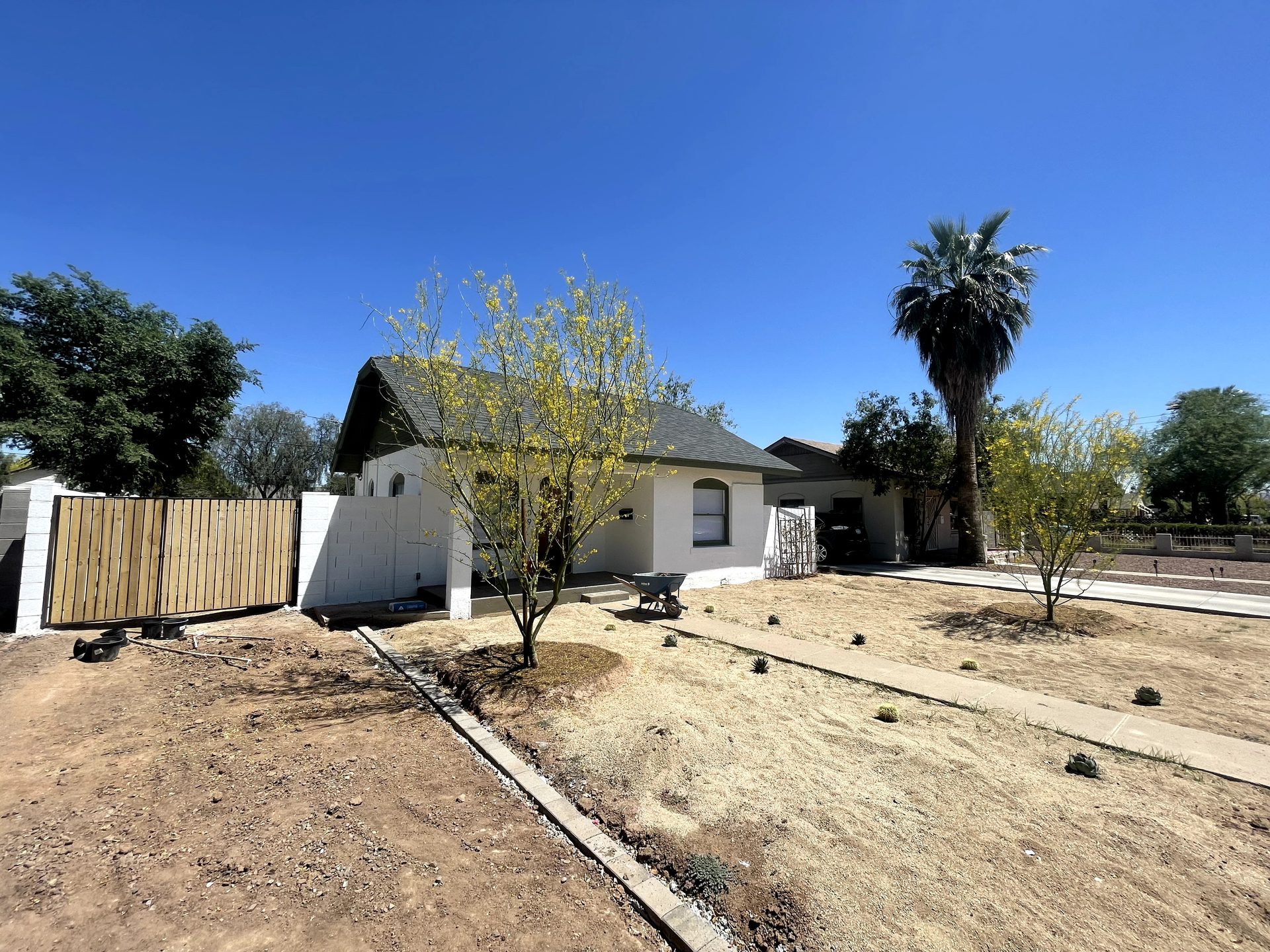
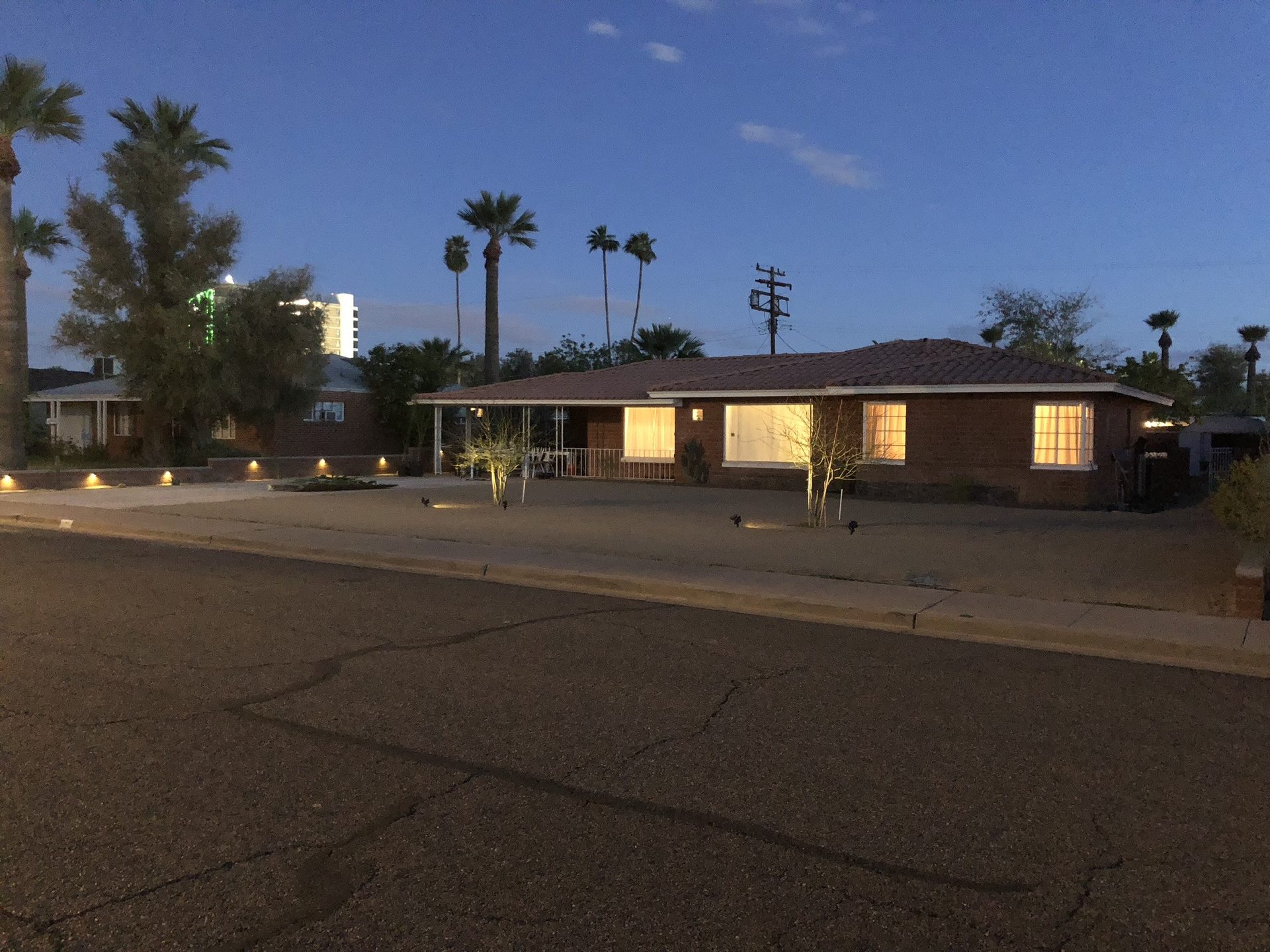
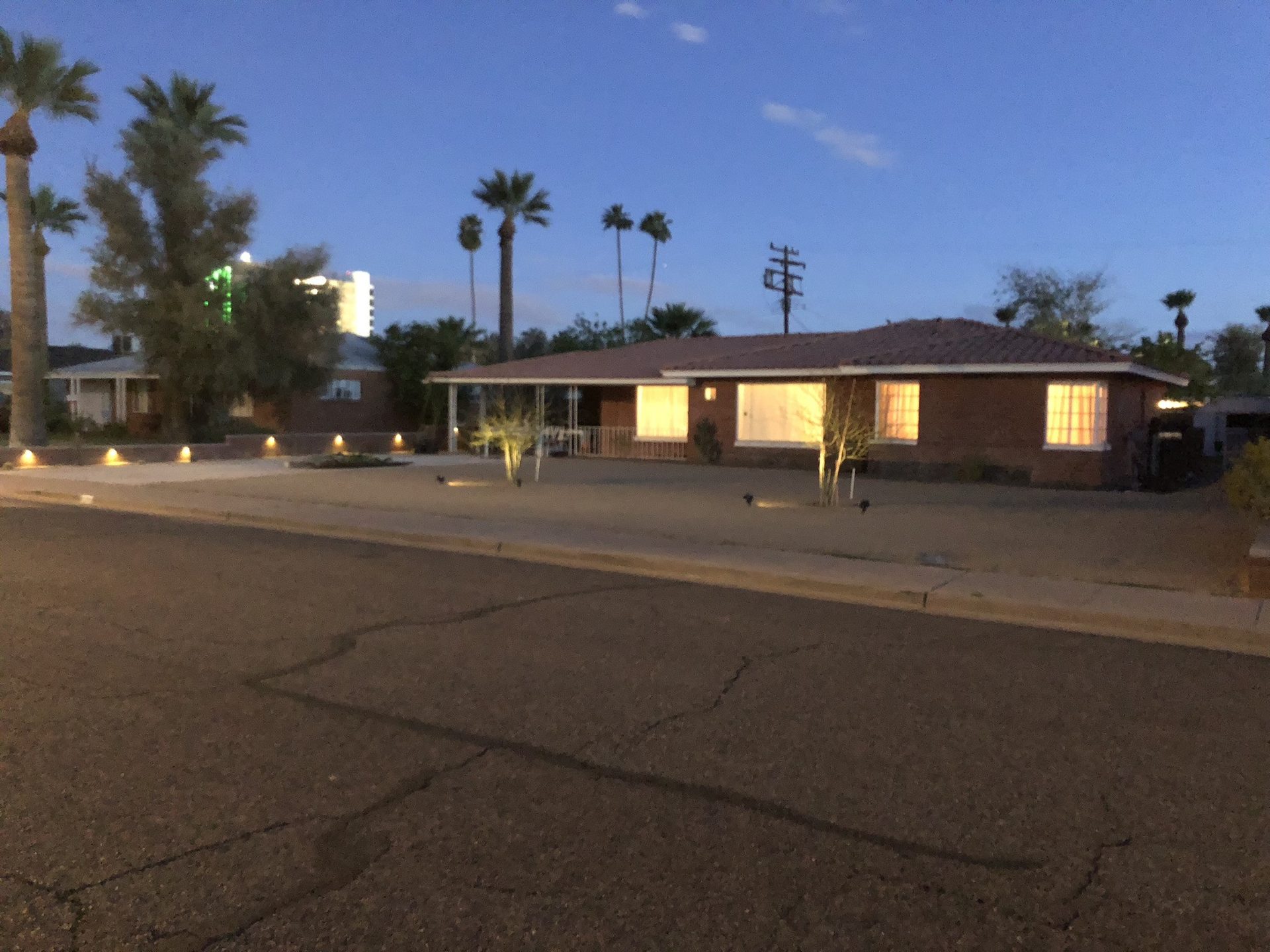
We build these on our desert landscaping jobs. The photos on this page are from a front yard we converted from grass to desert in Phoenix, lit on the last evening of the job. Norem Contracting is a licensed Class B general contractor, Arizona ROC #365090, and the new exterior outlet that a wired system sometimes needs sits inside that license. For the wider service, start with our low-voltage landscape lighting in a Phoenix desert yard page; this post is the decision and the technique.
Why Does a Desert Yard Need Lighting at All?
Because a xeriscape yard is a daytime design that disappears at 7 p.m. A grass-to-desert conversion is a real investment in plants, granite, and boulders that were placed to be looked at, and for half the year in Phoenix the hours you're home to look at them are dark. Lighting is what makes the yard exist after sunset, and it's also the thing that makes a front elevation read as finished from the street. On the Catalina front yard we converted from grass to desert, the path lights and the tree uplights went in on the same trench as the drip, and the last hour of the job was spent aiming them at dusk.
What Breaks Landscape Lights in Phoenix?
Four things: surface heat, ultraviolet light, dust, and water. A fixture sitting in decomposed granite in July is in a 150-degree oven every afternoon whether it's on or not. UV chalks powder coat, yellows plastic lenses, and splits gaskets in two to four years. Haboob dust cakes lenses and fills any fixture that sits below grade. Monsoon rain finds the gasket the UV already split. A fixture built for Ohio lasts a few seasons here. A fixture built for this survives, and the difference is mostly the metal it's made of.
Why brass and copper beat aluminum and plastic here
Solid brass and copper develop a patina and keep going. Powder-coated cast aluminum is acceptable in a marine grade, but it's the weak link: Phoenix UV chalks the coating, and an aluminum body touching a brass or stainless stake or fastener corrodes at the joint, faster with our mineral-heavy irrigation water on it. Plastic and composite fixtures embrittle and fade within a few summers. There's a functional reason for brass beyond durability: LED output and lifespan depend on the temperature inside the fixture, and a metal body is the heat sink. A plastic fixture in the sun runs its LED hot even when it's off.
Fixture materials in a Phoenix yard
| Material | Heat and UV | Dust and water | Realistic life here |
|---|---|---|---|
| Solid brass or copper | Patinas; body is the heat sink for the LED | Gaskets are the only wear part; lens O-rings checked yearly | 15 to 20 years on the body; gaskets and lenses are the maintenance items |
| Cast aluminum, marine-grade powder coat | Coating chalks; galvanic corrosion at any brass or stainless contact | Fine while the coating holds | 5 to 10 years |
| Plastic and composite | Embrittles, fades, lens yellows | Gaskets fail early; stems snap under a rake | A few summers |
| Consumer solar (plastic body, small battery) | Battery degrades in the housing heat; lens fogs | Dust on the panel kills the charge | 1 to 3 summers, dimming the whole way |
Solar or Low-Voltage Wired: Which One Belongs in a Phoenix Yard?
Wired for the front yard and anything you want to look designed; solar for low-stakes accents and spots with no cable route. Solar earns a fair hearing first, because Phoenix gives it the best case in the country: roughly 300 sunny days and some of the highest solar irradiance anywhere. If solar path lights work anywhere, they work here. The sun is not the problem. The heat is. Consumer solar fixtures use small nickel-metal-hydride or lithium cells, and battery life falls off a cliff at sustained high temperature. A fixture sitting on 150-degree granite cooks its battery every afternoon, and most units are noticeably dim by their second summer. The plastic lens fogs and yellows under UV, which cuts both the light out and the charge in. And a dusty panel charges poorly, so solar lights are the only landscape fixtures with a recurring cleaning chore that decides whether they work at all.
Output is the other half. A typical consumer solar path light puts out single digits to about 30 lumens, a good one around 50, and it dims through the night as the cell drains. A 12-volt path fixture starts around 50 lumens and runs well past 100, at the same brightness all night. Uplighting a tree needs punch, tight optics, and steady output, which are the three things a solar fixture cannot do. And solar fixtures drift apart in brightness as their batteries age unevenly, which looks worse than no lighting.
Solar vs. low-voltage wired, in a Phoenix yard
| Consumer solar | Low-voltage wired, brass LED | |
|---|---|---|
| Upfront cost | A few dollars a fixture, no install | Most of the budget; per-fixture figures are in the cost table below |
| Lifespan here | 1 to 3 summers, dimming | 15 to 20 years; a lamp is a five-dollar part |
| Light output | Single digits to about 30 lumens, a good one near 50, falling through the night | 50 to about 700 lumens by fixture, steady all night; the high end is a large canopy, not a path |
| Aimability | Stake it and hope | Beam spread chosen per plant, aimed after dark, re-aimed as it grows |
| Dust sensitivity | High; the panel is the charger | Wipe the lens once a year |
| What happens in July | Battery cooks; output drops | The brass gets hot; the LED runs |
| Best use | A path, a mailbox, a remote corner with no cable route, a rental | The front yard, specimen plants, anything that has to match |
| Five-year cost, 10 fixtures | Two or three replacement rounds; the cheap version bought three times | One install, plus a few lamps |
Solar prices are approximate retail; wired prices are Phoenix market ranges for 2026 and match our landscaping page. The five-year row is the honest comparison, because solar is a purchase you repeat.
Where solar makes sense on a desert lot
A back fence line nobody looks at closely. A side gate. A mailbox at the end of a long drive where trenching would cut an irrigation main. A rental where the fixtures will walk off anyway. A short-term fix before a real system. Those are legitimate, and we'll say so. What solar is not is a substitute for lighting a yard you spent ten thousand dollars building.
Uplighting, Path Lighting, or Moonlighting: Which Does What?
Uplighting gives drama and vertical form; it's what you point at a saguaro, a trunk, or a column of ocotillo canes. Path lighting is safety and the walk to the door, spaced so it reads as a rhythm and not a runway. Moonlighting is a downlight mounted high in a palo verde or mesquite and aimed down through the branches, so the tree throws a dappled shadow across the granite. Moonlighting is the most expensive-looking technique and the least used in Phoenix. Path lighting is the one homeowners overdo. A yard with twelve path lights and no uplights looks like an airport.
How Do You Light a Saguaro Without Making It Look Like a Gas Station?
Two fixtures, set back three to six feet from the base and roughly 120 degrees apart, aimed up with a narrow 10 to 15 degree spot, and shielded so the source is hidden in the granite. A single fixture flattens a saguaro's ribs and throws a hard shadow of the arms onto the house. Two fixtures keep the form round. A fixture jammed against the trunk creates a hot spot at the bottom and darkness at the top; set back, the light climbs the ribs. And nothing gets dug inside a saguaro's root plate: the roots are shallow and spread wide, and a trench at the base is a real hazard to the plant. Saguaros and many other natives are protected under the Arizona Native Plant Law. Moving or selling one takes a state permit, a saguaro over four feet needs a permit, tag, and seal, and even destroying a protected native on your own property requires advance notice to the Arizona Department of Agriculture, 20 days on a lot under an acre. That is why a trench line near a saguaro is a design decision, not a field decision.
Palo verde and mesquite
Light the canopy, not the trunk. A downlight mounted high in the tree aimed down through the branches, or a wide flood from below at 300 to 700 lumens. Mount with stainless hardware and a strap that can be let out, run the cable along a branch not stapled tight, because these trees grow fast and a rigid mount is an embedded wire in three years.
Ocotillo
Ocotillo is mostly negative space. A wide flood set far back lights nothing. Put a small fixture close to the base, aimed steeply up, so the light rakes the canes. One fixture is usually enough.
Agave and barrel cactus
A low spot at 100 to 200 lumens, and shield it. Agave is a glare machine: a wide-open fixture at ground level aimed at a shiny agave throws light straight back at the viewer. A glare guard or a honeycomb louver on the fixture fixes it.
Boulders and block walls
Graze, don't spotlight. A fixture close to the surface at a steep angle reveals texture; a fixture set back at a wide angle flattens it. A wall wash is also the easiest way to light the neighbor's bedroom by accident, which is where the ordinance section starts.
What Color Temperature Looks Right on Granite and Cactus?
2700K warm white on the house, the block, and the flagstone; 3000K on the plants; and one temperature per sightline, never mixed. Warm 2700K flatters tan block, brown granite, and mesquite bark. Slightly cooler 3000K makes the blue-green of agave, blue palo verde, and prickly pear look like its daytime color instead of muddy yellow. Mixed color temperature on a single elevation is the most visible amateur tell in a lit yard, and the blue-white 5000K floodlight look has no place in a desert landscape.
Can the Lighting Wire Share the Trench the Drip System Already Opened?
Yes, and it's the biggest cost saver in the job, which is why lighting belongs in the original xeriscape scope rather than next spring. Low-voltage cable is direct-burial rated. It shares a trench with poly drip line as long as it stays to one side, above the emitter line, and the run is marked with tape in the trench, so a future drip repair doesn't spade the cable and a leak doesn't sit on a connector. Retrofitting after the granite is down means pulling back base, cutting fabric, trenching around plants you're trying not to disturb, and re-blending the granite so the repair doesn't read as a scar. The same trench, the same day, costs a fraction of that. The drip side of that trench, and how to keep it running, is in sprinkler and irrigation repair in Phoenix.
Depth: for a listed low-voltage system, the electrical code allows six inches of cover on the 12-volt side, and six is the minimum, not the target. The 120-volt supply feeding the transformer is a different rule entirely, generally 18 inches in PVC conduit or 24 inches for direct-burial cable, confirmed with the inspector on the job. Caliche often stops a shovel shallower than that and homeowners re-dig for plants constantly, so we run six to eight inches, deeper where the bed will be replanted, and sleeve the cable in conduit under any walkway or driveway crossing. Arizona 811, the Blue Stake locate, is required by law at least two working days before digging, hand digging included, and it's free.
How Big a Transformer Do You Need, and Can It Run Off an Outlet You Already Have?
Add up the fixture wattage, add headroom, and pick the next multi-tap stainless magnetic unit up; then confirm there's an exterior GFCI receptacle within reach of the wall you'll mount it on. A transformer is rated in watts, and you size it to the connected fixture wattage with headroom, loading it to about 80 percent so there's room for fixtures added later. A bigger transformer does not fix a long run; the multi-tap terminals do. Typical sizing: a 150 VA unit for a small front yard, 300 VA for a full front, 600 VA once a back yard and a pool are in play. That's design practice, not code, and the count on your yard sets it.
Cable gauge comes off the load and the distance together, not off a default. In practice most residential runs land on 12-gauge direct-burial, with 10-gauge on long runs or heavier loads, sized so the far fixture still lands in range; the 16 and 14 gauge in box-store kits is what starves a run. Voltage drop is the reason: a long run of thin cable starves the last fixture, and a daisy chain makes it worse. The hub method, one heavy home run to a hub and short leads to each fixture, keeps every fixture within a few tenths of a volt of the others. Most quality LED landscape lamps tolerate roughly 9 to 15 volts, printed on the fixture and worth checking, which makes drop far less punishing than it was with halogen, and it's why the 15-volt tap exists: after the system is energized, we measure the voltage at the far fixtures with a meter and move that run to a higher tap if it needs it. Measured, not guessed.
Connections are what kill a system in year two. Pierce-type connectors, the kind that clamp onto the cable and puncture the insulation, expose copper to Phoenix's alkaline soil and mineral-heavy irrigation water, corrode, and turn into one dim, flickering fixture a season later. Gel-filled or silicone-filled direct-burial connectors don't. A photocell drifts here as dust builds on its lens, and Phoenix sunset swings from about 5:25 p.m. in December to 7:40 in June, so an astronomic timer or a smart controller that tracks the sun is the control that never needs resetting.
What a 12-volt system does and does not need a permit for
The 12-volt side downstream of the transformer is not the permit question. The 120-volt supply is. Plugging a transformer into an existing exterior GFCI receptacle needs no permit in Phoenix-metro cities. Adding a new exterior receptacle, running a new circuit, or hard-wiring the transformer is licensed electrical work, generally permitted, and it sits inside our Class B license; see a licensed electrician for a new exterior circuit for how that side runs. One detail that rarely gets said: the GFCI on the 120-volt receptacle protects the 120-volt side, not the 12-volt wiring in the yard. It will not sense a fault out at a fixture, though a failing, water-logged transformer will trip it, and that trip is usually the first symptom. That's why the low-voltage side is wired to be safe on its own.
How Does the Install Go?
- Night walk and mockup. Fixtures set on the granite after dark and aimed before anything is buried. This is the step that separates a designed yard from a box-store install, and it costs nothing. On a yard that's also being replanted it happens after the plants are in, because you can't aim at a plant that isn't there yet.
- Arizona 811. Two working days before digging. Required by law, hand digging included.
- Power source confirmed. An existing exterior GFCI, or the new one scheduled first because it may need a permit and an inspection.
- Transformer mounted on the wall near the outlet, about a foot above grade.
- Runs laid out on the surface, fixtures staked, then the actual run lengths measured for the voltage math.
- Trench, six to eight inches, sleeved under hardscape. Cable pulled with a service loop at every fixture, in the same trench as new drip if the yard is being built.
- Fixtures set, connections made with gel-filled direct-burial connectors, hub method on the long runs.
- Backfill and granite restored.
- Energize and measure the voltage at each fixture, adjust taps, re-aim after dark.
- Timer or astronomic controller set, layout documented and handed to the homeowner so the next person digging knows where the cable is.
A front yard of eight to fourteen fixtures is commonly one site day, with the aiming done that evening or on a short return visit. A full front and back with a pool is two to three site days. A new exterior receptacle adds the permit calendar. Caliche can turn a one-day trench into two.
What Does Landscape Lighting Cost on a Phoenix Desert Yard?
A professionally installed solid-brass LED fixture runs about $150 to $350 in the Phoenix metro, a front-yard package of eight to fourteen fixtures with cable and installation runs $1,800 to $4,500, and a quality multi-tap stainless transformer is $200 to $500 in material. Those are the same figures on our landscaping page. Published Phoenix market ranges run a little wider on both ends, and the bottom of those ranges reflects aluminum or composite fixtures rather than solid brass. The fixture quality moves the number more than anything else, which is why a per-fixture quote without a fixture spec means nothing.
| Line item | Typical Phoenix range | What moves it |
|---|---|---|
| Solid brass LED fixture, installed | $150 to $350 per fixture | Fixture grade, integrated vs replaceable lamp, run length |
| Front yard package, 8 to 14 fixtures, cable, install | $1,800 to $4,500 | Fixture count, specimen plants, hardscape crossings, caliche |
| Transformer, multi-tap stainless, material | $200 to $500 | VA rating, astronomic timer or smart control built in |
| Surge protection on the transformer circuit | $60 to $200 | Cheap insurance against a monsoon surge; not lightning-proof |
| New exterior GFCI receptacle or circuit | $250 to $700 | Distance to the panel, permit |
| Back yard with a pool | Meaningfully above a front yard | Longer runs around the pool shell, sleeving under decks, the pool-area wiring rules, more fixture types |
| Consumer solar path light, retail | About $10 to $40 per unit | The low end is disposable; expect to buy them again |
| Consumer solar, 10 fixtures over five years | $200 to $1,200 | Two or three replacement rounds as the cells and batteries fade |
Phoenix market ranges for 2026, consistent with our Phoenix landscaping service page, which carries the per-fixture matrix for the whole service. No pool-yard multiplier is printed here on purpose; that number comes from the walkthrough.
Want the Yard to Exist After Dark?
Send a photo of the front yard from the street and tell us which plants you want to see at night. We'll come out at dusk, set fixtures on the ground, aim them with you, and give you a count and a number before anything is buried.
Book a Dusk WalkthroughWhat Do Phoenix HOAs and Arizona's Dark-Sky Rules Let You Install?
Shielded fixtures aimed down or at the plant, warm color, nothing spilling past the property line, and a check of the CC&Rs before buying anything. Flagstaff is the famous dark-sky city, and it's not the rule Phoenix homeowners live under. The rules that apply here come in three layers. Unincorporated Maricopa County's dark-sky provisions, in Section 1112 of the county zoning ordinance, require outdoor fixtures to be shielded and aimed downward, with narrow exemptions for very low-output fixtures, and they apply outside the cities, not inside Phoenix, Scottsdale, Mesa, or Chandler. Phoenix's zoning ordinance, Section 704, requires exterior fixtures to be arranged and shielded so light does not shine or reflect onto adjacent residential property, with intensity standards kept on file by Planning and Development; in practice that means shielded fixtures aimed down or at the plant, and nothing spilling across the property line. Scottsdale is the strict one: fixtures below three feet must be shielded, fixtures above three feet must be full cutoff and aimed down, and landscape lighting is limited to accenting landscaping, aimed away from property lines, with extension shields to limit glare. A ground-level uplight sits below the three-foot line, so Scottsdale asks that it be shielded rather than aimed down: a glare guard, low output, a tight beam, and enough setback that the source is hidden, which is how we do them everywhere anyway.
The HOA is the binding constraint far more often than any city. Many CC&Rs restrict color temperature, fixture finish, uplighting, and holiday-light timing, and an architectural review rejection after the trench is backfilled is an expensive lesson. Read the CC&Rs and submit to the architectural committee before buying fixtures. The reassuring part: a fully shielded, warm-white fixture aimed at a plant satisfies almost every version of these rules at once.
What the Monsoon and the Dust Do, and How the System Is Built for It
Well lights and in-grade fixtures fill with granite, dust, and monsoon silt, and a sealed in-grade fixture that fills with water cooks itself. In a Phoenix yard we prefer above-grade bullet fixtures on brass stems, and where an in-grade fixture is the right look, it gets a drainable design set proud of the finish grade on a gravel sump. Gaskets and lens O-rings get checked once a year, because five summers of cycling between 40 and 115 degrees is what opens them. A surge protector on the transformer's circuit is cheap insurance against a monsoon surge, and no, it is not lightning-proof. And the most common failure on an old system is a cable cut by later digging, which is why the runs go in consistent corridors along walls and bed edges, get marked in the trench, and get drawn on a layout the homeowner keeps. Fixtures on solid brass stems in a PVC sleeve survive a granite crew's rake. Plastic stakes don't.
Questions Phoenix Homeowners Ask About Desert Landscape Lighting
Do solar landscape lights work in Arizona heat?
They work, but not for long, and sun is not the problem. Phoenix gives a solar panel the best charge in the country. What kills the fixture is the heat inside its housing, which degrades the small battery within one to two summers, and the dust on the panel, which cuts the charge before the battery ever fails. Solar makes sense on a path or a remote corner with no cable route. It disappoints on anything you want lit with punch, like a tree or a saguaro.
How many fixtures does a front yard need?
Eight to fourteen on a typical Phoenix front yard, all on one transformer. A long walk, several specimen plants, or a wide front elevation push the count up. More fixtures at lower output beats fewer fixtures at high output every time; the over-lit, sparse look is the most common amateur mistake in a desert yard.
Can landscape lighting wire go in the same trench as the drip line?
Yes, and it is the biggest cost saver in the whole job. Low-voltage cable is direct-burial rated and shares a trench with poly drip line as long as it stays to one side, above the emitter line, and the run is marked, so a future drip repair does not spade the cable. That is why lighting belongs in the original xeriscape scope rather than a year later, when the granite has to come up to get a trench in.
Do I need a permit for low-voltage landscape lighting in Phoenix?
The 12-volt side downstream of the transformer is not the permit question; the 120-volt supply is. Plugging a transformer into an existing exterior GFCI receptacle generally needs no permit in Phoenix-metro cities. Adding a new exterior receptacle, a new circuit, or hard-wiring the transformer is licensed electrical work and generally does, and it sits inside our Class B license.
What Else Makes Sense to Do While the Yard Is Open?
The trench is the asset. Once a crew has a trench open and a transformer location picked, the marginal cost of the next thing that needs a buried line or a low-voltage run drops hard, 25 to 50 percent under standalone when it's agreed up front. On a lighting job the order matters as much as the list, so here it is in the order it has to happen:
- The new exterior outlet first, because it may need a permit and an inspection, and that's the item with schedule risk. See electrical.
- Plant replacement before the lighting design, because you can't aim a fixture at a plant that isn't there yet, and the fixture positions depend on where the mature plant will be. See desert landscaping and grass-to-desert conversions.
- Drip line in the same trench, cable to one side and tubing to the other. See sprinkler and irrigation repair in Phoenix for the drip side.
- A concrete walkway or patio, so path fixtures get set against a finished edge rather than retrofitted around one. See concrete patios.
- Patio-cover or ramada downlights fed off the same transformer, easiest during the cover's framing. See patio covers and ramadas.
- Granite refresh and metal edging last, over the closed trench. Refreshing granite before the lighting is money thrown away.
In that order, every one of those rides the same trench. Out of order, the granite comes up twice.

Written by Harrison Norem, owner of Norem Contracting and a licensed Class B general contractor, Arizona ROC #365090. Fifteen years across the trades, including the lighting and drip on our desert landscaping jobs, across the Phoenix metro. More about Harrison.