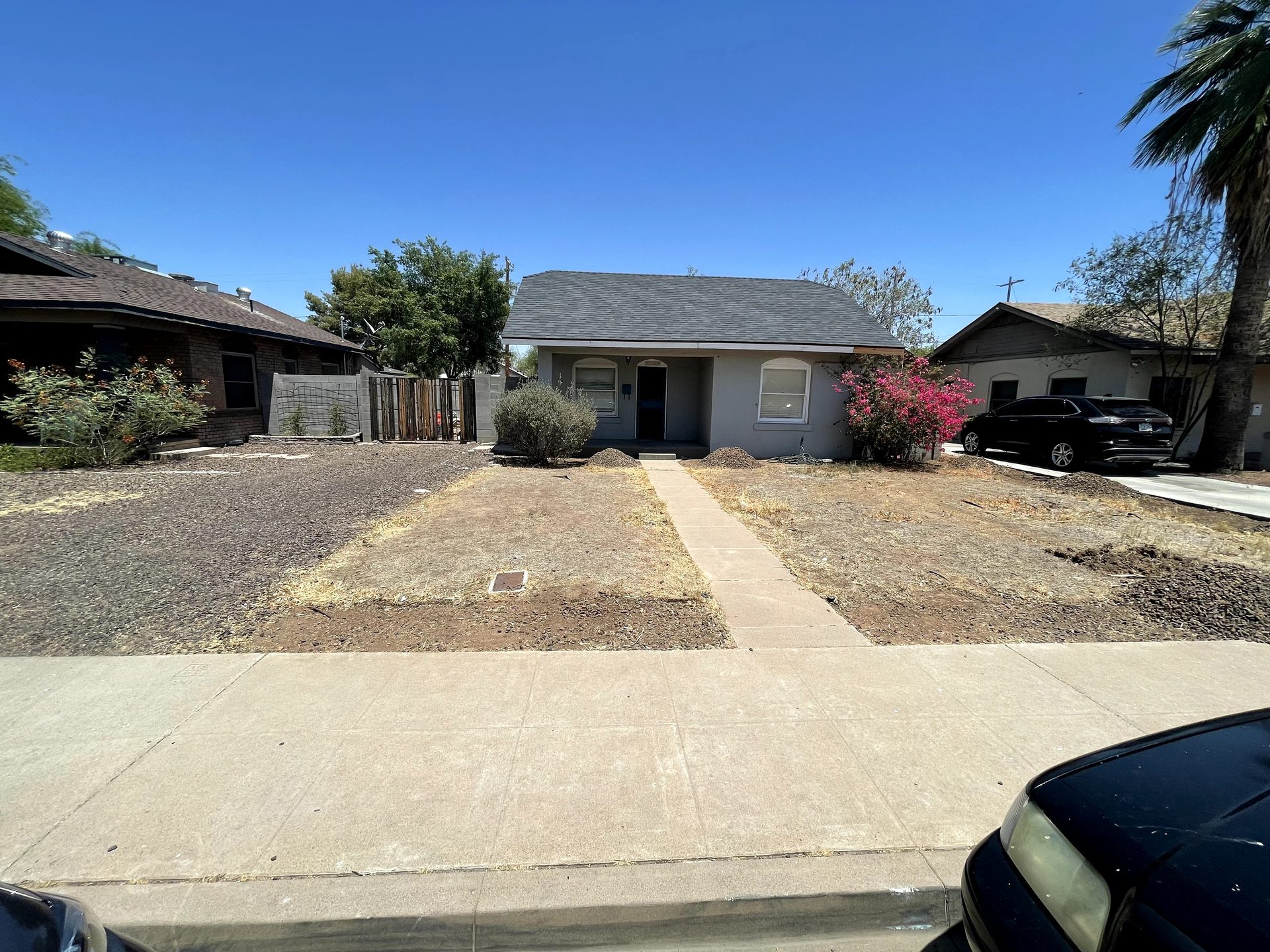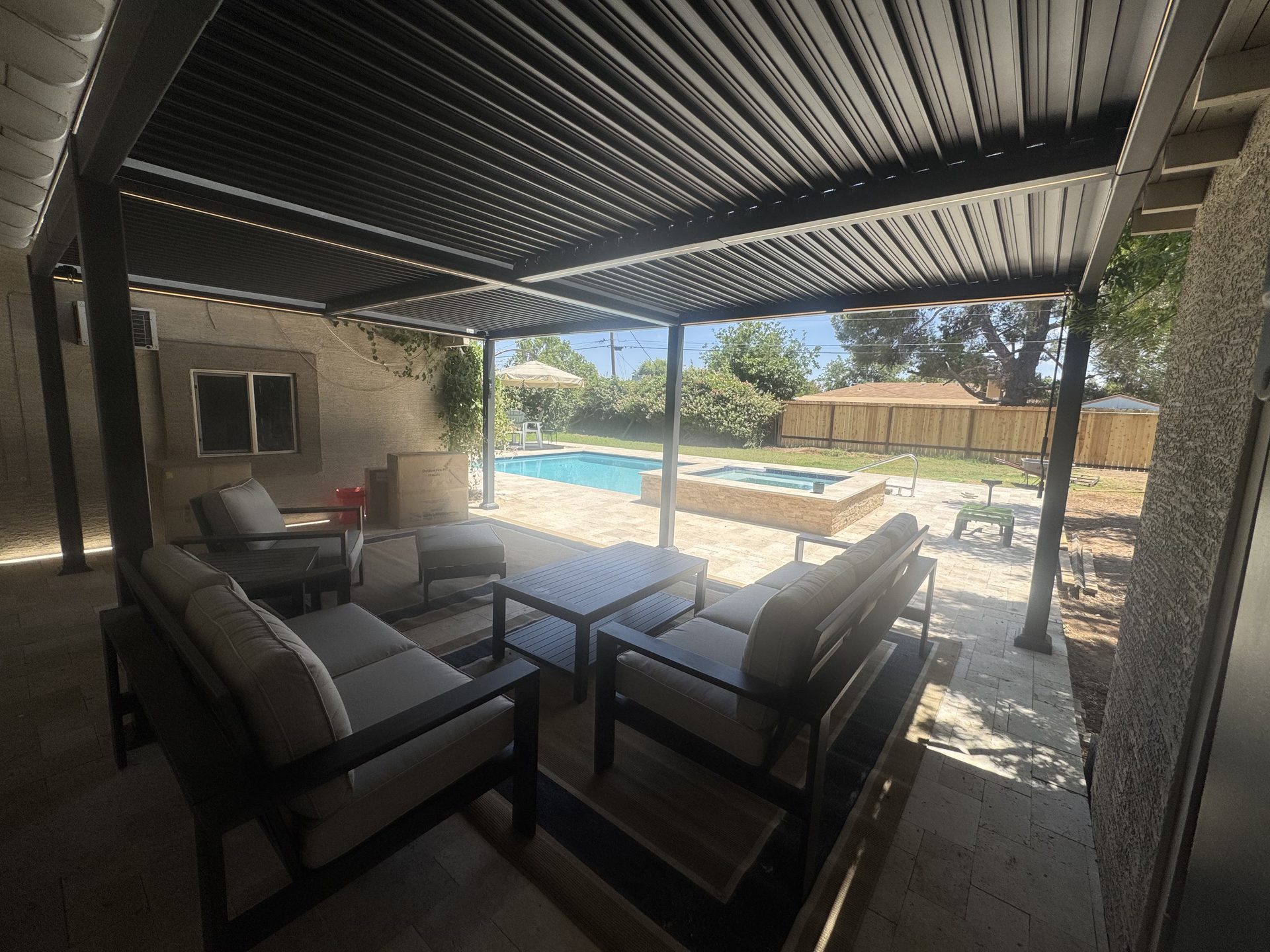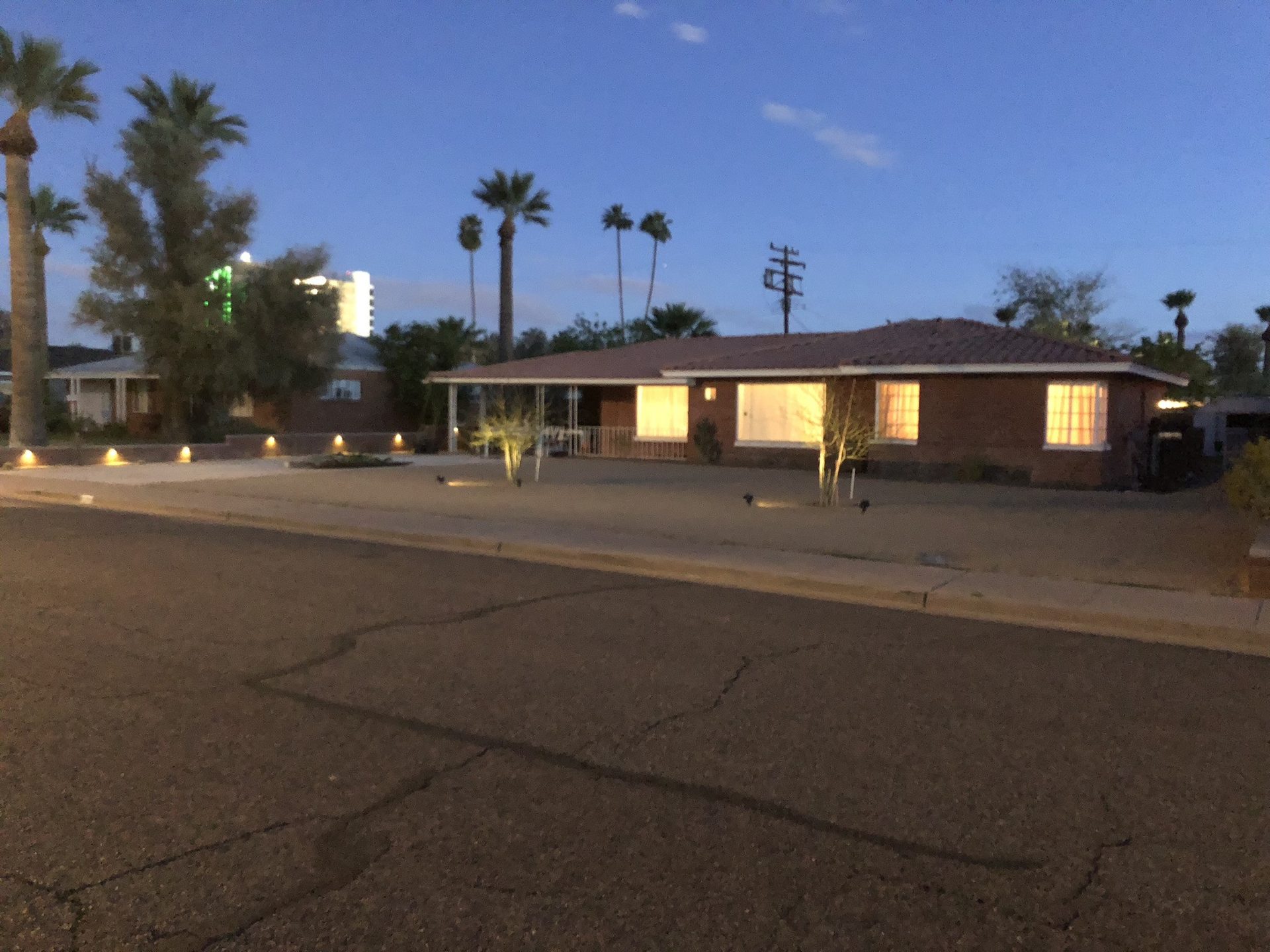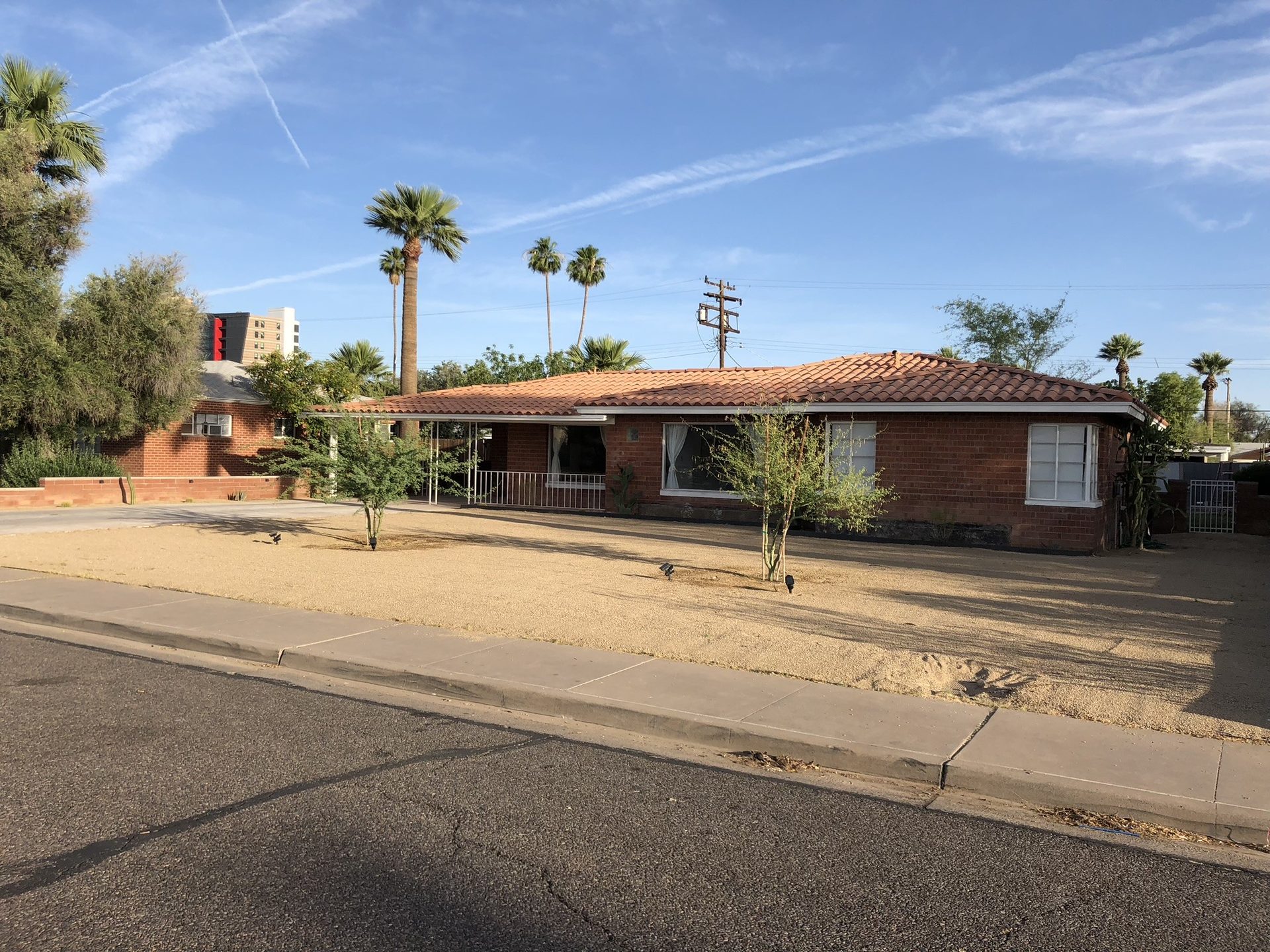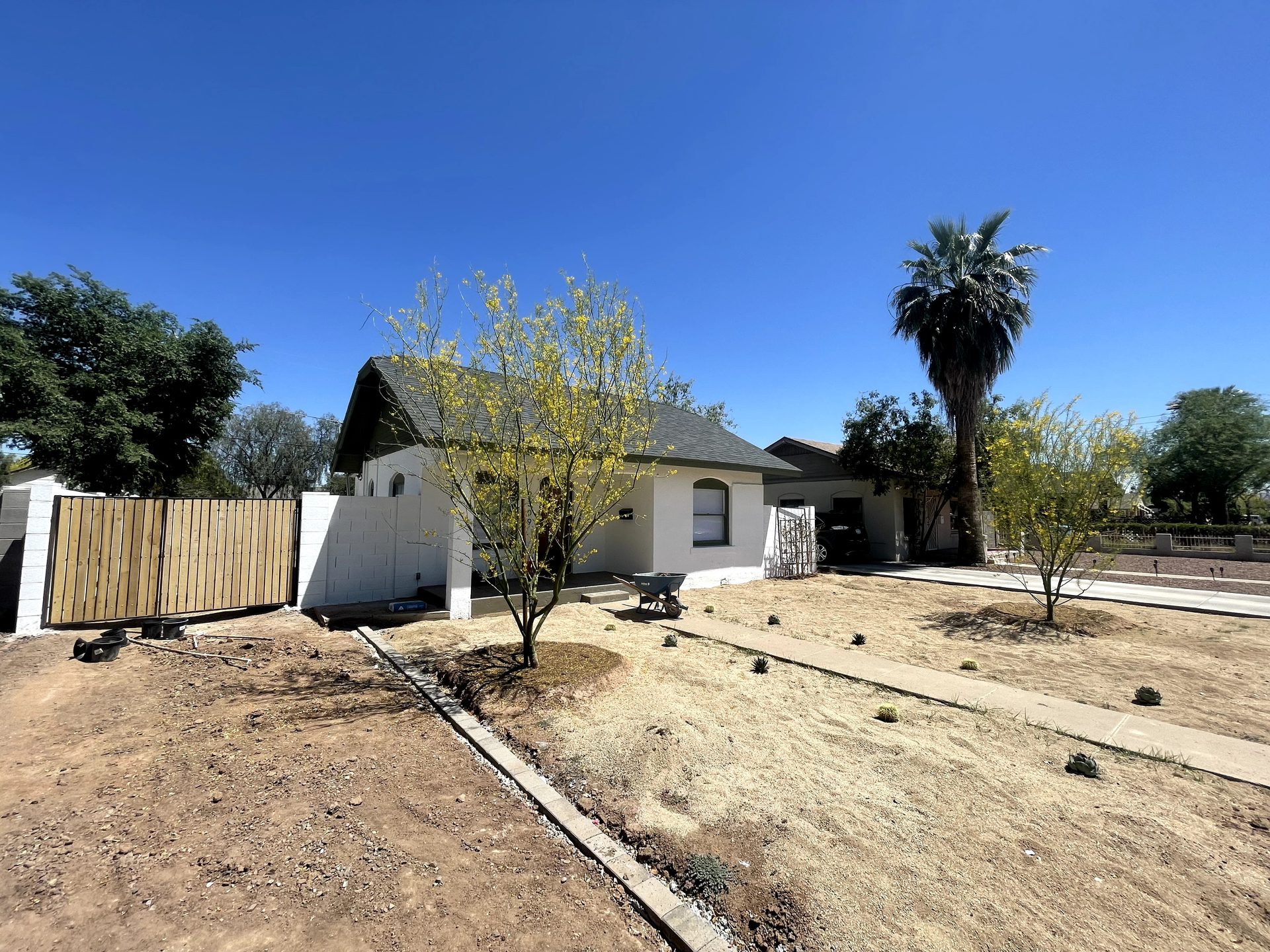
A Phoenix yard is built in layers and only the top one is the part you look at. Under the granite is a graded, compacted surface that decides where five inches of monsoon rain goes. Under the pavers is aggregate base and exactly one inch of screeded bedding sand. Under the turf is a base that has to still read flat in five years. Under the plants is caliche, and how deep that layer sits is the largest single difference between a bid and a final invoice in this valley. We build all of it on one contract: grass removal, grading and drainage, decomposed granite, desert plants and trees, drip irrigation, artificial turf, paver and travertine patios, flagstone paths, block and seat walls, outdoor kitchens, and low voltage lighting.
Norem Contracting is a licensed Arizona Class B General Residential contractor, ROC #365090. That license is why one company can carry an entire yard instead of one trade in it, and in landscaping that matters more than it does almost anywhere else in residential work. A yard is one continuous grade. The turf installer, the mason, the concrete crew and the irrigation tech all work on the same surface, and when four separate companies each set their own piece of it, the low spot that ponds against the house in August belongs to nobody.
It is also where the money is. Excavation, base rock, compaction and disposal are the same crew and the same machine whether the scope is turf, a patio or a granite conversion. Buying those three separately means paying three mobilizations for one day of setup. Buying them together is the largest saving available on any yard, and it has to be in the contract before we start rather than added on day four.
When a Phoenix yard goes wrong inside two years, the material is almost never the reason. It is the base, or it is the grade.
What actually goes into a Phoenix yard
Most of the yards we price want three or four of these at once, in some combination:
- Grass-to-desert conversions: the lawn and its root mat come out, the grade gets reset, decomposed granite goes down over a prepared surface, and desert plants go in on drip.
- Artificial turf lawns: the other answer to grass, and a different build with a different base spec, covered in its own section below.
- Hardscape: paver and travertine patios, pool decks, driveways, flagstone paths and concrete walkways, the surfaces you walk on and park on.
- Block work: seat walls, planters, courtyard walls, a pony wall hiding the pool equipment, the things that give a flat lot some shape.
- The parts that make a yard livable: low voltage lighting, drip irrigation on a timer, and an outdoor kitchen or fire feature if the back yard is going to get used.
That list is the common combinations, not the boundary. We also get called for pool surrounds, RV gates and parking pads, putting greens, courtyard makeovers, front-yard refreshes ahead of a sale, granite top-offs on tired yards, irrigation replacements where the plants are otherwise fine, and full backyard builds starting from bare dirt. Short of the pool itself, if it goes into a Phoenix yard, it is on the table.
If the whole job is losing a lawn and going low water, our desert landscaping and grass-to-desert conversion page goes deeper on plant palettes and the conversion itself. This page is the full yard, including everything hard that goes in it.
How we build one, in order
Seven steps, and the first four decide how the yard looks in year five. They are also the four a cheap bid compresses into a single afternoon.
-
Walk it and probe it
What the yard is for comes before what it is made of. We measure, probe the planting holes and footing lines for caliche, and watch where the roof and the neighbor's lot drain.
One visit -
Blue Stake and paperwork
Arizona 811 marks the utilities and we wait for them. If there is a city rebate on the lawn, that application goes in now, because removing grass first disqualifies it.
2 to 3 weeks lead -
Demo, grub and haul
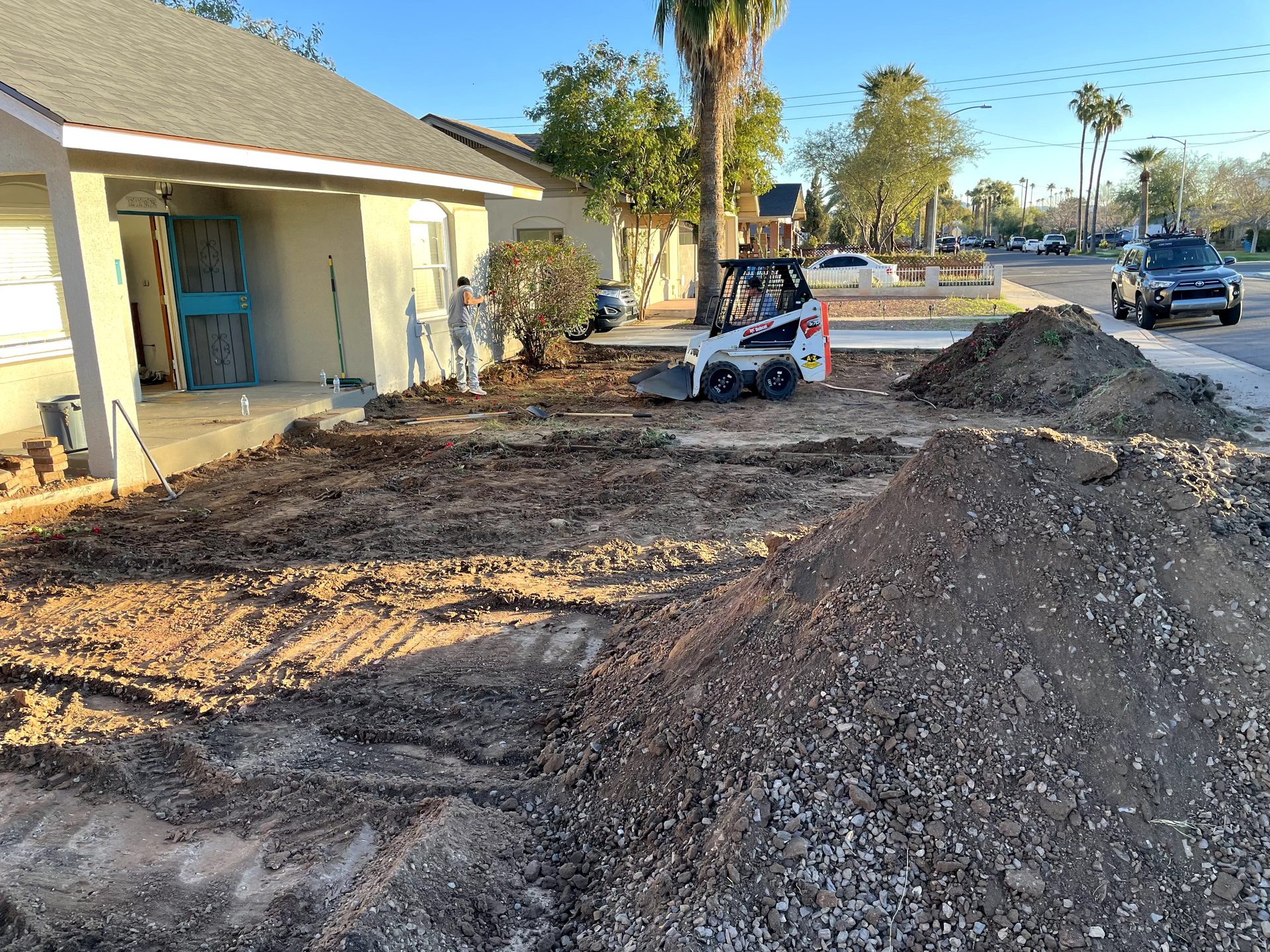
Grass off, root mat out, old irrigation capped, planters and slabs broken out. A crew clears roughly 600 to 900 square feet of rooted Bermuda a day.
1 to 3 crew days -
Grade and drainage
Fall set away from the house before anything hard goes on top of it. Anything paved within ten feet of the foundation gets at least 2 percent, which is code, not preference.
1 to 2 crew days -
Base and compaction
Aggregate base spread and compacted in 4 to 6 inch lifts, not one deep pass that only firms the top inch. Footings and block go in here too.
1 to 2 crew days -
Hardscape, then turf
Bedding sand screeded, pavers laid and cut, edge restraint fixed, joint sand swept and vibrated in. Turf gets seamed, anchored and infilled after the hard surfaces are set.
2 to 5 crew days -
Granite, plants, drip, lights
Rock spread and screeded to depth, plants set with emitters, timer programmed, fixtures aimed after dark because that is the only time you can aim them.
1 to 2 crew days
Those are working days on site, not calendar days. Block cures before anything loads it, plants go in last, and the rebate paperwork runs on the city's clock rather than ours. The ugliest stretch is day two through day four, when the lawn is gone and the base is not in yet.
Caliche, and why it decides your number
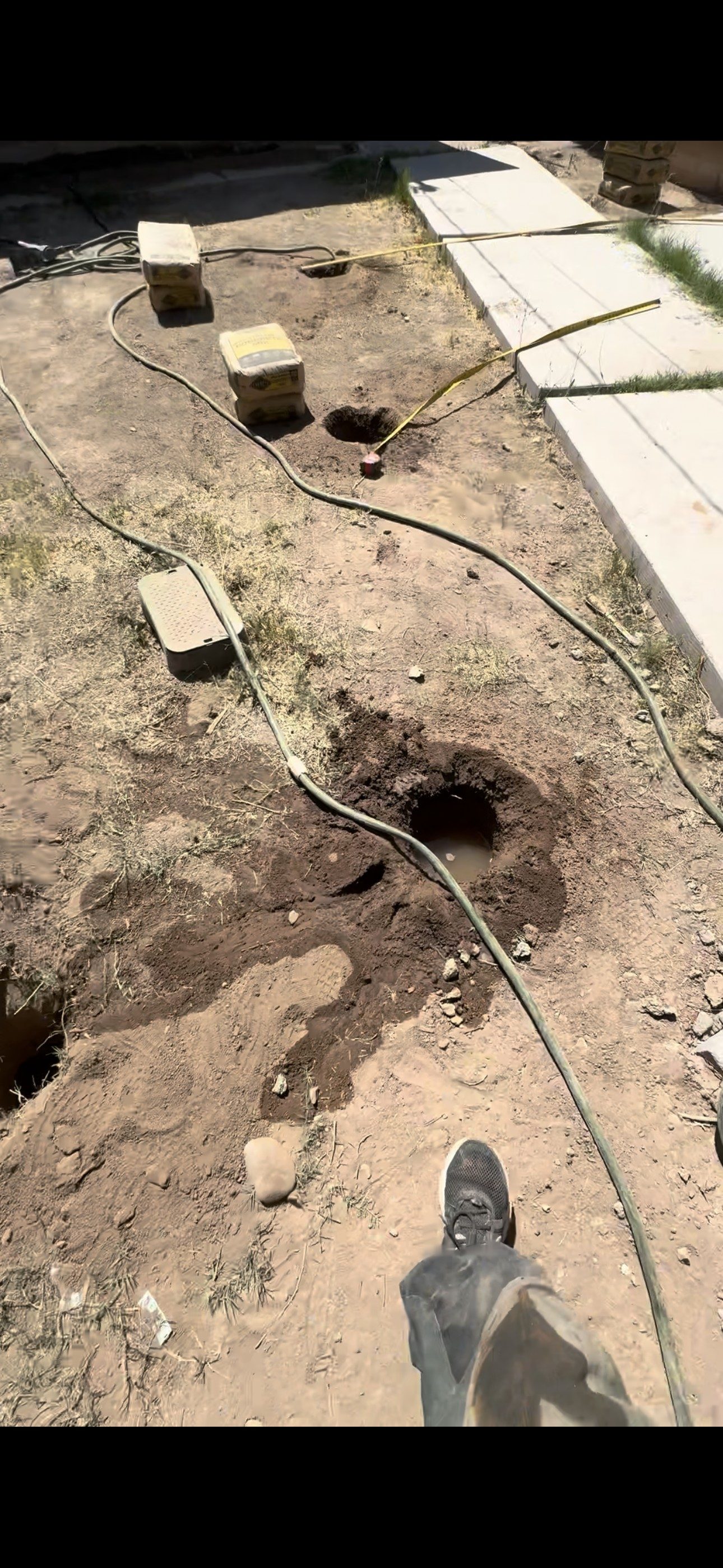
Caliche is a cemented layer of calcium carbonate that sits under a large share of Valley lots, sometimes a few inches down, sometimes three feet, sometimes in a band you only find when a shovel stops. It is the most expensive thing in a Phoenix yard and it is the thing almost nobody writes about. Of the eight highest-ranking Phoenix landscaping and turf pages we read while building this one, not one of them mentions it.
Two problems come out of the same layer. The first is that it is hard to dig, so a planting hole or a footing trench that would take twenty minutes takes two hours with a breaker, or wants a mini excavator across the whole yard. The second is worse and less obvious: caliche does not let water through. Dig a hole into it, backfill it with good soil, plant a tree, and you have built a bathtub. The tree drowns in a desert, usually in its second summer, and the homeowner blames the plant.
The University of Arizona Cooperative Extension publishes the test we use and any homeowner can run it. Fill the hole with water and watch the level. If it drops at least four inches in four hours, drainage is adequate. If it does not, the hole has to be opened completely through the caliche layer so water has somewhere to go. The same guidance sets the shape of the hole: no deeper than the root ball, three to five times as wide, and no drain holes bored directly underneath the root ball, because that routes water straight through the roots on its way down.
One correction worth making, because it circulates constantly on Valley gardening forums. Gypsum does not break up caliche. Gypsum is the amendment for sodic soil. For caliche the Extension recommends soil sulfur, roughly half an ounce per cubic foot in sandy soil, one ounce in silty, two ounces in clay, and none of it around cactus or desert species that want the alkalinity they evolved in.
What this means for a quote is simple. We probe before we price, so what we found is already in the number. If it comes in harder or deeper than the probe showed, you get told that day with a figure attached, and the choice is yours: break through it, move the tree to where the layer is thinner, or plant something that will live in a shallower hole.
Grade and drainage: the 2 percent that keeps water off your house
Phoenix gets most of its annual rain in a handful of monsoon storms, and a yard that is pitched wrong sends that water at the foundation. Grade is also the one thing that cannot be fixed afterward without pulling the finished surface back up, which is why it happens before anything hard goes down.
The number is in the code. The 2024 International Residential Code, section R401.3, requires grade to fall at least 6 inches within the first 10 feet away from the building. Where a lot line, a wall or a slope makes that impossible, the exception requires drains or swales, and it sets a hard floor on paved surfaces: impervious surfaces within 10 feet of the building foundation shall be sloped not less than 2 percent away from the building.
That 2 percent is the number to hold a hardscape bid to, and it is higher than the minimum the paver industry publishes for a patio, which is 1.5 percent. Both are correct. The 1.5 percent is about shedding water off pavers. The 2 percent is about keeping it away from your slab, and near the house the stricter one wins. A patio built at 1.5 percent tight against the foundation meets one standard and misses the one that matters.
The rest of the drainage work is unglamorous and mostly invisible. Where roof scuppers and downspouts land, whether the neighbor's lot drains onto yours, whether the new patio is now a dam across the side yard, and whether a low spot has been created behind a new block planter. Those get answered with a swale, a drain, or a change to the layout, and they get answered on paper before a machine shows up.
Does artificial turf belong in your yard?
Rolling turf out is the short part of a turf job. The lawn and its root mat come out first, old irrigation is capped or re-purposed to whatever plantings remain, the grade is reset with fall away from the house, and aggregate base goes down and gets compacted in lifts. Only then is the turf cut, seamed, anchored at the perimeter and infilled. That sequence is why one install still reads flat after five years and another ripples and puddles after two. If a turf bid comes in thousands under the others, base depth is almost always where the money left.
The honest caution is heat. Synthetic turf in full sun gets far hotter than living grass, hot enough that at least one Valley city writes it into rebate policy, and rinsing it cools the surface only briefly. That does not mean do not buy turf. It means put it where it gets afternoon shade, or put shade over it, and think hard before covering a whole south-facing back yard with it if kids and dogs are the reason you want it.
Turf is deep enough on its own that it has its own page: base depth and compaction, infill types and rates, seams and roll widths, pet installations, putting greens, the heat research read properly, and 2026 Phoenix pricing. See artificial turf installation in Phoenix.
Decomposed granite and rock: depth, edges, and the fabric question
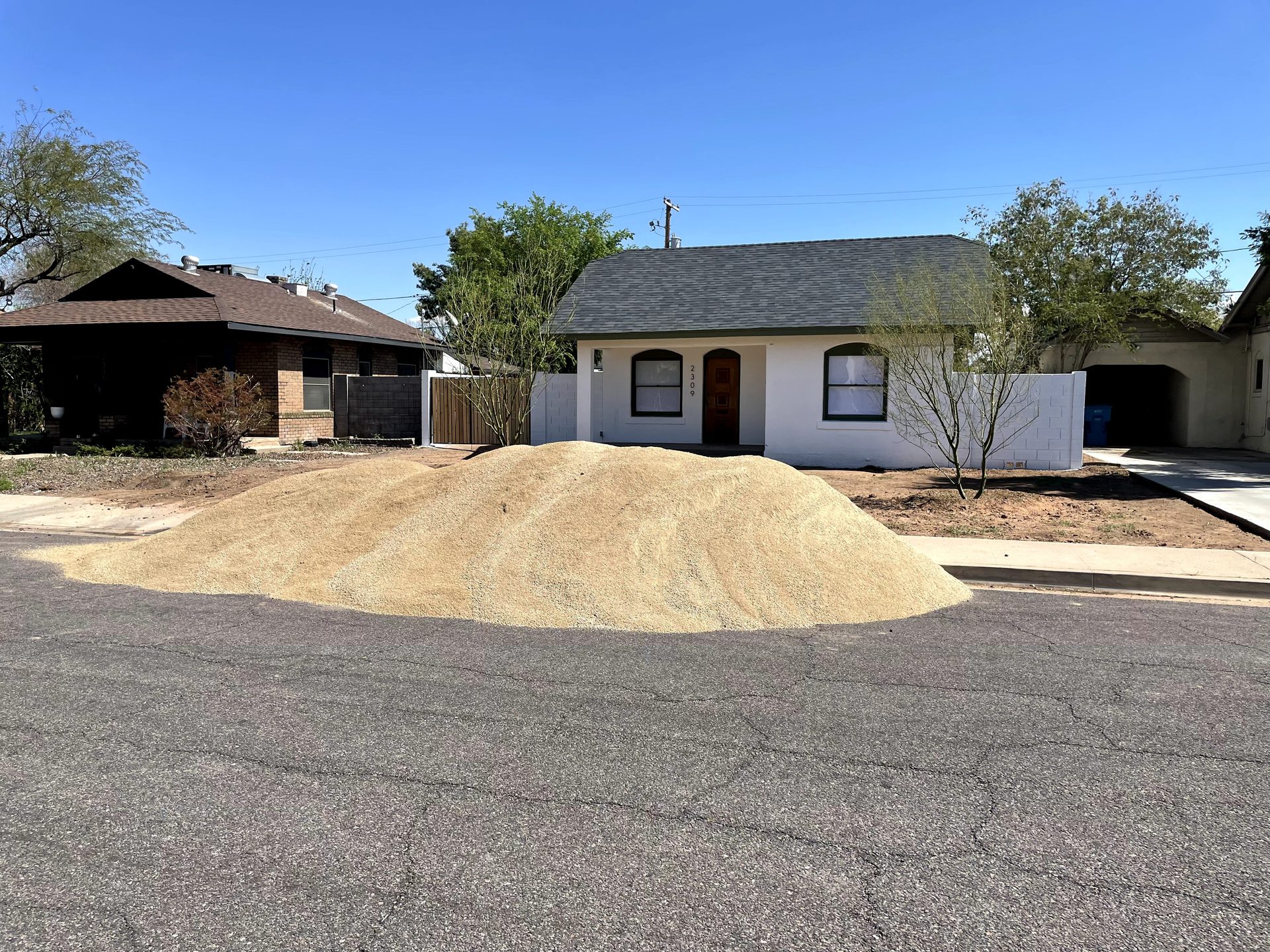
Rock is the cheapest surface in a Phoenix yard and the one most often installed badly. Two inches is the working depth, which is also what most city rebate programs require, and depth is measured after the material is screeded and compacted rather than when it comes off the truck. A ton covers roughly 80 to 100 square feet at two inches, so a thousand square foot front yard is ten to twelve and a half tons, which is three to four dump loads and a full day of moving material by wheelbarrow if access is tight.
Quarter-minus decomposed granite is the material that packs into a walkable surface and stays put. Larger decorative rock at three quarters of an inch and up does not pack, which is why it belongs in beds rather than on a path, and why it migrates when a monsoon sheet-floods the yard. Anything on a slope wants either a coarser stone that will not travel or a physical edge to hold it.
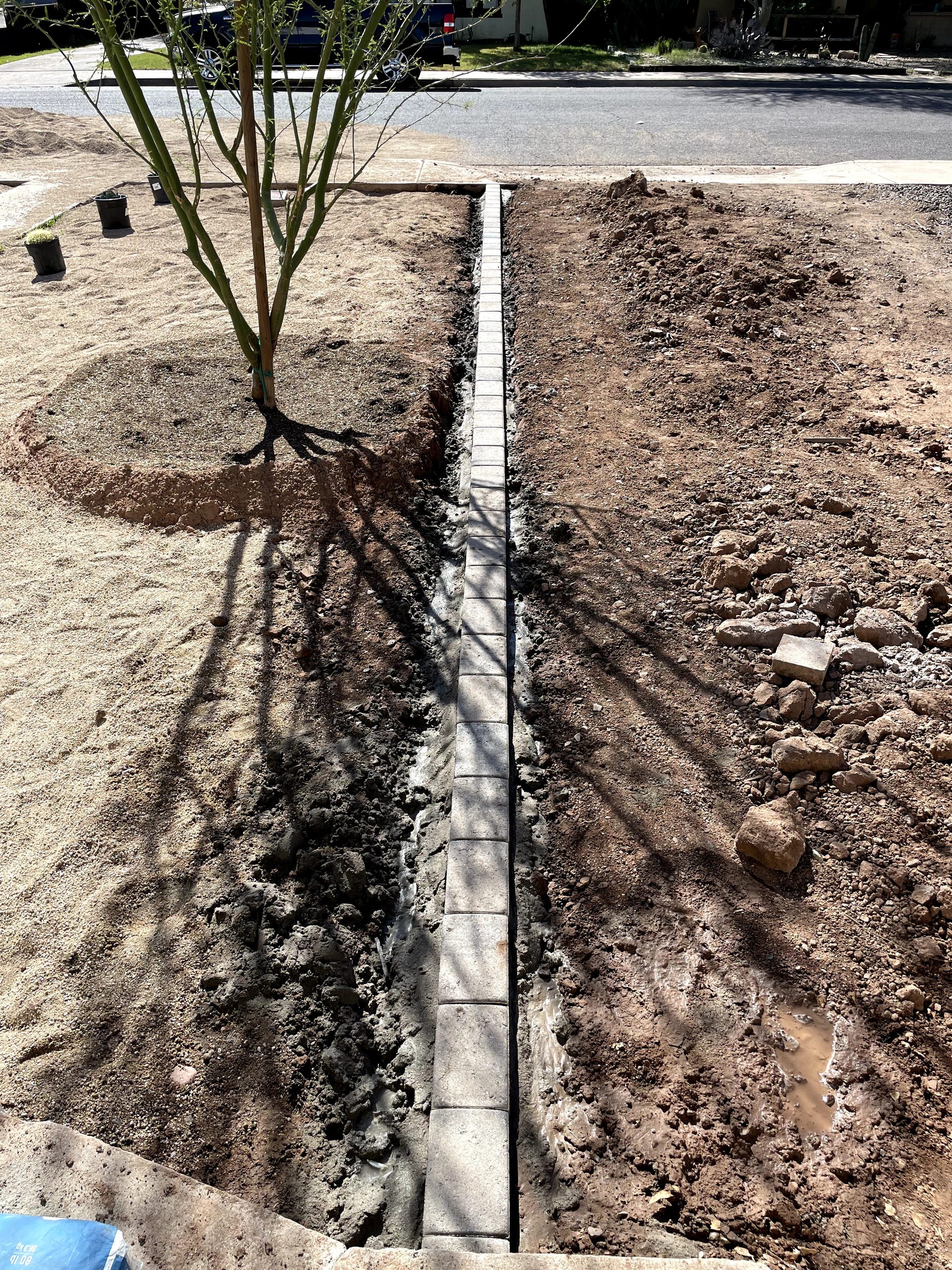
Edging is the difference between a yard that still has clean lines in year three and one that has granite in the driveway. Steel or aluminum edging set below the finish grade separates rock from planting beds and from turf, and a concrete band does the same job permanently where a walkway meets rock.
On landscape fabric, the honest version: it separates the rock from the soil underneath for a couple of years, which keeps your granite from disappearing into the dirt. It does not stop weeds for long, because weed seed blows in and germinates in the dust and organic matter that collects on top of the rock, where no fabric can reach it. Buy it for separation and expect to pull weeds anyway. What does not belong under rock is black plastic sheeting, which traps water and roots and which Mesa prohibits outright in its rebate areas.
Pavers and travertine: what the base spec actually says
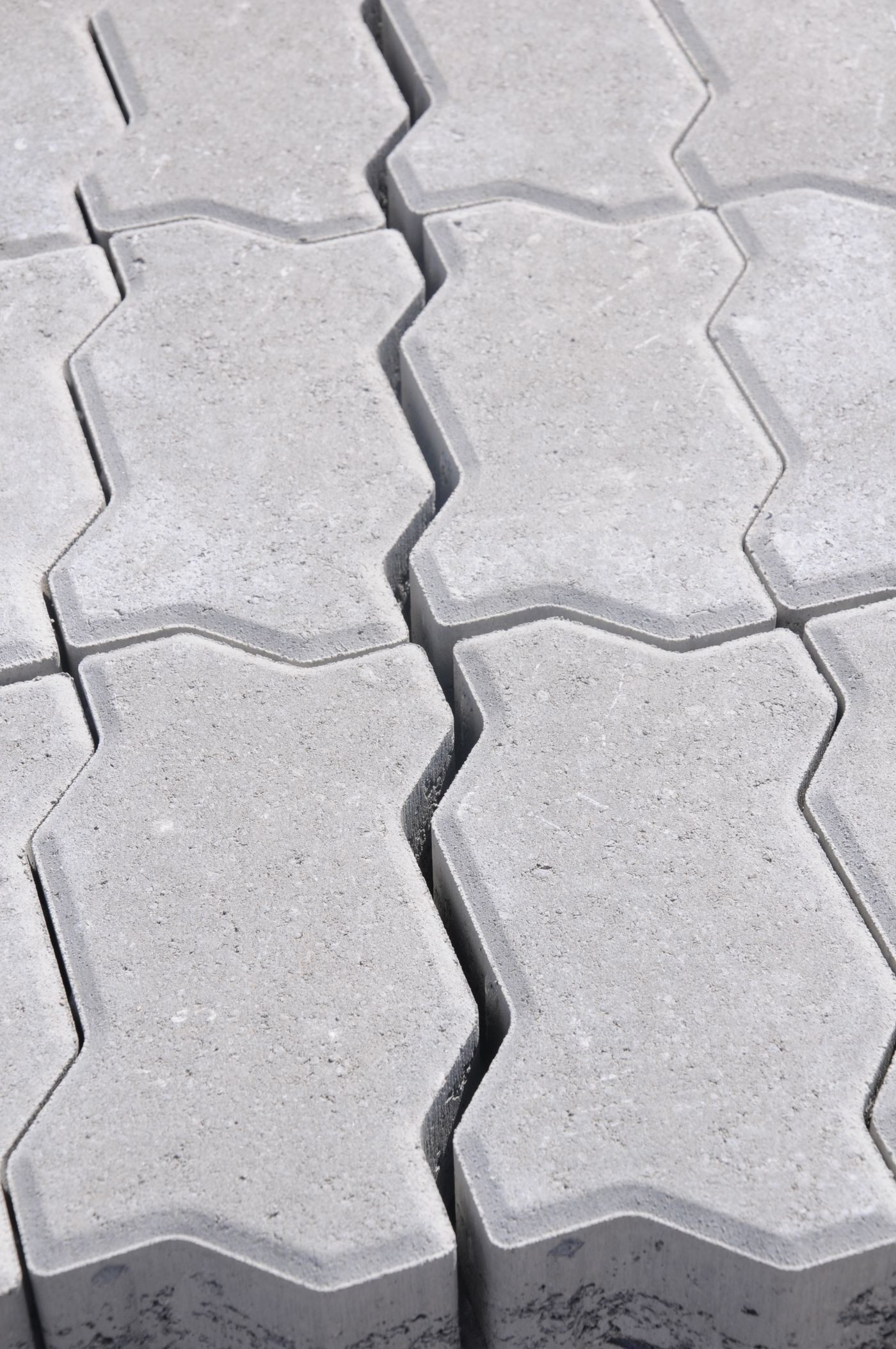
A paver field is built in layers and the paver is the last one. The governing document in this trade is the Concrete Masonry and Hardscapes Association tech note on interlocking concrete pavements, and it is specific enough to hold a bid to.
Base first. Four inches of compacted aggregate is the minimum for a patio or walkway over well drained soil, and six inches is the minimum for a residential driveway. That depth difference, not the paver, is most of why a paver driveway costs what it does. Base is spread and compacted in 4 to 6 inch lifts, to 98 percent standard Proctor density for pedestrian and residential driveway work, and the finished base has to hold within three eighths of an inch under a ten foot straightedge.
Bedding is where cheap installs go wrong. The spec is exactly one inch of uncompacted ASTM C33 concrete sand, and the tech note names the substitutes it prohibits: masonry sand for mortar should never be used for bedding, nor should limestone screenings or stone dust, because they do not compact uniformly and they inhibit lateral drainage. The most quotable line in the whole document is the one about using sand to fix a bad base: if the base is uneven from inconsistent compaction or poor grading, the bedding sand should not be used to compensate, because over time that unevenness reflects through to the surface. That single sentence explains most two year old wavy patios in this valley, and it is invisible on the day the job finishes.
Then the finish work. A plate compactor of at least 5,000 pounds force running at 75 to 90 hertz, at least two passes before joint sand and two to three more after. Joints between an sixteenth and three sixteenths of an inch. Edge restraint with at least an inch of vertical contact against the side of the paver, because without that the field creeps outward and the interlock is gone. Pavers set an eighth to a quarter inch high so minor settlement lands flush rather than low. And herringbone rather than running bond anywhere vehicles turn or brake, because herringbone is the pattern that resists creep under tire load.
One comparison that puts the material in context: ASTM C936 concrete pavers have to average at least 8,000 psi compressive strength with no more than 5 percent absorption. A typical residential concrete slab pour is 2,500 to 4,000 psi. The individual unit is stronger than a slab. It is the base under it that decides how the field behaves.
Travertine is the other half of Phoenix hardscape, and it took over pool decks for good reasons: it is light colored and porous, so it runs cooler underfoot than a dark concrete paver. We will not put a number on that difference. Every degree figure circulating on paver vendor pages traces back to marketing rather than to any measurement we could find, so treat the specific numbers with suspicion and the direction as real. The genuine trade-offs are that porous means it wants sealing, and that travertine is calcium carbonate, so acid dissolves it. If somebody acid washes your deck to brighten it, the etching is permanent. For pavers and travertine side by side with a poured slab on price and upkeep, see concrete vs pavers for a Phoenix patio.
Around a pool the stone is rarely the hard part anyway. The coping condition, the deck drainage and the pitch away from the water are. Work on the pool itself is licensed separately in Arizona and is not work we take: the shell and its coping, its plumbing and equipment, a deck poured as part of it, and removing or filling in a pool. We draw that line during the walk rather than mid job. We build paver and travertine decks around a pool when they sit on their own base and stop at the coping.
Desert plants, trees and drip irrigation
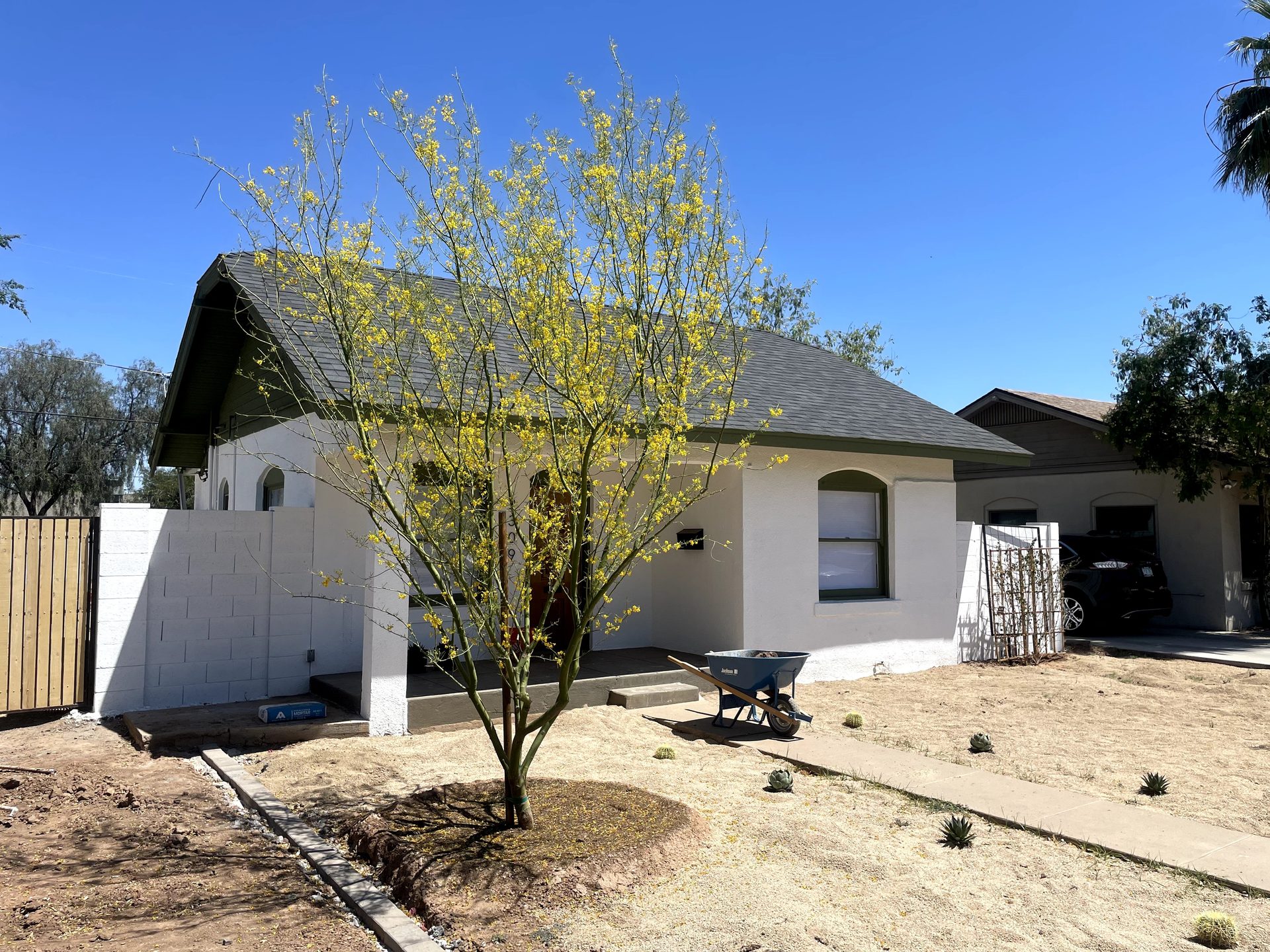
Plants are what keep a converted yard from reading as a gravel lot, and they are also what every city rebate program is actually paying for. Chandler wants 50 percent canopy coverage at maturity. Mesa wants the same 50 percent with living low water plants and says artificial turf alone will not qualify. Tempe wants 30 percent coverage of the removal area. Phoenix prohibits leaving bare soil. Read together, those rules say the same thing: the cities are buying shade and living plants, not gravel.
Planting in this soil follows the caliche rules above. Hole no deeper than the root ball, three to five times as wide, through the hardpan if there is one, and the water test before anything goes in the ground. Trees get staked only as long as they need it and get their emitters set out at the drip line rather than against the trunk, so the roots grow outward to find water instead of circling.
Drip is priced per zone, not per yard, and the reason matters when you are comparing bids. A two to four zone retrofit that waters new beds is a fraction of a whole property system with new trenching, a backflow preventer and a smart controller, and both of those get called "drip irrigation" on a quote. Materials are cheap: tubing runs cents per foot, pressure compensating emitters a dollar or two each. The cost is labor and trenching, which is exactly where caliche shows up again and adds a few hundred dollars to a run. Shrubs typically get one or two emitters, trees two to four, and the whole thing lands on a timer, because hand watering a new desert yard through its first July is how most of it dies.
Outdoor kitchens and fire features: the vents are not optional
An outdoor kitchen is masonry, gas and electrical wearing a countertop. The island is framed in block or in steel stud clad with cement board, veneered or stuccoed, and capped in granite, tile or poured concrete. Appliances are cut in to the manufacturer's cutout dimensions, and the grill has to be a unit listed for built-in installation. A freestanding cart grill dropped into a masonry surround is a genuine fire hazard, because it was built to shed heat on all sides and now it cannot.
The floor level openings are the ones that matter most and the ones most often left out, because propane is heavier than air and pools at the bottom of a sealed box. In Phoenix there is a second reason the geometry is not paperwork: those manuals cap the cylinder, regulator and hose at 125 degrees, and a closed stucco island sitting in July sun goes past that.
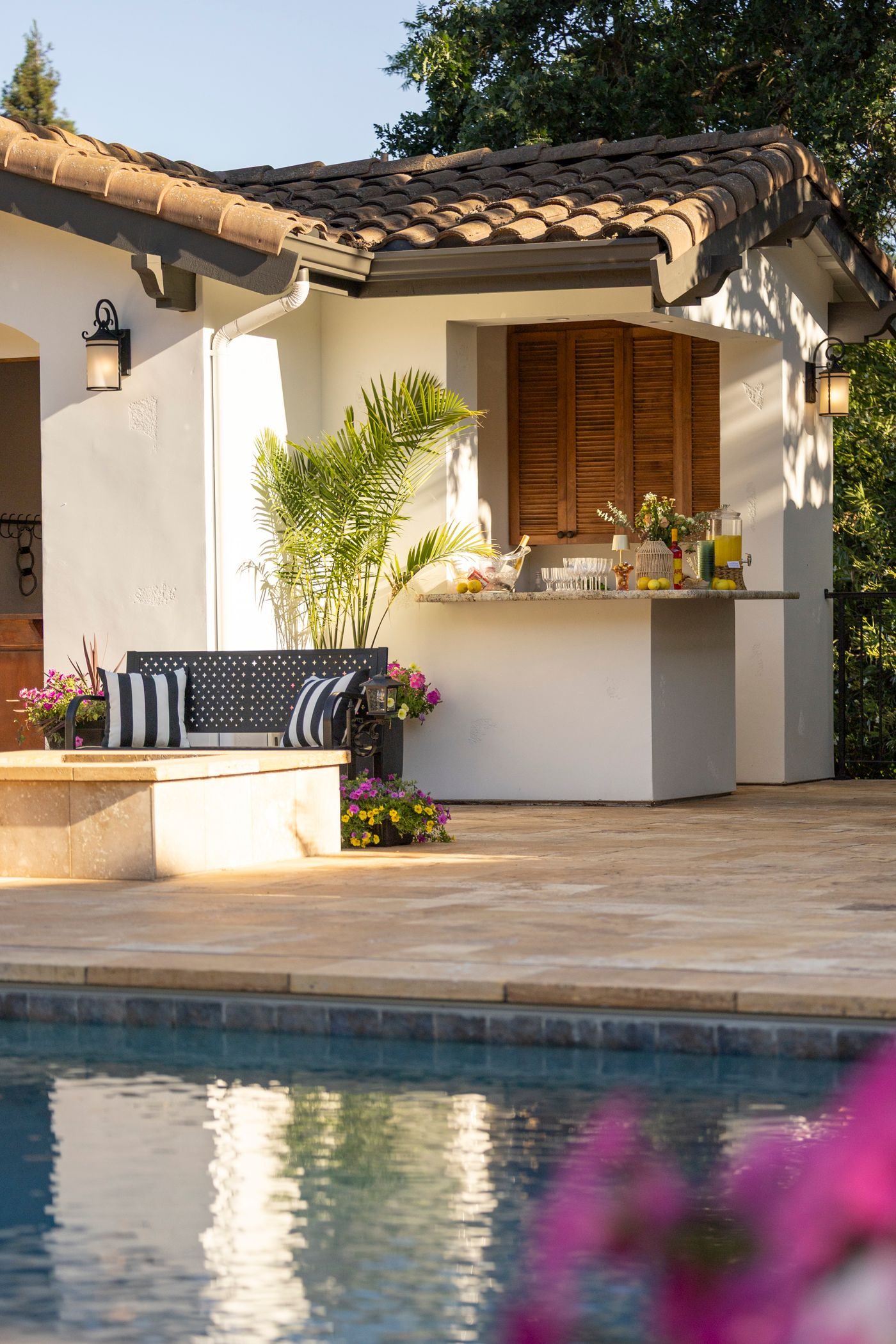
Clearances follow the same manuals: 18 inches to combustible construction, 14 inches to protected combustible, 4 inches to non-combustible like brick, and 4 inches from the back of the unit to a non-combustible backsplash. The rule that governs a lot of Valley back yards is the one about what is overhead. Combustible overhead construction requires an exhaust hood, which is what decides whether a built-in grill can go under a wood ramada or pergola the way people usually picture it.
Utilities are where an outdoor kitchen quietly gets expensive. Gas comes off the code's pipe sizing table rather than a rule of thumb: the BTU load of the appliances, the developed length of the run, and whatever the meter has left after the furnace, the water heater, the range and the pool heater. The electrical side wants a 120 volt, 15 amp GFCI circuit for the refrigerator, lights and outlets, with an in-use weatherproof cover on anything exposed. Gas and electrical are licensed trade work, they are permitted and inspected, and they run on our contract and our schedule instead of a separate one you have to chase. How an island gets vented, what Phoenix heat does to the appliances, and what the whole thing costs is covered in outdoor kitchens in Phoenix. A gas fire pit is the simpler cousin of all of this and needs the same gas run and the same clearance thinking.
Block walls, seat walls and planters
Block is the cheapest way to give a flat Phoenix lot some shape. A seat wall around a fire pit, a planter that lifts beds off the granite, a pony wall screening the pool equipment, a courtyard wall that makes the front of the house feel like a place. All of it is CMU laid on a footing with vertical rebar in grouted cells, capped, and tied together with a bond beam on taller runs. It can stay block, get stuccoed to match the house, or be veneered in stacked or natural stone.
Two Arizona facts drive the price. The first is caliche again, in the footing trench, which is a different order of work from digging a footing in dirt. The second is that caliche holds water above it, so a planter built on that layer without a drainage plan becomes the same bathtub a planting hole does, only bigger and full of expensive plants.
The permit question turns on height and on whether the wall retains soil, and the trigger is not the same number in every Valley city. Retaining changes the engineering as well as the paperwork. We pull the requirement for your address before the footing gets priced, because a retaining wall that needs an engineered detail and one that does not are not the same job.
Low voltage landscape lighting
Lighting is the cheapest thing on a yard that changes how much you use it, and it is the last thing installed because fixtures have to be aimed after dark. Path lights, uplights into trees, and downlights out of a canopy or a ramada each do a different job, and the count that actually lights a front yard is usually eight to fourteen fixtures on one transformer.
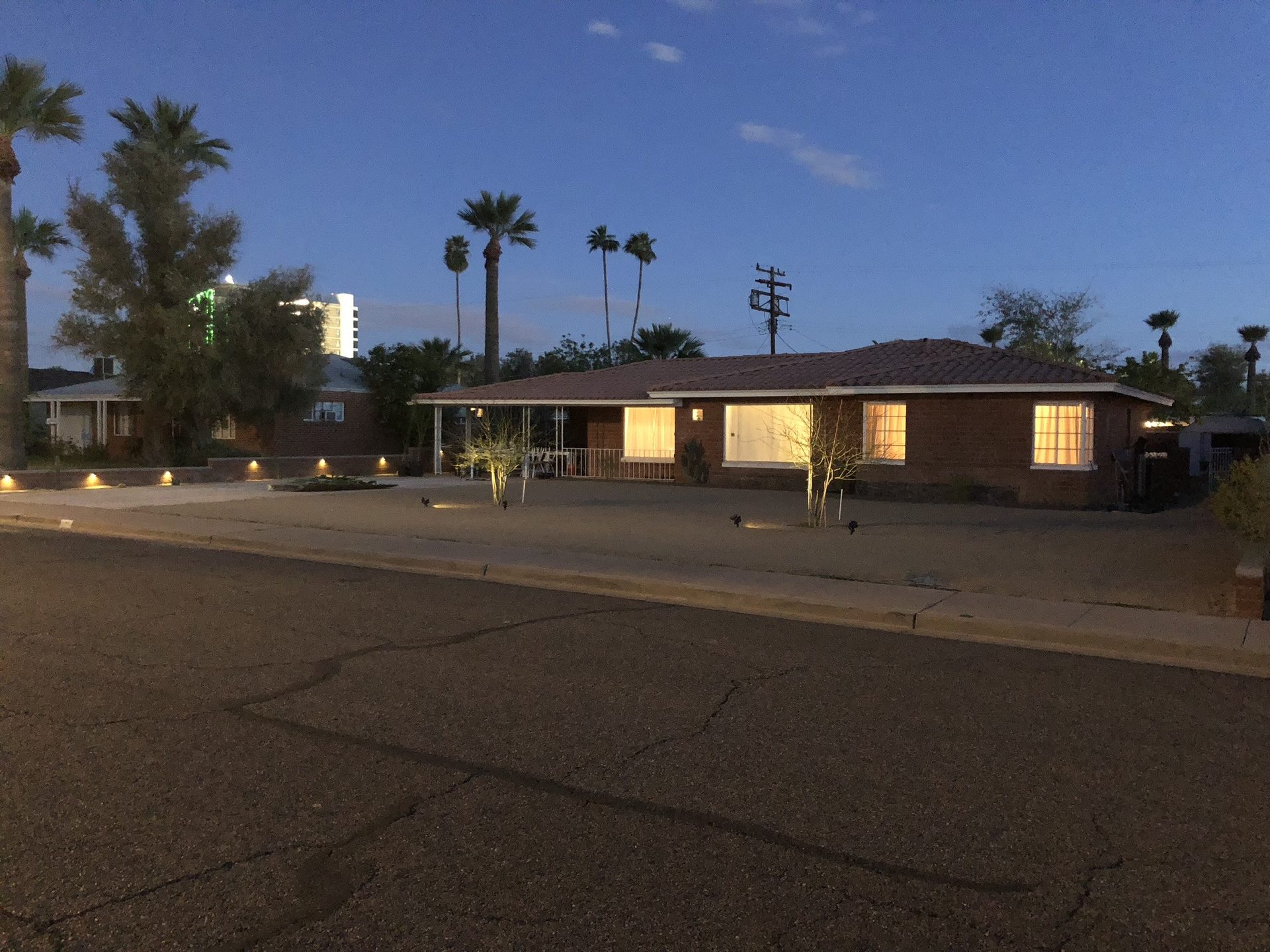
The wire wants to be buried before the base and the granite close everything up, which is the whole reason lighting belongs in the original scope rather than added next spring. The cost also swings hard on one question: whether the system can run off an existing exterior GFCI outlet or needs a new circuit run from the panel. On a front yard job we did in Phoenix, the fixtures fed off an outlet that was already there, which meant no trenching to the panel and no electrical work beyond the low voltage side. That is the difference between the bottom and the top of the per-fixture range below.
Phoenix Landscaping Price Chart, 2026
Installed prices for licensed, insured work in the Phoenix metro. Where we have our own recent numbers they are called out as ours. Everything else is the working Valley band, cross-checked against local installers who publish their rates rather than against national averages, which run low for this market.
| Scope | Typical installed price | What drives the price |
|---|---|---|
| Grass-to-desert conversion, all in | $5-$15 per sq ft | The everyday band. Designer-level work with boulders, custom edging and specimen plants runs $15 to $25. The low end is a simple rectangle of lawn to granite; the high end has trees, drip, lighting and hardscape in it. |
| Front yard conversion, project total | $5,000-$12,000 | A 600 to 1,200 square foot front yard with demo, granite, a dozen plants, two trees, drip and edging. A small simple yard lands $3,500 to $5,000. Nothing in this market floors a real conversion under about $4,500. |
| Whole back yard or full property | $12,000-$35,000 | Multiple surfaces at once: turf plus a patio plus block plus irrigation. Resort-level back yards with a kitchen, fire feature and shade structure go past $50,000. |
| Grass removal, grubbing and haul-off | $0.75-$1.50 per sq ft | Includes disposal. Rooted Bermuda has to be grubbed out rather than scraped, or it comes back through the granite. One crew day clears roughly 600 to 900 square feet of it. |
| Decomposed granite or decorative rock, 2 in deep | $1.50-$3.00 per sq ft | Material, delivery and the labor to move it. Truck access is the swing: a yard a dump truck can back into is at the bottom of this band, a back yard through a 36 inch gate is at the top. |
| Rock and granite material, by the ton | $35-$110 per ton | Quarter-minus decomposed granite $35 to $60, three quarter inch decorative $45 to $110, rip-rap and small boulders $65 to $100. Delivery $75 to $150 a load. One ton covers 80 to 100 sq ft at 2 inches. |
| Artificial turf, over new compacted base | $8-$14 per sq ft | The full Valley range is $6 to $22. Demo, base depth, turf face weight, infill type, and how many curves and seams the layout forces. The last turf yard we priced was 720 sq ft over 705 sq ft of demo at $7,650, which is $10.63 a foot with removal, haul, base, material, install and sprinkler capping in it. |
| Putting green | $9-$20 per sq ft | More than a lawn per foot because the base has to be flatter and the contours are built rather than found. Carries its own minimum, generally around $2,500. |
| Paver or travertine patio | $12-$28 per sq ft | Whether we start on dirt or tear out a slab first; base depth; pattern, because herringbone and French patterns waste more material in cuts than running bond; borders; and wheelbarrow distance from the truck to the back yard. |
| Paver driveway | $18-$30 per sq ft | Six inches of compacted base minimum instead of four, herringbone laid for creep resistance, plus the apron tie-in at the street and whatever your city requires in the right of way. |
| Flagstone path, dry-laid | $42-$45 per linear ft | Our own number, from a three foot wide reclaimed-stone path priced in 100, 200 and 300 foot tiers on client-supplied stone. That works out to about $14 to $15 a square foot. Add stone cost if it is coming from us, and add more if the layout needs a lot of cutting to keep joints tight. |
| Drip irrigation | $250-$900 per zone | A two to four zone bed retrofit is $600 to $1,800. A full property on three to five zones with trenching is $900 to $2,500. A backflow preventer adds $225 to $500 and a smart controller $250 to $600. Caliche in the trench line adds $150 to $400. |
| Desert plants, installed | $55-$185 each | Five gallon shrubs $55 to $95, fifteen gallon shrubs and agave $110 to $185, specimen cactus $150 to $400 and up. Includes the hole, the emitter and the amendment, which is roughly a third of the cost on a small plant. |
| Desert trees, installed | $200-$1,400 each | Fifteen gallon $200 to $300, 24 inch box $375 to $550, 36 inch box $900 to $1,400. Box sizes need equipment in the yard, which is why they are cheapest to plant while the demo machine is still on site. |
| Low voltage landscape lighting | $150-$350 per fixture | An eight to fourteen fixture package runs $1,800 to $4,500, plus $200 to $500 for the transformer. Bottom of the range feeds off an existing exterior GFCI; the top has a new circuit and trenching in it. |
| Block wall, seat wall or planter | $55-$125 per linear ft | A standard six foot privacy wall in six inch CMU sits around $60 to $95 a foot. Footing depth, whether it hits caliche, the rebar and grout schedule, decorative block, and whether the wall retains soil, which changes the engineering. |
| Stone veneer on a wall, column or island | $15-$22 per sq ft | Lath and scratch coat, stone type, and corner count. Corner pieces cost several times what flat pieces do, and a column is almost entirely corners, so a small column can cost more per foot than a long wall. |
| Built-in barbecue island | $5,000-$15,000 | Island size and framing, countertop material, how many appliances get cut in, and the gas and circuit runs from the house, which is the line people forget to budget. |
| Full outdoor kitchen | $20,000-$45,000 | Grill, side burner, sink with supply and drain, refrigeration, storage and counter run. A sink is the line that turns an island into a kitchen, because it brings water and waste with it. |
| Gas fire pit or fire feature | $3,500-$12,000 | Masonry, cap and burner kit, plus the gas run and clearances. A seat wall wrapped around it is priced by the foot from the block row above. |
| Site prep and regrading | $0.40-$2.00 per sq ft | A flat lot needing a cleanup pass is $500 to $1,500 as a lump. A real regrade, a caliche layer across the yard, or soil that has to be amended and replaced is $2,000 to $5,000. |
The entry tier on this chart is the one most cost pages leave out, and it is real. A 400 to 600 square foot front yard, lawn out, granite in, six to eight plants and a drip line on a timer, lands between $3,500 and $5,000 in this market. That job exists, it is most of what gets asked for, and the pages that answer "how much does desert landscaping cost" with $20,000 to $75,000 are describing a different customer. Send us the square footage and a few photos and you get your number back, free.
How to audit a yard bid in four numbers
Landscaping bids are hard to compare because nobody states the same things. These four make two bids comparable, and any real installer has them ready.
- Base depth and lifts. Four inches compacted is the published minimum under a patio, six under a residential driveway, and it goes in 4 to 6 inch lifts. Under turf, ask the same question. A bid that will not name a depth is not pricing a base.
- What is going under the pavers. The answer should be one inch of ASTM C33 concrete sand, uncompacted. Masonry sand, limestone screenings and stone dust are named as prohibited by the trade's own spec. This is the cheapest place to cut and the most expensive to fix.
- Granite depth, measured when. Two inches after screeding and compaction, not two inches off the truck. On 1,000 square feet the difference between a real two inches and a thin inch and a half is more than two tons of material.
- Which square footage the price is applied to. Chandler's own rebate policy notes that turf vendor measurements run larger than the grass area to account for curves and cuts. Fine for ordering material. Not fine as the number a per-foot price multiplies.
Ask all four of both bidders. The gap usually explains itself before anyone talks about price.
What the Valley cities pay you to take a lawn out
Six Valley cities run residential grass removal programs and the rules differ enough that a homeowner reading a turf company's blog will get them wrong. Every line below was read off the city's own page on 1 September 2026. Programs pause, exhaust their funding and change their rates mid year, so the date is on this table deliberately.
The one rule that is identical in all six, and the one that costs people the most money: approval comes before any grass comes out. Removing the lawn first is an automatic disqualification everywhere, it cannot be appealed, and it is the only mistake on this page that is completely unrecoverable.
| City | What it pays | Minimum | Plant requirement | Artificial turf | Before you start |
|---|---|---|---|---|---|
| Phoenix | $2.00 per sq ft | 250 sq ft | Bare soil not allowed; grass must be at least 75 percent alive and dense to qualify | Allowed as part of the replacement | Notice to Proceed required, allow about 3 weeks. Over 5,000 sq ft is case by case. No pools or water features in the removal area. |
| Scottsdale | up to $5,000 | Set by the current program | Low water replacement | Set by the current program | Pre-inspection required by ordinance for all removal rebates. The program reopened 8 July 2026 and this year's window closes 31 October 2026. |
| Chandler | $1.50 per sq ft, max $2,000 | 500 sq ft | 50 percent canopy coverage at maturity | Does not qualify. Chandler cites 180 degree summer surface temperatures, heat island effect, sun degradation and recycling difficulty. | Pre-approval, then 90 days from the notice to proceed to finish. |
| Mesa | up to $2,100 flat, by project | 500 sq ft of living grass | 50 percent canopy with low water use plants | Turf alone does not qualify; the yard still has to hit the living plant coverage | Qualify and apply before removal. Mesa pays a flat amount by project rather than by the square foot, plus a tree bonus. |
| Gilbert | up to $2,000 plus up to $1,000 more | Amount scales with square footage removed | All removed grass replaced with low water use landscape | Low water landscape required | First come, first served. A separate smart irrigation controller incentive pays up to $250 per household. |
| Tempe | $0.50 per sq ft, max $2,000 | Set by the current terms | 30 percent plant coverage of the removal area | Low water conversion required | Project pre-approval required. Tempe offers a free consultation with a water conservation specialist first. Cap is per home, per fiscal year. |
Mesa also issues a 1099 on the incentive, excludes flood irrigated and well watered grass, requires at least 2 inches of mulch or granite depth, prohibits black plastic sheeting underlay, limits concrete to a quarter of the converted area, and allows one incentive per property every three years. Rules like those are why a scope gets written to qualify rather than fixed afterward.
What a rebate actually takes off your number
The rebate guides list city amounts and no install pricing. The cost pages publish install pricing and give rebates a sentence. Nobody nets the two together, so here is the arithmetic on an 800 square foot lawn converted at $8 a square foot, the middle of the conversion band above.
| City | Job | Rebate | Net cost | Effective per sq ft |
|---|---|---|---|---|
| Phoenix | $6,400 | $1,600 at $2.00/sq ft | $4,800 | $6.00 |
| Chandler | $6,400 | $1,200 at $1.50/sq ft | $5,200 | $6.50 |
| Tempe | $6,400 | $400 at $0.50/sq ft | $6,000 | $7.50 |
Mesa, Gilbert and Scottsdale pay a flat amount by project rather than by the foot, so their net depends on which band the yard lands in rather than on this arithmetic. Scottsdale's ceiling is the highest in the Valley at $5,000 and its window closes 31 October 2026. Two things this table quietly answers: a Chandler homeowner who puts artificial turf in gets nothing, and in Phoenix the same 800 square feet done in synthetic still qualifies.
Permits, the county dust rule, and your HOA
Most landscaping in the Valley does not pull a building permit. What changes that is height, retention and utilities: a wall over the city's threshold, a wall retaining soil, gas or electrical for an outdoor kitchen, or a covered structure. Those are permitted and inspected, and they run on our contract.
The rule almost nobody knows about is the county's. Maricopa County Rule 310 says any activity capable of generating fugitive dust has to comply regardless of site size, and a dust control permit is required for disturbance of 0.10 acre or more, which is 4,356 square feet. That threshold is smaller than a lot of Valley back yards. The rule also carves initial landscape establishment out of its landscape maintenance exemption, so a full conversion counts as construction for dust purposes even though nobody is building anything. Phoenix's own rebate program independently requires compliance with it. In practice it means water on the ground before the machine starts, loads covered, and tracked material swept rather than blown.
On HOAs there is a state law worth knowing and worth not over-reading. Arizona HB 2131, signed 30 March 2022 and effective 24 September 2022, prevents a homeowners association from banning artificial turf where natural grass is permitted. Three carve-outs get left out when that gets repeated: it applies to planned communities and not to condominiums, the association may still adopt reasonable installation and appearance rules, and communities with unique geologic characteristics requiring preservation are exempt. So the law gets you the right to install turf. It does not get you out of submitting for architectural approval, and going in believing otherwise is how a fight starts.
Where a cheap yard bid gets cheap
These are the specific corners cut on low bids in this market. Every one of them is invisible on the day the crew leaves.
| The shortcut | What you see later |
|---|---|
| Bedding sand used to level out an uneven base | The trade's own spec says the unevenness reflects through to the surface over time. This is the number one reason a two year old paver patio reads wavy, and it is undetectable at handover. |
| Stone dust or masonry sand instead of concrete sand | Explicitly prohibited. It does not compact uniformly and it blocks lateral drainage in the bedding layer, so water sits where it should be moving. |
| Skipping the compaction passes after joint sand | Joints never fill, sand washes out in the first monsoon, and the field starts to creep at the edges. |
| No edge restraint, or one with under an inch of contact | The field spreads outward, joints open, and the interlock that makes pavers work is gone. |
| Base laid on caliche without breaking through it | Water perches on the hardpan. The same yard waterlogs and sheet floods in a single storm. |
| Planting pits dug into caliche and backfilled | The hole is a bathtub. The tree drowns in the desert, usually in year two, and the plant gets blamed. |
| Grading a patio at 1.5 percent right next to the house | Meets the paver minimum, misses the code minimum of 2 percent for impervious surfaces within 10 feet of the foundation. Water at the slab. |
| Turf laid over old sod or unconsolidated dirt | The dips, ripples and puddles that make a two year old install look tired. Fixing it means pulling the turf and starting at the base. |
| A sealed grill island, or vents only at the top | Propane is heavier than air and pools at the floor. The floor level openings are the ones that matter and the ones most often left out. |
| A built-in grill under a wood ramada with no hood | The manuals require an exhaust hood under combustible overhead construction. This one gets built wrong constantly because the picture people have in their head has a wood cover in it. |
| Tearing out the lawn before the rebate is approved | Between $500 and $5,000 gone depending on the city, permanently, for a decision made a week too early. |
When we will tell you to spend the money somewhere else
Some yards should not get the job that was asked for, and it is cheaper to hear that at the estimate.
If the lawn is going out for a rebate and it is already dead or dormant, stop. Phoenix wants at least 75 percent live, dense grass in the photos, Mesa excludes flood irrigated and well watered lawns, and a brown lawn photographs as ineligible. Water it back for a few weeks, then apply. That single piece of timing is worth more than anything else on this page to a homeowner with a struggling lawn.
If the whole south-facing back yard is going to be artificial turf so the kids have somewhere to play, we would rather talk about it. On a 114 degree Phoenix afternoon that surface has been measured hotter than asphalt. Turf plus shade works. Turf plus full sun plus small children is a surface nobody uses from June to September, and that is an expensive way to find out.
If the grade is the actual problem, drainage comes before decoration. Putting granite or pavers over a yard that ponds against the house is spending several thousand dollars to make a foundation problem prettier and harder to reach.
And if the budget for a full back yard is a few thousand dollars, phase it. A front yard conversion done properly for $5,000 is worth more than a whole property done thinly for the same money, because the thin version has to be redone and the base is the part you pay for twice.
What else makes sense while the equipment is in the yard?
Getting a skid steer, a compactor and a dumpster into your back yard is a day of work before anything gets built, and that day is paid for once no matter how much goes in behind it. A second item added to the same scope usually comes in a quarter to a half under what it would cost as its own trip. It has to be in the contract on day one. Added on day four, the machine is already gone and the discount goes with it.
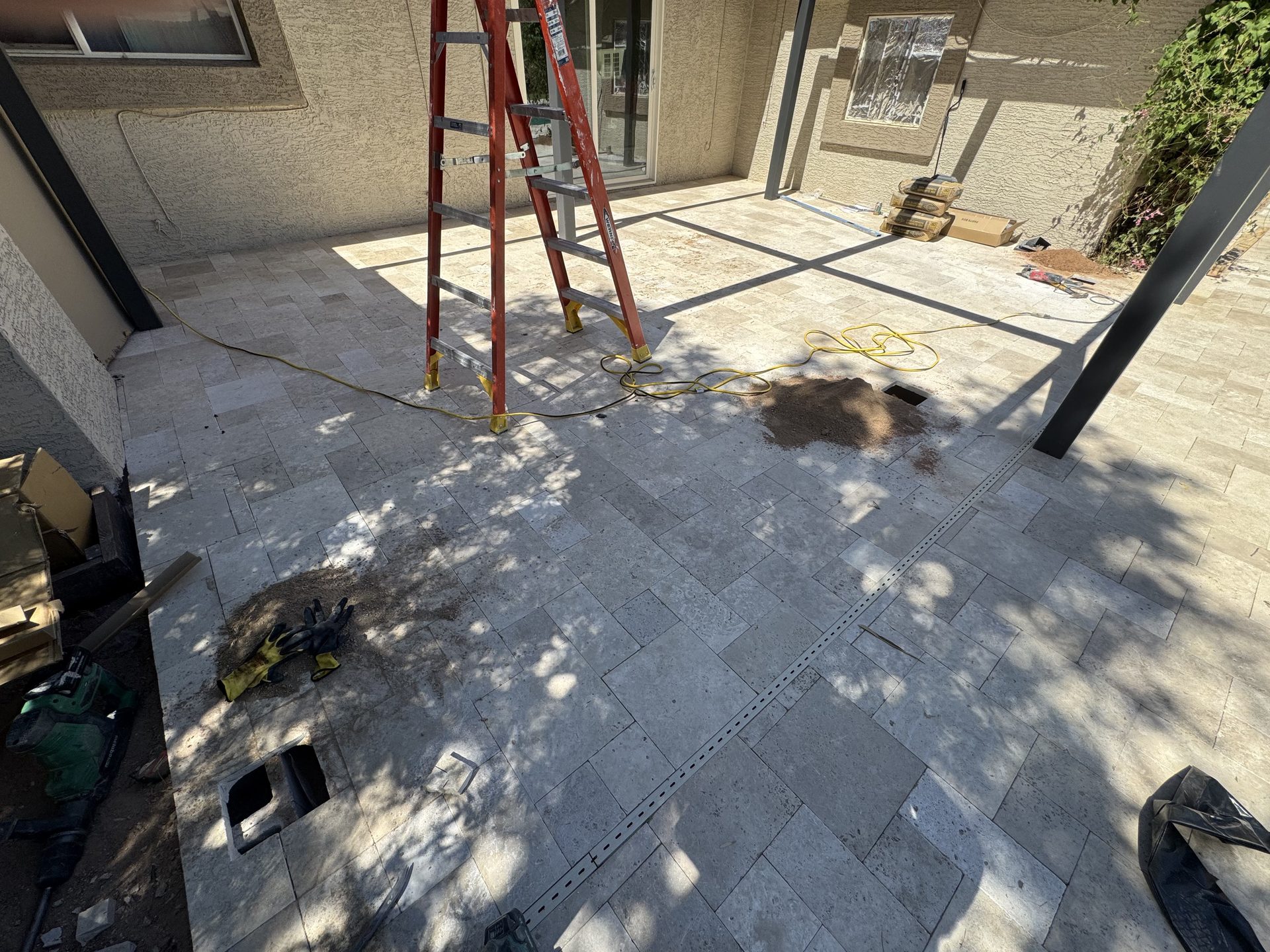
The things that share the most setup with a yard: a concrete patio, walkway or slab poured in the same pass as the paver base, because it is the same excavation and the same compaction; a patio cover, ramada or louvered pergola over the new surface, where setting footings before the pavers go down costs a fraction of cutting them in afterward, as the pergola footing photo further up this page shows; a fence or gate while the post holes and the equipment access are already open; low voltage lighting, which wants its wire buried before the base and the granite close everything up; and drip run to beds that do not exist yet but will, because the trench is open once. If the block wall is getting built anyway, painting or stuccoing it to match the house while the masking is already up costs a fraction of the return trip. Give us the whole list at the walk, even the parts you are not sure about, and the number you get back tells you which of them are nearly free once the machine is here.
Landscaping across the Phoenix metro
We take landscaping and yard construction in Phoenix, Scottsdale, Tempe, Mesa, Chandler, Gilbert, Glendale, Peoria, Queen Creek, Paradise Valley, Cave Creek and Fountain Hills. It is one of the trades we run. Here is the rest of what we do.
Hiring questions homeowners ask us
Can one contract cover the turf, the patio and the fence, or do I hire each trade myself?
One contract. We hold an Arizona Class B General Residential license, ROC #365090, which is what lets a single company carry an entire yard: demo, grading, drainage, granite, hardscape, turf, block, plants, drip and the fence or patio cover that goes with it. The value of that shows up in the grade. A yard is one continuous surface that every trade works on, and when four separate companies each set their own piece of it, the low spot that floods in August belongs to nobody.
How do I compare two landscaping bids that are thousands of dollars apart?
Ask both for four numbers and the gap usually explains itself. What depth of aggregate base, compacted in how many lifts. What is going under the pavers for bedding, and how thick. How deep the granite is going, measured after compaction. And what square footage the per-foot price is being applied to, because the grass area and the turf area are not the same number. A bidder who has those four ready is quoting the same job you are. One who answers in adjectives is quoting a different one.
Do you charge for the estimate, and can you price a yard from photos?
No charge, and photos plus a rough square footage get you a real range the same day most of the time. We still walk it before the number is firm, for two reasons that do not photograph: how deep the caliche sits, and how the yard drains. Both move a price more than anything you can see in a picture.
Will you handle the city grass rebate paperwork?
We build the scope so it qualifies and we get you the photos, measurements and receipts each city asks for. The application is in your name because the water account is. The part worth hearing twice: every Valley program requires approval before any grass comes out, and starting early disqualifies you permanently. Phoenix takes about three weeks to issue a Notice to Proceed, so the rebate decision comes before the schedule, not after.
Does a landscaper need a contractor license in Arizona?
For anything over $1,000 including materials, yes. Arizona's handyman exemption under A.R.S. 32-1121 stops there, which almost every real yard job clears on the first day. The specialty classification for this trade is CR-21, renamed from Landscaping and Irrigation Systems to Hardscaping and Irrigation Systems, and its residential scope has hard ceilings: decorative garden walls to six feet, retaining walls to three feet above the lower grade, non-loadbearing concrete, uncovered patios and walkways, and low voltage lighting. Norem holds a Class B General Residential license, ROC #365090, so a retaining wall taller than three feet, a covered structure, or work tied into the house stays on the same contract instead of sending you out to hire and coordinate a second company.
How long will my yard be a construction site?
A front yard conversion is usually four to six working days on site. A back yard with a paver patio and turf runs eight to fifteen. The calendar is longer than the working days because a city rebate needs its Notice to Proceed first, block work has to cure before anything loads it, and plants go in last. The worst-looking stage is day two through day four, after the lawn is gone and before the base is in.
What happens if we hit caliche deeper than expected?
You hear about it that day, with a number, before we keep digging. We probe the planting holes and the footing lines during the walk so the estimate already carries what we found. When it comes in harder or deeper than the probe showed, the options are priced the same way every time: hand tools and a breaker on a few holes, a jackhammer or a mini excavator across the yard, or moving a tree to a spot where the layer is thinner. Nobody backfills a planting hole in caliche and calls it done, because that hole becomes a bathtub and the tree drowns in the desert.
Related: desert landscaping & grass-to-desert conversions · concrete patios & walkways · patio covers, ramadas & pergolas · fencing & gates · see our completed work

Written by Harrison Norem, Licensed Class B General Contractor, AZ ROC #365090. About Harrison
Get a Real Number on Your Yard
Send the square footage and a few photos, including one of the worst-draining corner. You get back a range priced against the chart above, usually the same day, plus whether your city will pay you to take the lawn out. Free estimate from a licensed Arizona contractor, ROC #365090.
Request Free Estimate