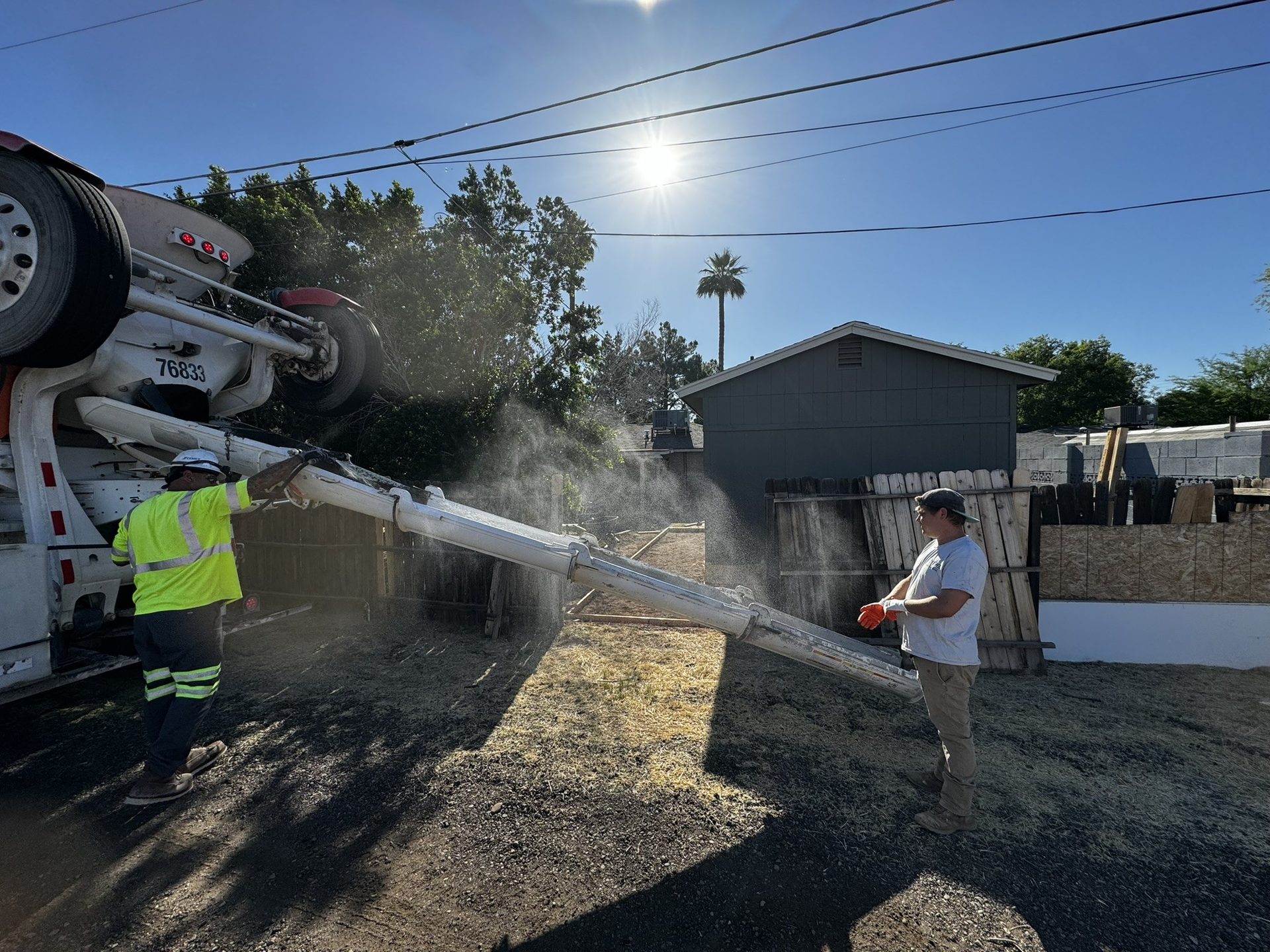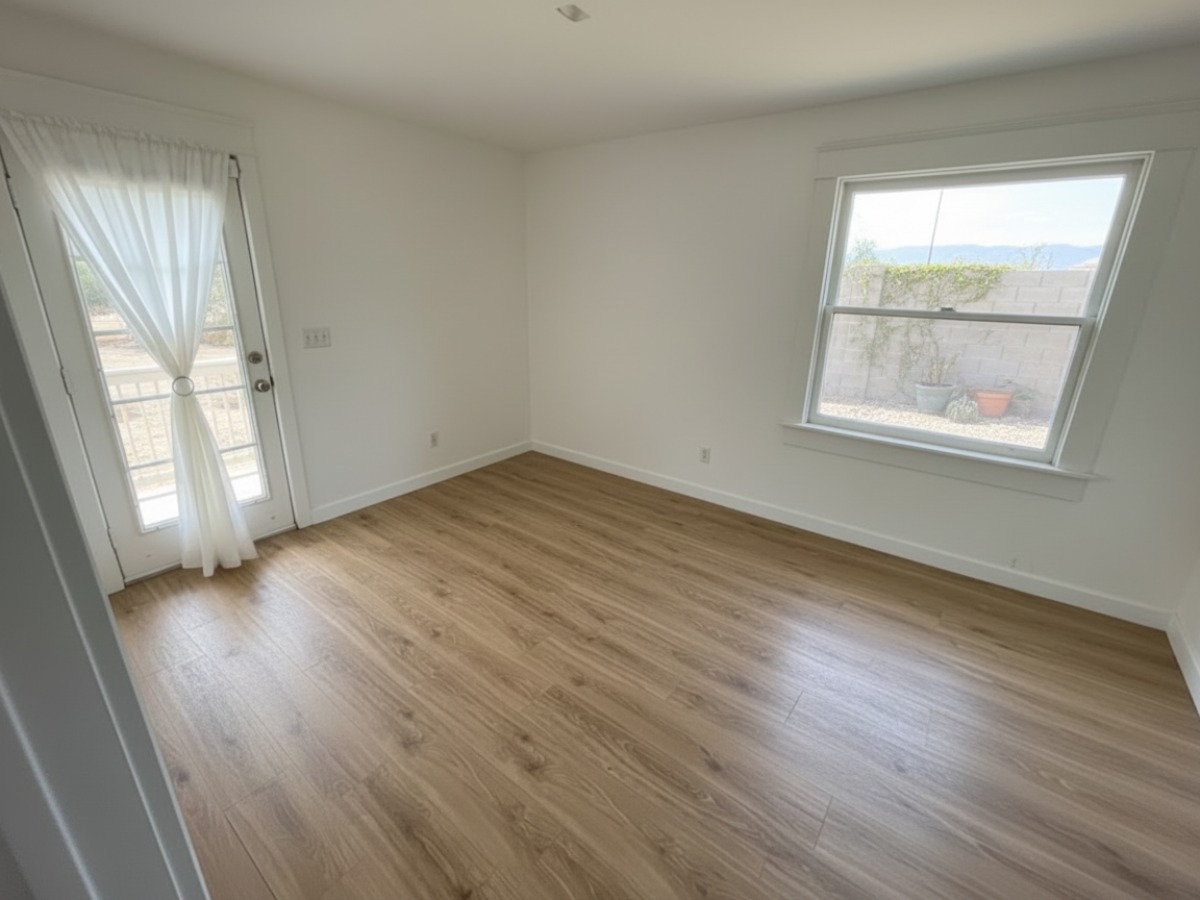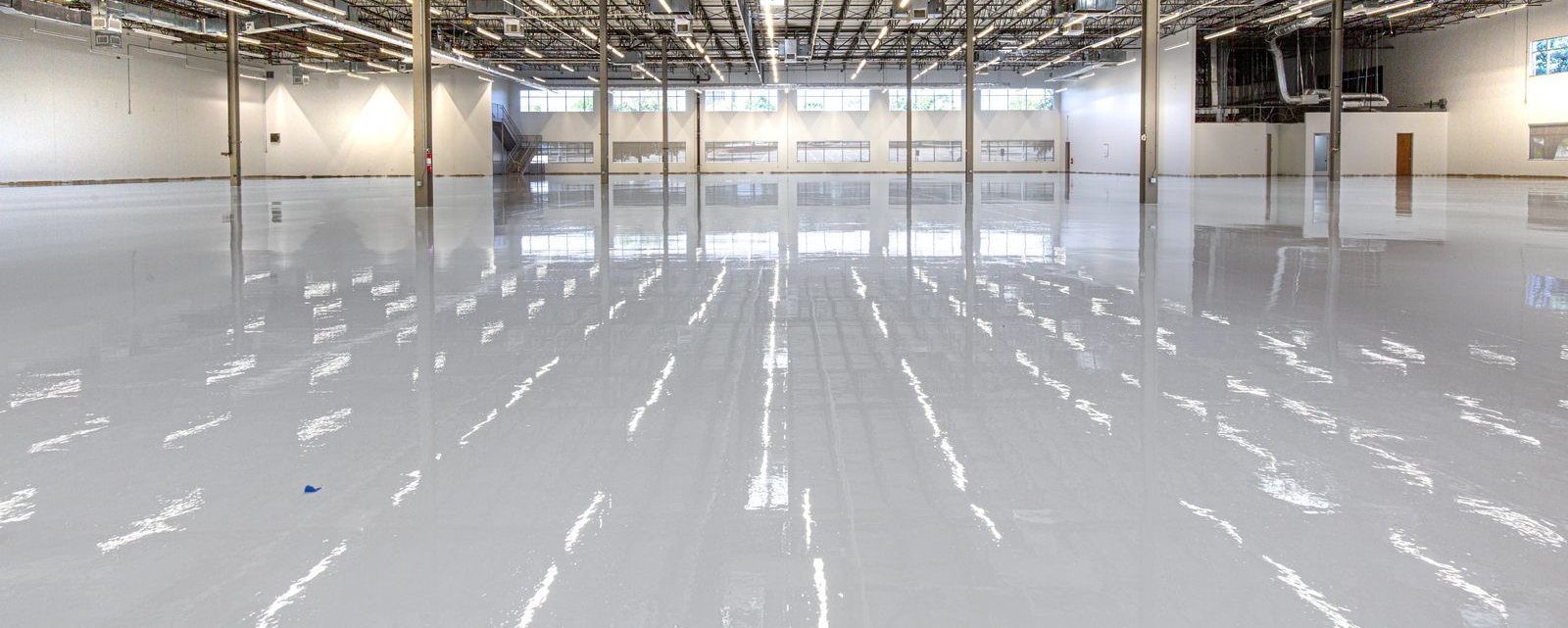
An epoxy garage floor is not paint. It is a bonded coating system, ten to twenty times thicker than what comes in a big-box kit, ground into the concrete rather than rolled on top of it, and on a slab that was prepared properly it should give you 10 to 15 years. Installed, the systems most Phoenix homeowners actually buy run $6 to $9 per square foot, which on a real two-car garage is roughly $2,400 to $5,200. This page covers the three things worth knowing before you spend that: what the different systems are and which one belongs on a Phoenix garage, exactly how we install one, and then the full price chart.
We are a licensed Arizona general contractor, ROC #365090. Garage floors are the core of this work, and we also coat patios, pool decks, home workshops and interior floors. The difference between us and a coatings-only company is what happens when the slab itself is the problem. A company that only sells coatings has one answer to every floor. We can tell you the concrete needs repair before anything goes on it, then actually do that repair, along with the drywall, the paint and the electrical work around it. Whatever the slab turns out to need, it stays on the same contract.
Two things decide more of your final number than the finish you pick. The first is that almost every cost page prices a "two-car garage" at 360 square feet, when a modern 24 by 24 is 576. That is 60 percent more floor, and it is the single biggest reason two quotes for the same job look like they came from different planets. The second is that the coating is the cheap part. What the concrete needs before it can take a coating is where the real variation lives, and it is the part a low bid leaves out.
Is that epoxy, or is it garage floor paint?
Both get sold as "epoxy," and the price gap between them is not a markup, it is a different product. A big-box kit lays down 3 to 5 mils of film. A professional system builds 10 to 20 mils, which is three to five times the material standing between your tires and the concrete.
Chemistry matters as much as thickness. Water-based epoxy is the cheap tier and is generally given 3 to 5 years. Solid and solvent-based systems are the long-lived ones. In this climate a properly prepared professional floor should give you 10 to 15 years, and a DIY kit is usually gone in 1 to 3. That is not a slur on homeowners who do their own work. It is what a badly shortened pot life in a hot garage does to a coating applied by somebody doing it for the first time.
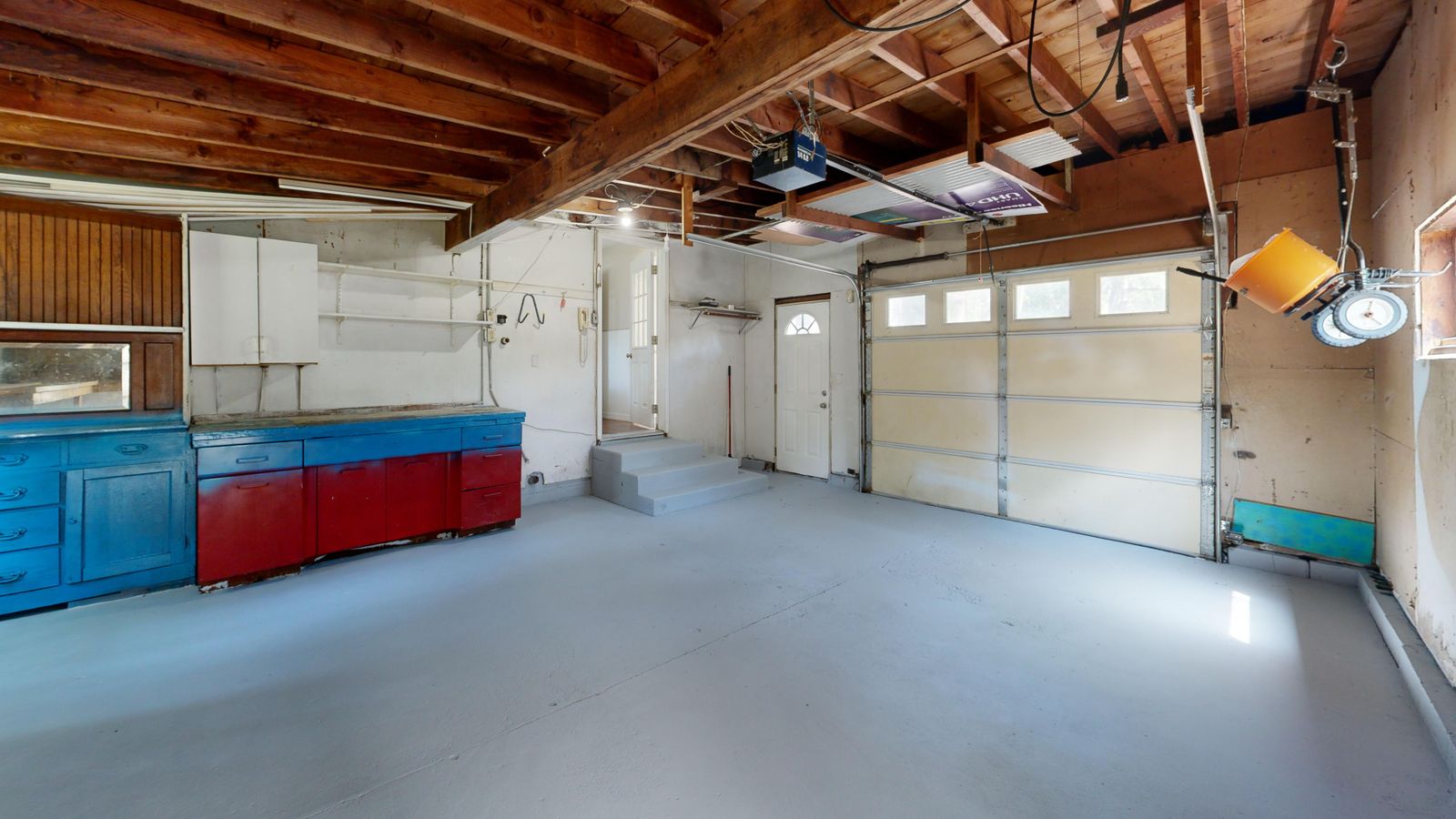
Garage floor paint at the end of its life. Everything on this slab has to come off with a grinder before a real system goes down, which is why coating over old paint is never the cheaper option it looks like. Stock photograph.
Epoxy or polyaspartic: which belongs on a Phoenix garage?
Start with a naming problem, because it explains a lot of confusing quotes. Most of what gets sold as an "epoxy garage floor" in Phoenix in 2026 is not epoxy. It is a polyurea base with a polyaspartic topcoat, and "epoxy" has quietly become the category name the way people say Kleenex. That is not dishonest by itself, but it does mean two bids using the same word can be describing different products, so it is worth asking which chemistry is actually going down.
Short answer for most Valley garages: an epoxy or polyurea base with a polyaspartic topcoat. Epoxy is the better film builder, has higher compressive strength and bonds hard to properly ground concrete. It is also the one that yellows in ultraviolet light. Polyaspartic wins on ultraviolet stability and cure speed, which are the two things epoxy is weak at. Epoxy underneath, polyaspartic on top.
You will see polyaspartic advertised as four times stronger than epoxy. Stronger at what is the question that claim never answers, and on the measure most people mean, epoxy is the harder of the two. Ask which property and you will learn more from the answer than from the multiplier.
Two things the category says out loud that are worth correcting. Polyurea is widely marketed as ultraviolet stable, and Concrete Network states plainly that it discolors over time, so do not buy polyurea on a sun claim. And "100 percent solids" is sold as a quality badge when it is really a formulation trade-off. Concrete Network documents early field failures of 100 percent solids polyaspartics and recommends 85 to 100 percent, with 70 percent acceptable where workability matters.
You will also see one-day installation sold as proof of quality. Speed comes from the chemistry. It tells you nothing about the workmanship. A one-day polyaspartic job over a properly ground and tested slab is a good floor. A one-day job over a slab nobody ground is a good floor for about a year.
How an epoxy garage floor actually goes down
Six steps. The first three are the ones that decide whether the floor lasts, and they are the three a cheap bid compresses.
-
Clear, degrease, mask
You empty the garage, including the second fridge. Oil stains get degreased and left to dwell before anything touches them, because grinding an oily slab only drives it deeper.
45 to 90 min -
Grind, field and edges
Planetary grinder with HEPA extraction across the open floor, then a hand grinder around the whole perimeter, the door track and every corner. The edges are the step cheap crews skip.
3 to 4.5 hrs -
Repair, then grind flush
Cracks, spalls and pop-outs filled with a rigid polyurea filler, never caulk, then ground back flat. Vacuumed twice. This is also the go or no-go check on slab conditions.
1.5 to 2.5 hrs -
Base coat and flake
Base goes down wet, working from the back wall toward the door, and the flake is hand-thrown into it before it sets. One continuous move, no pausing.
1 to 2 hrs -
Scrape and reclaim
Once it sets, the standing flake edges are scraped flat and the loose excess is blown and vacuumed off. Skip this and the floor feels like sandpaper and eats brooms.
About 1 hr -
Topcoat and hand over
Clear polyaspartic, with anti-slip grit at the door line and anywhere that gets wet. You get the cure dates in writing before we leave.
1 hr per coat
Every one of these moves with slab temperature. A cold January garage roughly doubles them. On the calendar it comes out as two days for an epoxy-based system and one long day for a polyurea and polyaspartic system. The part people underestimate is that the garage has to be completely empty for all of it, and you are not parking inside for anywhere from one day to a week.
One detail inside step six that decides whether the floor holds together: polyaspartic topcoats have a maximum recoat window as well as a minimum one. Come back too late and the previous coat has to be abraded before the next one goes on. Miss that and the coats never chemically link, and eventually the topcoat sheets off the base looking like a bond failure when it is really a scheduling one.
Parking early is the most common way a homeowner damages a new floor themselves, and it is worth being precise about why. Hot tire pickup is not tires melting the coating. It is an adhesion failure that tire heat reveals. A warm tire grips slightly, and as it heats and cools it works at the same patch of floor over and over. Where the coating is weakly attached, because the slab was etched instead of ground, or where the film is only a few mils thick, it lets go in the shape of the tire. On a well-bonded, properly built floor it simply does not happen. The most common cause on an otherwise good floor is parking before the chemistry has finished.
Why do epoxy floors fail in Arizona?
The overwhelming majority of coating failures are bond failures, not product failures. You can see it when a bad floor comes up: the coating peels away clean and the concrete underneath is still smooth and closed. Nothing was ever holding it on. Epoxy grips mechanically, into the texture of the concrete, so if there is no texture there is no floor.
That is why the grinder matters more than the bucket. Diamond grinding opens the surface. Acid etching, the shortcut, barely scratches it, leaves salt residue that has to be neutralized and rinsed, and does nothing at all to a slab that has been sealed before, because the acid never reaches the concrete. Etched floors in Arizona have been reported failing inside 12 to 18 months. We grind to the profile the product's own data sheet calls for. That number changes with the system, so it is one to ask about rather than assume.
Two checks you can run yourself. Before anyone quotes, drip water on the bare slab: if it beads instead of soaking in, there is a sealer on it, and stripping that is the biggest single swing in the price of a prep. Then after grinding and before any coating goes down, drip water again. It should absorb, and the floor should have gone from dusty gray to mottled with the aggregate showing through.
The other tell is at the edges. A walk-behind grinder cannot reach the last few inches at the wall, so the perimeter, the door track and every corner have to be done separately with a hand grinder or an edger. Skipping it is invisible on day one. It is why cheap floors start lifting at the wall line and the threshold first. Look on the truck for a hand grinder or an edger.
One thing to expect on any bid, including ours: grinding concrete produces respirable silica, and containing it with HEPA extraction is an OSHA requirement. The extractor runs off the grinder and the dust goes into a filtered vacuum instead of into your house.
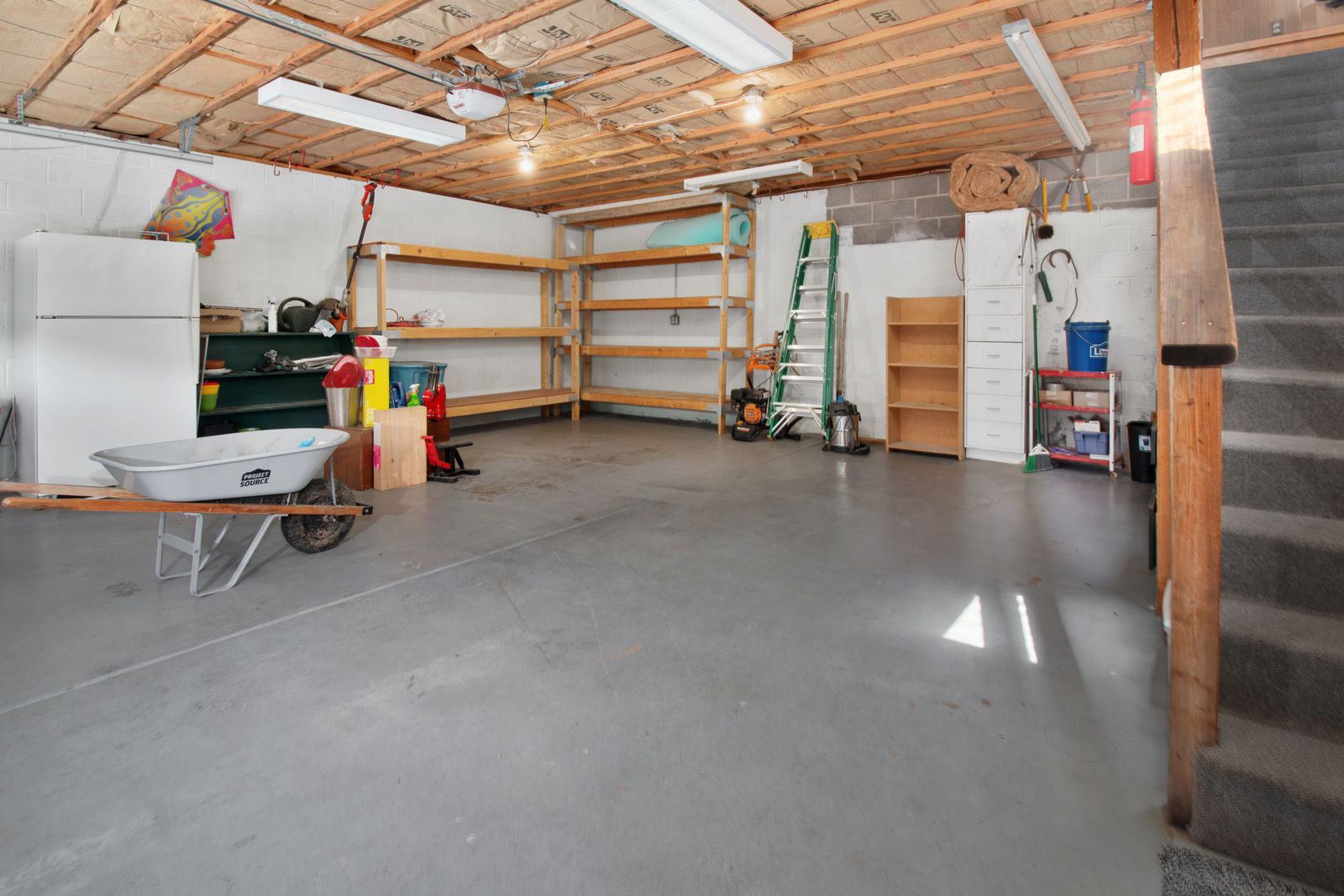
What we look at before quoting: the control joints, the apron at the door where spalling starts, oil staining, hairline cracking, and whether the slab is post-tensioned. Stock photograph, not a Norem project.
Does your slab need a moisture test first?
Water vapor moving up through concrete has to go somewhere. Put a film over it and the vapor collects underneath until it pushes the film off, which is why blistering shows up as dime-sized to hand-sized bubbles rather than as wear. New concrete also needs a minimum 28-day cure before it gets coated at all, though age is only a proxy. Moisture content is the real gate.
The rest of this market gets one thing wrong here, and it matters before you accept anyone's testing claim. ASTM F1869 (the calcium chloride test) and ASTM F2170 (the relative humidity probe) are test methods. They produce a number. They do not set the pass mark. The coating manufacturer does, and the limits vary a lot from product to product. The figures you see quoted everywhere, 3 pounds of moisture per 1,000 square feet over 24 hours for the calcium chloride test and 80 percent relative humidity for the probe, come from resilient flooring adhesives and are stricter than many epoxies require.
More to the point in Phoenix: F1869 is only valid if the space is held at 65 to 75 degrees and 40 to 60 percent humidity for 48 hours before and during the test. An uncooled garage in July is nowhere near that. So when a contractor tells you they ran a calcium chloride test on your garage in the summer, the number they got is not a valid F1869 result. We would rather say that than claim a standard we cannot meet in a July garage.
And if you have a post-tensioned slab, the probe test is off the table entirely. F2170 requires drilling a three-quarter-inch hole to 40 percent of slab depth. On a four-inch garage slab that is about an inch and a half down, and residential post-tension tendons run near mid-depth. Each of those tendons is holding tens of thousands of pounds of force. Nobody should be drilling your garage floor on spec to check the humidity. Most Valley production homes built from the mid-1980s onward are post-tensioned, usually because of expansive clay and deep engineered fill on graded lots. Look for a stamp or a small metal plate near the garage.
So on a post-tensioned slab nothing we do puts a hole in your floor. A plastic sheet test under ASTM D4263, a surface-mounted calcium chloride test, and an impedance meter reading. If any of it comes back marginal, the floor gets a moisture-tolerant primer. On every job, post-tensioned or not, we screen on the estimate visit and escalate to a full standardized test when the screen looks marginal. No residential garage crew in the country runs a 72-hour ASTM test on every floor, and anyone telling you they do is telling you what you want to hear.
When a slab does come back wet, the first move is not a product, it is finding the source. In this town it is very often irrigation running against the foundation, a downspout dumping at the slab edge, negative grade at the garage door, or a leaking water heater or softener. Fix that and the slab dries. If the source cannot be fixed, the options are a moisture-mitigation primer, switching to something breathable like polished concrete or a penetrating sealer that lets vapor through instead of trapping it, or telling you the floor is not a candidate. Any of those is a better outcome than a coating that lets go in a year.
Can you coat a garage floor in a Phoenix summer?
Yes, and a garage is one of the few jobs in this town that summer does not really threaten. Your slab is shaded, indoors and thermally massive. While the air outside is 110, the concrete is usually sitting somewhere in the eighties or low nineties. The 140-degree surface temperatures you read about are real, but they describe a driveway or a pool deck in direct sun, not the floor inside your garage.
What actually decides a summer install is humidity, not heat, and it runs the opposite way to what you would guess. Coatings want the slab at least 5 degrees warmer than the dew point, and warming rather than cooling. During monsoon the Valley dew point climbs into the sixties and low seventies, and a garage slab that has cooled overnight can sit right at that line or under it. When it does, the slab picks up a film of moisture you cannot see. On epoxy that shows up as amine blush, a greasy surface haze that has to be washed off or the next coat peels away in sheets. So the standard advice to start at dawn in summer is backwards in August. In monsoon season we often want the slab warmer, not cooler.
Polyaspartic has its own version of this, because it is moisture cured. Above roughly 80 percent relative humidity it cures too fast and gives off carbon dioxide as it goes, which gets trapped under the film as bubbles and foam. The product marketed as the one you can install any time is the one with the tightest humidity ceiling.
Heat does still compress the working time. Epoxy pot life runs 30 to 40 minutes at 70 degrees and roughly halves for every 18 degrees above that, so a hot garage gives you 15 to 20 minutes rather than 40. The trick is that pot life is measured for a full pail, where the material heats itself. Ribbon it out onto the floor and the working time roughly doubles. That is why a good crew mixes half batches and pours immediately instead of letting a bucket sit.
The hard window here is not July. It is December and January, when an unheated garage slab can sit at 50 to 58 degrees on a winter morning, at or under the minimum substrate temperature for a 100 percent solids epoxy, and the cure simply stalls. In summer we start later than you would think, to let the slab climb away from the dew point. In winter we start later for the opposite reason, to let a cold slab warm up. We will not refuse a month, but we will refuse a day on measured conditions: slab outside roughly 55 to 90 degrees, slab less than 5 degrees above dew point, or humidity over 80 percent for a polyaspartic.
Garage Floor Coating Price Chart, Phoenix 2026
Installed prices per square foot of floor, covering labor and material for licensed, insured work on a sound slab. Slab repair and moisture mitigation are separate and are listed at the bottom. Your number gets confirmed free, after we see the floor.
| System | Typical installed price | What drives the price |
|---|---|---|
| Garage floor paint or a big-box kit | $2-$4 per sq ft, installed | A 3 to 5 mil film, usually water based, over minimal prep. Cheapest way to change the color and the shortest-lived thing on this chart. We list it so you can recognize it in a bid, not because we recommend it. |
| Standard solid-color epoxy | $4-$7 per sq ft, installed | Diamond-ground prep and a 10 to 20 mil build. Price moves with slab condition, how much grinding the floor needs, and total square footage. |
| Flake or chip broadcast system | $6-$9 per sq ft, installed | The finish most people picture. The swing inside this band is coverage: a partial broadcast uses far less flake than a full broadcast thrown to rejection, and full coverage is the labor-heavy version. |
| Quartz broadcast | $9-$13 per sq ft, installed | Graded quartz instead of vinyl flake. Heavier build, more texture underfoot, more material. Common in wet areas, laundry rooms and mudrooms. |
| Metallic epoxy | $8-$18 per sq ft, installed | Published ranges disagree more here than anywhere on this chart. A single-color pour sits at the bottom, multi-layer and custom marbling at the top. It is an art finish, so the installer's hand is part of what you are buying. |
| Full polyurea or polyaspartic system | $8-$15 per sq ft, installed | The one-day systems. You pay for chemistry that cures in minutes, holds its color in sun, and gets you back in the garage fastest. |
| Polyaspartic topcoat over an epoxy base | add $2-$3 per sq ft over the base | The spec we recommend for most Phoenix garages. Epoxy builds the film and the bond, the polyaspartic takes the sun and the tires. |
| Crack and spall repair | $25-$250 per repair | Priced per defect. A hairline crack and a broken-out door apron are not the same job. |
| Slab resurfacing, when the floor is too far gone to coat | $3-$5 per sq ft, added | A skim of cementitious overlay to give a pitted or badly patched slab a flat surface. Some floors need this and some need a new pour instead. |
| Slab moisture testing | quoted per slab | The one line item nobody in this market publishes. We test before we coat, we give you the reading, and if the slab fails we tell you what it costs to fix rather than coating over it and hoping. |
Ranges reflect the 2026 Phoenix market for licensed, insured work. Send us photos of your garage floor and we will come back with your number, free.
How big is your garage, actually?
This is the question that makes every other number on the internet comparable, and no cost page asks it. Bob Vila and This Old House both price a two-car garage at 360 square feet. HomeAdvisor uses 500. That is a 39 percent spread in the denominator before anybody argues about the rate, and it is why one national page tops out at $4,300 for a job another one puts at $6,000.
Real garages are bigger than the small end of that. A one-car garage is commonly 12 by 20 feet. Two-car garages run 22 to 26 feet wide by 20 to 24 deep, which puts an older Phoenix 20 by 20 at 400 square feet and a modern 24 by 24 at 576. Three-car garages run 31 to 34 wide by the same depth. So when you read that a two-car garage costs $1,500, check what rectangle that number was built on.
What It Costs by the Size Your Garage Actually Is
The same published Phoenix rates, applied to real garage footprints instead of a category label. Measure yours and use the row that matches.
| Garage | Floor area | Standard epoxy | Flake system |
|---|---|---|---|
| 1-car, 12 x 20 ft | 240 sq ft | $960-$1,680 | $1,440-$2,160 |
| 2-car, older Phoenix build, 20 x 20 ft | 400 sq ft | $1,600-$2,800 | $2,400-$3,600 |
| 2-car, modern build, 24 x 24 ft | 576 sq ft | $2,304-$4,032 | $3,456-$5,184 |
| 3-car, 32 x 22 ft | 704 sq ft | $2,816-$4,928 | $4,224-$6,336 |
| The 360 sq ft "2-car" the national pages price | 360 sq ft | $1,440-$2,520 | $2,160-$3,240 |
Measuring takes about a minute. Run a tape from the inside face of one wall to the other, then from the garage door back to the far wall, and multiply. Deduct nothing for the water heater platform unless it is bigger than a closet. Send us the number you get, with a photo of the worst part of the floor, and we will price it against this chart.
This is also how you compare two bids. Ask both contractors for a rate per square foot and the square footage they measured. Without both numbers there is nothing to compare.
What do the finishes look like, and what does each cost?
| Finish | Cost / sq ft | Look | Life | Best for | Think twice |
|---|---|---|---|---|---|
| Solid color | $4-$7 | Flat, even, one color | 10-15 yr | Budget-conscious, clean look, shop floors | Shows dust, tire marks and every patch underneath |
| Flake, partial broadcast | $6-$8 | Speckled, base color still visible | 10-15 yr | Most garages. Hides dirt, adds grip | Coverage varies between installers, so ask |
| Flake, full broadcast | $7-$9 | Full chip coverage, base color hidden | 10-15 yr | The best-hiding, best-gripping garage floor | Roughly triple the flake and the labor of partial |
| Quartz broadcast | $9-$13 | Fine granular, natural stone tone | 12-15 yr | Wet areas, laundry rooms, mudrooms | More texture than most people want in a garage |
| Metallic | $8-$18 | Marbled, reflective, no two alike | 12-15 yr | Show garages, entries, feature floors | Glossy and slick when wet unless grit is added |
| Polyaspartic, full system | $8-$15 | Any of the above, higher clarity | 10+ yr | Fastest return to service, sun exposure | Cures fast, so it is unforgiving of a slow crew |
Full broadcast means flake is thrown until the surface will not take any more, then the excess is scraped and vacuumed off the next day. Partial broadcast leaves base color showing on purpose. It is the biggest cost variable inside a flake quote, and most bids do not state which one you are getting.
How to audit a flake quote in two numbers
Contractors quote flake by look, so "full coverage" means whatever they want it to mean. It is measurable, and these are the two figures to ask any bidder for.
- Flake. A true full broadcast to rejection runs roughly 0.10 to 0.20 pounds per square foot, so a 400 square foot two-car garage takes somewhere around 40 to 80 pounds. A quarter to well over a third of that gets swept up and reclaimed the next day, which is normal. A light or accent broadcast is nearer 0.01 to 0.05 pounds per square foot. If a bid for "full flake" comes with 20 pounds of chip, it is an accent floor.
- Resin. One gallon of a 100 percent solids product covers about 1,604 square feet at one mil, so divide 1,604 by your target thickness in mils and take 10 to 20 percent off for how thirsty the concrete is. For a 400 square foot garage getting a real base coat and two topcoats, that is roughly 6 to 10 gallons of material. A crew that shows up with two one-gallon kits is painting your floor, not coating it.
Ask for both numbers plus the square footage they measured.
What about the cracks, the spalling and the oil stains?
Cracks get opened slightly, filled with a rigid polyurea filler rather than caulk, and ground back flush. Priced per defect, most land between $25 and $250, because a hairline shrinkage crack and a broken-out apron at the garage door are not the same repair. On a post-tensioned slab all of that stays shallow by rule. No saw cutting, no deep chasing, no anchors, because the tendons in there are under enormous force and cutting one is a genuine danger, not a code technicality.
Control joints are a judgment call worth making out loud before we start. Filling them flat looks better and leaving them alone lets the slab move where it was designed to. Either way, the honest expectation is this: a crack in the concrete eventually becomes a line in the coating. That is the slab behaving normally, and it is better heard now than two summers from now.
Oil is different. A stain is cosmetic, but oil that has soaked in is a bond breaker, and no primer reliably fixes a saturated patch. That area gets ground deeper or cut out. If a floor is pitted or patched to the point where grinding will not give a flat surface, a resurfacing skim at $3 to $5 per square foot comes first, and some slabs are past coating entirely and want a new pour. That is an easier call to make when coating is not the only thing we sell. If yours turns out to need concrete rather than coating, we pour new concrete flatwork as well.
When we will tell you not to coat it
A coating is a film about as thick as a business card. It is a finish, not a repair, and there are floors where selling you one would be selling you a problem. These are the ones we turn down or redirect.
| If this is your floor | What we would do instead |
|---|---|
| Moisture with a source that cannot be fixed, or chronic white salt bloom | A penetrating sealer or polished concrete. Both let vapor through instead of trapping it under a film that will blister. |
| The slab is heaving, or has cracks that are still moving | Concrete work first. A coating will not hold a moving slab together, and the crack will come through the finish within a season. |
| Several layers of unknown old paint or sealer | Get the prep priced honestly before you commit. Removal can cost more than the coating, and occasionally tile or a fresh pour is cheaper. |
| You are selling the house in the next few months | Clean it, degrease it and seal it. It shows nearly as well for a fraction of the money, and no appraiser is paying you back for the epoxy either. |
| It is a working shop with welding | Not epoxy. Sparks and heat damage it. Flake hides dropped-tool chips far better than a solid color if you do coat it. |
| Your budget for a two-car garage is under about $1,200 | Do nothing yet, or seal it. A cheap coating is worse than bare concrete, because now you own a removal bill on top of the original problem. |
| The floor is already mostly covered in mats or gym flooring | Nothing. The mats are doing the job. |
One more that is about the house rather than the slab. If you have a gas water heater in the garage with a standing pilot, that pilot gets shut off and the space gets ventilated before any solvent-carrying product is opened in there. That happens before anyone opens a can, and it is not negotiable.
Will it be slippery, and will it turn yellow?
A high-gloss floor is slick when it is wet, and metallic finishes are the glossiest of the lot. The fix is an anti-slip aggregate broadcast into the topcoat, which costs very little and changes the feel underfoot slightly. A full flake broadcast already has meaningful texture and usually needs no help. If the floor is going anywhere near water, ask for grit in the topcoat and expect to see it on the estimate as its own line.
Metallic deserves a word here, because it photographs better than it lives. In a working garage it shows every tire mark, and it cannot be spot repaired, because you cannot blend a new metallic pour into an old one. It is also the slipperiest finish on the chart. Good floor for a show garage, if you know that going in. Poor default for a garage you work in.
Yellowing is a real risk and a specific one. Standard epoxy is not ultraviolet stable, and Arizona sun has been reported to visibly degrade an unprotected system within 6 to 12 months. It almost never shows in the middle of a closed garage. It shows in the first several feet inside the door, because that strip is the only part of a garage floor that gets real sun. Which makes the door line the detail to ask about. Where does the coating stop, and how? A light solid color will show ambering there badly. Flake hides it almost completely, and a polyaspartic topcoat is what prevents it in the first place. The good news is that ambering is cosmetic. It is not the coating failing.
How long does it last, and how do you look after it?
Think maintainable rather than permanent. A properly prepared professional floor should give you 10 to 15 years, with a topcoat refresh somewhere around year 7 to 10 as normal upkeep rather than as a failure. A refresh is a scuff and a fresh clear coat, a fraction of the cost of the original job, and it is one of the main reasons the topcoat is worth paying for. You will see 20-year and lifetime numbers advertised in this market. Nobody has 20 years of field data on the systems being sold in 2026.
Maintenance is light. Sweep it, because grit trapped under a tire is what actually abrades a topcoat, and mop it with something pH neutral. Keep citrus cleaners, solvents and harsh degreasers off it. Put a tray under anything that leaks.
Two rules for the first month. Do not turn the steering wheel while the car is stopped, because that puts a pure twisting load right at the bond line. And keep rubber-backed mats, cardboard and plastic off the floor for about 30 days, because plasticizers migrating out of rubber will stain and soften a fresh coating, sometimes permanently.
What about the patio, the pool deck and the rest of the house?
Same crew, same grinder, different rules outdoors. Standard epoxy does not belong in the Arizona sun, and outdoor work is a polyaspartic or otherwise ultraviolet-stable system, which is a different product and a different price. Coated exterior concrete in this climate is given 10 to 15 years. Patio coating runs $3 to $12 per square foot and pool decks $8 to $20, both over an existing sound slab. If there is no slab, or the slab is failing, that is a pour rather than a coating, and it belongs with concrete patios and flatwork.
A dark coated surface gets hot. Around a pool in July that is a design decision, and it argues for lighter colors, more texture, or getting the surface under a patio cover or ramada before you coat it.
Inside, the same systems work on home workshops, laundry rooms and entries, and metallic finishes get used as feature floors. This is residential work; we do not take commercial coating jobs. If you are turning the garage into living space, a coating is the wrong finish for that room and waterproof vinyl plank flooring is closer to what you want.
Should you just do it yourself?
Sometimes, honestly. If your slab is newer than a few years, clean, dry, crack-free and you want a color change rather than a twenty-year floor, a kit at $100 to $300 will do that, and you avoid a couple thousand dollars of labor.
The catch is what you cannot rent your way around. You are laying 3 to 5 mils instead of 10 to 20, you are almost certainly etching rather than grinding, and in a Phoenix garage the material starts going off in about ten minutes, which is not much time to learn the technique. That combination is where the 1 to 3 year DIY lifespan comes from. The grinder is the part a kit cannot sell you, and it is not a rental-counter problem you solve in an afternoon.
Is your contractor actually licensed for this in Arizona?
Worth checking, because nobody in this market volunteers it. Norem Contracting holds an Arizona Class B General Residential Contractor license, ROC #365090, licensed, bonded and insured, and we carry the contract for your job. Everyone who works on your floor is licensed for the work they are doing. Ask us for the numbers and look them up; we would rather you did.
Arizona names this trade in two specific classifications, and they are the ones to look for on a garage floor bid. R-8 Floor Covering lists "concrete coatings" in its scope, and R-34 Painting and Wall Covering lists "liquid floor and wall coatings." A coatings specialist holding one of those is not a lesser bidder than a general contractor. The question is only whether the person standing in your garage holds a license at all.
Which is where the useful test comes in, and it is aimed at the unlicensed end of the market. Arizona lets an unlicensed person take work only under the handyman exemption in A.R.S. 32-1121, which stops at $1,000 for the entire job including materials. Every real garage floor on this page costs more than that. So if somebody is bidding your floor without a license number, the job is outside what they can legally take, whatever the price. Ask for the number and look it up on the ROC site; it takes a minute.
Permits: coating an existing slab is a finish application and does not pull one in Phoenix, Mesa, Chandler, Scottsdale, Gilbert, Tempe or Glendale. That changes only if the work grows into slab replacement, structural repair or a new pour.
What else makes sense while the garage is empty?
A floor coating is the only job that requires your garage to be completely empty, masked and dust-controlled, and getting it to that state is most of the setup cost for half a dozen other jobs. Work folded into the same mobilization commonly prices a quarter to a half below what it costs as its own trip. The catch is that it has to be in the scope before the grinder comes out, not added on day two.
The obvious companions are the walls: garage drywall is usually the worst-finished surface in the house, and drywall repair and finish work followed by painting the garage walls costs a fraction of what it does as its own trip. Overhead racks, wall storage and the small installs that never get done are the same story, and that work sits with our handyman services. If you have been meaning to add a 240-volt circuit for an electric vehicle or a compressor, an empty garage is when the wiring is easiest to run, and that goes through a licensed electrical subcontractor as Arizona requires. And if the patio or the walkway is getting coated too, doing it while the grinder is already on site is the largest saving available on this page. Get one number for the whole list before you sign off on the coating.
Hiring questions homeowners ask us
Does square footage lower my cost per foot?
Yes, within limits. Mobilization, grinder setup and dust containment cost the same whether the floor is 240 square feet or 700, so a three-car garage spreads those fixed costs further and lands at a lower rate per foot than a single-car. Very small floors carry a minimum, which is why a one-car garage rarely prices at the bottom of the published range.
Do you charge for the estimate, and can you quote from photos?
No charge. Send us the measurement and photos of the floor, the cracks and the apron at the garage door, and we can usually get you a range the same day. We confirm it on site, because the things that change a price are moisture and slab condition and neither of those reads reliably in a photo.
What should I ask the other contractors bidding my floor?
Three questions, and a real installer answers all of them without hesitating. What machine is the slab getting ground with, and how are the last six inches at the wall being prepped? How many gallons of material and how many pounds of flake for my square footage? And will the slab moisture reading come to me in writing? Those answers separate the bids faster than the prices do.
Are you licensed for garage floor coatings in Arizona?
Yes. Norem Contracting is an Arizona Class B General Residential Contractor, ROC #365090, licensed, bonded and insured, and we carry the contract for your job. Everyone who works on your floor is licensed for the work they are doing. The two Arizona classifications that name this trade are R-8 Floor Covering, which lists concrete coatings, and R-34 Painting and Wall Covering, which lists liquid floor and wall coatings. Any garage floor job costs more than the $1,000 handyman exemption under A.R.S. 32-1121, so anyone bidding yours should have a license number.
Does an epoxy garage floor add to my home's value?
It shows well and it is a genuine quality-of-life upgrade, and we are not going to put a dollar figure on the resale. You will see companies in this market advertise that a coating adds $8,000 or more, or $8 per square foot of value. There is no appraisal data behind those numbers that we can find. Buy the floor because you want a garage that cleans with a mop and does not shed dust, and treat any resale gain as a bonus nobody can promise you.
What happens if the slab comes back wet?
We tell you, and we do not coat it that day. First we look for the source, because in Phoenix it is very often irrigation against the foundation, a downspout at the slab edge, or a leaking water heater, and fixing that dries the slab. If the source cannot be fixed, the options are a moisture-mitigating primer, switching to something breathable like a penetrating sealer or polished concrete, or telling you the floor is not a candidate. All three cost less than a coating that lets go in a year.
Garage floor coating across the Phoenix metro
We take garage floor and concrete coating work in Phoenix, Scottsdale, Tempe, Mesa, Chandler, Gilbert, Glendale, Peoria, Queen Creek, Paradise Valley, Cave Creek and Fountain Hills. It is one of the trades we run. Here is the rest of what we do.
Related: concrete patios & flatwork · flooring installation across the Valley · drywall repair · handyman services · see our completed work

Written by Harrison Norem, Licensed Class B General Contractor, AZ ROC #365090. About Harrison
Get a Real Number for Your Garage
Measure the floor, take three photos, and send them over. You get a clear range back, usually the same day, priced per square foot so you can hold it against any other bid you have. Free estimate from a licensed Arizona contractor, ROC #365090.
Request Free Estimate