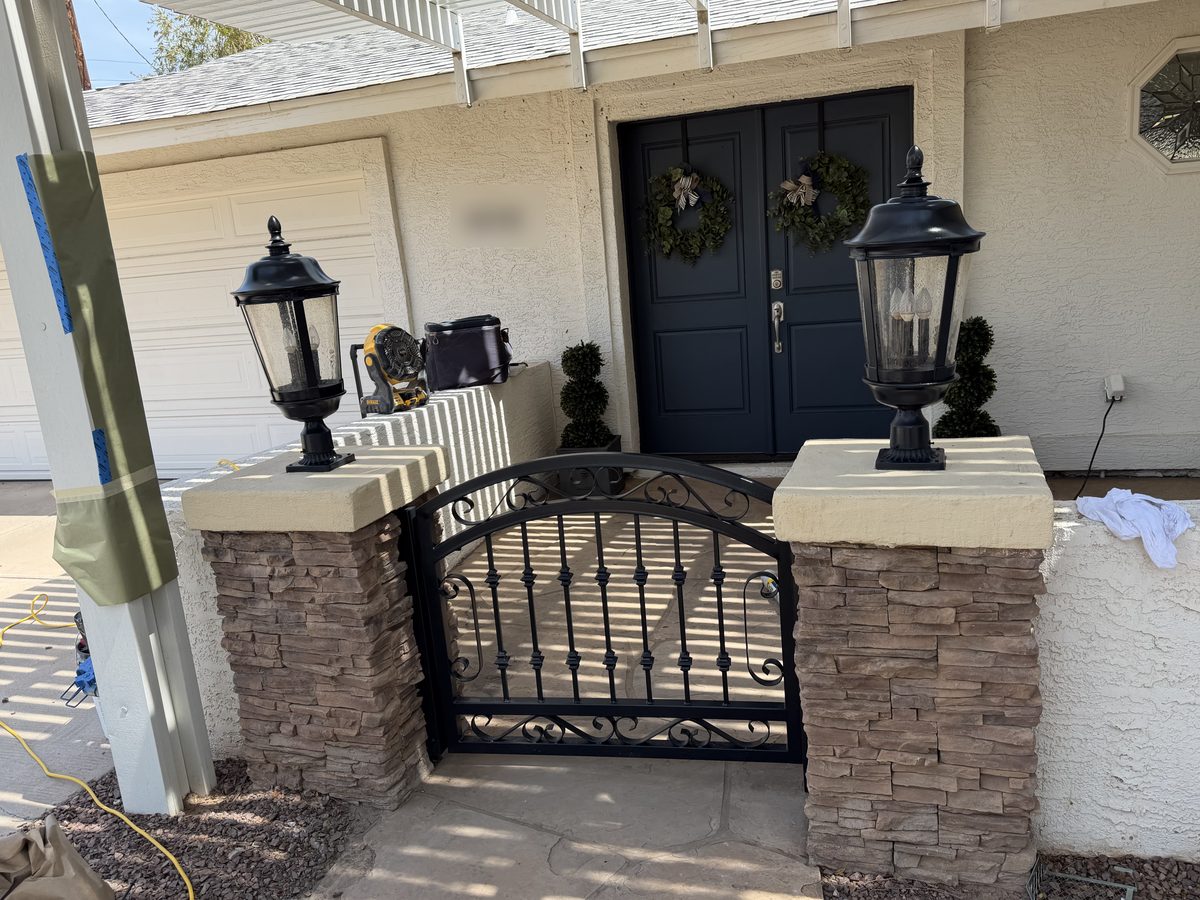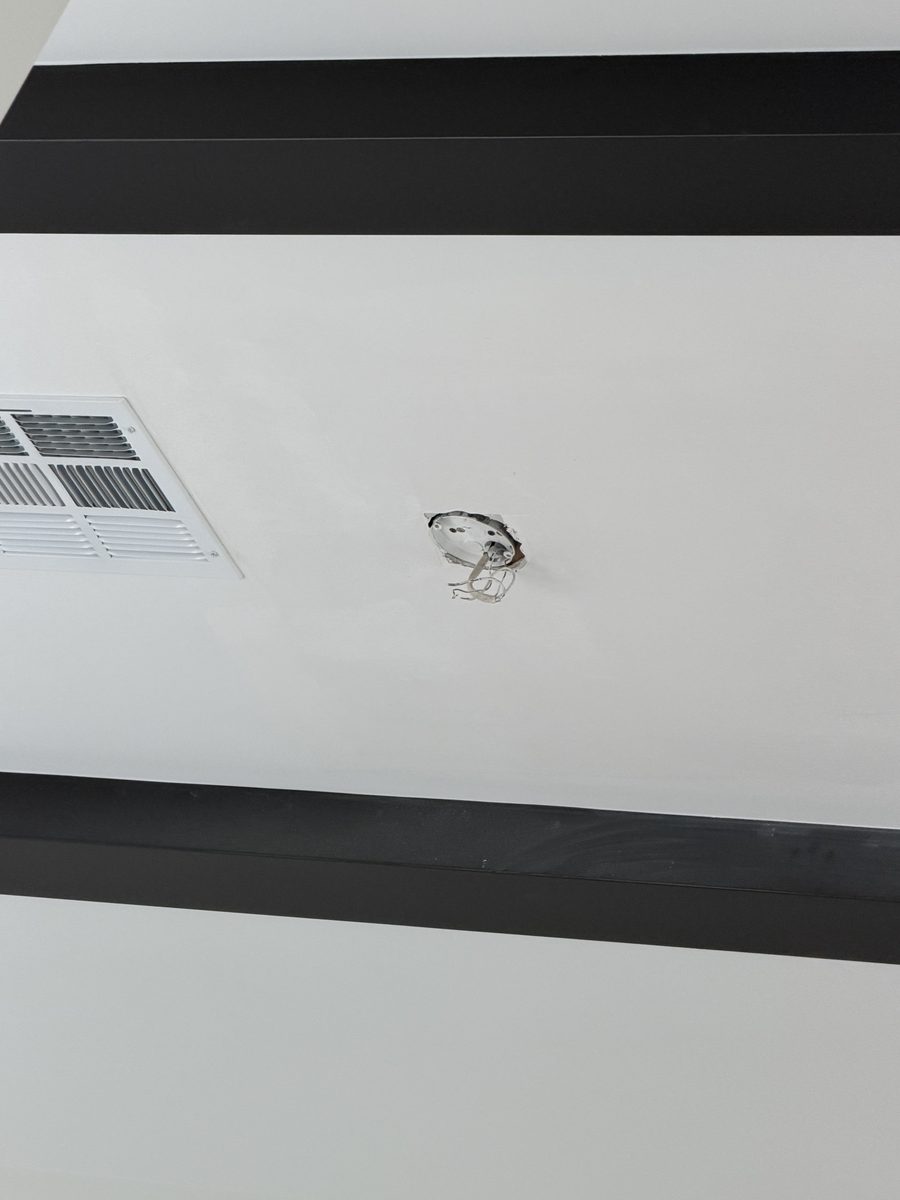
Rolling paint on a wall is the last and fastest part of an interior repaint. Everything that decides whether the job still looks right in three years happens before the first coat: what the wall is finished to, whether the patches got sealed, how much film actually lands on the surface, and how a room behaves when the air outside is eleven percent humidity. We are a licensed Arizona general contractor, ROC #365090, and interior painting sits with our drywall and trim work rather than apart from it, because on most Phoenix houses the reason the paint looked wrong was never the paint.
That is the practical difference between hiring us and hiring a paint-only crew, and Arizona writes it into the license itself. The state's painting classification, R-34, is defined as "surface preparation to install, apply, and repair" wallpaper, wall covering, decorative texture, paint and liquid coatings. Repair work outside that craft is allowed to a specialty licensee only where it is "incidental and supplemental" to the craft they hold, which is the test in A.R.S. §32-1105. Filling a nail hole clears it. A ceiling opened up over a shower does not. The B General Residential Contractor license we hold is defined as permission to "construct and repair all or any part of a residential structure," with no incidental test to argue about. So when the wall behind the paint turns out to need corner bead, a texture match or real board work, that stays on the same contract with the same crew and the same number.
This page walks the work in order: what the wall you already own will and will not carry, how we run a repaint through a house you are living in, what the desert does to a wet edge, why cheap jobs fail in specific and predictable ways, and then the full 2026 price chart with the one number every other cost page leaves out.
What we paint, and where the lines are
Walls, ceilings, baseboards, casing, interior doors, closets, cabinets, stair railings and the inside face of the garage door. Residential is the whole business, so this is houses, casitas, guest houses and rentals rather than office suites or retail space. Everything on the outside of the building takes different coatings and sits on the exterior painting page.
One other line, before you read any further. Troweled mineral finishes, Venetian plaster and Roman Clay and lime wash, are a separate trade at four to ten times the price of paint, and they live on the interior plaster finishes page. One wall in plaster and the rest of the room in paint is a normal ask, and we quote both on the same job.
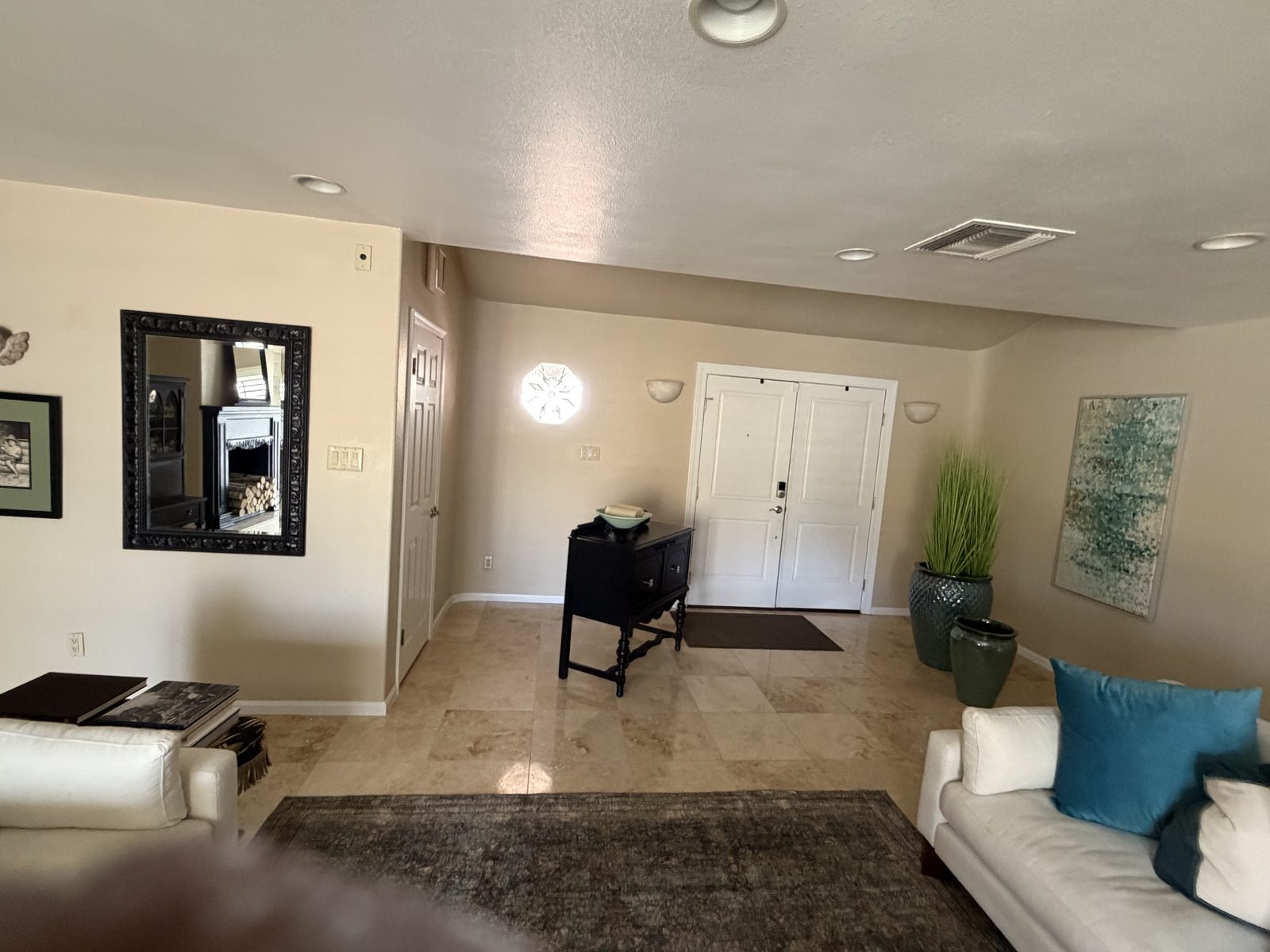
The finished entry on a central Phoenix job, furniture in place the whole time. Trim, casing and doors repainted through the living areas with the walls left alone.
The wall decides the sheen, not the other way around
Almost nobody explains this before the quote, and it decides more about how a wall looks afterward than the color does.
Drywall gets finished to a level, and the levels are defined by the Gypsum Association in GA-214. A Level 4 wall gets two coats of compound over the tape and one over the fasteners. Level 5 is all of that plus a skim coat of joint compound over the entire surface. Nearly every tract house in the Valley is a Level 4 wall with a texture sprayed over it.
Here is what GA-214 actually says about a Level 4 wall, word for word: it is specified where "smooth wall designs are decorated with flat paints, light textures, non-continuous textures, or wallcoverings are to be applied," and then, plainly, "Non-flat or dark/deep tone paints are not recommended; refer to Level 5."
Read that again with a paint chip in your hand. The navy accent wall in eggshell that you have been picturing is not a color decision. On a Level 4 wall it is a drywall decision, because the standard says that finish level was never rated to carry a sheen or a deep tone. Nobody's going to stop you, and plenty of Phoenix walls carry eggshell perfectly well. But if the seams start showing through your new color under the afternoon light, the wall was telling you something the specification already knew.
Texture is the other half of it, and it is not the builder shortcut people assume. GA-214 names the condition it solves: "In critical lighting areas, flat paints applied over light continuous textures may reduce joint photographing." Critical lighting means strong light raking across a surface from the side, which in a city with roughly 85 percent possible sunshine and low winter sun angles is what a west-facing room does every afternoon. Knockdown texture on a Phoenix wall is an engineering answer to a lighting problem. Stripping it to get a smooth wall means buying the Level 5 skim coat that smooth wall requires, which is real money and belongs on the quote before anyone starts.
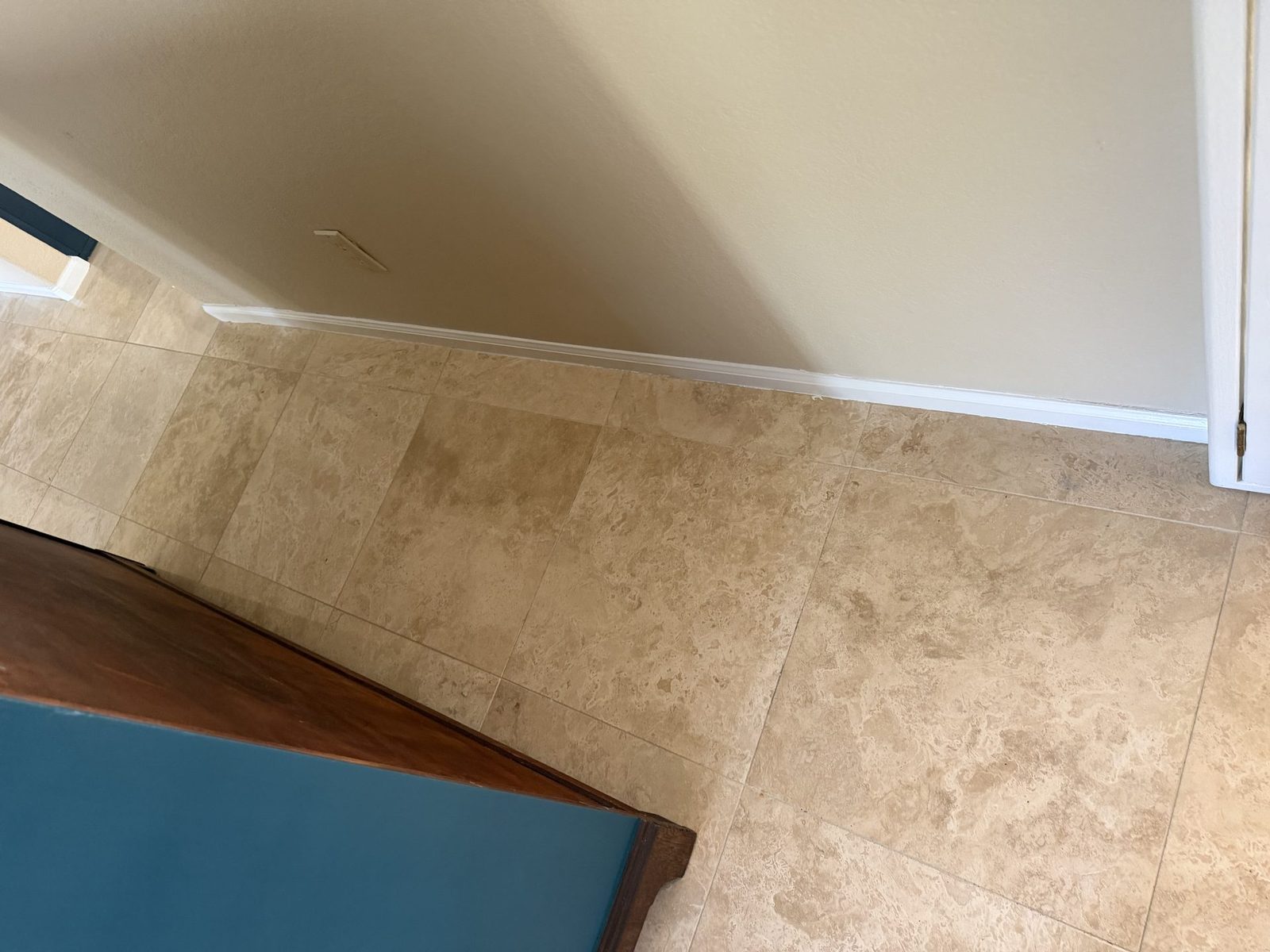
A light knockdown wall in a central Phoenix house, with the sun raking down it from the left. That shadow line is critical lighting, and it is the exact condition the texture is there to defeat. Photographed on our own job in August 2026.
Practically, that turns into three questions we ask at the walkthrough rather than three we answer for you. Is the wall smooth or textured. Is the color going darker or glossier than what is on it now. And does that room take hard side light in the afternoon. If the answers stack up the wrong way, the honest quote includes wall work, not just paint.
How we run an interior repaint
Seven steps. The paint shows up in step five.
-
Walk it and write it
Room by room with a paint chart: every color, every sheen, what is included and what is not. Nail pops, cracked corner bead and any brown ring on a ceiling get counted here, not discovered on day two.
At the estimate -
Repair and texture
Patches, corner bead, anchor holes and cracks, then the texture matched to what is already on the wall. This is the step that sets the schedule, because mud has to dry before it can be sanded.
Mud dries overnight -
Spot prime and seal
Every patch gets primed. Water and smoke stains get a shellac stain blocker, which is a thirty minute step, not a day. Glossy trim gets sanded dull before anything goes over it.
30 min recoat -
Mask and cover
Furniture to the middle and covered, floors covered wall to wall, plates and vent covers off, and a tape line pressed down hard on every edge that is not getting painted. In a furnished house this is most of day one.
Most of day one -
Ceilings, then walls
Overhead first so nothing drips onto finished walls. Cut the edges, roll the field, keep the sections small enough to hold a wet edge. Second coat once the first one has had its four hours.
4 hr recoat -
Trim, doors and cabinets
Slow brush work with its own product and its own sheen. Enamel wants sixteen hours between coats, which is why trim usually reaches across two days even when the walls did not.
16 hr recoat -
Pull tape and put it back
Tape comes off while the film still gives slightly, plates go back on, furniture comes off the middle of the floor, and we walk the rooms with you before the truck loads.
Same day
Every one of these is the manufacturer's own figure at 77 degrees and 50 percent relative humidity, and every data sheet prints a line underneath saying the times are temperature, humidity and film thickness dependent. Phoenix is not that room. What that actually does to the work is further down this page.
Masking is most of the day in a furnished house
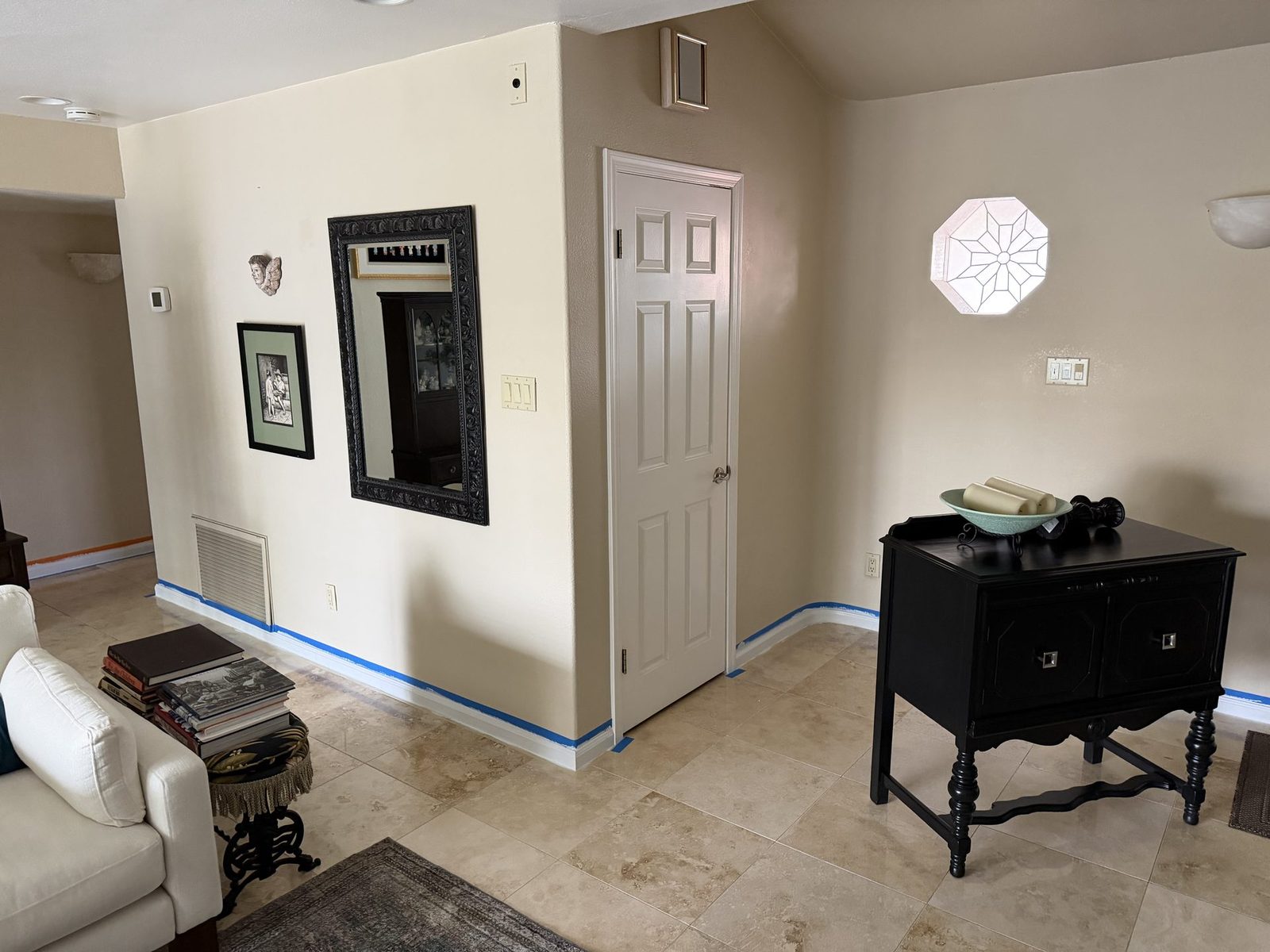
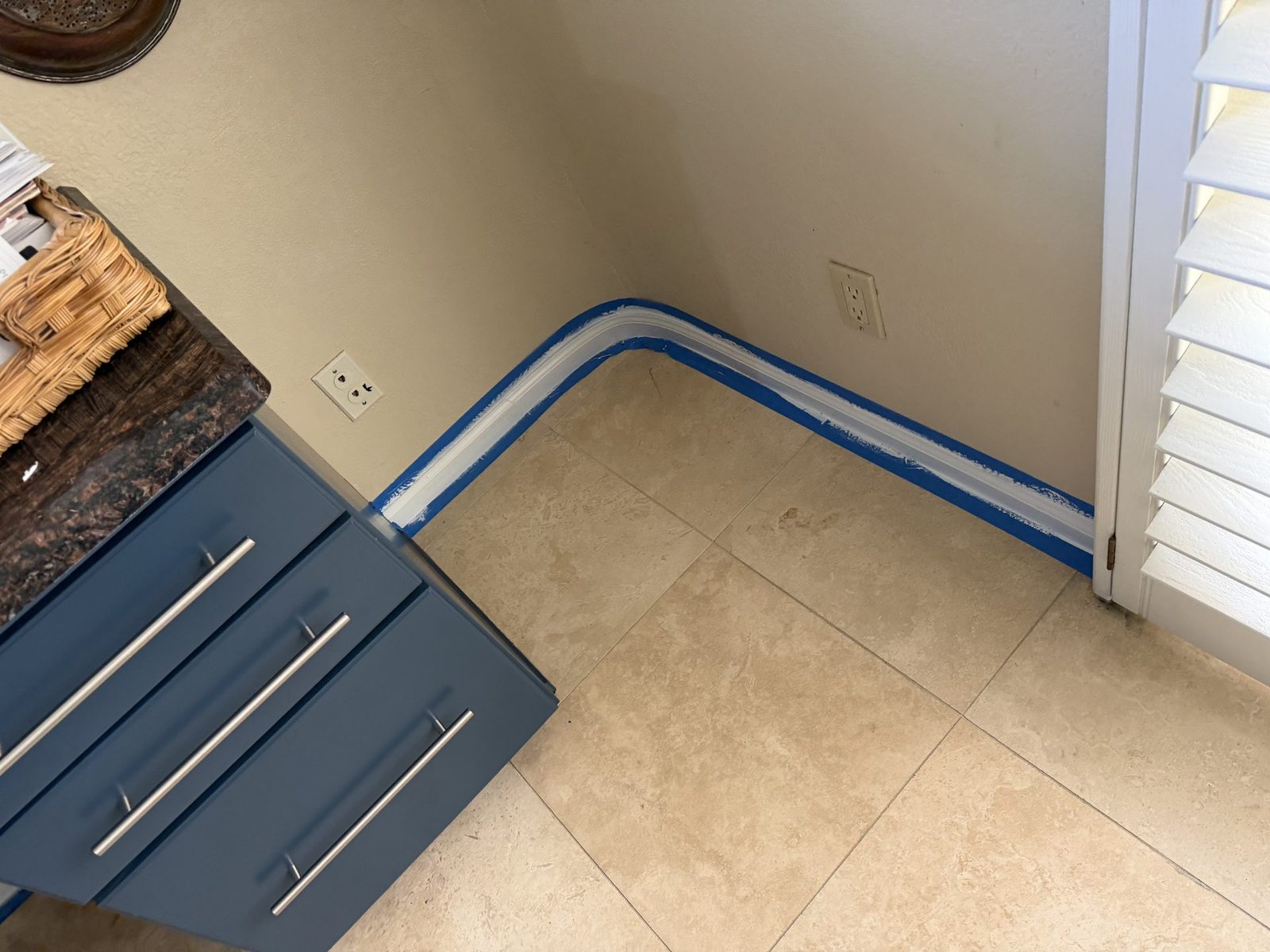
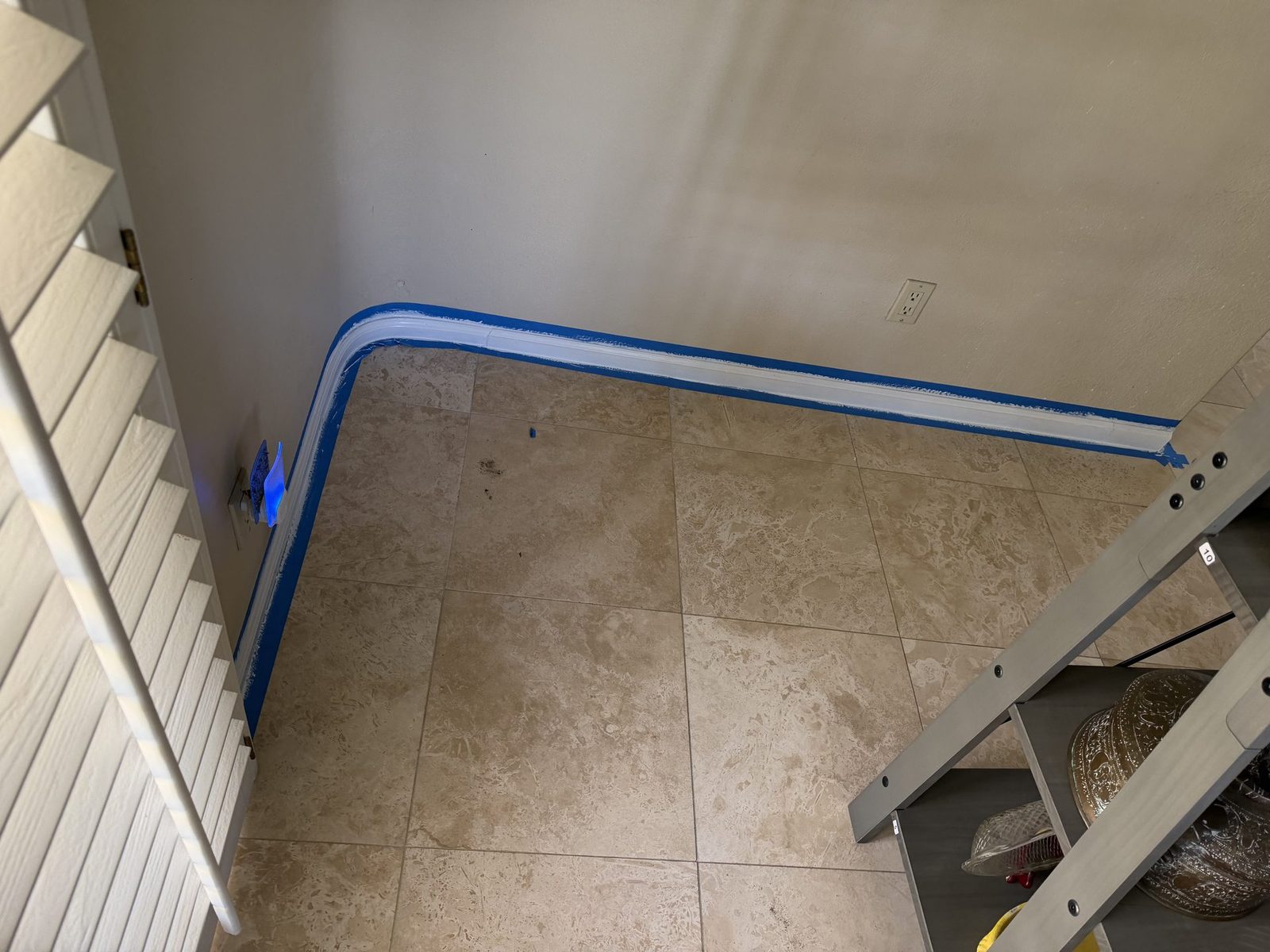
An empty house paints fast. In a house you are living in, the tape and the plastic are the job and the paint is the easy part. Hard floors change that math here specifically. On a central Phoenix house we painted in August, travertine ran wall to wall through the living areas, so the tape went down onto the stone itself and got burnished tight against the bottom edge of the baseboard. That is what lets a base get painted its full height without a drop reaching the floor. Plantation shutters came down to the sill on most of the windows, and every one of those frames got masked by hand.
None of it shows up in a finished photo, which is why it's the first thing a cheap bid leaves out. Tape laid on but not burnished is the reason paint bleeds under it onto stone and tile, and it is a callback that costs more to fix than the hour it would have taken.
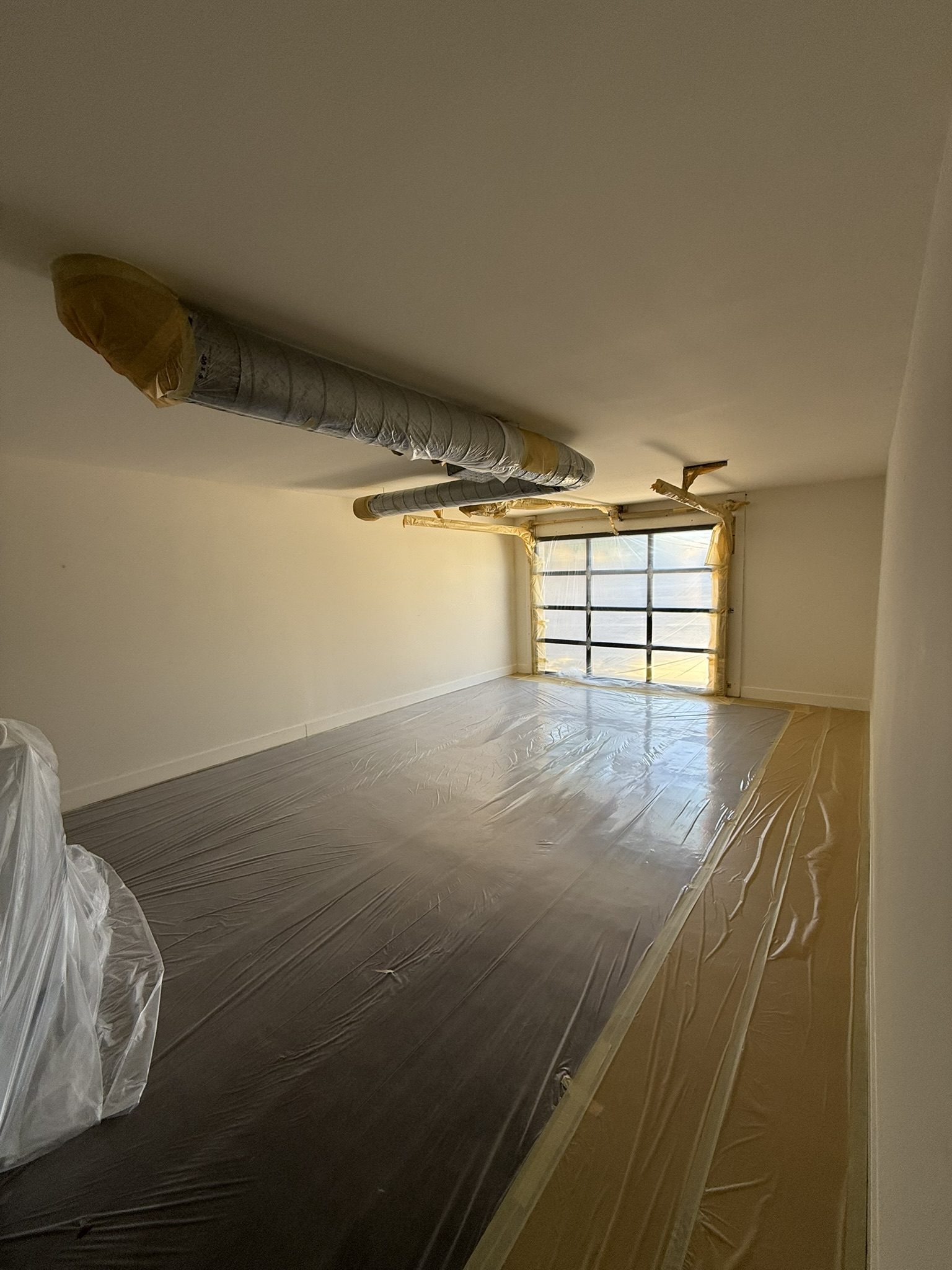
Our prep on a whole-house repaint. An empty room is not an excuse to skip the floor: sheeting wall to wall, ducts and hardware wrapped, before a single lid comes off.
Primer is a product, not a marketing word
Paint and primer in one is sold as a way to skip a step, and the manufacturers don't agree. Sherwin-Williams specifies its own drywall system as one coat of primer plus two coats of finish. Benjamin Moore's guidance on repaints is the same shape: prime bare areas, and "for best hiding results, tint the primer to the approximate shade of the finish coat, especially when a significant color change is desired." Self-priming is a real and narrow case: a sound, previously painted wall going back in a similar color and sheen. Outside that case, primer is a separate can doing a separate job.
Three jobs, specifically. The first is porosity. Fresh joint compound drinks the vehicle out of paint faster than the wall around it, so the patch cures to a different sheen from the same can and shows up weeks later as a dull or shiny ghost. That is flashing, and the fix is spot priming the patches, not a third finish coat. Sherwin-Williams puts it in its own prep line: joint compounds must be cured and sanded smooth, and all sanding dust removed.
The second is stains. A water ring will bleed straight back through two coats of latex, because latex cannot seal a water soluble stain. A shellac based blocker does, and it is fast: touch dry in fifteen minutes and recoatable in thirty. The stain block step costs half an hour. Skipping it costs the whole ceiling.
The third is color. Sherwin-Williams sells a gray shade primer system precisely for this, running from light gray up through darker shades, because a primer tinted toward the finish color balances how much light the surface absorbs and reflects under the topcoat. Their own product sheet says it flatly: when repainting involves a drastic color change, a coat of primer will improve the hiding performance of the topcoat color.
Two coats, three coats, and why some colors are worse
Two coats is the default when the color is changing, and there are colors where two won't do it no matter who is holding the roller. That is chemistry, not workmanship. Bright, clean yellows, oranges and reds use pigments that are physically more transparent, while muted and grayed-off colors carry iron oxides and black that hide well. A clean red is a three coat job. A greige is a two coat job. If a bidder quotes your red at two coats and the same price as your neighbor's greige, one of you is getting a thin wall.
One coat is a real option and it is right more often than people expect: a refresh in the existing color, or light over light, over a surface that is already sound. On the central Phoenix job in these photos the agreed scope was one coat on the baseboards, casing and the inside face of the garage door, living areas only, bedrooms left out. That got settled at the walkthrough, and it is why that piece of the job came in at $600 rather than double.
How to audit an interior bid in two numbers
Interior painting is quoted by feel, so "two coats" means whatever the bidder wants it to mean. It is measurable, and these are the two figures to ask any bidder for.
- Spread rate. A professional interior latex is rated at 350 to 400 square feet per gallon, which lands 4 mils wet and 1.7 mils dry. That is the number the warranty assumes. A crew stretching a gallon to 500 square feet is putting roughly 25 percent less film on your wall than the can was designed to leave, and it will not show for two years. Ask how many gallons the job takes and divide it into the wall area they measured.
- Which square footage. Ask whether the rate is quoted against the floor area of the house or the paintable wall area, because a room has about two and a half times more wall than floor. Nobody in this market states it, and it is the single largest reason two bids look incomparable.
Both answers should come back in one sentence each. Hesitation on either one tells you something.
Which sheen goes where
Sheen gets decided last and then lived with for years. The working pattern in a Phoenix house: flat or matte on ceilings, eggshell or matte on bedroom and living room walls, satin in kitchens, bathrooms, laundry rooms and hallways where walls get wiped, and satin or semi-gloss on trim, doors and casing.
There is a real trade-off underneath that and it pulls both directions. Higher sheen is easier to clean, and Benjamin Moore says so plainly: the lower the sheen, the gentler you have to be with it. But higher sheen is also what makes a Level 4 wall photograph every joint and every fastener, which is the reason GA-214 sends non-flat paint to a Level 5 wall. Durability and appearance are not on the same side of this argument. On a textured Valley wall the texture buys you most of the way out of it, which is another reason not to strip it.
Semi-gloss on trim that was never filled and caulked properly looks worse after painting than it did before. Gloss finds every dent, every unfilled nail hole and every ridge in a caulk line, and then holds a light on it.
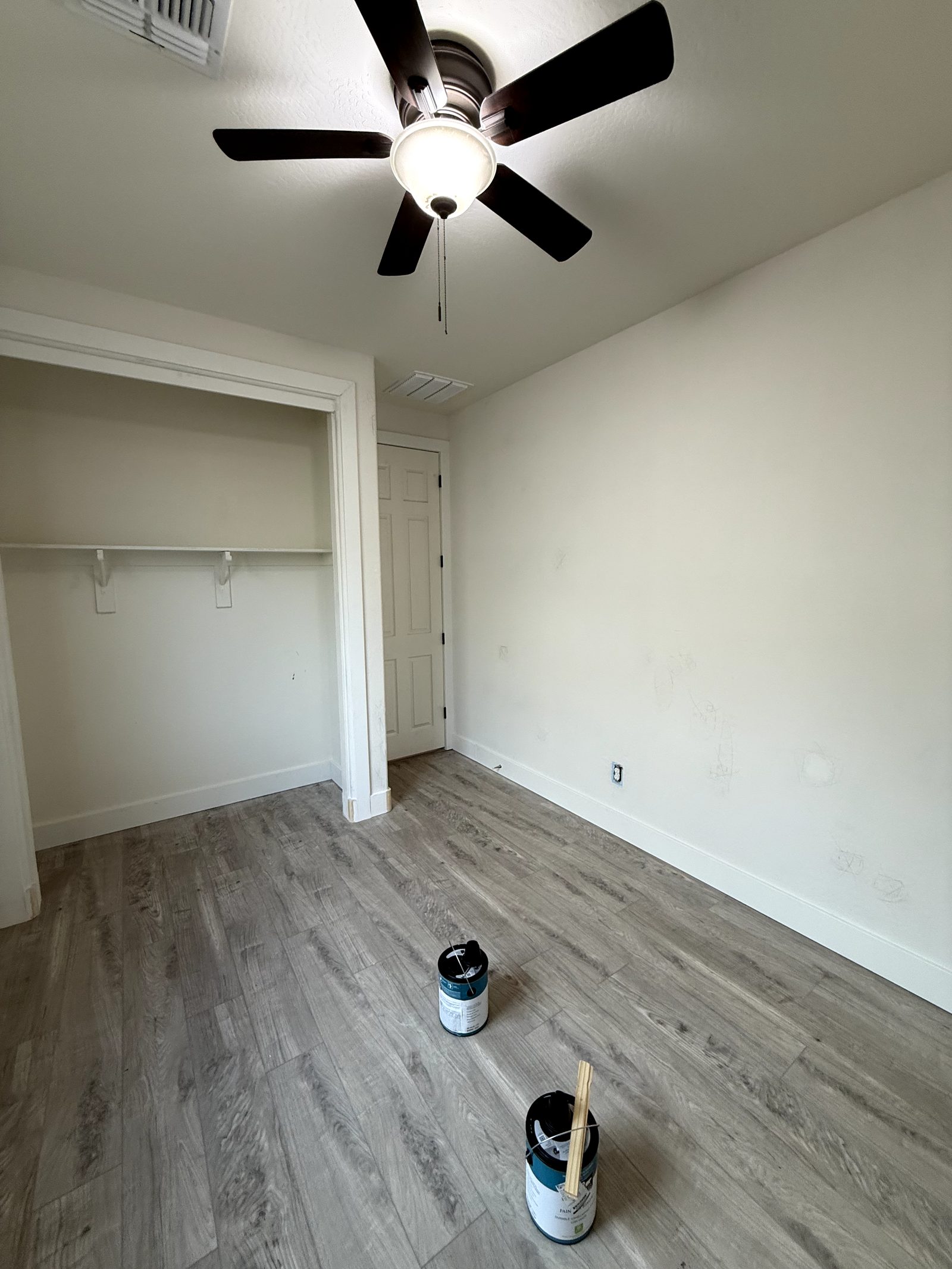
A bedroom we finished: matte on the walls and ceiling, satin on the trim and door. The sheen split is doing the work here, not the color.
What Phoenix does to a paint job
Every technical data sheet in the industry states its dry times and recoat windows at 77 degrees and 50 percent relative humidity. Phoenix in June averages 24 percent relative humidity in the morning and 11 percent in the afternoon. The annual afternoon average is 23 percent. That gap is not trivia, and it changes four things about how the work has to be run.
The wet edge closes in minutes. Benjamin Moore's application instruction is to apply generously from the unpainted area into the wet area and avoid lap marks by maintaining a wet edge. At 11 percent humidity the water leaves the film far faster than the sheet assumed, so the window to maintain that edge is short. Lap marks and roller flashing across a long Phoenix wall are usually a humidity artifact, not a sloppy painter. The fix is working in smaller sections, keeping the room out of direct sun while it is being coated, and where conditions call for it, a manufacturer's extender in the paint. Flood's Floetrol is sold for exactly this and doses at 8 ounces per gallon for brush and roller, up to 16 ounces in extreme temperatures.
An un-air-conditioned interior is outside the product's own spec. Benjamin Moore's Advance enamel lists a maximum surface temperature during application of 90 degrees. A vacant house with the power off, a casita, or a closed-up garage interior in June clears 90 easily, which means the coating is being applied out of spec inside the building. Sherwin-Williams is direct about what happens above 100: the film can dry before it has had a chance to properly adhere, and it peels later. If a room is over 90 we get the air conditioning on and let it come down, or we come back. It is a short conversation and it saves a repaint.
The paint in the truck has the same problem. That same sheet caps storage temperature at 90 degrees. A can that rode a work truck through a July afternoon has been well past it. Material lives inside, not in the bed.
Your paint aisle is regulated differently here. Maricopa County Rule 335 governs architectural coatings, and it binds anyone who applies or solicits the application of a coating in the county, which includes a homeowner buying paint for their own house. It requires the VOC content on the container, requires application containers to be closed when not in use, and computes VOC for a tint base without the colorant added after. Benjamin Moore's national data sheet lists AZMC, Arizona Maricopa County, as its own compliance jurisdiction alongside California's SCAQMD and CARB. A national manufacturer formulates for this county by name, because Phoenix and Mesa sit in ozone nonattainment. Rule 335 also carries a stricter tier of limits that takes effect on a contingency trigger rather than on a calendar date, so anyone quoting you a hard 2026 number for it is guessing.
The upside of all this: interiors are the one trade in this town that a Phoenix summer barely touches, as long as the house has power. Inside a conditioned room the conditions are better than most of the country gets in August. The jobs that go wrong here are the vacant ones and the ones with the AC shut off to save money during the work.
Zero VOC, low odor, and what the label is actually telling you
Worth being precise about, because it is the question people ask when there is a baby or an asthma diagnosis in the house, and the marketing does not answer it.
VOC content is a measurement of what is in the can, computed excluding water and excluding the colorant added to a tint base. Emissions are what comes off the wall and into the room you are breathing. Those are different numbers, and the low one on the shelf does not guarantee the low one in your hallway. Since the Federal Trade Commission's consent orders on this, a marketer substantiating a zero VOC claim is expected to show trace level emissions at six hours or less after application, and the earlier orders required VOC levels to be stated after tinting or carry a disclosure that they may increase with colorant.
What to actually look for is an emissions certification rather than a number on the can. GREENGUARD Gold measures emissions into indoor air rather than content in the product, and CDPH certification does the same. Sherwin-Williams ProMar 200 Zero VOC carries GREENGUARD Gold under UL 2818; Benjamin Moore Advance is CDPH emissions certified. Tell us if low odor matters in your house and we will specify to that. It is a product choice, not an upcharge argument.
Why a cheap interior job fails, line by line
Interior painting failures are not random. Each one traces back to a specific line item that got cut to make a number work.
| What you see | What actually happened | The line that was cut |
|---|---|---|
| Dull or shiny ghosts where the patches were | Joint compound absorbs the vehicle faster than the wall around it, so the same paint cures to a different sheen over the patch | Spot priming the repairs |
| A water stain bleeding back through two finish coats | Latex cannot seal a water soluble stain. Only a shellac or dedicated stain blocker does | A 30 minute shellac primer step |
| Streaky color that needs a third and fourth coat | A deep or clean-chroma color over white, with transparent organic pigments doing the hiding | The gray tinted primer coat |
| Trim or cabinets peeling inside a year | Coating applied over gloss, grease or silicone. Glossy surfaces have to be sanded dull first, and glossy alkyds sanded before a waterborne enamel goes over them | Degrease, rinse, scuff sand, remove the dust |
| Cabinet doors sticking to the frames or printing fingerprints | Rehung and used before block resistance developed. Full hardness can take up to 30 days | The 16 hour recoat wait and the 5 to 7 day service delay |
| Thin, patchy coverage that fails in two years | Gallons stretched past 350 to 400 square feet, leaving under 1.7 mils dry per coat | Enough material, and back-rolling behind a sprayer |
| Lap marks and roller flashing across a long wall | The wet edge closed before the next pass got there, at single digit humidity | Smaller working sections, extender, and not painting a room in direct sun |
| Paint bled under the tape onto stone or tile | Tape laid down but never burnished, or the wrong tape for the substrate | The masking hour |
| Seams and fasteners showing through a new deep color | A non-flat or deep tone paint on a Level 4 wall in critical lighting, which is the condition GA-214 sends to Level 5 | Either the skim coat, or an honest conversation about sheen |
| The wall repair nobody will own | The bid was painting only, and the drywall turned out to need work that a painting license does not cover | Hiring one contractor licensed to do both |
Older Phoenix houses: lead paint and popcorn ceilings
If your house was built before 1978, sanding it is a federal question. The EPA's Renovation, Repair and Painting rule covers anyone paid to disturb paint in pre-1978 housing, and the exemption for minor repair stops at six square feet of paint per room inside, or 20 square feet outside. Six square feet is one modest patch. The rule says explicitly that it applies to all firms, even sole proprietorships, and that window replacement and demolition of painted surfaces are always covered regardless of square footage. Doing your own house is your business. Paying someone to do it puts them inside the rule.
Popcorn and acoustic ceiling texture from the same era is an asbestos question before it is a paint question. The number people repeat, 160 square feet of surfacing material, is a federal notification threshold, and it mostly does not reach a single family house, because that rule carves out residential buildings of four dwelling units or fewer. Read that as a paperwork exemption and not a safety one. It does not make the fibers harmless and it does not put a scraper in anybody's hand. The order matters: test, then decide. Scraping first and asking later is how a cosmetic job becomes an abatement.
There is a cheaper answer that people rarely hear. A sound popcorn ceiling can often simply be painted rather than removed, which leaves the material undisturbed and costs a fraction of a scrape. It is worth asking for before you commit to the demolition.
Cabinets are a cure-time job, not a paint job
Cabinet painting is the most under-quoted work in this category, and the reason is that people price the painting and forget the waiting. Benjamin Moore's Advance is the standard waterborne alkyd for this, and its own sheet is the schedule: dry to touch in four to six hours, recoatable at sixteen, and do not return shelves and tabletops to service for at least five to seven days. Full hardness and final sheen can take up to thirty days. A kitchen quoted as a three day job is quoting the spraying, not the curing.
Prep is where cabinets are actually won or lost. The manufacturer's instruction is that all surfaces be roughened by sanding at 220 grit or coarser before priming, with light sanding between coats and all dust cleaned off. Kitchen doors also carry twenty years of cooking grease, which has to be degreased and fully rinsed rather than sanded through.
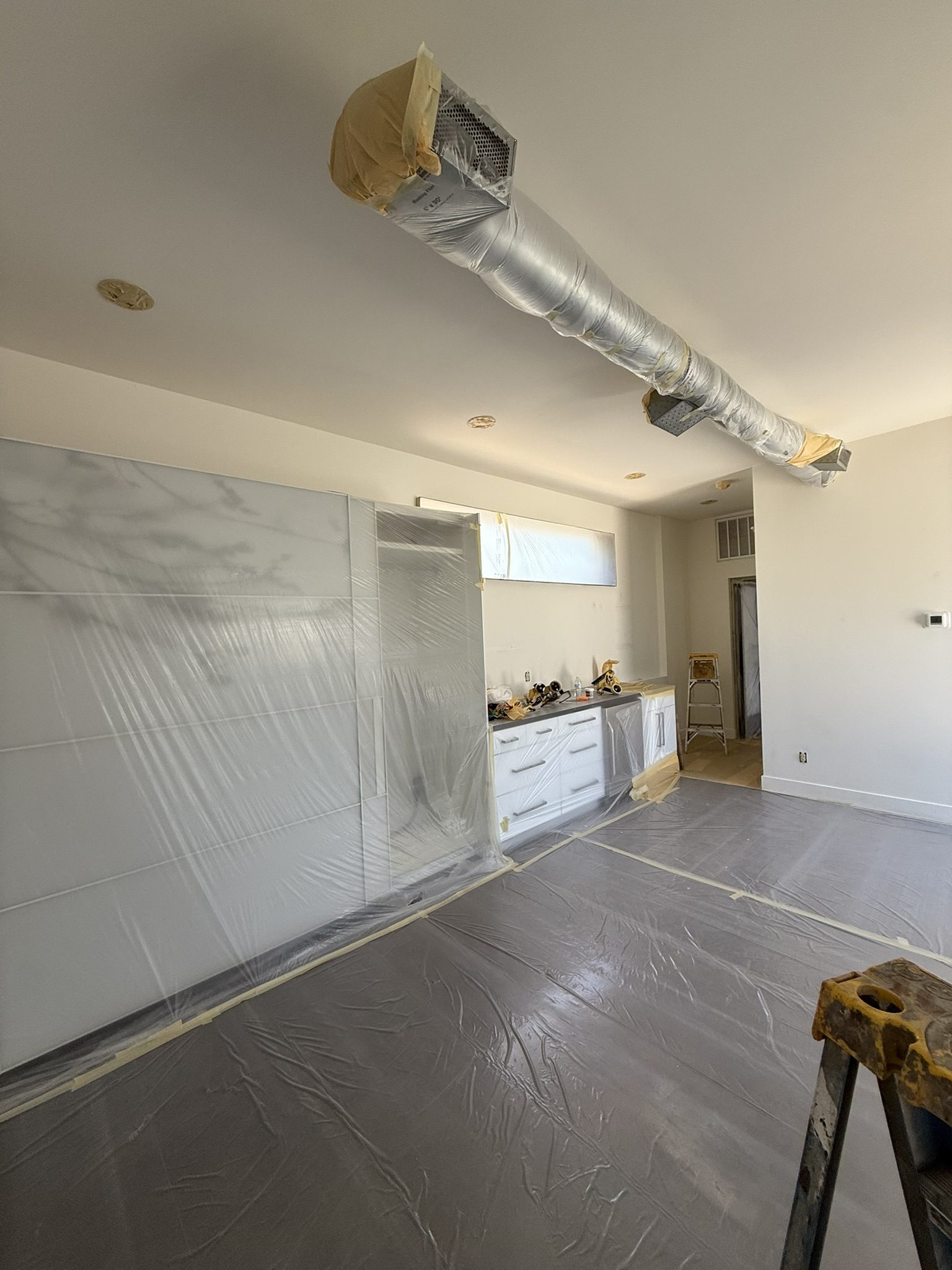
Cabinet and counter runs sheeted off on one of our repaints before wall work starts. Whichever side of the tape the cabinets are on, they get wrapped, because overspray does not care which line item it was quoted under.
One hard limit before you spend the money: silicone. Furniture polishes and dusting sprays containing silicone leave a contaminant that prevents good adhesion and produces chipping, peeling and flaking in the new finish. General Finishes puts it about as bluntly as a manufacturer can: "There are no guarantees with silicone. It is almost impossible to remove." If your cabinets have been polished with a silicone product for years, we'd rather tell you that at the walkthrough than after the first coat.
One more thing about that enamel: waterborne alkyd yellows slightly over time, and the manufacturer notes the effect is accelerated in dark or poorly ventilated areas and is more visible in lighter colors. On a bright white cabinet inside a closed pantry, that is a real consideration.
Trim, baseboards and doors on their own
Trim-only is a real scope and most people never think to ask for it. Baseboards, casing, interior doors and the inside of the garage door carry most of the visible wear in a house: vacuum scuffs, dog nails, twenty years of shoes. Repainting them without touching the walls makes a room read as freshly done for a fraction of a full repaint.
That is what the job in these photos was. Baseboards, casing and the inside face of the garage door through the living areas, one coat, bedrooms excluded, walls untouched, $600. The other half of that same central Phoenix job was outside, two rusted iron gates and a pair of entry lanterns, which we wrote up on its own in the gate and lantern refinish.
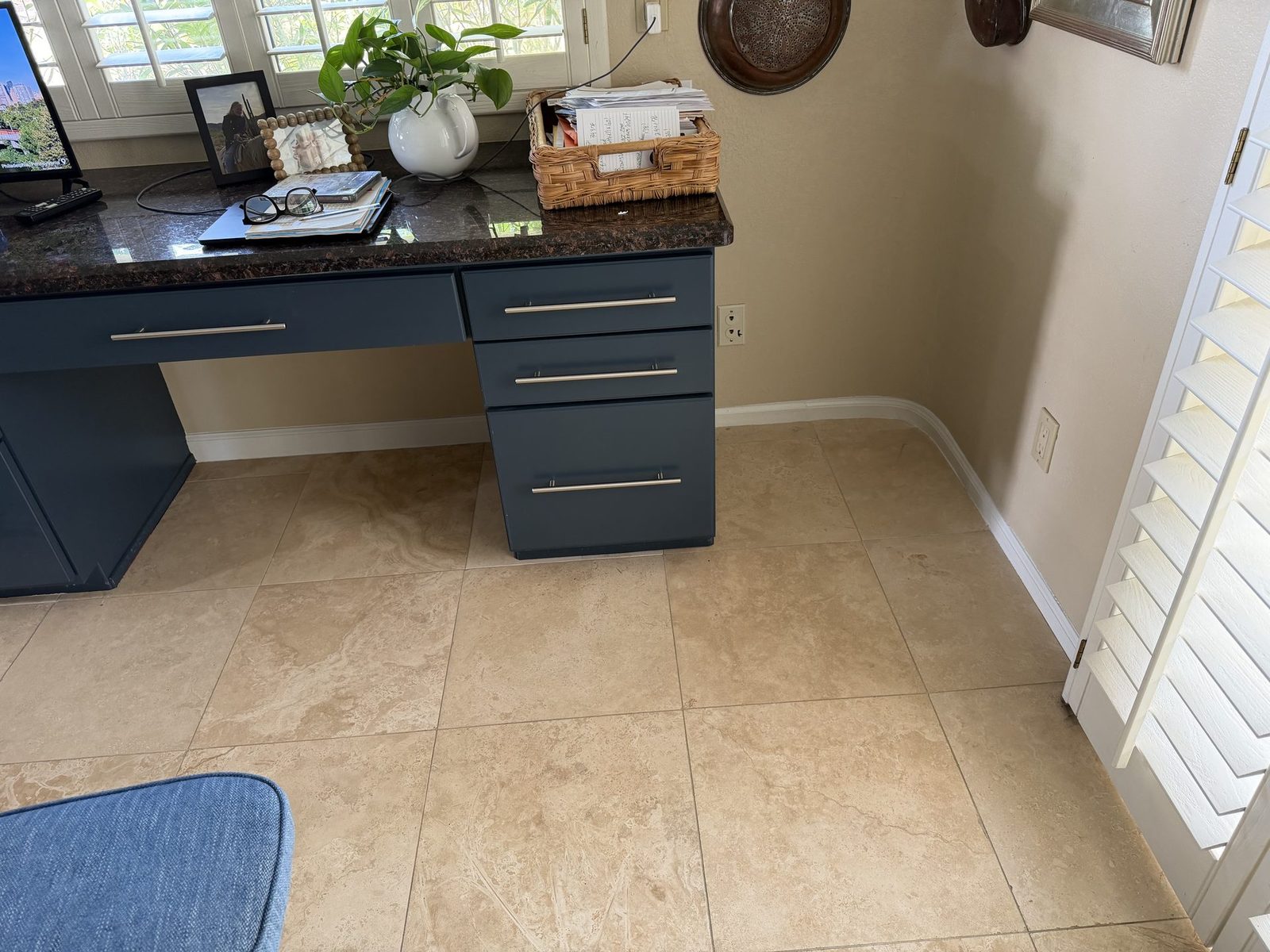
The same trim run carried through a home office, around a built-in desk that never moved. Trim-only scopes are why a room can be freshened without emptying it.
What interior painting costs in Phoenix in 2026
Start with the number that makes every other number on the internet comparable, because not one painting company in this market publishes it.
Interior painting in Phoenix is quoted per square foot of the home's floor area, not per square foot of wall. You can prove it from the published quotes: the local rate of $1.50 to $3.00 per square foot, applied to a 1,500 square foot house, gives exactly the $2,250 to $4,500 those same companies publish as the total, and applied to an 1,800 square foot house it gives exactly their $2,700 to $5,400. The rate is being multiplied by the listing square footage.
That matters because a room has roughly two and a half times more wall than floor. A 12 by 14 bedroom with nine foot ceilings has 168 square feet of floor and 468 square feet of gross wall, or about 420 square feet once a door and two windows come out. So "three dollars a square foot" can mean $504 or $1,260 for the same room depending on which square footage the bidder had in mind. Every price below names its basis in the same sentence, and we do the same on the quote.
Whole Interior, by Scope, Phoenix 2026
Priced per square foot of the home's floor area, which is the basis the Phoenix market quotes against. Two coats, normal prep, licensed and insured work. Drywall repair and cabinets are separate lines and are further down.
| Scope | Per sq ft of floor area | 1,500 sq ft home | 2,000 sq ft home |
|---|---|---|---|
| Walls only, two coats | $1.50-$3.00 | $2,250-$4,500 | $3,000-$6,000 |
| Walls, ceilings and trim | $3.25-$4.50 | $4,875-$6,750 | $6,500-$9,000 |
| Full interior: walls, ceilings, trim, doors, heavy prep | $4.50-$6.00 | $6,750-$9,000 | $9,000-$12,000 |
| Ceilings above 10 feet, or a two-story entry and stairwell | add $0.60-$1.05 | on the rooms affected | on the rooms affected |
A word on the wide published totals you will find elsewhere. One aggregator puts the Phoenix average interior job at about $2,000 while a local contractor publishes $6,000 to $12,000 for the same size house. Neither is wrong. The aggregator's average is full of partial jobs, a few rooms with the homeowner's own paint, and the contractor's number is a full interior with premium paint included. That is a scope difference wearing a price disagreement's clothes, which is why this chart is a ladder rather than a single figure.
By the Room and by the Piece
What the same work costs bought on its own, which is how most people actually buy it. These are Phoenix rates for two coats and normal prep, labor and application.
| What you are buying | Typical Phoenix price | What moves it |
|---|---|---|
| Bathroom or powder room, walls | $200-$500 | Almost all cut-in and very little roller. A vanity, a mirror and a toilet to work around is what the time goes into. |
| Bedroom, walls | $500-$900 | Ceiling height, how much furniture moves, and whether the color is changing. A refresh in the existing color covers in fewer coats. |
| Kitchen, walls only | $500-$900 | Cabinets take most of the wall away, so this is cut-in around uppers, backsplash and appliances. Cabinets are their own line below. |
| Living room or great room, walls | $1,000-$2,200 | Volume ceilings, a fireplace wall, and heavy furniture that has to be moved and covered rather than carried out. |
| Ceilings | $1.37-$2.95 per sq ft of ceiling | Height, texture, and the fact that a ceiling forces everything below it to be covered wall to wall before a roller comes out. |
| Baseboard, casing and interior doors | $2.30-$4.88 per linear foot | Coat count and condition. One coat over sound trim and a bare-wood repaint are different jobs at the same linear footage. |
| Kitchen cabinet painting | $50-$150 per linear foot of run | A 25 foot Phoenix kitchen lands between about $1,250 and $3,750. The bottom of that band is a spray-only job on sound, clean boxes. The top is stripping, full box work and doors sprayed flat off site. |
| Drywall patch and texture match before the paint | $250-$700 per repair | The size of the damage and who owns the paint. Our full chart by hole size is on the drywall repair page. |
One room always costs more than its share of a whole-house number, and it is worth knowing why before you feel overcharged. At the whole-house walls-only rate, a 132 square foot bedroom's share is roughly $200 to $400. Bought on its own that same bedroom is $500 to $900. The difference is not the paint. It is that the truck, the masking, the setup and the cleanup happen once whether we paint one room or nine.
Real Norem Interior Jobs, 2026
Not market averages. These are signed, deposit-paid or paid jobs out of our own book, with the scope that produced the number. On every one of them the customer bought the paint and we brought the primer, which is now the house split and the reason these read low against the market ranges above.
| The job | What we charged | The scope behind the number |
|---|---|---|
| Bathroom ceiling: drywall repair, then the whole ceiling repainted | $700 one day on site | Damage in the ceiling above the shower. Drywall repaired first, texture matched, then the entire ceiling repainted in the existing color rather than a patch that would have flashed. |
| Post-leak ceiling: repaired, primed and painted by us | $500 two days on site | Placeholder panels out, the opening closed continuous, texture matched, and both the primer and the finish coats ours. Two days because mud has to dry before it can be sanded. |
| Ceiling section repaired and textured, customer paints | $400 about 20 sq ft, two days | Bathroom ceiling roughly 4 by 5 feet cut out, new half-inch board, three-coat finish, texture blended. Customer primed and painted it themselves. |
| Interior partial repaint across five areas | $1,200 two days on site | A Scottsdale house: all casita ceilings except the bedroom, a bathroom and closet hallway wall primed and painted, both walls flanking the fireplace, an entry hall wall, and hallway ceiling and entryway touch-ups. |
| Baseboards, casing and the inside of the garage door | $600 living areas, one coat | The central Phoenix house in the photos on this page. Living areas only, bedrooms excluded, walls untouched. At the market rate of $2.30 to $4.88 per linear foot, $600 buys roughly 125 to 260 feet of trim, which is what a living-area run comes to. |
| Interior stair railings | $200 each railing | Three railings, roughly 3 by 7 feet each with 12 spindles apiece, two coats, masking included, customer's paint. Spindle count is the whole job on a railing. |
| Door casing replaced, caulked, filled and painted | $175 per opening, materials included | New casing at two openings, filled and caulked, then painted. This is the carpentry-plus-paint rate rather than a paint-only rate. |
| Painting an interior door during a door replacement | add $50 per door | On a prehung interior door swap, painting the new door and jamb is a $50 add per opening. Buying it as part of the door work is far cheaper than buying it as its own trip. |
The ceiling numbers are a ladder, and the rung is who owns the paint: $400 when you prime and paint it, $500 when we prime and paint the repair, $700 when we repaint the whole ceiling to match. That is worth asking for by name, because on a ceiling repair a patch painted alone will flash against the rest of the ceiling and the full repaint is often the cheaper-looking mistake to avoid. Send us photos of the rooms and we will come back with your number, free.
How long an interior repaint takes
Days, not weeks. Our five-area partial repaint was two days on site. The bathroom ceiling with a drywall repair under it was one. A whole-house repaint runs longer and it runs room by room, so you keep a kitchen and a bed the whole time.
Two things stretch a schedule and neither of them is the painting. The first is mud: on anything past a small patch, drying time sets the calendar no matter how fast anyone works, which is why a physically small ceiling repair is a two day job and why customers who price it as a one hour job are surprised. The second is enamel: trim and cabinets want sixteen hours between coats, so a trim scope reaches across two days even when the walls did not.
Do you need a licensed contractor to paint the inside of a house?
For one small room, no. Arizona's handyman exemption, A.R.S. §32-1121, caps unlicensed work at $1,000 per job including materials, and a single bedroom fits inside that. A whole interior does not, and neither does painting plus the drywall repair that usually comes with it. Splitting a larger job into sub-$1,000 phases to stay under the cap is not allowed either.
Two things follow from that when you are comparing bids. A crew working under the exemption cannot legally take the whole job and has no bond behind it if the work goes wrong. And a painting-only licensee, holding R-34, is licensed for surface preparation and coatings. Arizona lets a specialty contractor take work in other trades where it is incidental and supplemental to the craft they hold, so a filled nail hole is fine, but a wall that needs corner bead or a section of new board is past that line. It is a real limit the moment your wall needs more than paint. We hold the Arizona Class B General Residential Contractor license, ROC #365090, licensed, bonded and insured, and we carry the contract for your job. Ask us for the number and look it up on the ROC site. It takes a minute and we'd rather you did.
One oddity, and it costs nothing to check. Painting and Wall Covering in Arizona is classification 34, in its R, C and CR forms. Classification 24 is Ornamental Metals. If a painting company's website shows you a 24, either they made a typo they have never caught or they are advertising a license that does not cover what they are selling you. Look at the number, not the badge.
Permits: repainting existing interior surfaces is a finish application and does not pull one anywhere in the Valley. That changes only if the work grows into structural repair or something that moves a wall.
What else to fold in while the furniture is already moved
On an interior job you are mostly paying for the setup. Furniture off the walls, floors covered, plates and vent covers off, and a licensed crew inside the house for a run of days. Anything else that needs those same conditions runs 25 to 50 percent cheaper folded into this job than it does as a separate visit later, as long as it is on the quote before day one and not added halfway through day two.
The natural additions are the ones that touch the same surfaces. Every nail pop, corner crack and old anchor hole gets patched and texture matched while the walls are already prepped, and a water stain gets its stain blocker in the same pass. If one wall is going to be a troweled plaster finish, the room only has to be masked once. Fresh paint makes yellowed switch plates and dated fixtures impossible to unsee, so plenty of customers have us swap the switches, outlets and plates and hang new fixtures or a ceiling fan before the covers go back on. Interior doors are the cheapest add on this list, because painting a new door is $50 on top of the door work rather than its own visit. If new flooring is in the plan, say so at the walkthrough: which trade goes first changes the masking and the baseboard work, and it is a five minute conversation that saves a day. And if the garage is on the list, the walls and the floor coating want to happen in the same emptied-out week.
Whatever ends up on the list, put it in one scope and ask for the combined number before you greenlight the first item.
Hiring questions homeowners ask us
Is your price per square foot of my house or per square foot of wall?
Of the house. Every per square foot number on this page is quoted against the floor area of the home, which is how the Phoenix market quotes interior work, and we say so on the quote. It matters because a room has roughly two and a half times more wall than floor. A 12 by 14 bedroom with nine foot ceilings has 168 square feet of floor and about 420 square feet of paintable wall once a door and two windows come out. Ask every bidder which number they used. Two bids that both say three dollars a foot can be two and a half times apart.
Do we have to move out while you paint the inside of the house?
No. We work room by room so the house stays livable, and we put the rooms you use most at the front or the back of the schedule depending on what suits you. We move and cover furniture rather than asking you to empty a room, and everything comes back off the floor at the end of the day. Bedrooms are the one thing worth planning around, because a room painted in the afternoon is better slept in the next night.
Do you supply the paint, or do I?
Either way works, and on most of our recent interior jobs the customer bought the paint and we brought the primer. Buying it yourself gives you the receipts and any leftover cans for touch-ups later. If we supply it, that is a line on the quote. Before the first drop cloth goes down we bring a paint chart and confirm every color and sheen with you, so nobody finds out at the end of the day that the trim went on satin instead of semi-gloss.
What should I ask the other contractors bidding my interior?
Four questions, and a real painter answers all of them without pausing. Which square footage is your rate quoted against, the house or the wall? How many gallons for my job, and at what spread rate? Are the patches getting spot primed before the finish coats? And who fixes the drywall if the wall turns out to need it? The answers separate the bids faster than the prices do.
Do you patch the drywall first, or do I need a separate contractor for that?
We do it, on the same contract, and it is the part of this page worth reading twice. Arizona writes the painting license, R-34, as surface preparation to install, apply and repair paint and wall coverings. A specialty licensee can take work in another trade only where it is incidental and supplemental to the craft they hold, which is the test in A.R.S. §32-1105, and a wall that needs corner bead or a section of new board is past incidental. The B General Residential Contractor license we hold is written as construct and repair all or any part of a residential structure, so there is no incidental test to argue about. Patching, corner bead, texture matching, stain blocking and the finish coats are one scope with one crew and one number, and nobody is standing in your hallway explaining that the wall is somebody else's problem.
Can you match a color that is already on the walls?
Yes, and it is the usual ask on a repair. On a Phoenix bathroom ceiling this summer the whole ceiling went back in the existing color rather than a new one. If you still have the can or the paint code from the last time, that is the fastest and closest route. If you do not, we take a chip from somewhere it will not be missed, behind a switch plate or inside a closet, and have it scanned and matched at the paint counter. A scan gets close, and on a wall that has had years of sun on it a scan of the faded surface is closer than the original formula would be.
My house was built before 1978. Does that change anything?
It changes who is legally allowed to sand it. The federal Renovation, Repair and Painting rule covers anyone paid to disturb paint in housing built before 1978, and the exemption stops at six square feet of paint per room inside. That is one modest patch. The EPA is explicit that this applies to all firms, even sole proprietorships, and that window replacement and demolition of painted surfaces are always covered regardless of square footage. Popcorn ceilings from that same era are an asbestos question before they are a paint question. The 160 square foot figure people repeat is a federal notification threshold, and it mostly does not reach a single family house, because that rule carves out residential buildings of four dwelling units or fewer. That is a paperwork exemption and not a safety one, so the order stays the same. We test, or we leave it alone. We do not scrape first and ask later.
Do you charge for the estimate, and can you quote from photos?
No charge. Send photos of each room, tell us the ceiling height and whether the color is changing, and we can usually get you a range the same day. We confirm it on a walkthrough, because the two things that move an interior price most are the condition of the drywall and how much furniture has to be worked around, and neither of those reads reliably in a photo.
When can we hang pictures and wash the walls again?
Sooner than the paint is actually cured, which is the part nobody mentions. Wall paint is dry to the touch in about an hour and takes its second coat at four, and Benjamin Moore's own guidance is to wipe a spill after four to six hours but wait about two weeks before you dust or clean a newly painted wall. Trim and cabinet enamel is slower on purpose: sixteen hours between coats, five to seven days before shelves and tabletops go back into service, and up to thirty days to reach full hardness and final sheen. Furniture and pictures can go back the same day. The scrubbing is what waits.
Interior painting across the Phoenix metro
We paint home interiors in Phoenix, Scottsdale, Tempe, Mesa, Chandler, Gilbert, Glendale and Peoria. Painting is one of the trades we run. Here is the rest of what we do.
Related: exterior house painting · interior plaster finishes · drywall repair & texture matching · epoxy & garage floor coatings · punch list & touch-up work · see our completed work

Written by Harrison Norem. Licensed Class B General Contractor, AZ ROC #365090. About Harrison
Get a Firm Interior Painting Price
Send photos of the rooms, tell us the ceiling height and what you want painted, and we will come back with a clear number quoted against a square footage we name. Free estimate from a licensed Arizona contractor, ROC #365090.
Request Free Estimate