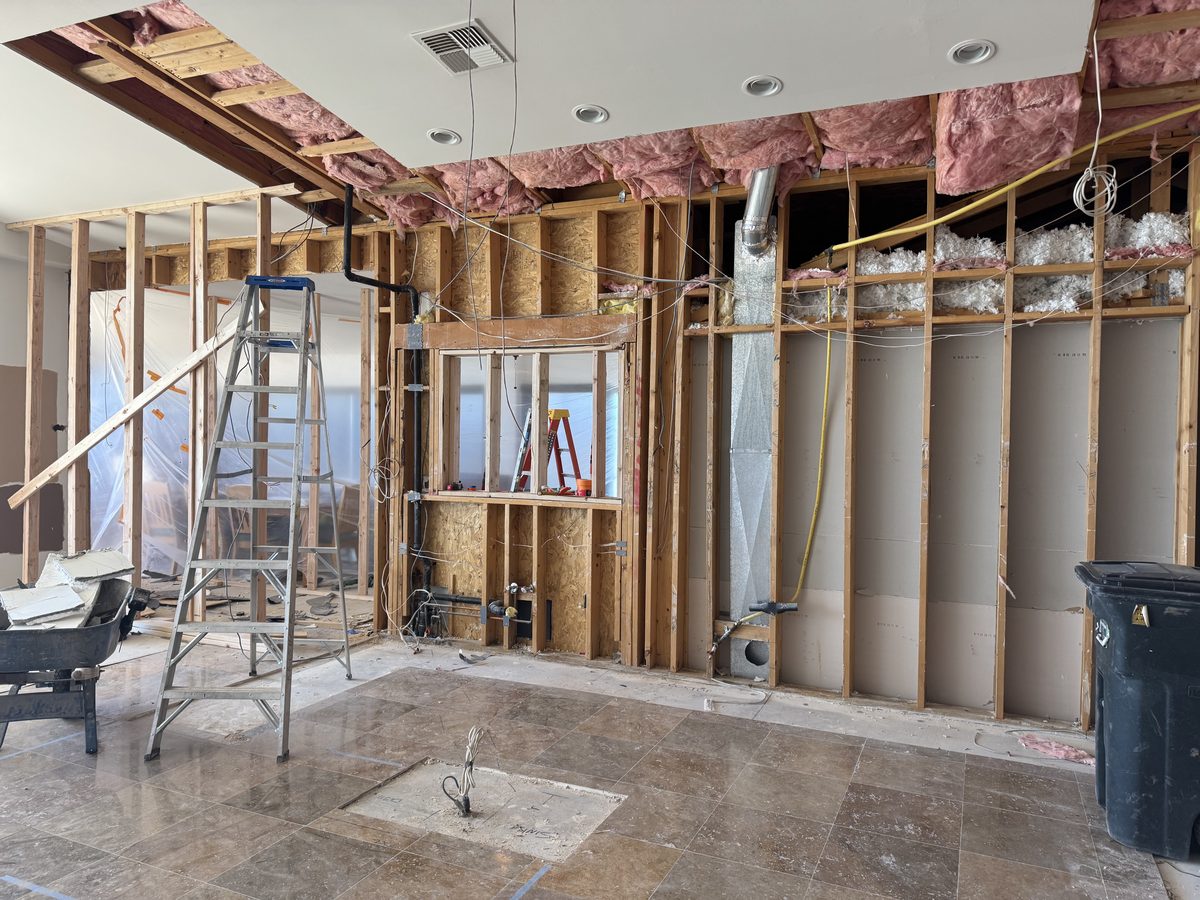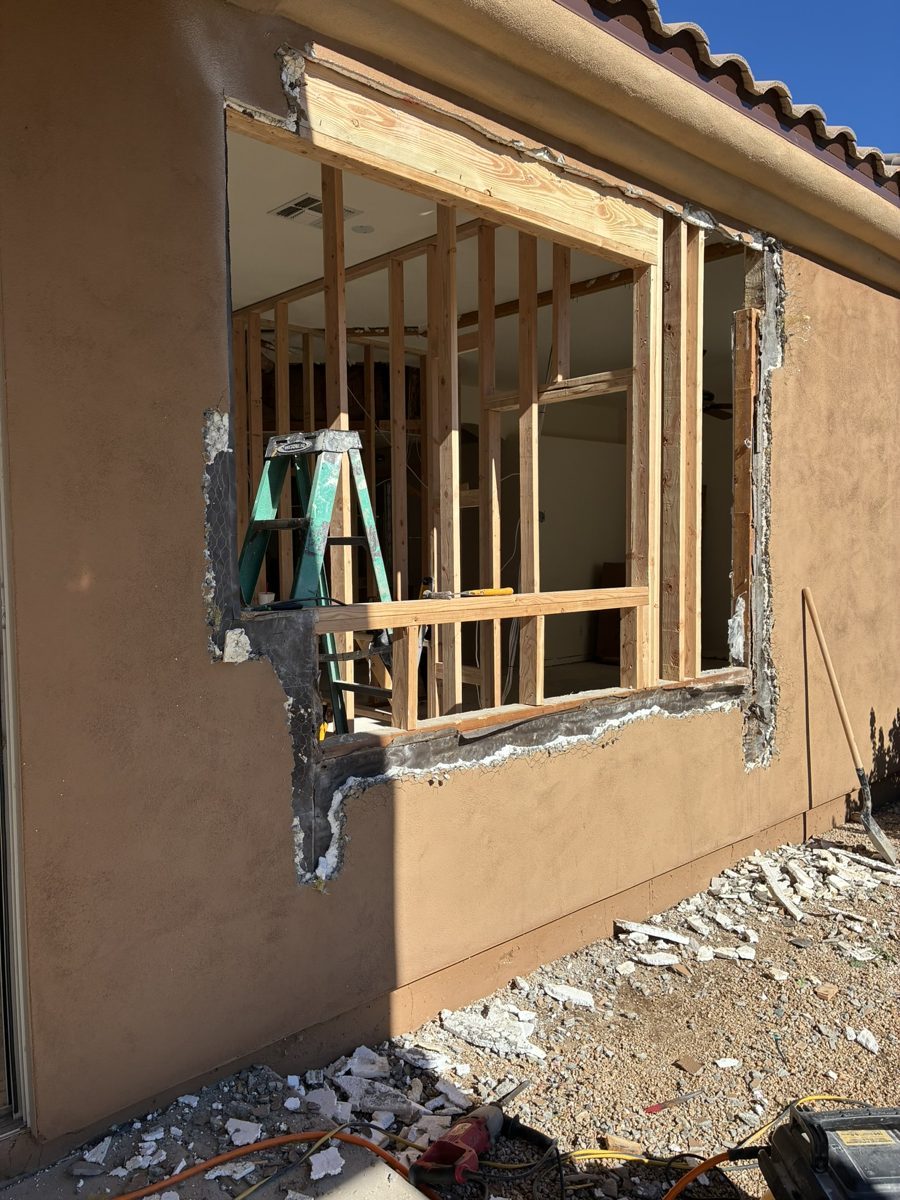
Any time a window or door is added, moved or closed off on a stucco house, the new stucco has to tie into the old. What keeps the water out isn't the stucco. It's the building paper behind it. That goes for any wood-framed stucco home in Phoenix, built in the '70s or last year: tear that paper, or lap it the wrong way, and the wall will leak. We cut the stucco back to sound old paper all the way around the opening, lap new paper into it like shingles, overlap the lath, and only then put stucco back on.
The framing half of the job is on our framing, new openings and headers page.
What's Behind the Stucco on a Phoenix House?
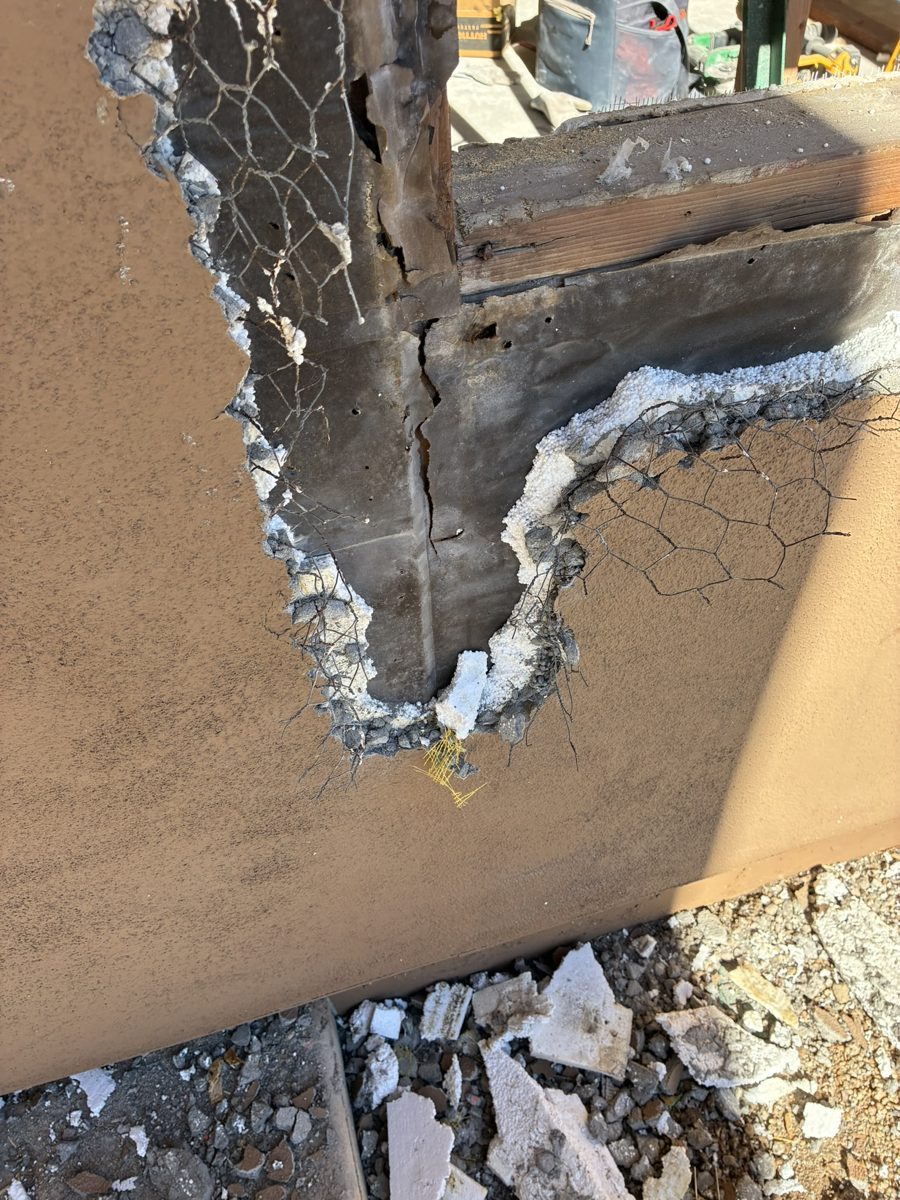
Most newer frame homes in Phoenix are built in layers. Working from the outside in: the stucco finish, wire lath, foam board, building paper, then plywood or OSB sheathing over the framing. Some homes don't have sheathing at all. On those, line wire is stretched tight across the studs and the paper goes on over it, so the wire backs the paper and keeps the stucco from pushing it into the stud bays.
Stucco is a hard shell, and it cracks. The foam adds insulation and gives the stucco something flat to go on, but it doesn't stop water. That's the building paper's job: water that gets through a crack runs down the face of the paper and out the bottom of the wall. As long as the paper is in one piece, the framing stays dry. Together these layers are the house's building envelope, and a new opening cuts a hole in it.
Phoenix builds to the 2024 International Residential Code, and section R703.7.3.1 gives dry climates like ours two ways to back stucco: two separate layers of 10-minute Grade D paper, or one layer of 60-minute Grade D paper with foam or a drainage space between it and the stucco. Many newer Valley houses are built the second way, with foam board over a single 60-minute paper. Either way, a patch repeats the layers already there, each lapped into the old.
Why Does New Stucco Around a Window Leak When the Old Wall Never Did?
Because the old wall's paper runs unbroken down to the weep screed, and a patch's paper often doesn't. Section R703.1.1 of the code calls for a water-resistive barrier behind the cladding and a way for water that gets past the stucco to drain outside. On stucco, that drain is the weep screed along the bottom of the wall, with the paper lapped over its flange. Reverse one lap at the head of a new window and the water running down from above gets steered behind the paper, straight onto the header and the framing.
How Is Old Stucco Cut Back Without Tearing the Paper?
Before new paper goes on, intact old paper has to show all the way around the opening: at least 2 inches above and below and 6 inches at the sides, the same laps the code sets for a new wall. Swing a hammer or run a saw too deep and the old paper tears, and then there's nothing to tie into. So we score a line with the blade set just shy of the full depth of the stucco, chip the stucco back by hand a few inches past where the lath will be cut, snip the lath, then pull the lath and foam away gently so the paper stays put. That leaves a band of clean old lath for the new lath to overlap.
Old paper can be brittle or already cracked, and lapping onto a torn edge only moves the leak a few inches. On the job in these photos, we chipped one side back further than planned to reach paper sound enough to lap.
How Does the New Paper Tie Into the Old?
Think of shingles on a roof. The new paper slides up under the old paper above it and laps over the paper below it, so water always runs out and never gets behind. Section R703.2 sets the minimums for a new wall: paper runs horizontally, "with the upper layer lapped over the lower layer not less than 2 inches," and laps at least 6 inches at joints. A patch holds the same laps against paper that's already on the wall.
The hard part is the head of the opening. Where the old paper won't lift without tearing, a horizontal slit lets the new paper slide in behind it, and the slit gets taped. On a two-layer wall, each new layer slides behind its matching old one, and both layers lap down over the head flashing. Only the side and sill flashing drain between the two layers. On a foam wall with one 60-minute paper, such as Super Jumbo Tex 60 Minute, the flashing goes to the paper's outside face.
What Happens When the Tie-In Is Done the Cheap Way?
The fast way is to butt the new paper against the old, caulk the seam and stucco over it. It looks fine on day one. Then water finds the seam, runs behind the paper and sits on the framing, and a few monsoons later the sill plate is rotted. By then the repair costs far more than doing it right would have. Caulk belongs in the joint between the stucco and the window frame, never in place of a lap.
How Is a New Window Flashed in a Stucco Wall?
Flashing carries water around the window and back onto the paper. Section R703.4 requires overlapped flashing "applied in shingle fashion," any self-adhered flashing tape to meet AAMA 711, and window flashing done to the window or flashing maker's instructions. The order runs bottom to top:
- Sill first. Tape or a formed sill pan wraps the rough sill and turns up the sides, so anything that gets past the window drains out.
- The window. Set level and square, fastened through its nailing fin per the manufacturer.
- Sides, then head. Flashing over the side fins, then over the top fin, each piece lapping the one below. The bottom fin stays untaped so the sill can drain.
- Paper from above. The building paper above the window comes down over the head flashing, never behind it.
- Inside. Air sealing in the gap between the window and the framing, which R703.4.1 requires.
Then the lath and stucco go on, stopped at the frame with a casing bead that leaves room for a sealant joint.

Why Does the New Lath Have to Overlap the Old?
Because stucco cracks where the lath stops. The new lath overlaps the old before any stucco goes on, which keeps the patch from cracking along the seam, a weak line known as a cold joint.
The lath is nailed or stapled no more than 7 inches apart along the framing, per R703.7.1. Traditional cement plaster over lath takes at least three coats under R703.7.2: scratch, brown and finish. Many Phoenix homes built over foam use a one-coat system instead, approved through its maker's ICC-ES evaluation report. The patch follows whichever system the wall already has, so it cures and weathers the same way.
Is Closing Off, Adding or Enlarging a Window a Different Job?
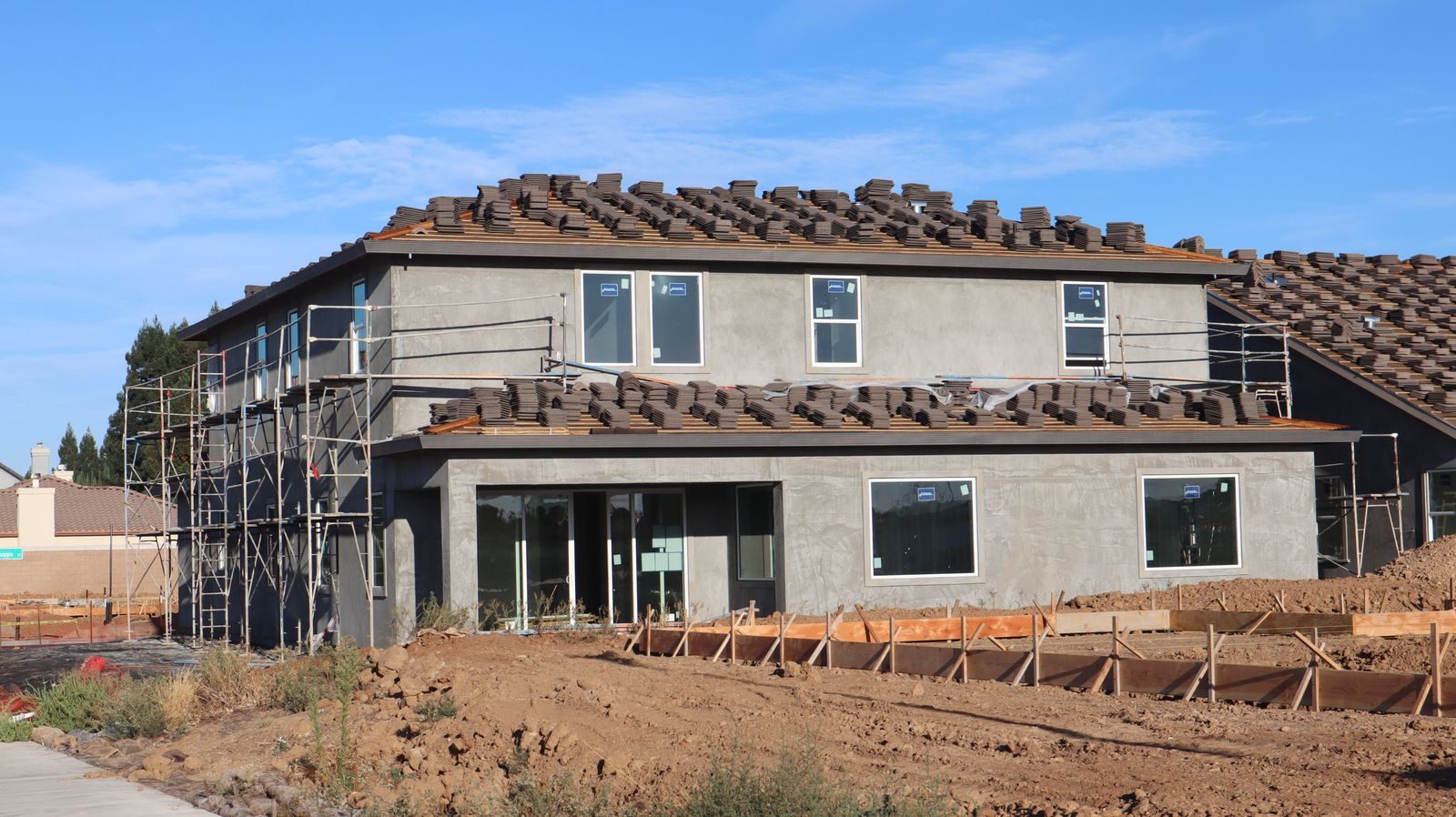
The tie-in is the same. What changes is what happens inside the opening.
- Adding a window. A frame wall needs a header sized for what it carries. Our guide to telling whether a wall is load-bearing covers the checks.
- Closing off a window. The opening is framed in at the wall's stud spacing, sheathed or line-wired to match the old wall, insulated, and papered into the old on all four sides. On a foam wall, new foam of the same thickness goes on next so the patch finishes flush. Inside, our drywall repair work patches and textures the wall.
- Moving a window. Both jobs at once: one opening closed, one cut, two tie-ins.
- Enlarging a window into a door. The cut runs to the slab, so the weep screed and the bottom of the wall are reworked too. See turning a window into a patio door.
- Block walls. Stucco on block usually has no paper behind it, and the opening needs saw cutting and a lintel. See what a new opening costs in a block wall.
Will the Stucco Patch Match the Rest of the Wall?
The texture can be matched. The color almost never matches on its own. We can copy a sand finish, lace or dash by hand, but the wall around the patch has faded in the Arizona sun for years, and a fresh color coat comes out brighter.
So the finish is planned to a natural break: a color coat or paint carried corner to corner, or to a control joint or downspout the eye reads as an edge. On a painted house that usually means one full side.
How Much Does It Cost to Add or Close Off a Window in a Stucco Wall in Phoenix?
Cutting a new window opening in a frame wall and framing its header, with the stucco and drywall patched, runs $1,500 to $3,000 in the Phoenix metro before the window, and $3,000 to $6,500 in a block wall. A stucco tie-in around a replaced window runs about $500 to $900, and closing off a window, inside and out, lands around $1,500 to $3,000.
| Work | 2026 range | What moves it |
|---|---|---|
| New window opening in a frame wall, stucco and drywall patched | $1,500 to $3,000 per opening, window extra | Header size, a bearing wall, and how far back the sound paper is. |
| New window opening in a concrete block wall | $3,000 to $6,500 per opening, window extra | Saw cutting, the lintel and the stucco face. |
| Closing off a window, stucco outside and drywall inside | $1,500 to $3,000 per opening | Opening size and texture matching on both faces. |
| Stucco tie-in around a replaced window, same opening | $500 to $900 per window | Patch size up to about 10 sq ft, and matching the texture. |
| Enlarging an existing window in a frame wall | $1,500 to $3,000 per opening, window extra | How much bigger, and whether the header changes. |
| Color coat or paint over the patched area | $200 to $800 | Where the finish stops. A full side of the house costs more. |
| Structural engineer review | $350 to $800 | A bearing wall or a wide opening. |
Labor and materials, 2026. The new-opening and enlarging rows are Phoenix metro rates. The other rows are national averages.
A good quote says how far the stucco comes back, what happens if the old paper is brittle, and whether the color coat is included.
Adding or Closing Off a Window or Door?
Send us a photo of the wall and we'll tell you what the tie-in will take. Free estimate, licensed Arizona contractor, ROC #365090.
Free EstimateHow Many Visits Does It Take, and Does Monsoon Season Change It?
A single opening takes several visits: framing, the window, paper and lath in a day or two, then the stucco coats with cure time between them, and the color coat last. In summer heat we stucco early, work a west wall while it's still in shade, and keep the new coats damp. During monsoon season, June 15 through September 30, we don't leave an opening exposed overnight. By the end of the first day it has the window and flashing in, or it's sheathed over and wrapped.
Questions Phoenix Homeowners Ask About Stucco Around Windows
Can you stucco straight over an old window opening?
No. Stucco needs backing and building paper behind it. The opening is framed, sheathed, insulated and papered into the old wall first, with new foam where the wall has foam. Stucco bridged over a hole or an old window frame cracks along the outline and lets water into the wall.
Will the stucco patch crack?
Hairline cracks show up in almost all stucco. The one to worry about is a straight crack outlining the patch, which usually means the new lath wasn't lapped over the old. Using the wall's own stucco system and giving each coat its cure time also keeps the edges from showing.
How can you tell water is getting behind the stucco around a window?
Outside: stains or white, powdery efflorescence below the window corners, bubbling paint, or a crack tracing the window's outline. Inside: swollen baseboard, soft or stained drywall under the window, or a musty smell. Around a replaced or patched window, those signs point at the tie-in.
What if the old building paper is torn for a long way?
The stucco comes back further until it reaches sound paper, because new paper lapped onto a torn edge stops nothing. That can make the patch bigger on one side, as it did on the job in these photos.
What Else Makes Sense While the Wall Is Open?
Once the wall is open and our crew is set up to stucco and paint it, more work on that wall is cheaper to add. Put it on the original quote and it typically costs 25 to 50 percent less than a separate trip.
- Repaint that side of the house. The patch needs a finish anyway, and carrying it across the wall through our exterior painting work hides it.
- Sun screens on the new window. A west- or south-facing window takes a lot of Phoenix sun. See sun screen and window tint installation.
- A light by the new opening. With the wall open, running wire to an exterior fixture is simpler now than later. See light fixture installation.
- A patio door instead. If the window looks onto the patio, taking it to the floor now saves a second tie-in later. See patio door installation.

Written by Harrison Norem, owner of Norem Contracting and a licensed Class B general contractor, Arizona ROC #365090. Fifteen years in the trades, including framing, new window and door openings and stucco repair in the Phoenix metro. More about Harrison.