Kitchen cabinet refacing in Phoenix keeps your cabinet boxes and replaces everything you see and touch: doors, drawer fronts, hinges, slides, hardware, and a new skin on the face frames and exposed ends. A typical 10 by 10 kitchen in the Valley runs about $6,000 to $12,000 refaced, roughly $3,500 to $7,000 repainted, and $2,500 to $9,500 for new stock or semi-custom boxes before the countertops and everything else a replacement drags along. Refacing is the right call when the boxes are sound and the layout already works. It's the wrong call when either of those isn't true, and telling the difference is what the rest of this comes down to.
A company that only sells refacing will find a refacing job in every kitchen it looks at. We do the reface, the repaint, and the full replacement, which means we can tell you when refacing is a waste of your money. Norem Contracting is a licensed Class B general contractor, Arizona ROC #365090, and this is the same walkthrough we run in your kitchen.
What Does Kitchen Cabinet Refacing Include?
Refacing is not painting, and it is not new cabinets. It keeps the carcasses fixed to your wall and floor and rebuilds the surface and the mechanics. Most people arrive thinking refacing is a paint job with a markup. It's finish carpentry, and the price makes sense once you see what's in it.
A complete reface includes new doors and drawer fronts, new drawer boxes where the old ones are stapled particleboard, thin wood-veneer or laminate skins over the exposed cabinet ends and any exposed backs, a sixteenth of an inch or less so the door reveals don't change, pre-finished veneer from the same door manufacturer over the face frames between the doors, new concealed soft-close hinges, new undermount soft-close drawer slides, new knobs and pulls, a re-skinned toe kick, and new crown, light rail, and filler strips. The interior of the boxes stays. The layout stays. The plumbing, the soffit, and the countertop stay exactly where they are.
What refacing does not touch
Refacing does not move a single box. It does not change the countertop, the sink, the backsplash, or the soffit above the uppers. It does not fix a bad layout, and it does not make a 1980s kitchen with a fridge blocking the walkway into a kitchen where the fridge is somewhere better. If you want the doors gone and the soffit gone, the soffit comes out first and changes the reface, because you now need taller uppers or a stacked design. We covered that job in removing the soffit above your cabinets. Decide it before the doors are ordered.
Veneer, thermofoil, or solid wood doors: what each one is
The doors are where the reface budget goes and where the look comes from. Painted MDF doors are a dense engineered panel with a factory-sprayed finish, and they hold paint better than solid wood in a dry climate. Wood veneer doors put real wood grain over a stable engineered core, and pre-finished veneer from the same door manufacturer, in the same finish run, goes on the face frames so the doors and frames match. Site-stained veneer over a face frame almost never matches a factory-finished door, which is a point most refacing quotes skip. Solid wood doors are the traditional choice and the one that moves the most in Phoenix air. Thermofoil doors are a vinyl film heat-pressed over MDF, the cheapest option, and the one with an Arizona-specific way of failing that gets its own section below.
Reface, Repaint, or Replace: Which One Is Your Kitchen?
Repaint if the doors are solid, the style is fine, and only the color is wrong. Reface if the boxes are sound and the layout works but the doors are dated, damaged, or the wrong style. Replace if the layout is wrong, if enough boxes need structural repair that the repair labor plus new fronts gets close to the price of new stock boxes, or if you want drawers where you have doors. That's the whole decision. The detail behind each branch is below.
Repaint
Same doors, same boxes, new color and sheen. Done right it's a full disassembly, degrease, bonding primer, and sprayed enamel with the doors sprayed off site.
- Solid wood or sound MDF doors
- You like the door style
- Budget is the constraint
- A bridge to a later remodel
Reface
Same boxes, new doors, drawer fronts, veneer, hinges, slides, and hardware. A different kitchen on the same skeleton.
- Boxes plywood or sound particleboard
- Layout already works
- Doors are thermofoil, warped, or a style you hate
- You want soft-close everything
Replace
New boxes, which means a new counter, usually a new backsplash, and often plumbing and electrical moves. The only path that changes the layout.
- The layout is the problem
- Swollen sink base plus other bad boxes
- Racked boxes that lost square
- You want a bigger fridge, a pantry, an island
The three options side by side
| Option | What changes | Cost, relative | Days on site / calendar span |
|---|---|---|---|
| Repaint | Color and sheen only. Door style, boxes, layout, counter all stay. | Lowest of the four | 3 to 5 days on site; 1 to 2 weeks while doors cure off site |
| Reface | Doors, drawer fronts, veneer, hinges, slides, hardware, crown, toe kick. Boxes, layout, counter stay. | Roughly half of a stock replacement once the counter and extras are counted | 3 to 5 days on site; 3 to 6 weeks including door lead time |
| Replace, stock boxes | Everything, including the counter and usually the backsplash. Layout can change. | Cabinets alone can undercut a reface; the counter, backsplash, plumbing, and patching are what push it past | 3 to 5 days for cabinets; 2 to 4 weeks plus counter template and fabrication |
| Replace, semi-custom | Everything, with sizes and finishes made to the kitchen. | Highest, cabinets plus the same extras; figures in the cost section below | 4 to 7 days for cabinets; 8 to 14 weeks including cabinet and counter lead times |
Phoenix market ranges for 2026. A 10 by 10 kitchen is the industry benchmark, about 20 feet of base cabinets and 20 feet of uppers, and a lot of Valley kitchens are bigger than that. The replacement rows are cabinets only; the extras they drag along are what make an honest comparison, and they come up again in the cost section.
When repainting is the honest answer
If you have solid wood doors in a style you can live with and the only complaint is the color, repainting is the right money. The catch is the word "proper." A proper cabinet repaint takes every door and drawer front off and labels them, degreases everything because a Phoenix kitchen carries a cooking-oil film no primer bonds through, scuff sands to dull, fills and caulks, uses a bonding primer and a stain-blocker on oak so the tannins don't bleed through white in a month, and sprays two coats of a cabinet enamel with the doors laid flat in a shop. A brushed latex job with the doors on is the thing people regret, and it's why "painted cabinets" has a bad name.
Two honest limits. Painted oak still looks like oak unless the grain gets filled, and filling grain on thirty doors gets close to refacing money. And paint changes color, not shape. A cathedral-arch raised-panel door in white is still a cathedral-arch raised-panel door.
When refacing wins
Refacing wins when the doors are the failure and the boxes aren't. Thermofoil that's peeling, oak you want gone grain and all, a door style that dates the room, hinges that have chewed the door stiles, and drawers on 1985 epoxy slides. A reface replaces all of the mechanics along with the look, which a repaint never does.
When replacing is the smarter buy
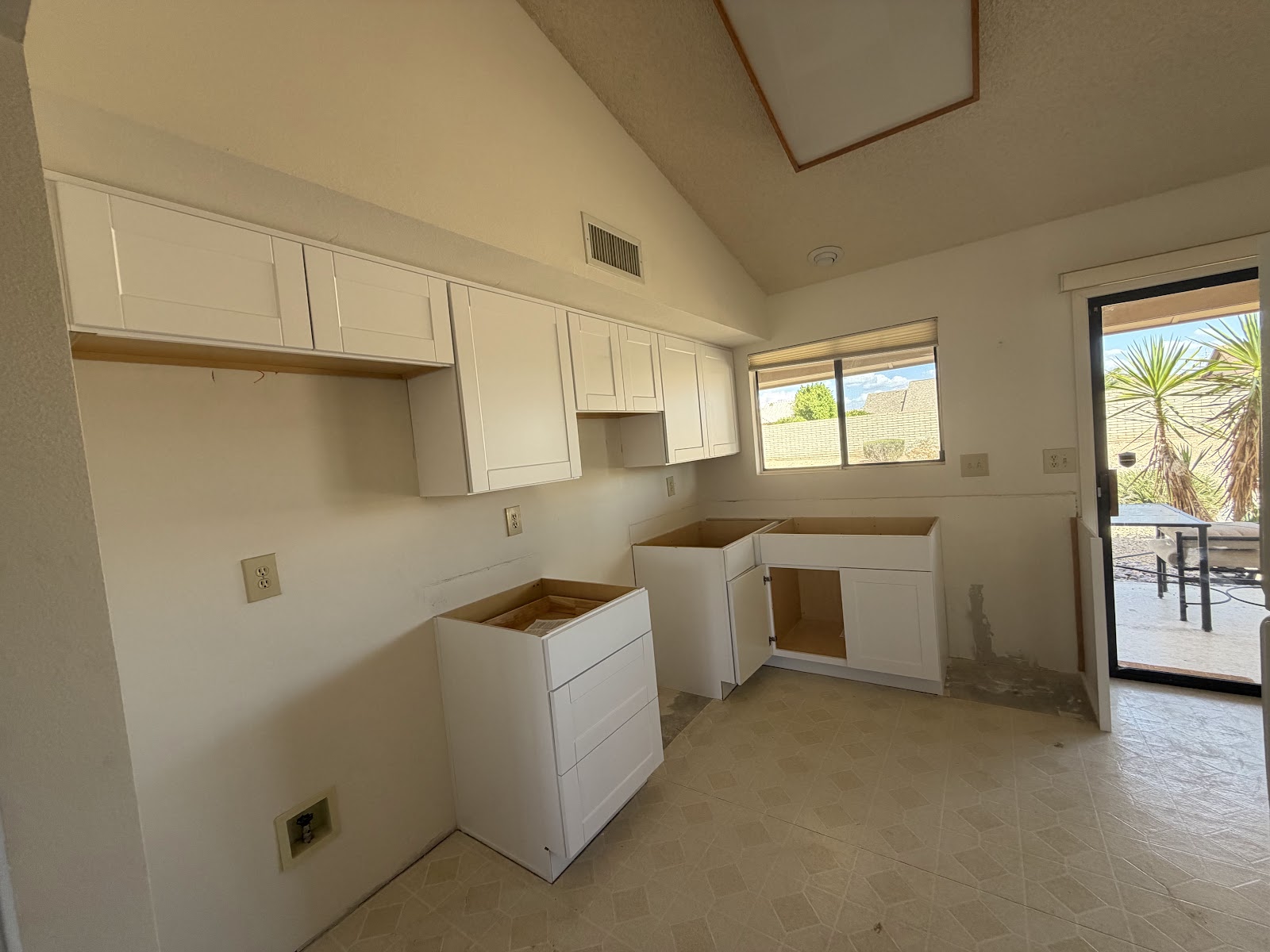
Replace when the layout is wrong, full stop. Refacing spends nine thousand dollars preserving a problem. Replace when the sink base is swollen and so are two others, when boxes have lost square because the bottoms are failing, when you want a pantry, an island, or drawers instead of doors, or when the fridge opening has to grow. On the Sun City West job where we hung a run of new white Shaker cabinets, the owner had priced a reface and a replace, and the replace won because assembled stock boxes cost less than new doors plus veneer plus hardware on forty-year-old oak.
Are Your Cabinet Boxes Worth Keeping?
Open a door and look at the raw edge of the side panel. Layered plies mean plywood, and plywood boxes are worth refacing almost every time. Compressed brown chip means particleboard, which is a judgment call, not an automatic no. Then check the sink base, because that's where the water has been. Those two checks decide most kitchens in five minutes. The full walkthrough we run on site is below.
| Check | What you're looking for | What it means |
|---|---|---|
| Box material | The raw edge of a side panel inside a door. Plies or chip? | Plywood: reface. Particleboard: fine if dry and square, watch the next rows. |
| Sink base floor | Swelling, a spongy floor, dark stains, a lifted toe kick, a bulged side at the bottom | Swollen particleboard never dries flat. One bad sink base can be replaced as a single box. Several swollen boxes tip the job toward replacement. |
| Square | Doors that never stayed aligned, diagonal gaps, a box that rocks when pushed | Minor racking is fixed with shims and refastening. A box out of square because its bottom is failing is not. |
| Face frames | Solid hardwood frame, tight joints, stripped hinge-screw holes | The frame is the thing you're paying to keep. Stripped holes are plugged and re-bored; that's routine. |
| Fastened to studs | Push hard on an upper. Any movement | It was hung into drywall or the screws pulled. Fixed before any veneer goes on, every time. |
| Interior | Delaminating melamine, sagging shelves, a mildew smell | Cosmetic. Shelves sag because they're undersized, not because the box is done. |
| Layout | Do you like where things are? | The one that matters most. Refacing freezes the layout. |
The two Valley kitchens we see most
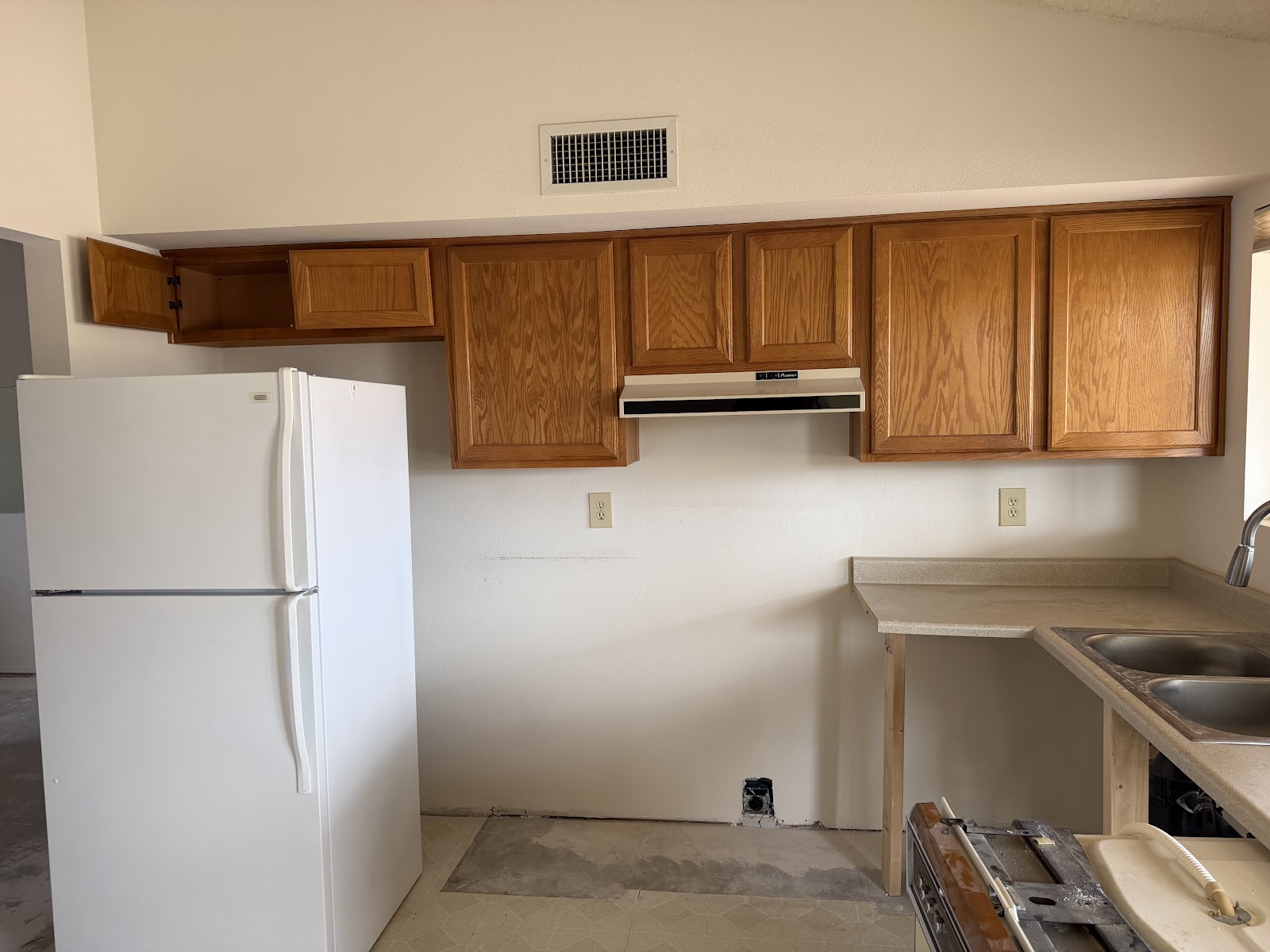
The first is 1980s to early-90s golden oak, everywhere in Phoenix tract homes from that era. These are usually the best refacing candidates in the Valley: solid oak face frames, often plywood sides, built when materials were used generously. The problem is purely visual, the orange tone and the heavy grain, and that's exactly the problem refacing solves. One thing to know: most of these run partial-overlay or lipped doors on semi-concealed or surface-mount hinges, so the reface converts them to concealed cup hinges and usually to full overlay, which changes the whole reveal pattern for the better. Lipped doors are worth flagging early, because the conversion changes how the new doors are sized.
The second is mid-90s and 2000s white thermofoil. Different story. The boxes are usually particleboard with melamine interiors and the doors are the failure, not the boxes. If the boxes are dry and square, refacing a thermofoil kitchen is good money, because you're throwing away the part that broke. If the doors are peeling and the sink base is swollen, the kitchen is telling you it wants to be replaced.
Why Phoenix Heat and Sun Are Hard on Cabinet Doors
Thermofoil doors delaminate when the adhesive under the vinyl film gets hot enough, and in a Phoenix kitchen that happens next to the range, above a dishwasher that vents forward, and on a west wall that takes afternoon sun through a big window. Manufacturers generally put the safe limit around 170 degrees, and most thermofoil warranties either exclude heat damage outright or require a heat shield and a minimum clearance at a range or a self-cleaning oven. Read the warranty on the doors you're buying. Once a thermofoil door peels it cannot be re-glued. That's the most Arizona-specific fact in cabinet work, and it should drive the door choice.
The second Arizona factor is dry air. Outdoor humidity on a Valley afternoon in May and June routinely drops near 10 percent, and an air-conditioned house runs dry too, commonly in the teens to low thirties, well below the 35 to 45 percent most cabinetry is built and acclimated at. Solid wood moves in that air. A solid-wood panel shrinks in its groove and exposes an unstained line at the edge, and a painted solid-wood door cracks the paint film at every rail-and-stile joint. Neither is a defect. It's wood doing what wood does in air that dry. It's also why painted MDF is the better painted door for Phoenix: MDF doesn't move, so the seam lines never show.
Door materials in an Arizona kitchen
| Door material | Heat next to a range | Dry air and sun | Where it belongs |
|---|---|---|---|
| Thermofoil (vinyl over MDF) | Delaminates around 170 degrees; the doors flanking the oven go first | Stable in dry air; peels faster on a sun-blasted west wall | A north or east kitchen with modest heat, and never beside a range without a heat shield |
| Painted MDF, factory finish | Fine with normal clearances | Does not move, so no seam lines; weak point is water at the bottom edge | The best all-around painted door for Phoenix |
| Wood veneer on engineered core | Fine | Stable core keeps it flat; stain fades unevenly under direct west sun | Anyone who wants real grain; the same veneer goes on the frames so everything matches |
| Solid wood | Fine | Panels shrink and show a line; painted joints crack. Acclimate in the house, not the garage | Stained finishes for people who understand the panel line; for paint, use MDF panels |
| Laminate or acrylic slab | Better heat and UV stability than old thermofoil | Very durable | Contemporary slab looks; priced near painted MDF |
What we spec differently here because of it
We steer painted kitchens to MDF, keep thermofoil away from the range and the west wall or skip it, and acclimate any wood door inside the conditioned house, unwrapped and stickered so air reaches both faces, for three to seven days before it's hung. On a kitchen with a big uncovered west window we'll raise window film or a sun screen before the doors go in, because direct afternoon sun fades any stained finish over the years and it fades unevenly, doors darker than the shaded frames. Small decisions, and they're why one reface still looks new at year ten and another looks tired at year three.
How a Refacing Job Runs, Day by Day
The doors are made to your boxes, not pulled from a catalog, so the job starts with a field measure of every opening and ends three to six weeks later when they arrive. The site work in between is three to five days. The order matters, because it's what bad refacing jobs scramble.
- Field measure and door schedule. Every door and drawer front measured opening by opening, hinge side and overlay noted. The door order goes in, and the clock starts.
- Doors arrive and get checked against the schedule. Count, size, hinge boring, and finish verified before anything comes off the boxes.
- Protect the room. Counters, floor, appliances, and the rooms the kitchen opens into get covered, and dust control goes up.
- Demo the old fronts. Doors, drawer fronts, old hinges and slides, crown, light rail, and old end skins come off.
- Box repair before any veneer. Re-square racked boxes, refasten loose face frames, replace a water-damaged sink base floor or the whole sink base, re-shim boxes to the studs, plug stripped screw holes. Veneer over an out-of-square frame preserves the problem in a nicer color.
- Prep the frames and ends. Sand, degrease, fill, and flatten. Veneer telegraphs every ridge under it.
- Skin the exposed ends first, scribed tight to the wall and the underside of the counter, then veneer the face frames, so the frame veneer laps over the end panel's front edge and no raw edge shows at the corner.
- Hang doors and drawer fronts. Bore for cup hinges, set the slides, mount the fronts. New drawer boxes go in here if the old ones were stapled particleboard.
- The alignment pass. Every door and drawer set to consistent reveals. This takes hours, not minutes, and it's the step that separates a professional reface from a weekend one.
- Crown, light rail, toe kick, fillers, scribe molding last, so they die into finished surfaces.
- Hardware, bumpers, soft-close adjustment, clean, walkthrough.
The parts nobody photographs: end panels, fillers, toe kick
A reface looks custom or looks like a kit depending on the pieces nobody thinks about. The exposed end of a peninsula, the return next to the range, the filler where the run meets a wall, the toe kick, and the crown stack all get the same material as the doors and all get scribed to walls that were never straight. On a soffit-less kitchen the crown is where the job either reads as cabinetry or reads as a strip glued on, so those pieces get the same attention as the doors.
Can you use the kitchen while it's happening?
Yes, with no doors on it for a few days. The sink, the range, and the fridge all keep working. The only thing you lose during a reface is privacy for your cereal boxes. That's the biggest practical difference from a replacement, which takes the sink, the counter, and usually the range out of service for two to three weeks while the new counter is templated and fabricated.
How Much Does Kitchen Cabinet Refacing Cost in Phoenix?
Cabinet refacing in the Phoenix metro runs about $150 to $300 per linear foot, measuring the uppers and the bases separately, which is how most Valley refacers quote. A 10 by 10 kitchen has about 20 feet of base run and 20 feet of upper run, so roughly 40 feet of cabinet, and that lands at $6,000 to $12,000 with thermofoil at the bottom, wood veneer in the middle, and solid-wood doors with veneered boxes at the top. Phoenix labor runs a bit above the national average and Valley kitchens run bigger than the 10 by 10 everyone quotes, so the number you get on site is often above the low end of that band.
| Line item | Typical Phoenix range | What drives it |
|---|---|---|
| Refacing, per linear foot | $150 to $300 per linear foot | Uppers and bases measured separately; door material, drawer count, exposed ends, crown |
| Doors and drawer fronts only, per opening | $130 to $180 per opening | The door alone; veneer, hinges, slides, and trim are on top. Glass fronts and tall pantry doors cost more |
| Refacing, 10x10 kitchen (about 40 feet of uppers and bases combined) | $6,000 to $12,000 | Thermofoil low, veneer middle, solid wood high |
| New drawer boxes and undermount soft-close slides | $90 to $180 per drawer | The cheapest quotes leave the 1985 boxes and slides behind the new fronts |
| Sink base replacement, single box | $350 to $700 | Plumbing disconnect and reconnect, matching the veneer |
| Proper sprayed repaint, 10x10 kitchen | $3,500 to $7,000 | Grain fill on oak, number of doors, off-site spraying |
| Replacement, stock boxes, 10x10, cabinets only | $2,500 to $5,500 | Plus counter, backsplash, plumbing, patch, and 2026 tariff pricing on imported boxes |
| Replacement, semi-custom, 10x10, cabinets only | $5,000 to $9,500 | Same extras, plus a 4 to 8 week cabinet lead time |
Phoenix market ranges for 2026, drawn from published cost data and the work we quote. Imported cabinet pricing is running roughly 10 to 14 percent above 2024 levels, which is a real reason refacing has closed the gap on cheap replacement.
What drives the number
Linear feet first, then door material, then drawer count, then exposed ends and crown. A kitchen with a peninsula has two more exposed ends than a galley. A kitchen with a drawer stack on every base has three fronts per box instead of one. Solid wood doors typically run two to three times thermofoil, depending on species and door style, with painted MDF between them. Those four things explain most of the spread between two refacing quotes on the same kitchen.
Why refacing quotes vary so much between Phoenix companies
Because they don't all include the same job. The cheapest quotes keep the original drawer boxes on the original epoxy slides behind beautiful new fronts, and you find out the first time a drawer sticks. Some skip the end panels. Some veneer over the old crown. One question separates them: are the drawer boxes and slides included, or just the fronts? Ask it before you compare numbers.
Where refacing stops saving money
Refacing beats replacement until the box repairs pile up. Once repair labor plus new fronts gets close to the price of new stock boxes, which on a typical Valley kitchen happens somewhere around a quarter of the boxes needing work, or once the layout is wrong, the money is better spent on new cabinets, and we'll say so. That crossover is where what a kitchen remodel costs in Phoenix becomes the right page to read instead of this one.
Not Sure Which Kitchen You Have?
Send us three photos: the inside edge of a cabinet side, the floor of the sink base, and the whole kitchen from the doorway. We'll tell you whether it's a repaint, a reface, or a replace, and what each would run.
Get a Cabinet AssessmentHow Long Does Refacing Take, and What's the Lead Time?
Three to five days on site, three to six weeks on the calendar. The wait is the doors. They're made to your measurements after the order is placed, and nothing on site starts until they're in hand, because demo exposes boxes that need their new fronts the same week. A repaint is faster on the calendar, usually one to two weeks, because the doors only have to be sprayed and dry enough to hang. Full cure on a cabinet enamel takes two to four weeks, so go easy on cleaners and hard knocks for the first month. A replacement is slower, because after the cabinets are set the counter still has to be templated and fabricated, which is another one to two weeks with no sink.
Do You Need a Permit or a Licensed Contractor to Reface Cabinets?
Refacing by itself is finish work and needs no building permit in Phoenix-metro cities. The permit shows up the moment the job touches electrical, plumbing, a soffit, or a wall: a new under-cabinet lighting circuit, a moved outlet, a relocated sink, a range hood duct, a soffit that turns out to have a duct in it. Two that catch people here: a soffit in a Valley tract home often hides an HVAC trunk or a return, and rerouting it is its own mechanical permit; and once an electrician opens up the kitchen receptacles, current code on countertop circuits and GFCI protection comes with it. Those are exactly the add-ons people bundle with a reface, so "no permit needed" is only true for the narrowest version of the job. Requirements differ city to city across the Valley, so we confirm with your jurisdiction before the work starts.
On licensing, Arizona caps unlicensed handyman work at $1,000 including materials. Every reface in this post is past that number, which means the person doing it should hold a contractor's license. Norem Contracting is a licensed Class B general contractor, ROC #365090, so the reface, the electrical for the lighting, the plumbing for a new sink, and the drywall around a removed soffit all sit under one license and one contract. See our kitchen remodeling in Phoenix page for the full scope we handle.
Common Questions About Cabinet Refacing in Phoenix
How long does cabinet refacing last?
A reface done with wood veneer or painted MDF doors, concealed hinges, and new slides should last 15 to 20 years in a Phoenix kitchen, about as long as the boxes underneath it. Thermofoil doors are the exception. Next to an oven or in a west-facing kitchen they can start peeling in 5 to 8 years, and a peeled door cannot be repaired.
Can you reface cabinets and change the layout at the same time?
No. Refacing keeps every box where it is, so the layout you have is the layout you keep. Moving the sink, adding a pantry, swapping doors for drawers, or shifting a run to fit a bigger fridge means new boxes, and at that point you are replacing, not refacing. That is the first question to settle, before any talk about door styles.
Can thermofoil cabinets be refaced, or do they have to be replaced?
Usually they can be refaced, because on a thermofoil kitchen the doors are what failed, not the boxes. If the boxes are dry and square, new doors and drawer fronts in a different material fix the problem for good. If the sink base is swollen and the doors are peeling, the kitchen is telling you it wants to be replaced.
Does refacing add value when you sell a Phoenix home?
A refaced kitchen photographs like a new one, and in the Valley that is what moves a listing. National remodeling data consistently shows minor kitchen updates returning a higher share of their cost at resale than full remodels do, because you spend a third of the money for most of the visual change. Refacing is the definition of a minor update. Treat any percentage as a direction, not a promise.
What Else Makes Sense While the Cabinet Fronts Are Off?
A reface puts a finish carpenter in your kitchen with the room masked, the doors off, and the light rail out, and it usually brings a short electrical visit for lighting. Anything that shares those trades and that masking costs a good deal less agreed up front than as its own trip later, typically 25 to 50 percent less. For a reface, these are the ones that pay:
- Countertops. New counters on refaced boxes get the biggest visual return for the money, and the template is easiest when the boxes have just been re-leveled. If the old counter stays, the toe kick and skin details have to work around it, so decide early. It's part of our kitchen remodeling work.
- The soffit. If it's coming out, it comes out before the doors are ordered, because it changes every upper. See removing the soffit above your cabinets.
- Under-cabinet lighting. The wiring runs behind the light rail, and the light rail is being replaced anyway. Later it means cutting into a finished backsplash.
- Backsplash. It goes on after the counter and has to coordinate with the light rail. Doing it later means re-masking a finished kitchen.
- Interior repaint. The kitchen is already masked and out of service. Painting it and the rooms it opens into during the same window costs a fraction of coming back. Our interior painting page covers the prep that matters in a dry climate.
- Sink and faucet. The moment to swap them is when the counter is off, because an undermount sink is a countertop decision, not a plumbing one.
One timing note rather than an add-on: refacing doesn't disturb the floor, so it's a good fit for a kitchen with a floor you like. If the floor is going too, that conversation has to happen before the doors are measured.

Written by Harrison Norem, owner of Norem Contracting and a licensed Class B general contractor, Arizona ROC #365090. Fifteen years across the trades, from finish carpentry and cabinet work to full kitchen remodels, across the Phoenix metro. More about Harrison.