A broom-finish concrete patio runs $8 to $15 a square foot installed in the Phoenix metro, stamped concrete $12 to $20, and a concrete paver or travertine patio $12 to $28. On a 16 by 20 foot patio that's about $2,600 to $4,800 in broom-finish concrete, $3,800 to $6,400 in stamped concrete or concrete pavers, and $4,800 to $9,000 in travertine. Both surfaces last for decades when the base under them is built right. The choice comes down to budget, the look, heat underfoot, and whether anything under the patio may need to be reached later.
We pour concrete and lay pavers and travertine, and a lot of Valley yards end up with both: a slab where the table and the grill sit, pavers or travertine out by the pool. For the service itself, see concrete patios and the hardscape section of our landscaping page.
Is It Cheaper to Pour a Concrete Patio or Use Pavers?
Broom-finish concrete costs less per square foot. At $8 to $15 installed, it runs roughly half to three-quarters of the same area in pavers or travertine. The gap closes as soon as the concrete gets decorative: stamped concrete at $12 to $20 matches the price of concrete pavers, and at that point the decision is about look, upkeep and repair rather than price.
Three things move either number in this market. Tearing out an old slab or lawn first adds cost to both. Access matters, since a back yard through a 36 inch gate means a concrete pump or wheelbarrows instead of a truck chute. And pattern matters for pavers, because herringbone and multi-size patterns waste more material in cuts than a simple running bond.
Which One Cracks, and Does It Matter?
Concrete will crack, and a good installer plans where. The National Ready Mixed Concrete Association says it plainly: cracks in concrete can't be prevented entirely, but they can be controlled by properly designed joints. Its guidance puts control joints at 24 to 36 times the slab thickness, which for a standard 4 inch patio is about every 10 feet and never more than 15, in panels close to square. It also notes that wire mesh doesn't prevent cracking. Mesh holds a crack tight once it forms, as long as it sits up in the slab on chairs.
So a concrete patio that cracks inside its joints is doing what it was designed to do. On a Tempe patio we poured over bare dirt beside a casita, we graded and compacted the base, isolated the new slab where it met the building and the older concrete, and tooled in control joints so the slab cracks where we want it to.
Pavers handle movement differently. Every joint is a small, flexible break, so the field flexes with the ground, and a paver that settles or lifts does it on its own instead of cracking the surface. That's also why the base decides how a paver patio ages: if the aggregate under it wasn't compacted properly, the surface goes wavy over a couple of years. Our landscaping page covers the base spec in detail.
Which One Stays Cooler Underfoot?
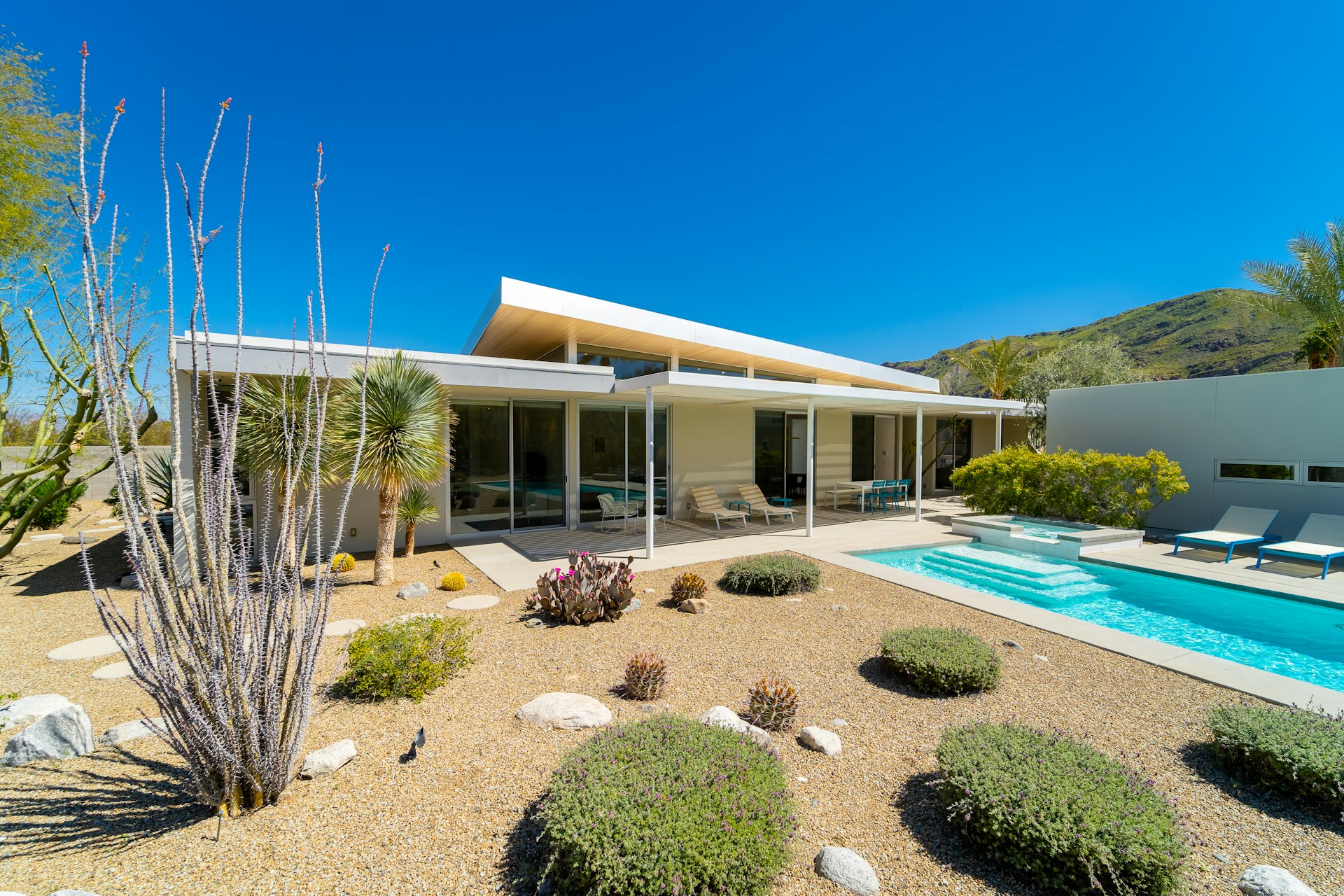
Color decides more than material. The Arizona Burn Center warns that outdoor surfaces can reach 180 degrees in a Phoenix summer, and it names concrete and flagstone along with asphalt. A light color helps, but no surface is safe barefoot on a July afternoon, so the first rule for either one is to go light where people walk barefoot. Travertine took over Valley pool decks largely because it's pale and porous, and a light gray or buff paver or a light concrete does the same job.
An ASU study of Phoenix's reflective street coating, led by Ariane Middel, found the coated surface ran 10 to 12 degrees cooler at noon, yet people walking on it felt about 5.5 degrees more heat from the sun bouncing back up at them. A light surface is kinder to bare feet and a little harder on the person standing on it at midday, which is one more reason shade over the patio and a light deck belong together.
On concrete pool decks, cool deck is the classic Valley finish. The original, Kool Deck, is a colored, textured cement surface that its maker says significantly lowers the surface temperature of concrete. It's slip-resistant and gets refreshed as it wears and fades.
When Is Concrete the Right Call?
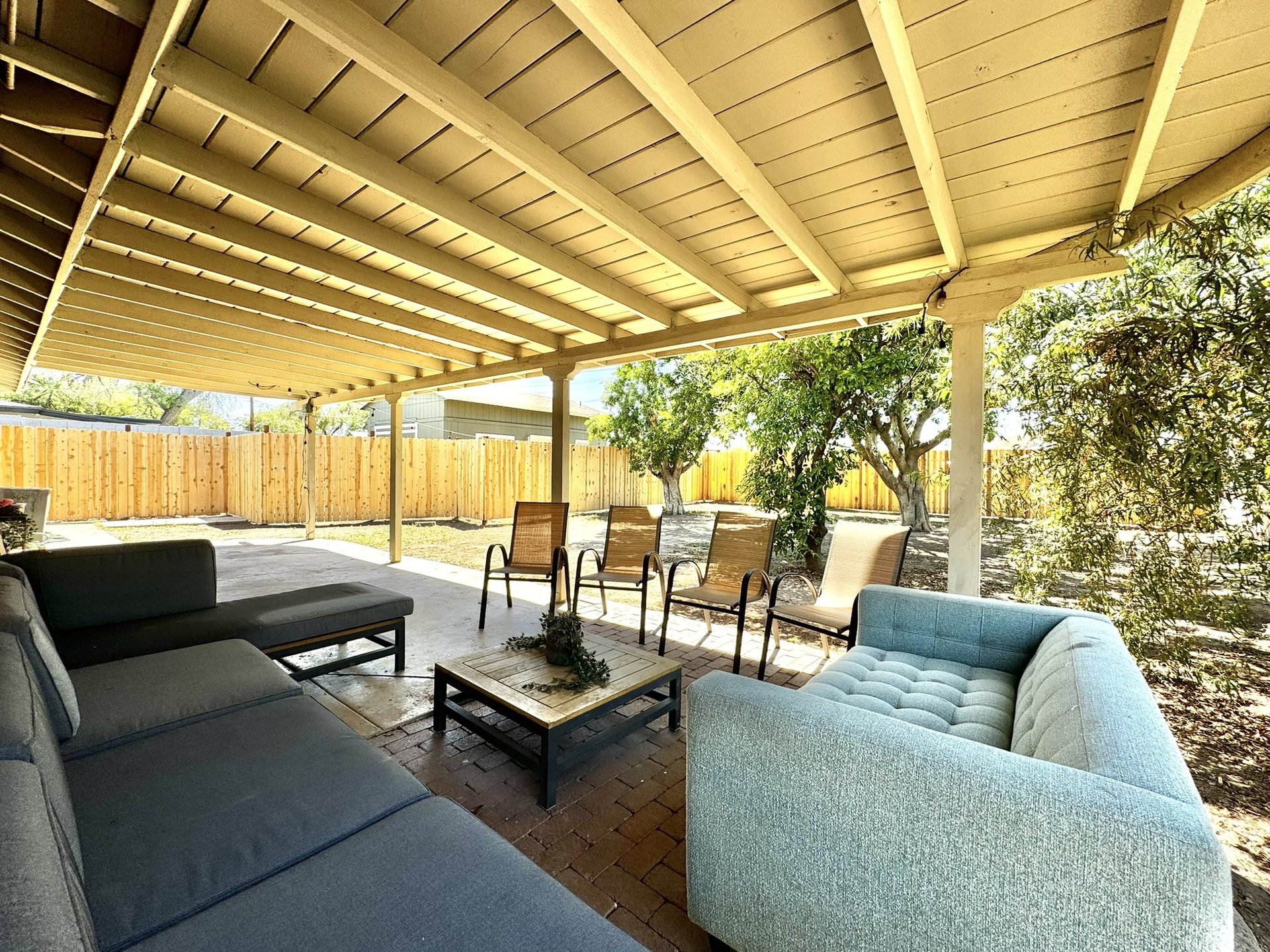
When you want the most patio for the money, a smooth continuous surface, or a clean modern look. It's also the usual floor under a patio cover or ramada.
Concrete fits best when
- The budget has to cover a large area, or other projects in the same yard
- The patio sits under a cover or ramada and wants a smooth, easy-to-sweep floor
- Furniture, a table or a wheelchair needs a flat, continuous surface
- The design is modern: large panels, clean saw-cut lines, or a sand or salt finish
- You want color or pattern in one continuous surface: colored concrete for less than pavers, or stamped for about the same price
What to plan around
- Hairline cracks inside the joint pattern are normal
- A repair patch rarely matches the surrounding slab exactly
- Stamped and colored concrete want a fresh coat of sealer every few years
- It needs a few days before furniture and full use
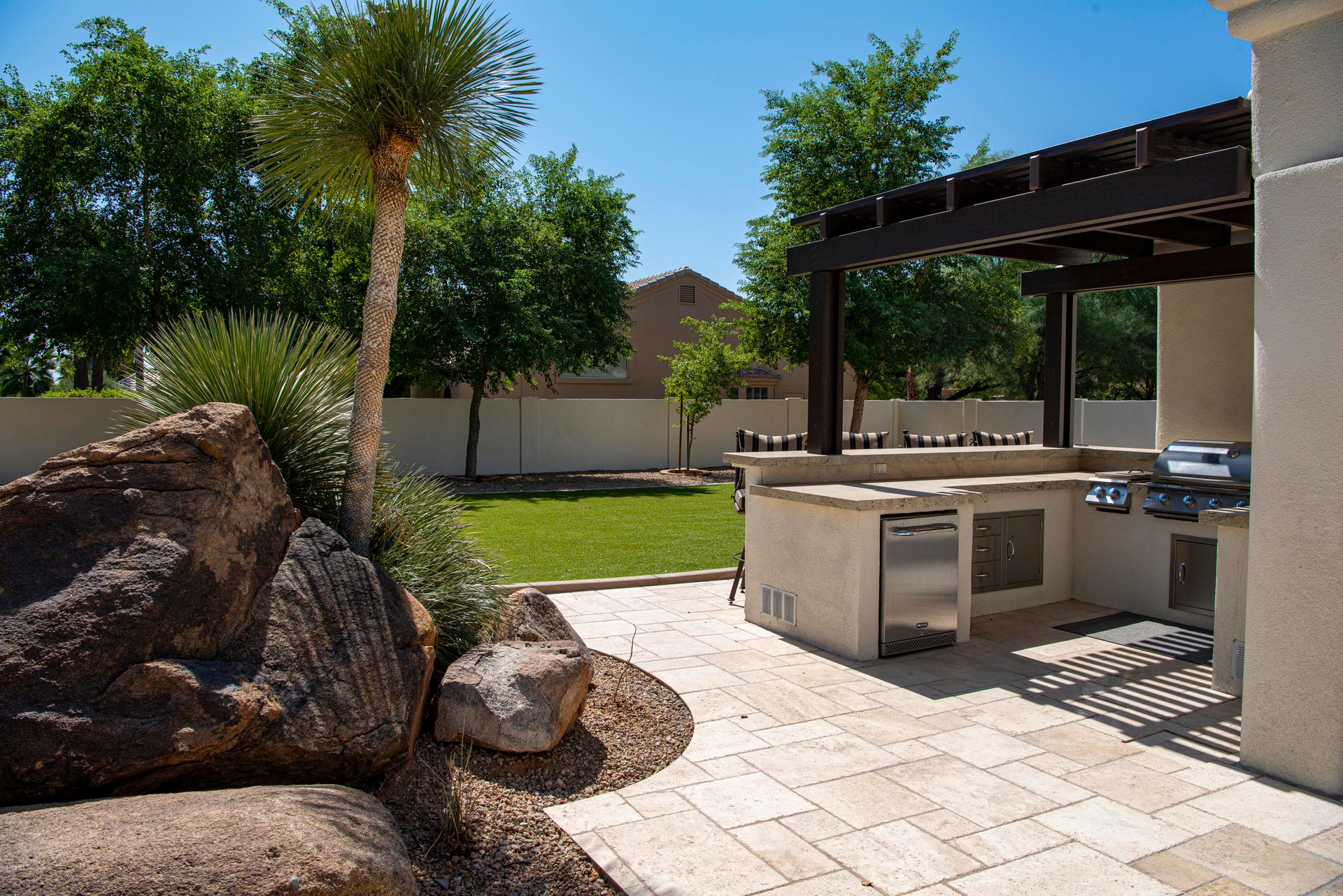
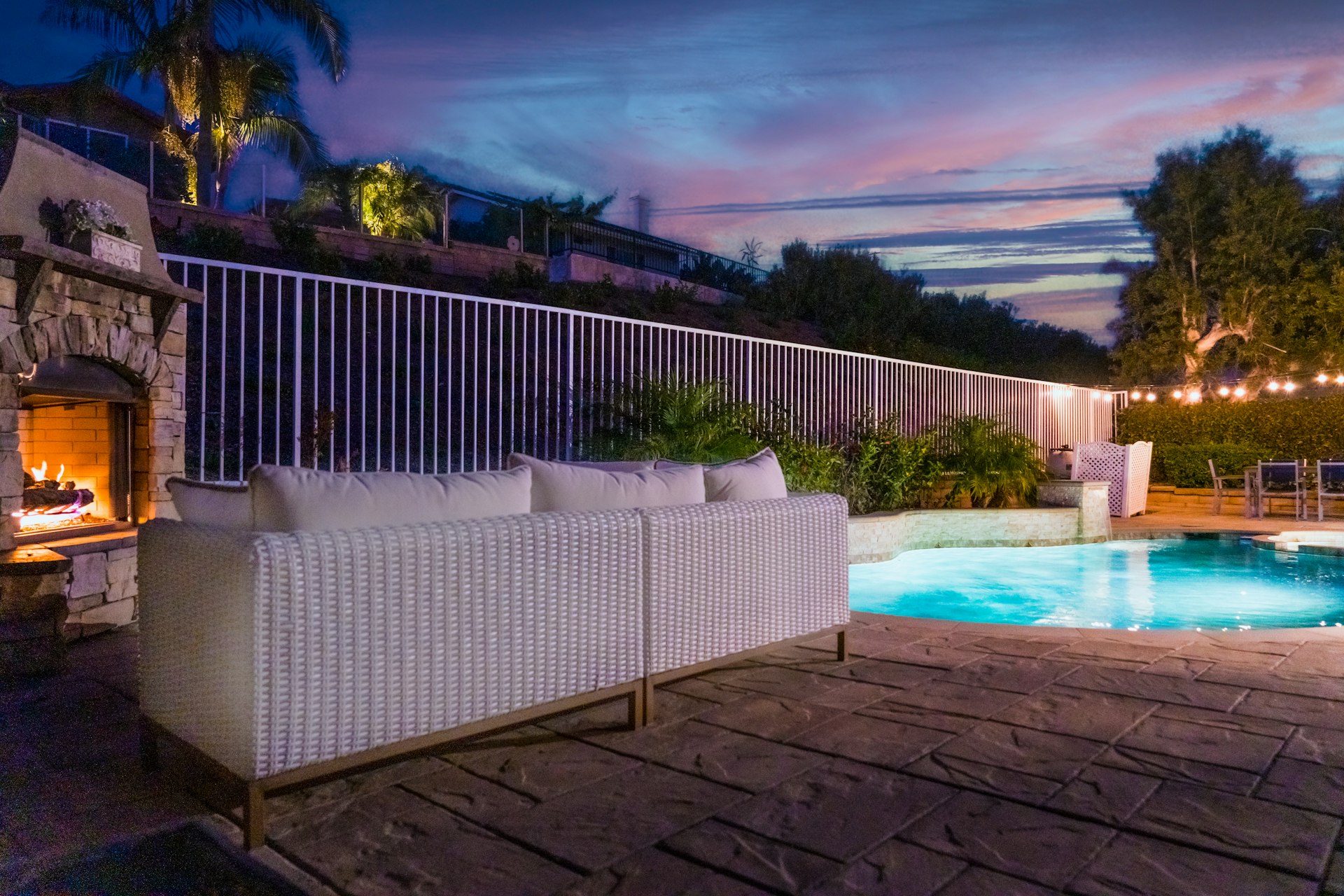
Stamped concrete gives a lot of Valley homeowners the look of stone in one continuous surface. The pattern and color go in with the pour, so there's no joint sand to weed or top up, though it still gets saw-cut control joints like any slab, usually hidden in the pattern's grout lines. Around a pool, its sealer gets a non-slip additive.
When Are Pavers or Travertine the Right Call?
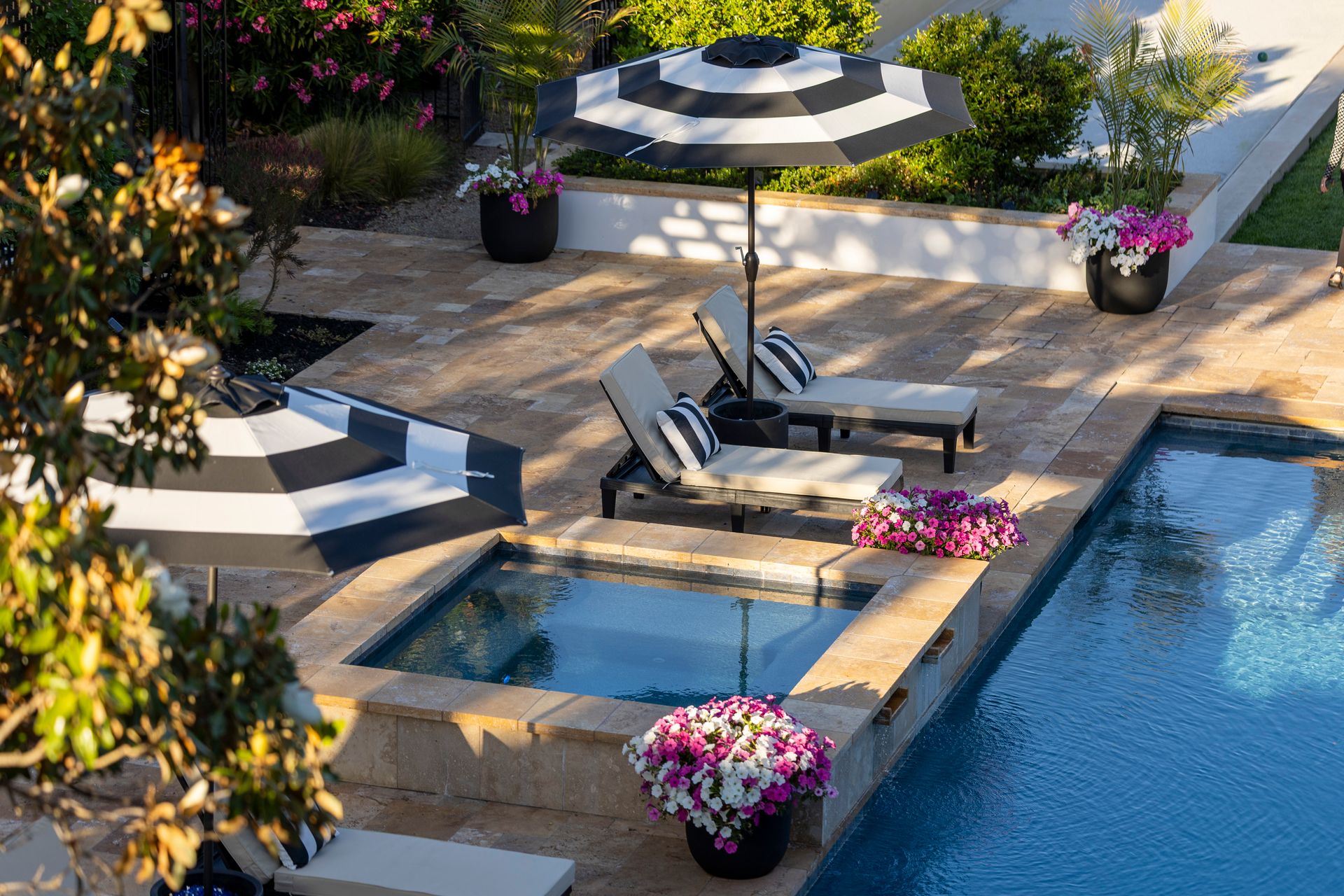
When you want pattern and borders, when it wraps a pool, or when there's any chance the patio will need to be opened up later. Pavers come out and go back in, so the patio can be opened and closed again without a patch.
Pavers or travertine fit best when
- It wraps a pool and you want travertine's pale color and texture
- You want pattern, borders, curves or mixed colors
- Pipes, irrigation or wiring run under the patio and may need reaching later
- You want to use it the day it's finished
- A future pergola or kitchen may need a footing set through it
What to plan around
- Joints need checking after monsoon storms
- The base under it has to be built to spec, or the surface goes wavy
- Travertine etches with acids, so vinegar and lemon cleaners stay off it
- A higher price per square foot than broom-finish concrete
Pavers are the easiest surface to repair. A stained, cracked or sunken paver comes out and a new one goes in, and the repair is hard to spot, especially with a few spare pavers saved from the original order. When we set a louvered pergola into an existing travertine patio, we cut openings at each post, poured footings in the soil below, and patched the travertine back around each post. On a new slab, the cleanest route is to pour the footings first and place the concrete around them.
Many of the pavers used across the Valley are made here, too. Belgard runs a paver plant in Phoenix, and Acker-Stone makes concrete pavers in Chandler, so matching colors and extra stock for future repairs are close to home.
What Type of Patio Lasts the Longest?
Both last for decades, and the part you can't see, the base, decides how well. Unit for unit, the paver is the stronger material: concrete pavers built to ASTM C936 average at least 8,000 psi, where a typical residential slab pours at 2,500 to 4,000 psi. But a paver field is only as good as the compacted base under it, and a slab is only as good as its base, joints and cure.
Where the two differ over time is in how they age. A slab stays one smooth, continuous piece, and a repair on it will show. A paver patio can be renewed a piece at a time: lifted, re-leveled and relaid with the same pavers. Heat matters for new concrete in particular. The concrete association notes that concrete cured at high temperatures early on won't be as strong later as the same concrete cured near 70 degrees.
Is Concrete or Pavers Better Around a Pool?
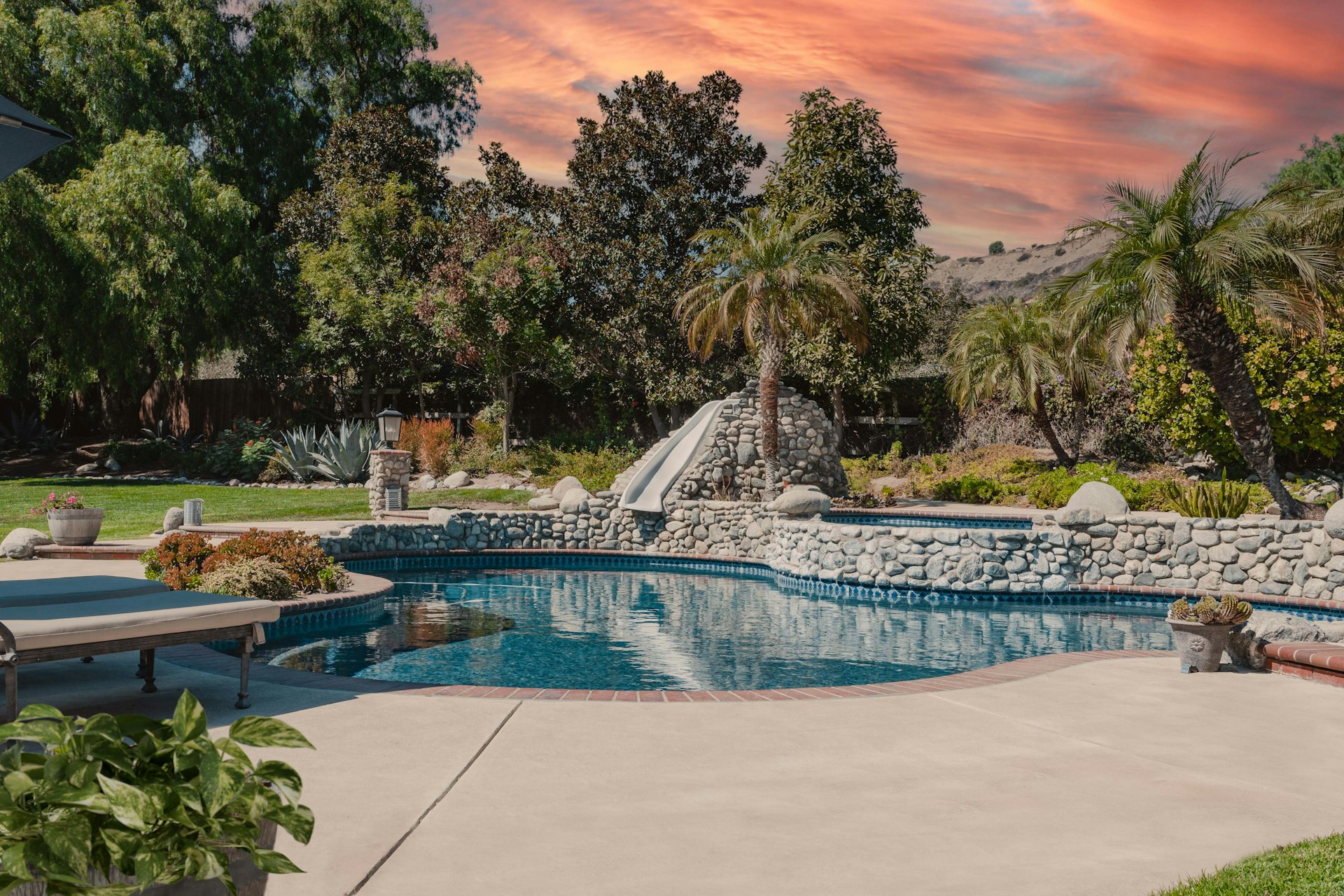
Both make good pool decks here. Which one fits depends on the look of the pool and how the deck meets it. Travertine or a light paver gives a pale, textured deck that's among the easier surfaces on bare feet and can come up in sections if a pool line under it ever needs work. Concrete with a cool-deck finish is a long-time Valley favorite: it flows around any freeform shape and covers a big deck for less per square foot.
Whichever surface goes down, three details decide how the deck performs. The coping, the cap stone or concrete edge at the water, meets the deck at a flexible expansion joint, usually a self-leveling sealant, and that joint has to stay sound so water doesn't get under the deck. The deck has to pitch away from the pool and away from the house, so splash-out and monsoon rain run to a planted area rather than back into the water or against the foundation. And the texture has to stay slip-resistant when wet, which rules out polished or glossy-sealed finishes around a pool.
How Does Each One Handle Monsoon Water?
Neither surface soaks up a monsoon downpour, so both are built to shed water, and the slope does that work. Hard surfaces within 10 feet of the house are built to a 2 percent minimum fall away from the foundation, a quarter inch per foot, which is stricter than the 1.5 percent the paver industry publishes as its own minimum for patios. Both a slab and a paver field need that fall built into the grade and the forms before the surface goes down. It can't be added afterward.
The difference is at the joints. A concrete slab sends all its water across the surface to the edge, so the landscaping at the low side has to take it. A paver field sheds most of its water the same way, and a heavy storm can wash out plain joint sand, which is why polymeric sand or a stabilizer earns its place on a Phoenix patio. Where runoff has nowhere good to go, permeable pavers are the answer: wider joints filled with small clean stone over an open-graded stone base, so water drops through the patio instead of running off it. Over caliche or tight clay that base gets a perforated underdrain, and next to the house the system is lined or kept back so it doesn't soak the soil under the foundation.
Either way, the question to settle first is where the water goes when the storm hits. If the yard already ponds against the house, we fix the grading before any new surface covers it.
What Does a Concrete or Paver Patio Cost in Phoenix?
Broom-finish concrete runs $8 to $15 a square foot installed, colored or exposed aggregate about $1 to $2 a square foot more, stamped concrete $12 to $20, concrete pavers $12 to $20, and travertine $15 to $28.
Patio surfaces, Phoenix metro, 2026
| Surface | Typical Phoenix range, installed | What moves the price |
|---|---|---|
| Broom-finish concrete | $8 to $15 per sq ft | Size, thickness, base prep, truck access |
| Colored or exposed aggregate concrete | About $1 to $2 per sq ft over broom finish | Integral color or seeded stone, and the extra finishing time |
| Stamped concrete | $12 to $20 per sq ft | Pattern, number of colors, borders, sealer |
| Concrete pavers | $12 to $20 per sq ft | Paver line, pattern waste, borders, base depth |
| Travertine pavers | $15 to $28 per sq ft | Stone grade, French pattern vs single size, bullnose edges and steps |
| Breaking out and hauling an old slab | $1 to $3 per sq ft | Thickness, rebar, and how far to the truck |
Common patio sizes, installed, Phoenix metro, 2026
| Size | Broom-finish concrete | Stamped concrete or concrete pavers | Travertine |
|---|---|---|---|
| 12 x 20 ft (240 sq ft) | $1,920 to $3,600 | $2,880 to $4,800 | $3,600 to $6,720 |
| 16 x 20 ft (320 sq ft) | $2,560 to $4,800 | $3,840 to $6,400 | $4,800 to $8,960 |
| 20 x 20 ft (400 sq ft) | $3,200 to $6,000 | $4,800 to $8,000 | $6,000 to $11,200 |
Phoenix metro installed rates, 2026, multiplied out by area. Demo of an existing surface, a long carry from the truck, and pattern or border upgrades move a job up the range.
A 12 by 20 paver patio runs about $2,880 to $4,800 in concrete pavers and $3,600 to $6,720 in travertine. A 15 by 20 stamped concrete patio, 300 square feet, runs about $3,600 to $6,000. And a 16 by 16 broom-finish slab, 256 square feet, runs about $2,048 to $3,840.
Want both surfaces priced for your yard? We price concrete and pavers or travertine for the same space, side by side. Request a free estimate or text a photo to (602) 492-1815.
How Long Does a New Patio Take to Cure in Arizona?
Concrete takes light foot traffic after a day or so, furniture a few days later, and reaches its design strength at about 28 days. Pavers can be used the day they're finished.
A paver patio finished with polymeric joint sand takes foot traffic immediately, per Techniseal's own data sheet, with vehicles kept off for 48 to 72 hours and pressure washers kept off the joints for the first 30 days.
In summer we pour concrete in the cool of the morning, following the concrete association's hot-weather guidance to avoid the hottest part of the day for placing and finishing, and keep the slab moist while it gains strength.
Planning a pergola, cover or kitchen too? Put its footings in before the patio surface goes down. It's the difference between pouring a footing in open ground and cutting a finished patio to reach it.
What Upkeep Does Each One Need in Phoenix?
Not much for either, and different chores for each.
- Broom-finish concrete. Sweep and rinse. A clear sealer is optional and helps with stains around a grill.
- Stamped or colored concrete. Reseal every few years to keep the color and the sheen, and rinse off hard-water spotting from irrigation overspray before it bakes on.
- Pavers. Check the joints after heavy monsoon storms and keep sprinklers off the field. Plain sand gets topped up, and polymeric sand that has washed out gets raked out to depth and refilled. A white haze in the first months is usually efflorescence. It's harmless, and much of it wears away.
- Travertine. Rinse, and if it's sealed, use a penetrating sealer rather than a glossy film. Never use acid-based cleaners, including the vinegar trick people use on faucets for hard water, because acid etches the stone.
What Should You Ask Before Hiring for Either One?
Two bids for the same patio can look alike on paper and be very different underneath. Five questions bring the difference out, whichever surface you choose:
- How deep is the base, and how is it compacted? The base is the foundation of both a slab and a paver field. Four inches of compacted aggregate is the industry minimum for a paver patio, compacted in lifts of a few inches at most, so a deeper base goes in as several layers rather than one pass that only firms the top.
- Where do the control joints go? For concrete, ask to see the joint layout. A 4 inch slab wants joints about every 10 feet, in panels close to square.
- What goes under the pavers? The trade's own specification calls for one inch of washed concrete sand as the bedding layer. Stone dust and masonry sand are the shortcuts it rules out.
- When will you pour in summer, and how will you keep the slab moist while it cures? The answer should be early morning and a real curing plan.
- Where does the water go? Ask for the fall direction and where the runoff lands before anything is poured or laid.
These are the questions we walk through on every patio estimate, for either surface.
Can You Use Both Concrete and Pavers in One Yard?
Yes. Each surface goes where it performs best, and a shared color or a border ties the two together.
- A slab under the patio cover, travertine at the pool. Smooth, easy concrete where the table, grill and chairs live in the shade, and pale stone where people walk barefoot.
- A concrete field with a paver border. Most of the area at concrete cost, framed with a band of pavers that gives it a finished edge.
- Pavers laid over a sound existing slab. The old patio becomes the base, and nothing gets broken out or hauled away.
- A concrete walkway into a paver patio. The everyday path from the side gate is poured, and the pattern goes where you sit.
One crew doing both in one project also means one excavation, one base, and one set of grades that drain away from the house, instead of two contractors meeting at a seam.
Price Both Before You Decide
Send a photo of the space and rough measurements. We'll price it in concrete, in pavers or travertine, and as a mix of the two, side by side, so you can choose on the numbers and the look. Free estimate from a licensed Arizona contractor, ROC #365090.
Request Free Estimate Text a Photo: (602) 492-1815Questions Phoenix Homeowners Ask About Patio Surfaces
Is a 10 by 10 patio big enough?
Just barely, for a small table for four. Houzz's patio planning guide puts a round or square table for four on a patio at least 10 by 10 feet, and a round table for six at 10 and a half by 10 and a half, ideally 12 by 12, with at least two and a half feet from the table edge to the patio edge. Add a grill, a lounge chair or a path to the door and we usually suggest 12 by 16 or larger.
Does thicker concrete prevent cracking?
No. Thickness adds strength for loads like a vehicle, but a patio cracks because concrete shrinks as it cures and moves with the ground under it. The National Ready Mixed Concrete Association is plain that cracks can't be prevented entirely, only controlled, and that wire mesh doesn't prevent cracking either. What controls it is the base, the water in the mix, the curing, and control joints spaced for the slab's thickness.
Can pavers go over an existing concrete patio?
Often, if the slab is sound, flat and drains. An overlay keeps the old slab as the base and saves the cost of breaking it out and hauling it off. It raises the patio by the thickness of the paver and setting bed, so door thresholds, the step down from the house and the stucco weep screed at the base of the wall get checked first, and the bedding needs a way for water to drain off the slab. A slab that's heaving or badly cracked comes out instead.
Do pavers get weeds and ants?
Joints filled with plain sand can, which is why most Valley paver patios get polymeric joint sand or a joint stabilizer. The Concrete Masonry and Hardscapes Association notes that sealers and stabilizers help keep joint sand from washing out and help stop weeds and insects. Check the joints after heavy monsoon storms: plain sand gets topped up, and polymeric sand that has washed out gets raked out to depth and refilled, because a thin layer over old polymeric sand doesn't bond.
What is the white film on new pavers?
Usually efflorescence, a natural salt deposit that comes out of concrete products as moisture moves through them. It looks alarming and is harmless: the Concrete Masonry and Hardscapes Association states it doesn't affect the structural performance or durability of concrete pavers, and much of it wears away over the first months. A white film that shows up in the first days after polymeric sand goes in can instead be polymer haze, which doesn't wear away and needs a haze remover.
Will a pergola or patio cover work on either surface?
Yes, as long as the posts reach their own footings in the soil rather than bolting to the surface. On pavers we lift or cut the pavers at each post, pour a footing below, and patch the pavers back. On a slab, the concrete is cored or cut at each post for the footing, and in newer Valley homes the patio slab can be part of the house's post-tensioned foundation, which is never cored until the tendons are located. Planning the posts before the patio goes in is the cleanest version: the footings get poured first and the surface is laid around them.
What Else Should Go In Before the New Patio Covers the Ground?
During a patio job, the ground is dug, graded and compacted, and our crew and equipment are already in the back yard. That's the cheap moment for any sleeve, trench or footing that has to sit under the new surface. Added to the patio estimate up front, that work commonly runs 25 to 50 percent below what it costs as a separate job once the surface is down.
- Shade over the new patio, with its footings poured first. See pergola or solid patio cover and patio covers and ramadas.
- Conduit and irrigation sleeves under the surface, so lighting, outlets and drip lines can cross later without cutting anything. See light fixture installation and sprinkler and irrigation repair.
- Grading on the low side of the patio, so runoff from the new surface has somewhere planned to go. See desert landscaping.
- An outdoor kitchen or grill island, set on its own footing while the ground is open. See what an outdoor kitchen costs in Phoenix.
- A privacy fence or block wall along the patio side, built before the flatwork so nothing gets dug beside new concrete. See fencing.
Planned together, it all goes in on one schedule and in the right order: fence and footings first, flatwork last. That's how our Tempe casita patio went, written up in a private backyard retreat in Tempe, and more of our yard work is in the project gallery.

Written by Harrison Norem, owner of Norem Contracting and a licensed Class B general contractor, Arizona ROC #365090. Fifteen years across the trades, including concrete flatwork, pavers, patio covers and yard construction across the Phoenix metro. More about Harrison.