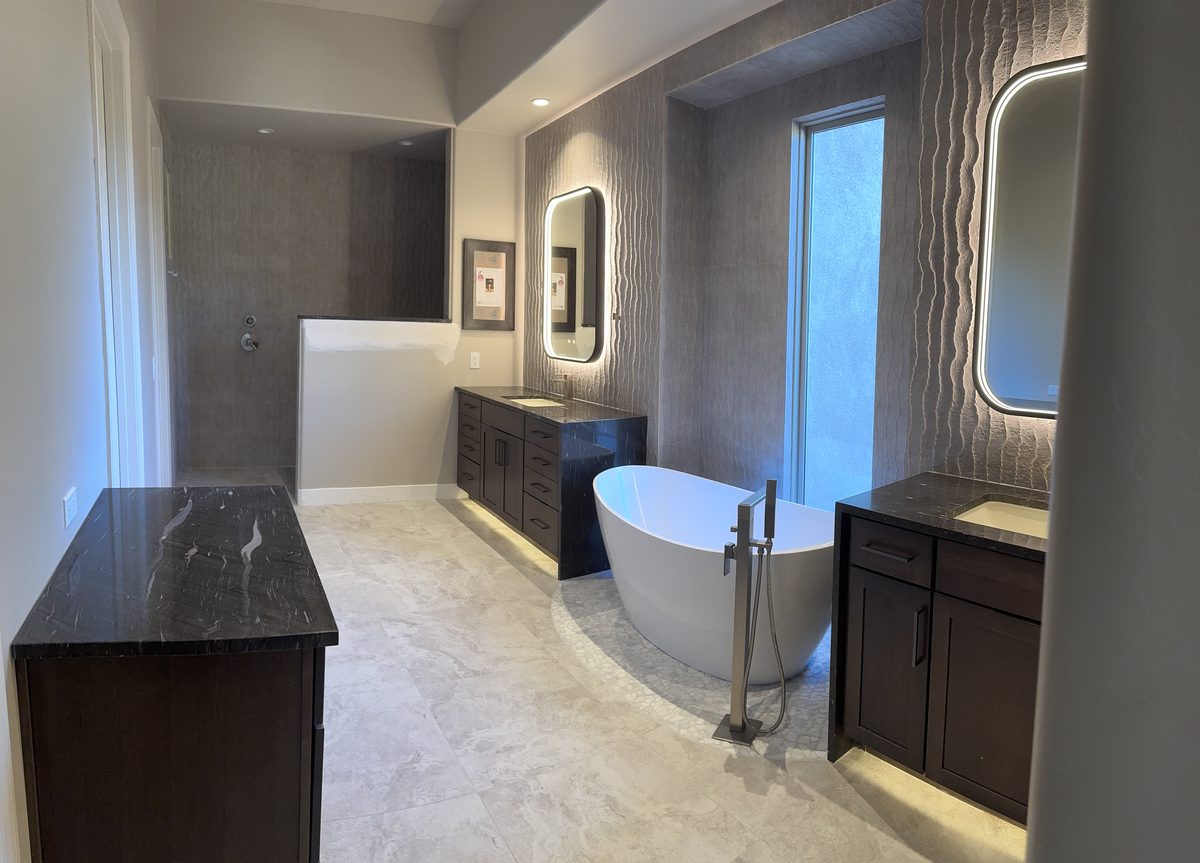
A bathroom designed for Arizona starts from three local facts: City of Phoenix water tests at 10 to 17.6 grains per gallon of hardness, summer attics in the Valley commonly reach 140 to 150 degrees, and monsoon dust gets into every gap. Those facts point to factory-coated shower glass, epoxy or single-component grout, spot-resistant brushed finishes on the fixtures, porcelain instead of travertine in the shower, and a quiet humidity-sensing fan ducted outside through a damper.
Make these choices at the planning stage, months before demolition, while each one is still a line on a drawing. Code requirements, the waterproofing method and whole-room price bands are on our bathroom remodeling page.
What Does Phoenix Hard Water Do to Fixtures, Toilets and Stone?
It leaves white mineral scale on anything that stays wet, it slowly etches unprotected glass, and the acid cleaners that dissolve it etch natural stone. The City of Phoenix 2025 water quality report puts total hardness at 172 to 302 parts per million, which is 10 to 17.6 grains per gallon. Every drop that dries on a faucet, a shower head or a toilet bowl leaves that mineral behind.
Fixtures are the easy fix. Moen's Spot Resist and Delta's SpotShield finishes are both sold on resisting water spots and fingerprints, and both come in brushed nickel and stainless. For shower heads, Delta's Touch-Clean spray holes are soft rubber nozzles that let you rub mineral buildup off with a finger instead of soaking the head in descaler. A hand shower on a hose helps too: it rinses soap off the walls and glass so a squeegee can take the water off before it dries, and drying is the habit that keeps scale from setting.
Inside the wall, the same minerals scale valve cartridges, which is why the valve body is worth spending on. It is the part that gets buried behind tile, and a brand whose replacement cartridges you can still buy years from now turns a worn cartridge into a repair instead of a demolition.
Toilets take scale at the waterline. TOTO's CEFIONTECT is a super-smooth permanent glaze that the company says keeps debris from sticking. TOTO's own care sheet also says not to use acid or alkaline detergents on it, so the vinegar soak people use for hard water is out.
On stone, the damage comes from the cleaning. Marble, travertine and limestone are calcium carbonate, and the Natural Stone Institute warns that products containing lemon, vinegar or other acids can dull or etch them, which rules out vinegar and acid-based scale removers on any of them. Unprotected glass etches permanently where minerals dry on it. The hard-water section of our bathroom remodeling page has the details.
Fixture finishes against Phoenix water
| Finish | How hard-water spots show | Notes |
|---|---|---|
| Spot-resistant brushed nickel or stainless | Least visible | Moen Spot Resist and Delta SpotShield are sold on resisting water spots |
| Untreated brushed nickel | Low; the brushed grain hides a lot | Mid-tone hides both white scale and dark grime |
| Polished chrome | Every dried droplet | Durable and easy to clean, but needs wiping to look clean |
| Matte black | White mineral rings stand out | Dried minerals are white; white shows on black |
Spot visibility is our comparison from Valley bathrooms, not a manufacturer rating.
Which Tile Holds Up Best in an Arizona Bathroom?
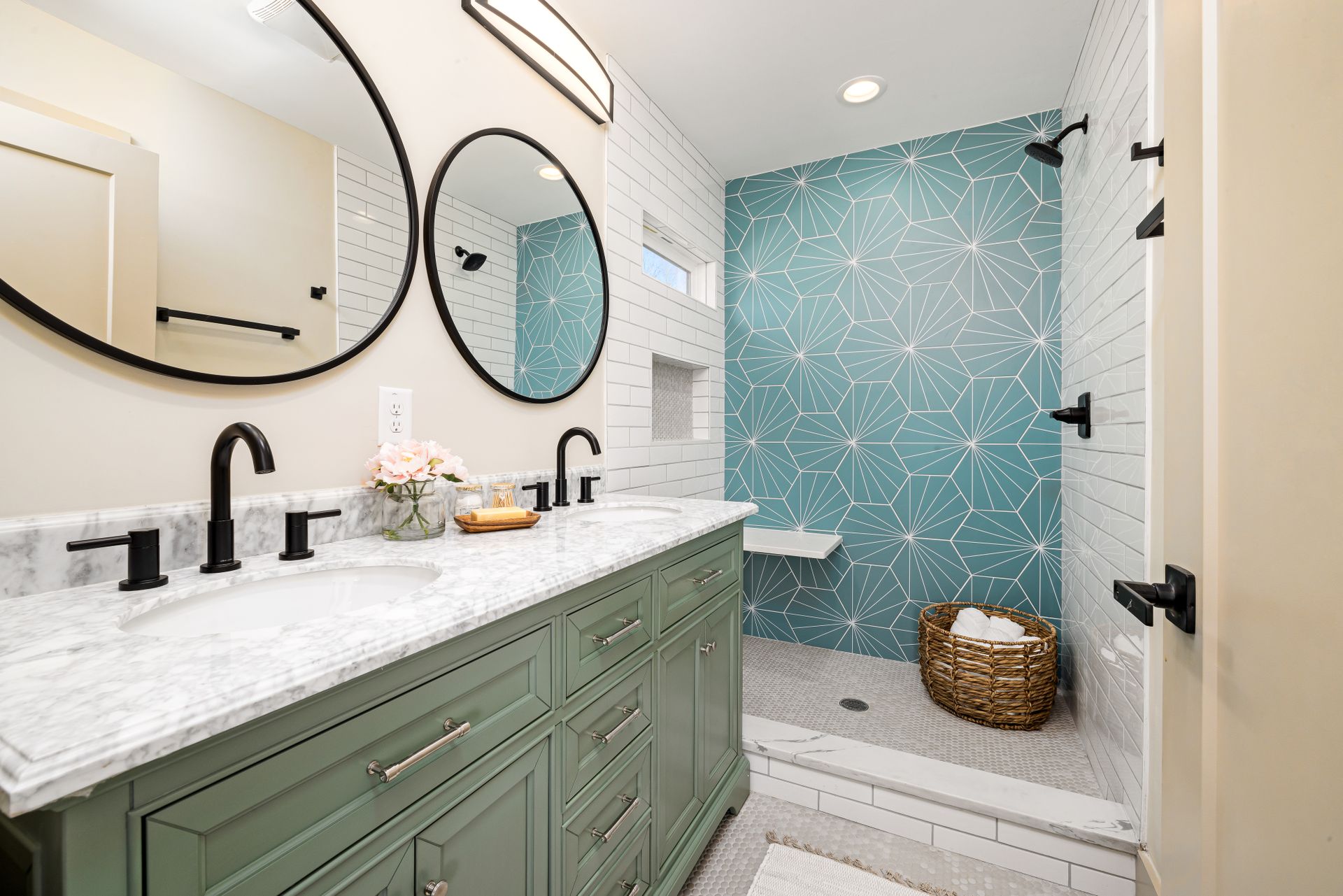
Porcelain, almost everywhere. The Tile Council of North America defines porcelain as tile with a water absorption of 0.5 percent or less, so it takes in almost nothing, and because it is not calcium carbonate it doesn't etch when you clean it. It also comes in large formats like 24 by 48 inches, and bigger tile means fewer grout lines collecting scale.
Large format has one requirement that rarely comes up before the bid. The tile installation standard, ANSI A108.02, holds tile with any edge 15 inches or longer to a flatter substrate: no more than 1/8 inch of variation in 10 feet and 1/16 inch in 2 feet. Plenty of slabs and older walls miss that, so a large-format bid should include floating or patching the surface flat. Ask whether yours does.
The shower floor is the exception to big tile when it has a center drain. That floor slopes four ways to one point, and small mosaics follow those slopes while giving bare feet more grip from all the grout joints. A linear drain lets the floor slope in one plane, which is what makes larger tile workable there. For any floor that gets walked on wet, look for the slip number on the spec sheet: ANSI A137.1 calls for a wet dynamic coefficient of friction of 0.42 or higher on tile recommended for level interior floors walked on when wet.
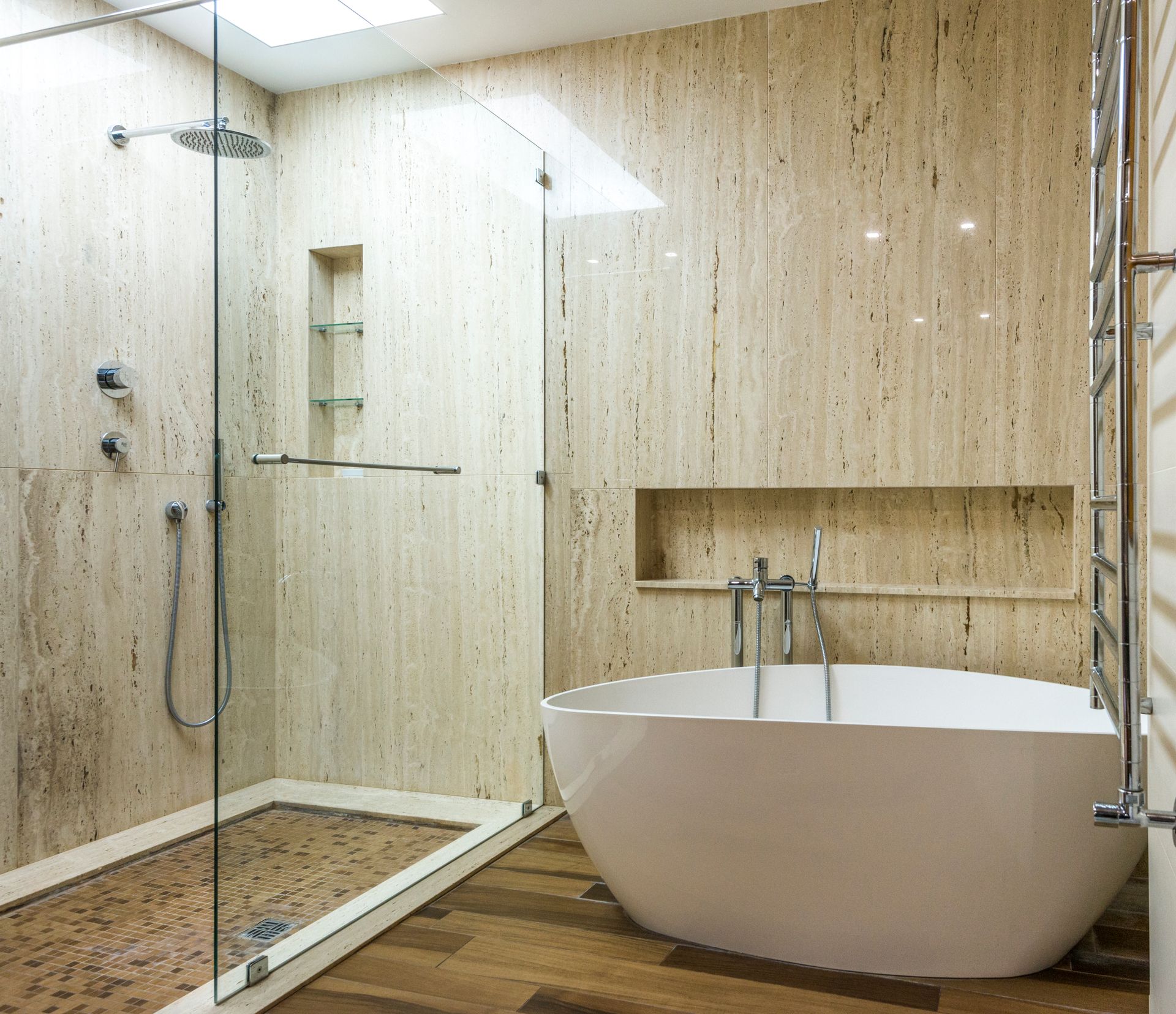
Travertine is the material many Valley owners are replacing. A lot of Phoenix-area showers from the 2000s were built in tumbled or honed travertine, and it has two problems in a wet room with hard water. All travertine etches under acid. And its natural pits and holes, left by gas bubbles in the mineral spring where the stone formed, are filled with cement or resin at the factory on most honed and polished tile and often left open on tumbled tile. On a dry floor or a vanity wall travertine is fine. Inside the shower, choose a travertine-look porcelain instead.
Saltillo, the handmade Mexican terracotta in many older Arizona homes, is extremely porous. Its makers say it has to be sealed before grouting and again after installation. It belongs on a bathroom floor away from the shower, sealed, and never inside one.
Under the tile, concrete slabs crack over the years. Schluter's DITRA is an uncoupling and waterproofing membrane that goes between the slab and the tile, and its job is to keep a hairline crack in the concrete from cracking the tile and grout above it.
Bathroom tile against hard water and heat
| Porcelain | Travertine | Marble | Saltillo | |
|---|---|---|---|---|
| Water absorption | 0.5% or less | Higher; natural voids | Varies by stone | Extremely porous |
| Acid cleaners | Unaffected | Etches | Etches | Sealer takes the wear |
| Sealing | Tile none; grout depends on the product | Regular | Regular | Before grout, after install, and ongoing |
| Where it belongs | Shower walls and floor, bathroom floor | Dry floors and walls | Vanity tops and dry walls | Bathroom floor, away from the shower |
What Grout and Caulk Should a New Arizona Bathroom Get?
A grout that never needs sealing, in a mid-tone color, with 100 percent silicone at every corner. In a city with water this hard, a porous cement grout that relies on a sealer can start holding scale and stains once the sealer wears. Three products we spec on new tile, with what their makers claim:
- Laticrete SpectraLock Pro PremiumA high-performance epoxy grout that never needs sealing, sold as stainproof for residential installations.
- Custom Building Products Fusion ProA single-component, ready-to-use grout sold as stain proof and color consistent, with no sealing required.
- Mapei Flexcolor CQA ready-to-use grout used straight from the pail, with no water added and no sealer required.
Then the color. Hard-water residue dries white, so a dark grout shows a white haze along every joint at the bottom of the shower, and a bright white grout shows dirt and soap. A mid-tone gray, greige or sand hides both. Wherever two planes meet, wall to wall or wall to floor, the joint gets silicone rather than grout, because those joints move and grout cracks there first.
Narrower joints help too. Rectified porcelain, cut to exact size at the factory, can be set with a narrower joint than tile with cushioned edges, and every narrower joint is less porous surface for scale to settle into.
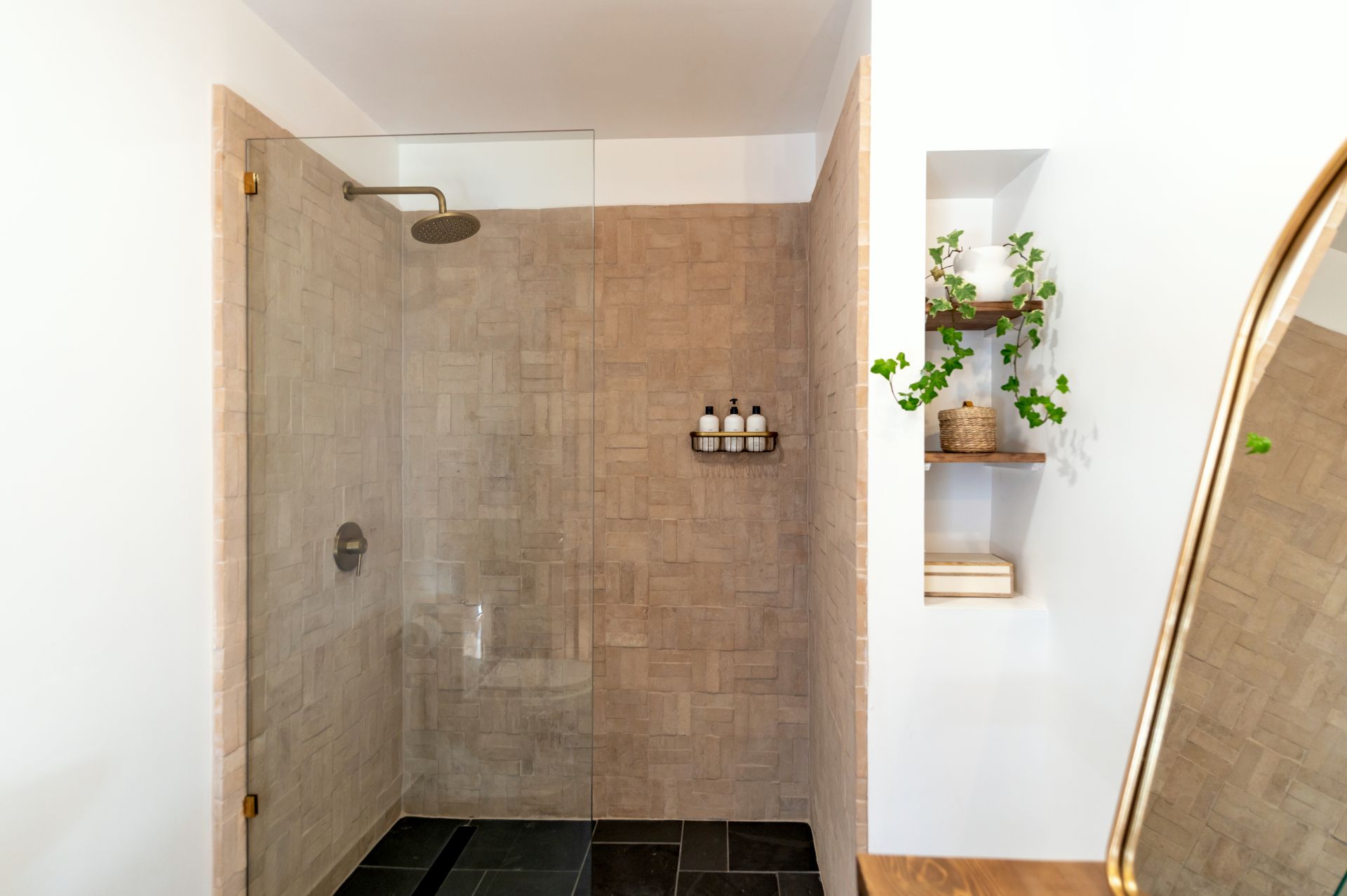
Should You Coat the Shower Glass or Put in a Water Softener First?
Decide both before the glass is ordered, because the coating is part of the glass order and the softener changes what the glass sees every day. Phoenix water etches unprotected glass, and once glass is etched it doesn't come back.
Glass protection comes two ways. Guardian's ShowerGuard is bonded to the glass when it is made, and Guardian backs it with a limited lifetime warranty. EnduroShield is applied after fabrication, by the glass shop, by a professional on installed glass, or by the homeowner with a kit. The company's warranty runs 10 years on new glass, 5 years on existing glass treated by a professional and 3 years for the do-it-yourself kit. A factory coating like ShowerGuard can't be added later, so that choice belongs on the glass order.
The softener works on the water itself. A single-tank salt softener is the common whole-house choice, a twin-tank unit keeps soft water flowing while one tank regenerates, and salt-free conditioners are sold too, though they leave the calcium and magnesium in the water, so they do little for spots on glass. The cost question is plumbing. If the house was built with a softener loop, a capped pair of pipes where a softener can tie in, the install is simple. A house without one needs new piping run to wherever the unit goes.
How Should a Desert Bathroom Be Ventilated?
With a fan ducted all the way outside, sized for the room, and fitted with a damper that closes when the fan is off. The Home Ventilating Institute sizes a bathroom fan at 1 CFM per square foot of floor up to 100 square feet, with 50 CFM as the minimum, and by fixture above that: 50 CFM each for the toilet, the shower and the tub. Bathrooms here deal with two kinds of weather: monsoon humidity, in a season the National Weather Service officially dates from June 15 through September 30, and the blowing dust that comes with the storms.
Those dates are a convention. Before 2008, Phoenix's monsoon began after three straight days of dew points averaging 55 degrees or higher. The National Weather Service fixed the calendar dates that year. Either way, it is the stretch of the year when a weak bathroom fan shows.
The damper is the Phoenix detail. A roof or wall cap without a backdraft damper lets outside air, dust and pests push back into the duct whenever the fan is off. During a haboob that is fine dust headed straight for your bathroom ceiling.
Panasonic's WhisperSense FV-0511VQC1 shows what a current fan can do. It has motion and humidity sensors, a delay-off timer from 30 seconds to 60 minutes, a switch for 50, 80 or 110 CFM, a rating under 0.3 sone at 0.1 inch of static pressure, and a built-in damper that Panasonic says reduces back drafting.
Install the fan close to the shower, keep the duct short and straight through the attic, and never let it end in the attic itself. The code minimums for airflow, duct and sound are on our bathroom remodeling page.
How Do You Keep a Bathroom Comfortable in Phoenix Summers and Winter Mornings?
Keep the cold lines out of attic heat, choose a shower valve that holds its temperature, and put heat under the floor tile for winter mornings. Phoenix Sky Harbor hit 118 degrees in July 2024 and dropped to 35 on a January morning the same year, and the bathroom has to work at both.
Summer first. The City of Phoenix reports its tap water at 47 to 92 degrees across the year, and that is before the pipes in your house add their own heat. Once outdoor temperatures pass 100 degrees, water sitting in the pipes picks up heat, and cold lines running through a hot attic pick up the most. That is why the cold tap runs warm in July. Where new supply lines have to cross the attic, as they do in many Valley repipes, run them low on the ceiling side and bury them under the insulation instead of over it.
The shower valve deals with the swing. A pressure-balancing valve reacts to a pressure change, like a toilet flushing, so the shower doesn't scald you. A thermostatic valve lets you set a temperature and holds it while the supply water swings between seasons. Either one meets the code.
Winter is about the floor. Electric floor heat goes under the tile: Schluter's DITRA-HEAT holds heating cable in the studs of a quarter-inch membrane, so heat goes wherever it is wanted with no self-leveler over the cable and no height difference between heated and unheated areas, and Nuheat sells mats and cable systems. DITRA-HEAT comes in 120-volt and 240-volt versions, and the heating system is wired to code on the same contract as the rest of the bathroom electrical, with its thermostat on the wall where you'll see it. A hot-water recirculation pump shortens the wait for hot water at a far bathroom. And if the room has a west-facing window, the afternoon sun through it heats the room every day. Our sun screen and window tint page covers the fixes.
What Lighting Works in a Phoenix Bathroom?
Layered, warm light that shows color accurately: a ceiling light for the room, light at face height at the mirror, and a rated fixture over the shower. Golden Lighting recommends a color temperature in the 2500K to 3000K range and a color rendering index of 90 or higher for vanity lighting, which keeps skin tones accurate when you're shaving or doing makeup.
The shower zone has rules. Any fixture inside the tub or shower footprint has to be marked for damp locations, or wet locations where it gets spray, and cord-hung or chain-hung fixtures are not allowed within 3 feet horizontally and 8 feet vertically of the tub rim or shower threshold. A recessed light rated for wet locations over the shower is the usual answer. Put the vanity lights and the ceiling light on separate switches, with a dimmer on at least one, so a trip to the bathroom at night doesn't mean full brightness. For the rest of the room, sconces on either side of the mirror throw light across the face instead of straight down onto it, and a cove of indirect light fills the corners a single ceiling fixture leaves dark. We cover that in what makes cove lighting look built in, and fixtures and dimmers on our light fixture installation page.
How Much Do Arizona-Proof Bathroom Upgrades Cost in Phoenix?
Most of them are a few hundred to a few thousand dollars each, small next to the remodel they ride along with. A salt-based whole-house softener sized for Phoenix water runs about $1,800 to $5,500 installed, electric floor heat $6 to $12 per square foot in materials plus $200 to $500 for the electrical hookup, and an exhaust fan $135 to $250 installed, with a humidity-sensing model adding the fan's own price, about $214 for Panasonic's WhisperSense. Whole-room remodel bands, from a cosmetic refresh to a primary suite, are in our bathroom remodel cost guide.
| Upgrade | Phoenix installed, 2026 | What moves it |
|---|---|---|
| Salt-based water softener, sized for Phoenix water | $1,800 to $5,500 per house | Single tank at the low end, twin tank and higher grain capacity at the top; one Phoenix dealer publishes $2,195 to $2,895 for single-tank units and $4,195 for a twin tank |
| New softener loop, house has none | $800 to $3,500 per house | Distance from the main line to the softener location |
| Electric floor heat under tile, materials | $6 to $12 per sq ft in materials, plus $200 to $500 for the electrical hookup | Mat or cable system and thermostat; laying the cable is labor on top, and the tile is priced separately. |
| Bath exhaust fan, installed | $135 to $250 per fan | A like-for-like swap on existing wiring and duct sits at the floor; a new opening with a short duct run to a roof or wall cap at the top. A humidity-sensing model adds the fan's own price; Panasonic's FV-0511VQC1 lists at about $214. |
| Porcelain floor tile, 12 x 24 | $7 to $10 per sq ft | Straight lay; patterns add about $2 per sq ft |
| Porcelain floor tile, 24 x 48 | $9 to $12 per sq ft | Large format needs a flatter slab |
| Frameless shower glass | $1,200 to $4,500 per enclosure | Panel count, thickness, hardware and the hard-water coating |
| Hard-water glass coating, national | $4 to $20 per sq ft of glass, about 30% on top of the door | Factory-applied on the glass order, like ShowerGuard, or professionally applied after, like EnduroShield |
| Hot-water recirculation pump | $195 to $586 per pump | Pump model, timer or push-button control, and an outlet under the sink; a dedicated return line is a larger plumbing job |
| Smart water shutoff, device only | $580 to $624 per device | Phyn Plus or Moen Flo; installed on the main line as plumbing work |
Tile and fan figures are the same Phoenix rates on our bathroom remodeling price chart. Floor heat figures follow WarmlyYours' 2026 cost guide, the softener range is Angi's 2026 Phoenix data, the coating row is national (HomeGuide and Angi), and the smart-shutoff prices are the makers' own.
The cheapest upgrade isn't in the table: wood blocking in the walls for grab bars, a shower seat or a heavy mirror. It costs a few dollars of lumber while the walls are open. Adding it later means opening finished tile. We set it during rough-in as part of our framing work. Finished bathrooms are in our project gallery.
Plan the Bathroom Before You Pick the Tile
Send photos of the bathroom, the shower and the ceiling, and tell us whether the house has a softener. We'll tell you which of these choices matter most in your room and what they add to the budget.
Free Design ConsultWhat Should Snowbirds and Second-Home Owners Build In?
Automatic water shutoff, leak sensors at every fixture, and supply lines that won't fail while the house sits empty. A slow leak in an occupied house gets noticed quickly. In a house that sits empty from May to October, it can run for months.
Two examples. Moen's Flo learns a home's normal water use and shuts the water off automatically when something looks wrong, and its Away Mode shuts the water off if any use is detected while you're gone. Phyn Plus listens for leaks through pressure-wave analysis and can also shut the water off automatically. Both makers call for professional installation, because both go on the main line, and we handle it as plumbing work on the same contract, to code.
Then the small things that fail in empty houses: braided stainless supply lines at the toilet and the vanity instead of plastic, quarter-turn shutoff valves that still close, and a battery leak sensor on the floor beside each toilet and under each sink. A shutoff stops the leaks it detects, and a scheduled walkthrough catches the slow ones, like an angle stop weeping behind a vanity. Phoenix heat also dries out the water seal in drain traps nobody uses, and a few ounces of mineral oil down seldom-used drains slows the evaporation. Our home watch service is built around that schedule.
Which Bathroom Design Mistakes Show Up Most in Valley Homes?
These seven, from a fan vented into the attic to glass measured before the tile was finished, are the ones we see most on walkthroughs. Each is cheap to get right on paper and expensive to fix after tile.
- A fan that dumps into the attic. It moves the moisture into the roof instead of out of the house, and the code doesn't allow it.
- Flat niche shelves. A niche bottom with no slope holds a puddle of hard water against the grout. Every horizontal surface in a shower slopes toward the drain.
- Polished stone on the floor by the shower. It etches under the cleaners that hard water calls for, and every drip shows.
- Dark grout in the shower. It looks sharp on day one and soon shows a white mineral line along the joints.
- No blocking in the walls. A grab bar or a heavy mirror added later means opening finished tile. See framing.
- Glass measured before the tile was finished. Frameless glass is templated on the finished walls. Measured off the framing or a drawing, the door won't close right against the real tile.
- The softener decided after the glass. By then the coating question is already settled, usually by default.
If you're comparing bids, our guide to choosing a bathroom remodel contractor in Phoenix covers what to ask, and if the shower you have now is already leaking, start with shower pan rebuild and leak repair.
Questions About Designing a Bathroom for Arizona Water and Weather
Does matte black hardware show hard water spots?
Yes, more than lighter finishes. Phoenix water dries into white mineral residue, and white shows against black. Matte black works if you are willing to wipe it down after showers. If you're not, a brushed nickel or stainless finish with a spot-resistant treatment, such as Moen Spot Resist or Delta SpotShield, hides hard water far better.
Is travertine a good choice for a Phoenix shower?
Not inside the shower. Travertine is calcium carbonate, so the acidic cleaners that remove hard-water scale etch it, and its natural holes are either factory-filled with cement or resin, which can wear back open, or left open on tumbled tile. Travertine is fine on a dry floor or a vanity wall. For the look inside the shower, a travertine-look porcelain gives the color without the upkeep.
What grout color hides hard water stains?
A mid-tone: gray, greige or sand. Hard-water residue dries white, so it shows as a haze on dark grout, and bright white grout shows dirt and soap instead. Pair the mid-tone color with a grout that never needs sealing, such as an epoxy or a single-component grout, and the color stays the color you picked.
Does a water softener stop shower glass from etching?
It helps, but it doesn't replace a glass coating. A softener removes the calcium and magnesium that form scale, but it doesn't remove the rest of what is dissolved in the water, so drops left to dry still leave residue. Coated glass and a squeegee after each shower keep the glass clear for years, and a softener makes that job much easier.
Can Saltillo tile go in a bathroom?
On the floor, yes, if it is sealed properly. Saltillo is extremely porous, and its makers say it has to be sealed before grouting and again after installation, then kept sealed. Keep it out of the shower itself and away from the spray, and use porcelain inside the wet area.
Bring a sample of any tile you're considering into the bathroom it is going in, and look at it under that room's light at the time of day you use it.
What Else Should Ride Along With a Bathroom Redesign?
Whatever can use the open ceiling, the bare walls and the finish crew already on the schedule. A bathroom remodel is the one time all three line up, and work decided before demolition commonly comes in 25 to 50 percent below what it costs as a separate trip later.
- The circuit, fan and lighting. A dedicated 20-amp bathroom circuit, a fan ducted outside and layered lighting all go in through the open ceiling. See electrical work and light fixture installation.
- The floor tile, carried into the hall. Running the same porcelain out the door removes the transition strip and adds only tile. See flooring.
- Paint in the bathroom and the rooms around it. The masking is already up. See interior painting.
- A plaster finish in the powder room. A small room is the affordable place for Roman clay or Venetian plaster. See interior plaster finishes.
- A sun screen or tint on the west window. It cuts the afternoon heat coming through the glass. See sun screens and window tint.
- Blocking in every wall that might ever hold a bar. See framing and structural work.
Ask for each as a separately priced option on the original quote, so you can choose line by line before the room is opened.

Written by Harrison Norem, owner of Norem Contracting and a licensed Class B general contractor, Arizona ROC #365090. Fifteen years across the trades, including bathroom design, tile and waterproofing, across the Phoenix metro. More about Harrison.