Home Watch Phoenix Metro
Someone licensed checks the house, and can fix what he finds.
We are a licensed Arizona general contractor, ROC #365090. We carry the contract for your job, and everyone who works on your home is licensed for the work they are doing.
Most home watch companies can tell you something is wrong and then hand you a list of people to call. We walk the same checklist every visit, send a dated report with photographs the same day, and quote and carry the repair ourselves.
What home watch runs
- Single visit, home up to 3,500 square feet $75
- Monthly plans, priced by how often we come $75 to $260 a month
- ROC #365090 Arizona Class B
- Licensed & Bonded Insured in Arizona
- 5.0 on Google Homeowner reviews
- Photo report Same day, every visit
What we check on every visit
The same list every time, inside and out, and the report shows you what we saw.
Inside The House
The failures that do the most damage before anyone notices.
- Full walk of the property, inside and out
- Inspect for leaks, water stains and anything wet
- Indoor temperature read and recorded
- Confirm the air conditioning is running and holding
- Pests, bees and anything nesting
Water & Systems
A slow leak in an empty house is the expensive one.
- Run every tap, shower and toilet, then shut the main
- Check water heater, washer connections and the ice maker line
- Pool level, clarity and equipment
- Irrigation running, and any wet ground that should be dry
- Roof and patio cover checked from the ground after wind
Secured & Reported
Proof of what happened, and one contractor to fix what did not.
- Doors, windows, gates and garage secured
- Mail, packages and flyers cleared
- Dated report with photographs, same day
- Repairs quoted and carried on our license, ROC #365090
Leaving for the season? Tell us the dates and the square footage and we will tell you which plan fits. We cover Phoenix, Scottsdale, Paradise Valley, Cave Creek, Fountain Hills, Tempe, Mesa, Chandler, Gilbert, Glendale, Peoria and Queen Creek.
What is home watch, and how is it different from house sitting?
Home watch is a recurring, scheduled visit to a property you own and are not currently living in, with a written record afterward. Its value is frequency and the record.
It gets confused with three other things. House sitting means somebody lives in the house while you are gone, which solves the empty-house problem by bringing a stranger's life into your home for five months. Property management is about tenants and rent, which is a different business under a different Arizona license. And a pre-sale home inspection is a one-time, top-to-bottom report for somebody about to buy a house.
Home watch asks a smaller question over and over: what is happening at this house right now that was not happening last week? We walk it, inspect for damage and for repairs that need making, and put it in writing with photographs. The practical difference from an inspector is that ours ends with the repair.
Is home watch just for vacant homes?
No, and this is the question people actually type. The reason to buy it is absence, not vacancy.
Seasonal owners who leave in April or May and come back in October are the largest group by a wide margin. After them: out-of-state owners who bought a Valley house for a retirement that has not started yet, people carrying a house through a probate or a divorce, owners between long-term tenants, and residents who travel six or eight weeks at a stretch for work, which in July is the same problem as snowbirding.
Two groups it is not for. If your house is occupied year round and you take a two-week vacation, you need a mail hold and a neighbor, not a service. And if you are renting the place out on short stays, the property is earning and its problems are turnover problems. That is a different job and it lives on our short-term rental repair page.
What goes wrong in an empty Phoenix house?
Six things, and they are the reason the visit list above looks the way it does.
Heat. A Valley house with the cooling off does not sit at 90. Rigid core vinyl plank, the floor in a very large share of Phoenix homes, is specified by manufacturers to sit in a room held roughly between 55 and 85 degrees after installation. A Chandler mobile home we looked at measured 102 degrees indoors after its AC failed. Adhesives soften, which is where cabinet edge banding and the occasional bathroom sink let go. The long version is on our flooring page.
Water. Shutting the main off is the single most effective thing an absent owner can do, because a line with no pressure in it cannot flood the house. It is rarely one valve, though. Handle the water heater first, before the main goes off, so an electric unit never sits energized on a tank that has drained: gas goes to VAC, electric goes off at the breaker. Then irrigation, which on many Valley houses tees off downstream of the house shutoff and cannot stay live. Then the pool, because shutting the main and leaving the auto-fill dead is how people lose a pump. One caveat worth knowing: a twenty-year-old gate valve in a Phoenix front yard often will not close, and sometimes will not reopen. That is why exercising the main is part of the walkthrough.
The pool. The EPA estimates an uncovered 500-square-foot pool loses 12,000 to 31,000 gallons a year to evaporation, and Phoenix sits at the hot, dry, windy end of that. If the auto-fill quits the level falls, the pump loses prime and runs on air, the shaft seal overheats, and the water left in the pump pot boils, which on a plastic pump is enough to warp the pot and the impeller. The motor is usually the second casualty.
Irrigation. It stops, and mature desert planting that took years to establish can be gone in one summer, which is exactly how a Phoenix yard dies over a single season. Or it sticks on and runs into the ground for weeks. Worth knowing before you decide how much risk you carry: the standard homeowners form covers trees, shrubs and lawns only for a short named list of causes, capped at five percent of the dwelling limit and no more than $500 for any one plant. Heat, drought and a failed timer are not on that list at all.
Pests. University of Arizona Cooperative Extension documents that honey bees swarm in spring and summer and that a resting swarm usually moves on within 24 to 72 hours unless something invites it to stay. What invites it is exactly what an unattended property offers: wall voids, block-wall cavities and open irrigation valve boxes. Once a colony is established in a wall you are dealing with comb and honey and a wall that has to come open.
Monsoon. The National Weather Service dates the season June 15 to September 30, which lines up almost exactly with the months Valley houses sit empty. Wind takes fence panels, gates and patio covers, and dust packs the condenser coil until head pressure climbs and the unit trips on a high-pressure lockout. Then the power goes out, and an air conditioner does not reliably come back on its own: a blown low-voltage fuse on the control board is the most common no-cool call after a storm, and a brownout is harder on a compressor than a clean outage because it makes the machine try to start on low voltage. In an occupied house somebody notices within the hour. If a storm takes a fence or a patio cover, that is fencing and patio cover work we do ourselves.
What temperature should you leave a vacant house at in an Arizona summer?
Set it to 85, put the fan on AUTO, and set a high-temperature alert at 90. Do not turn the system off.
The published advice contradicts itself, anywhere from 82 to 90, because two different goals are being optimized and nobody says which one they are on: the lowest possible power bill, or the house arriving in one piece. Above the mid-eighties your floors, cabinetry and adhesives start hitting their stated limits. Going lower is not automatically safer either, because a Valley system is sized for roughly a 20 to 25 degree split off the outdoor design temperature, so on a 115 degree afternoon a dust-loaded unit asked to hold 82 will run flat out for months with nobody watching it.
Two things matter more than the number. A setpoint is where cooling switches on, not the temperature the house holds, so a house set to 85 spends real time above 85. And it only works if the air conditioner is still running, which is why "I set it to 85 and I have a smart thermostat" is a plan with one failure mode nobody is watching. Fan on AUTO, not ON: a fan running continuously through monsoon season re-evaporates condensate off the coil back into the house.
What does a slow leak in an empty house cost if nobody finds it?
Be honest about which leak a schedule catches. A burst washing machine supply hose runs roughly 650 gallons an hour. No visit schedule catches that one; that is what shutting the main off is for. The leak a schedule catches is the slow one, and it is the common one: an angle stop weeping behind a vanity, a toilet fill valve running into the overflow, a water heater relief valve dripping into a pan that was never piped to a drain. Same failure in all four rows below. The only thing changing is how long it ran.
A wet floor and a plumbing repair
Water is shut off at the fixture, the line is replaced, the floor dries. Phoenix plumbing labor runs about $70 to $170 an hour in normal business hours, with a service or diagnostic visit around $50 to $165. Nothing structural has happened yet. A few hundred dollars, and one trip.
Flooring, baseboard and the first drywall
The water has moved. Clean-water mitigation in Phoenix runs about $3.50 to $4.00 a square foot, which is the all-in number covering extraction, drying equipment and the days it runs. Flooring and drywall repair start at a few hundred and climb by the room. Low thousands, and now there is a claim.
Category change, and remediationStanding water that has sat is no longer clean water. Gray-water mitigation runs about $5.25 to $6.50 a square foot and category three about $7.00 to $7.50 or more, with mold remediation from $500 to $6,000 on top. Cabinetry and framing are in scope now. Here is what that looks like opened up, on a Scottsdale job where a shower had been leaking into the wall. Five figures is where this lands.
And the argument with your carrier starts
This is the part people do not price in. Your policy requires you to give prompt notice of a loss and to protect the property from further damage. Twenty weeks of unreported water is where a carrier starts asking when you last had eyes on the house. More on that further down. The repair bill, plus the coverage fight.
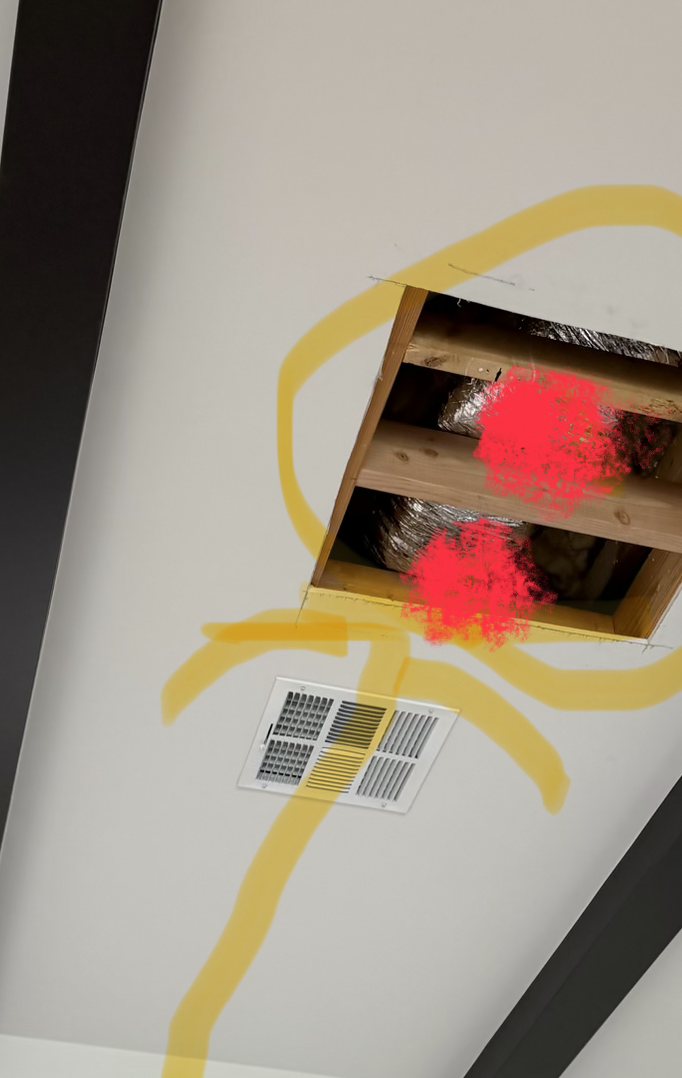
A Phoenix ceiling opened up on a Norem job. This one was opened deliberately, for a fixture. Water found late opens the same ceiling, except the framing is wet and the drywall, texture and paint all follow. Real Norem project photo.
What do home watch services do on a visit?
Roughly 45 minutes to an hour and a quarter on a typical Valley home, longer on a larger property or one with a casita. Grouped the way houses actually fail rather than by system, because "is anything wet" is a more useful question than "how is the plumbing."
One thing we do not do: sell this as a numbered point count. Competitors advertise 45-point and 56-point inspections, and a bigger number is not a better visit, it is a longer list with more items that get ticked without being looked at. What you get instead is somebody who repairs these things for a living walking your house.
Leaks and anything wet
- Under every sink, at the base of every toilet, around the water heater
- Ceilings and walls below bathrooms, photographed so stains can be compared visit to visit
- The washer connections and the ice maker line
- The water heater pan and drain
- Any change to a stain we already have a photograph of
Heat and power
- The indoor temperature, read and recorded every visit, so you can see the trend
- Whether the air conditioning is actually running and the thermostat still holds its setting
- Thermostat batteries, which die on their own over a long absence
- The air filter, because five months on one filter is an airflow and freeze-up problem
- Whether anything has tripped and the refrigerator and freezer are still cold, if you left them running at all
- Smoke and carbon monoxide alarms chirping
Running the house
- Main opened, every tap and shower run, every toilet flushed, then the main shut again
- A few ounces of mineral oil down seldom-used traps and floor drains, which slows evaporation and keeps the seal
- Ice maker stop and laundry box valves left shut, washer lid left open
- Disposal run
- Dishwasher and washing machine cycled on the schedule you want
- Water heater left in vacation mode
- A vehicle started if you left one and have asked for it
Outside
- A walk of the full perimeter, not a look from the driveway
- Doors, windows, gates and the garage, all confirmed secured on the way out
- Roof and patio cover looked at from the ground after wind
- The condenser coil after a dust storm, which packs with dust and palo verde debris and drives head pressure up
- Pool level, clarity and whether the equipment is running
- Irrigation running or not running, and any wet ground that should be dry
- Mail, packages, flyers and anything else advertising that nobody is home
What has moved in
- Bee activity at soffits, wall cavities and valve boxes
- Droppings, nesting or gnaw marks in the garage and around the attic access
- Birds under the patio cover
- Open gaps a hose bibb, a vent or a soffit has developed
Whatever else you asked for
- Meeting a pool, landscape or cleaning service at the house and confirming they came
- Letting in a service you have scheduled and locking up afterward
- Opening or closing the house at either end of the season
- Anything specific to your property that you tell us about at the walkthrough
The visits are not on a fixed day of the week. A car in the same driveway at 10 a.m. every Tuesday is a pattern, and a pattern is information for anybody watching the street.
What do you get after each visit?
A dated email the same day with photographs: the time somebody was in the house, the indoor temperature reading, photographs of anything that changed, photographs of the ordinary things too so next month's photograph has something to be compared against, and a short note in plain language. Anything urgent gets a phone call, not an email.
What we do not have, said up front rather than left for you to find out: no customer portal, no app, no GPS check-in stamp. Several operators in this market sell those, and if a live dashboard is what you want, one of them is a better fit. What an email gives you instead is a record you own. It sits in your own inbox, in order, timestamped by something other than the company that sent it, and you can forward the whole thread to a claims adjuster without asking anybody's permission.
The comparison photograph is the part that does the work. A stain on a ceiling means nothing on its own. The same stain photographed on four consecutive visits is either stable or spreading.
How often should a vacant home be checked in Arizona?
Every two weeks from October through April. Weekly from May through September.
The cadence should be set by how fast the fastest-moving failure gets expensive. In the cool months most of what goes wrong is slow, and two weeks is a reasonable exposure window. In summer three things change at once: the air conditioning becomes load-bearing for the contents of the house, pool chemistry moves fast enough to turn between visits, and storm season sits inside those months and arrives on no schedule at all.
Monthly is a real option and we sell it, but be clear what you are buying. A month is long enough for a leak to move from a plumbing repair into flooring and drywall. It is a sensible plan for a smaller, low-risk property or for the cooler half of the year, and a thin plan for a five-bedroom house with a pool in July.
Two things legitimately change the answer. A leak-detection device with an automatic shutoff shortens your exposure on the most expensive failure mode there is, and Arizona's own insurance regulator suggests homeowners consider one. And if your property has no pool, no irrigation and no landscape worth losing, most of the summer argument disappears with it.
What does your homeowners policy say about leaving the house empty?
Less than the internet claims, and the part that matters is not the part people have heard of. This is written against the standard ISO Homeowners 3 Special Form. Yours may be amended, and the only way to know is to read your own declarations page.
The clause everybody has heard of is the 60-day vacancy provision, and it is narrower than its reputation. On the standard form it removes coverage for vandalism and malicious mischief, and separately for glass breakage, "if the dwelling has been vacant for more than 60 consecutive days immediately before the loss." That is its whole reach. Pages claiming it also voids theft and water damage are wrong about that form. There is also a definitional point in your favor: a furnished seasonal home you return to every October is generally unoccupied, not vacant. If a home watch company tells you your policy is void because you left for the summer, be skeptical.
Now the part that matters. Your policy imposes duties on you when there is a loss. The carrier "has no duty to provide coverage under this policy if the failure to comply with the following duties is prejudicial to us," and those duties include giving prompt notice and protecting the property from further damage. There is a separate exclusion for neglect, defined as failing "to use all reasonable means to save and preserve property at and after the time of a loss."
Read those against a leak that began in May and was found in October. Notice was not prompt. The property was not protected from further damage. Neither depends on the house being legally vacant or on any 60-day clock. That is the real exposure, and a dated record of scheduled visits with photographs is the direct answer to it: it shows the property was being looked after, and it dates the loss.
We are contractors, not insurance advisers. Call your agent, ask what your form says about an unoccupied residence, and ask whether a documented periodic check changes anything for them.
What happens when we find something broken?
You get a call, photographs, and a number, and then we do the work. That last part is why you would hire a contractor for this instead of a home watch specialist.
An inspection-only service finds water on the floor and sends you a photograph, and there the report ends, because repair is outside what they sell. One Scottsdale firm states it directly: it "does not perform property services, we manage the professionals who do." A West Valley operator bills the coordination itself at $45 an hour with a two-hour minimum.
What happens here instead: the same person who found it writes the scope, you get a number before anything starts, and the work is carried on our contract under ROC #365090. Everyone who works on your home is licensed for the work they are doing, and permits are pulled where a permit is required.
The authorization rule, so nothing is ambiguous while you are two time zones away. Stopping active damage happens immediately and we tell you as we do it: shutting a valve, killing a breaker, moving what is in the water's path, getting the water out. Anything past that gets a written scope and a number and your approval first.
Is a home watch company licensed to fix what it finds?
Usually not, and this is the easiest thing on this page to check for yourself. Arizona publishes a free contractor license lookup. Take any company you are considering, including this one, and search the name.
We did exactly that across ten Valley operators in September 2026. Not one publishes an Arizona ROC number. The patterns: "licensed and insured" with no number and no class, which is the most common by a wide margin; a trade-association certification number presented where a state license number would go; one firm whose only named contractor license is in Wisconsin; and two that never raise the subject.
Why it matters comes down to a dollar figure. An unlicensed person in Arizona may take work only under the handyman exemption at A.R.S. § 32-1121, which stops at $1,000 for the whole job including materials and disappears the moment the work requires a permit. More on where that line falls on our handyman page. A water heater, an air conditioner, a slab leak and an electrical panel all cost more than $1,000, and in Phoenix the permit exemption for replacing a water heater applies only when a licensed contractor does the work.
One correction, because we would rather be accurate than persuasive. A licensed home watch operator is not impossible, and at least one Valley firm does hold an Arizona specialty license. The pattern is not that they are all unlicensed. It is that none publishes a number you can verify, and a Class B general scope is broader than a specialty one. Ask for the number.
Home Watch Price Chart, Phoenix 2026
How much does a home watch service cost in Phoenix?
A single visit is $75 for a home up to 3,500 square feet, and the monthly plans run $75 to $260 depending on how often somebody is there. Base prices cover a home up to 3,500 square feet, which is where the market sets its break too.
| Plan | Visits | Price | Per visit | What drives it |
|---|---|---|---|---|
| Single visit | One, on a date you pick | $75 | $75 | For a trip, not a season. No schedule, no commitment. The same visit as any other row. |
| Monthly | 1 per month | $75 / month | $75 | Low-risk properties and the cooler half of the year. A month is a long gap in July. |
| Every two weeks | 2 per month | $140 / month | $70 | The default for October to April, and the minimum we would suggest on a house with a pool. |
| Weekly | 4 to 5 per month | $260 / month | $52 to $65 | May through September, and any property where the pool, the landscape or the contents carry real value. |
| Larger home | Any plan | +$15 / visit | — | 3,500 to 5,000 sq ft. More rooms, more fixtures, more perimeter, more time. |
| Large home | Any plan | +$30 / visit | — | 5,000 to 6,500 sq ft. Above 6,500, or multiple structures, we price it at the walkthrough. |
| Pool on the property | Any plan | +$10 / visit | — | Level, clarity and equipment checked every visit. This is not pool service; see the add-ons below. |
| Casita or guest house | Any plan | +$15 / visit | — | A second structure is a second set of fixtures, a second air conditioner and a second door. |
A five-month season on a typical 2,400 square foot Valley home with a pool, visited weekly from May through September, runs about $1,500. The same house every two weeks from October through April is about $1,120. Both figures include the pool add-on at $10 a visit.
Getting the house opened and closed
| Add-on | Price | What it is |
|---|---|---|
| Closing the house | $150 | The full departure pass: main shut off, water heater to vacation mode, thermostat set, appliances handled, timers and alarms checked, everything photographed so we both have a record of the state you left it in. |
| Opening the house | $150 | The reverse, done two to three days before you land so a problem is found before you are standing in it, not after. |
| Both, booked together | $250 | Same work, one commitment. |
| Meeting a service at the house | $45 / hour | Letting in a pool, landscape, cleaning or delivery service and locking up afterward. Charged only when you ask for it. We do not charge to coordinate a repair we are carrying. |
| Extra unscheduled visit | $75 | You want eyes on it after a storm, or a neighbor called. Same visit, same report. |
| Repairs found on a visit | Quoted before we start | Written scope and a number for your approval. Stopping active damage happens first and we tell you as we do it. |
What the rest of the Valley publishes
Most operators in this market do not put prices on their website at all. Here is every published figure we could find, read directly from their own sites and profiles.
| Where | Published rate | What it covers |
|---|---|---|
| East Valley operator, Thumbtack profile | From $35 / visit | "Our rates start at $35 per visit and go up from there depending on the location, size of home and tasks that are required." |
| Scottsdale specialist, FAQ | From $50 / visit | Stated as a starting price for a standard property such as a condominium, adjusted upward by complexity. No rate card published. |
| West Valley operator, published rate card | $59 / $99 / $179 per month | One, two and four visits a month, homes to 3,500 sq ft, then +$15 and +$30 a visit in the same size bands we use. |
| East Valley operator, published rate card | $80 / $140 / $260 per month | Once monthly, twice monthly and weekly, single-family homes. Separate annual pricing for manufactured and park-model homes from $225 to $859 a year. |
| Scottsdale estate firm | $2,500 to $9,000 per month | Full estate management retainers. Home watch is bundled into a much larger service, and the firm states it does not perform property work itself. |
| Everyone else in the set | Not published | Five of the ten publish no figure of any kind. You get a price after a phone call and a site visit. |
Read directly from each company's live website or public profile on 8 September 2026. Rates change, and two of these already differed from what search engines had cached.
Caught early versus found in October
These are Valley market rates for whichever trade does the work, not our rate card. Everyone who works on your home is licensed for the work they are doing.
| What went wrong | Caught early | Found in October |
|---|---|---|
| Supply line or angle stop lets go | $50 to $165 diagnostic, plus labor at $70 to $170/hr | Mitigation at $3.50 to $7.50+ per sq ft, plus flooring, drywall and cabinetry |
| Water heater fails | $1,500 to $2,800 replaced, 40 to 50 gallon | Same replacement, plus the damage. Main shut, it is 50 gallons on the floor. Main on, the tank keeps refilling until somebody stops it |
| Air conditioning stops in July | A capacitor and a service call | Five months of a house held above every material limit in it, and a machine nobody looked at |
| Condensate drain clogs | A drain cleared, $100 to $375 | The system shut itself off on the float switch in June, or the secondary pan failed and it went into the ceiling |
| Pool chemistry goes | Balanced on the next service | Green-pool recovery, days of it, and a mosquito problem |
| Auto-fill quits, level drops | Topped up on the visit, pool contractor on the auto-fill valve | Pump seal, then the motor |
| Irrigation line sticks open | Line repaired | Water billed at $6.13 per 748 gallons above the summer allowance, plus wet ground at the foundation |
| Irrigation stops | Controller or valve fixed | A mature landscape, which your policy covers for eight named perils and $500 a plant |
What makes one house cost more than another?
Four things, and all four are time on site. Size, because a visit is a physical walk, and our bands break at 3,500 and 5,000 square feet where the one Valley firm publishing size bands breaks its own. What is on the property besides the house. A pool adds checks every visit, a casita is a second building with its own fixtures and its own air conditioner, and mature landscape on irrigation is a system with failure modes. Where it is, because the driving is real, and a property well outside the areas we run adds travel we would rather tell you about at the walkthrough than build invisibly into a rate. And how much you want done: meeting a landscaper at the gate, cycling a washing machine monthly, starting a car, opening and closing the house at either end of the season.
When should you set up home watch?
Before you leave, not after. The walkthrough is the part that makes the service work and it has to happen while you are standing in the house.
March and April are the right time to call. You are still here, the house can be walked properly, keys and codes get handled face to face, and the schedule starts the week you leave rather than three weeks into the heat. May and June are when most people call, generally the week they are packing, which works, it is just compressed. July and August calls are almost always a problem already in progress. And September or October is worth a call even if you never wanted a subscription: a single visit two or three days before you land turns a bad homecoming into a phone call you get while you are still packing, and it costs $75.
Can a neighbor or a camera do this instead?
Sometimes yes, and it is worth being straight about when.
A neighbor genuinely works if they are here through the summer, which rules out most of the people you would ask in a seasonal neighborhood, and if they will go inside rather than look at the front of the house from the street. Reliability is not usually where it breaks down. What happens next is: a neighbor finding water on the floor at four on a Saturday in July has your key and no authority, no contractor and no way to make a decision for you.
Cameras and sensors are genuinely useful and we recommend them. A leak-detection device with automatic shutoff is the one piece of technology worth buying for an empty Valley house. A smart thermostat with alerts tells you when the temperature is climbing. What none of them do is smell, or look under a sink, or notice the stain on the ceiling is bigger than last month, or find wet ground on the side of the house nobody points a camera at. And all of them assume power and internet, both of which the storm that caused the problem tends to take out first. Sensors and a schedule work together.
Then there are the free programs. Several Valley police departments and community posses run vacation watch programs at no cost. If your budget for this is zero, sign up for yours. Two things to understand: they are exterior only, so nothing inside is being looked at, and the departments do not guarantee the checks happen on any particular day. It is worth having in addition. It is not a substitute for somebody going inside.
When we will tell you not to buy this
You are gone two or three weeks. USPS Hold Mail runs a minimum of 3 days and a maximum of 30, which is a useful boundary: if your trip fits inside a mail hold, it probably does not need a service.
Your house is low risk and you have good sensors. A small home, no pool, no irrigation, a leak detector with auto-shutoff and a smart thermostat you watch. Monthly is plenty and weekly is us taking your money.
You have family in the Valley who will actually go inside. Not "check on the house," go inside. If that is real, you already have the service.
You want a portal, an app and GPS-stamped check-ins. We do not have those, and two or three operators in this market do it well.
You want somebody living there. That is house sitting, a different service with a different risk profile, and we do not do it.
How do you handle keys, gate codes and alarm codes?
Access is set up face to face at the walkthrough, in writing, listing exactly what we hold: keys, gate and garage codes, the alarm code and the alarm company's password, and who else has access. If a code changes while you are away it changes on that document too.
Our preference is a lockbox or a smart lock with a code of its own rather than a key that travels, because a code can be changed the day the arrangement ends and a copied key cannot. If you use a smart lock we would rather have our own code than share yours, so your log tells you who opened your door and when.
Your alarm company needs us listed as authorized or your first visit becomes a false alarm and eventually a fine. A gated community usually needs a vendor registration and sometimes a transponder, which takes longer to arrange than people expect and is a good reason to handle this in March. We are a small contractor, not a security company, and we are licensed, bonded and insured, ROC #365090.
What else makes sense to do while the house is empty?
An empty house is the best working condition a contractor ever gets. Nobody has to move out, cover furniture or live around a crew, and the setup and protection that come with working around people are a large share of what interior work costs. Work folded into that window commonly comes in 25 to 50 percent below what the same list costs as its own separate trips. The catch is timing: it has to be on the quote before you leave, not decided by email from wherever you are in July.
The obvious candidates are the ones that need the house unoccupied. Interior painting is the clearest, because a whole-house repaint in an empty home is a fundamentally easier job. Flooring is the same argument and more so. And an epoxy garage floor requires the garage to be completely empty, which is the hardest condition to arrange in an occupied home and is already true of yours all summer.
Then there is the list a season of visits generates on its own: the drywall and ceiling repair where something leaked, the fence panels or gate the August storm took, the exterior paint on the west elevation that is chalking. Booked as one bundled list in September, you land in October to a house that is finished rather than a list of jobs to chase.
Hiring questions homeowners ask us
Do you charge for the walkthrough that sets the price?
No. Somebody comes out, walks the property with you, and you get a written price and a plan for your specific house. The walkthrough is also where access, alarm codes, the water main and the irrigation get written down, so it is useful whether or not you hire us. If you are already gone, we can price it from photographs and a video call and confirm on the first visit.
Are you accredited by the National Home Watch Association?
No, and you should know what that means in both directions. The NHWA is a private trade association that vets member businesses and requires background checks and insurance, and several good Valley operators hold it. It is the strongest credential in this category and a fair thing to ask for. What it is not is a state license. What we hold instead is Arizona ROC #365090, a Class B General Residential Contractor license issued by the state, which you can verify yourself on the ROC's public lookup in about a minute, and which is what allows us to carry the repair rather than hand you a phone number.
What should I ask the other companies I am getting quotes from?
Four questions, and the answers separate the field faster than the prices do. What is your Arizona license number, and what class is it? What happens between finding a problem and it being fixed, and what do you charge for that part? Do you go inside every visit, and will you send me a photograph of the same ceiling every time so I can compare? And who actually comes to my house, and what happens when that person is away?
Are you licensed to actually fix what you find?
Yes. Norem Contracting holds Arizona ROC #365090, Class B General Residential Contractor, licensed, bonded and insured. We carry the contract for the work, permits get pulled where a permit is required, and everyone who works on your home is licensed for the work they are doing. That is the difference between this and an inspection-only service, whose report has to end with a referral because repair is outside what they sell.
How quickly can you start, and what do you need from me?
Usually within a week of the walkthrough. Access is the part that takes the longest, and there is a full breakdown of keys, codes, alarm authorization and gated-community registration further up this page. The other half is the specifics of your house: where the water main is, what runs off it, what the irrigation controller does, and anything you already know is fragile.
Am I locked into a contract?
No minimum term, no cancellation penalty, and you can change the frequency mid-season, which most people do at least once when the weather turns. We would rather you moved from weekly to every two weeks in October than cancelled and started again next May. Worth knowing that no-contract is normal in this market rather than a concession, so do not let anybody sell it to you as one.
Home watch across the Phoenix metro
We take home watch work in Phoenix, Scottsdale, Paradise Valley, Cave Creek, Fountain Hills, Tempe, Mesa, Chandler, Gilbert, Glendale, Peoria and Queen Creek. If your property sits well outside where we run, tell us at the walkthrough and we will either price the travel honestly or tell you we are the wrong fit. Here is the rest of what we do.
Related: why a Phoenix yard dies over one summer · keeping the heat out of a closed-up house · see our completed work

Written by Harrison Norem, Licensed Class B General Contractor, AZ ROC #365090. About Harrison
Set It Up Before You Leave
Tell us where the house is, roughly how big it is, whether there is a pool, and when you are going. You get a written price and a plan for your specific property, and the walkthrough that sets it costs nothing. Licensed Arizona contractor, ROC #365090.
Request Free Estimate