Hanging a chandelier on a 16 to 26 foot ceiling costs about $900 to $3,000 or more in labor, according to Modern Chandelier's 2026 installation cost guide, and most of that money buys access. A two-story great room needs a rolling scaffold tower or a 19-foot scissor lift instead of a ladder, and Valley rental yards list that lift at $123 to $283 a day. Size the fixture to the volume: about 2.5 to 3 inches of chandelier height for every foot of ceiling, so a 20-foot ceiling wants a fixture roughly 50 to 60 inches tall. Then settle the mounting before the fixture ships, because a lot of great rooms in North Scottsdale, Paradise Valley and Cave Creek sit under a vault, exposed beams, a wood ceiling or a flat foam roof, with no attic to work from.
If the piece is a heavy Restoration Hardware, Arhaus or Pottery Barn chandelier, what those weigh and what the code asks of a ceiling box are in our designer chandelier guide. The service itself, from a single pendant to a two-story ring fixture, is on the chandelier and light fixture installation page.
What Changes Once the Ceiling Is 16 Feet or Higher?
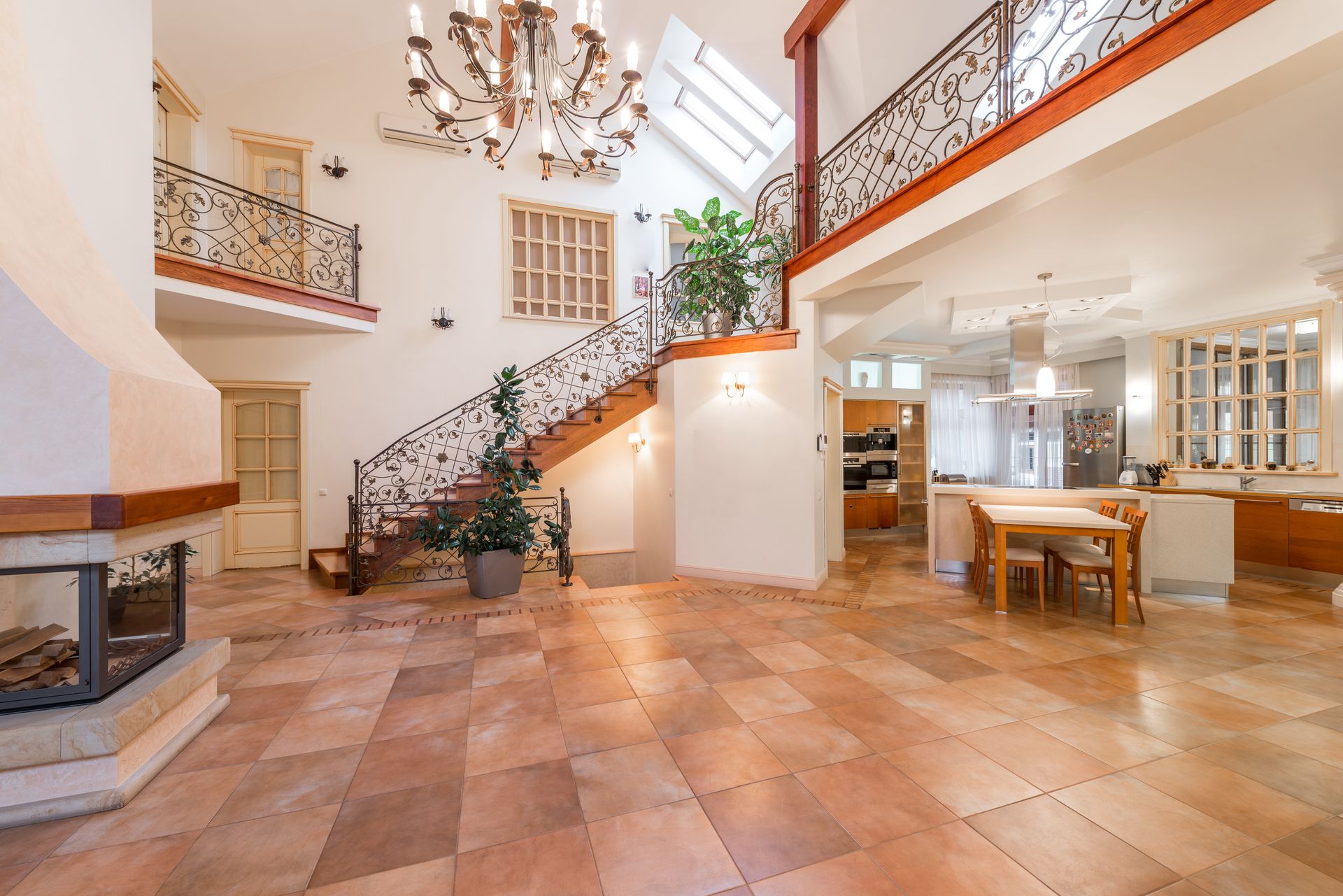
Access changes first: at 16 feet and up the job starts with a scaffold tower or a lift instead of a ladder. On a standard or raised ceiling, a chandelier goes up off a good ladder with a second person taking the weight. Higher than that, nobody should be holding a fixture over their head from a ladder leaned into open space. The scaffold or lift has to come through the house, stand on a finished floor and fit around the furniture, the stair and the railing.
Height changes the order of the work too. Most fixtures get put together on the floor, on moving blankets, where every arm and socket can be checked before anything leaves the ground. Some glass and crystal goes on only after the frame is hung, piece by piece from the platform. A fixture hung 8 feet below its canopy swings farther from a bump and takes longer to settle, and air from a nearby supply register can keep it drifting. On rigid stems, the same length puts more leverage on the canopy and the mount. The canopy and the mounting get checked for movement before the glass goes on, while it is still easy to get at them.
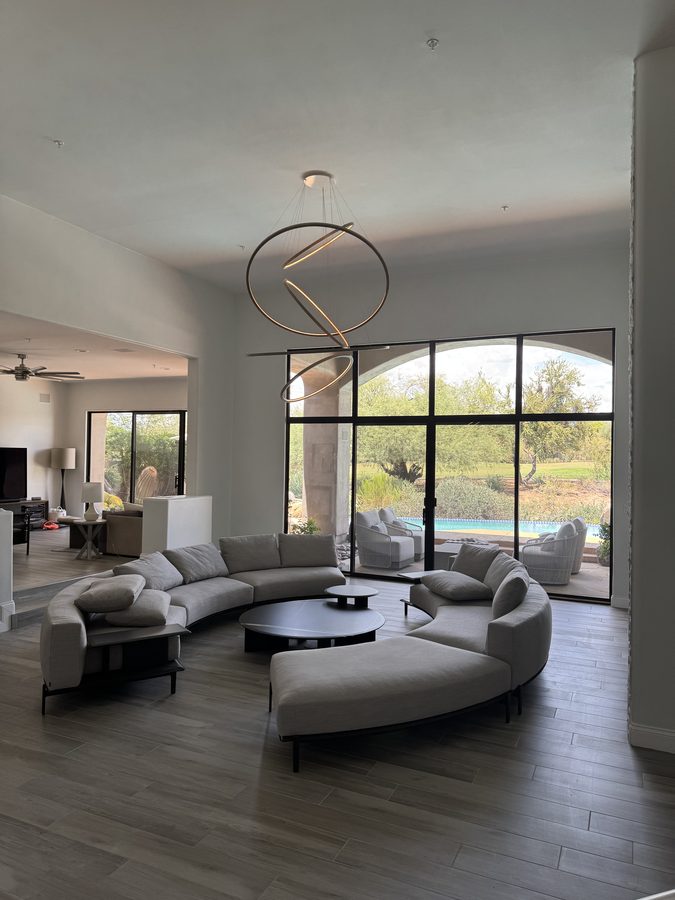
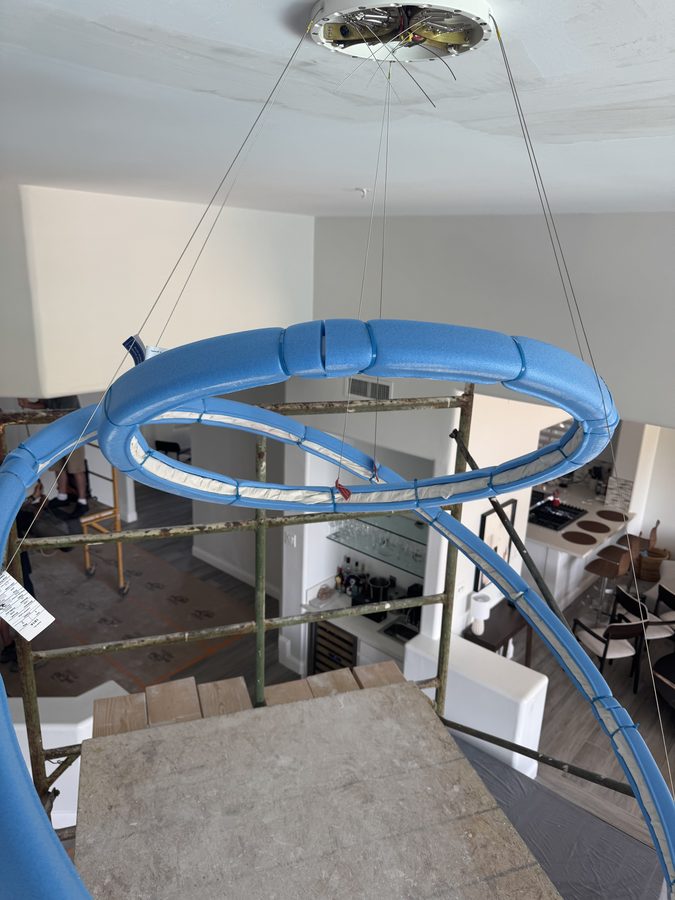
Level gets judged from more than one place. A fixture that reads level from the sofa can read tilted from an upstairs landing, so in a two-story room it gets checked from both. On the North Scottsdale ring chandelier in our statement lighting job, the rings were adjusted until they read level from every angle on the floor below.
How Big Should a Chandelier Be for a Two-Story Room?
For a 20 by 18 foot great room under a 20-foot ceiling, two common rules of thumb point to a chandelier about 38 inches across and 50 to 60 inches tall. For diameter, Visual Comfort's sizing guide adds the room's width and length in feet and reads the total as inches. For height, 1800Lighting's guide to 20-foot ceilings allows 2.5 to 3 inches of chandelier for every foot of ceiling.
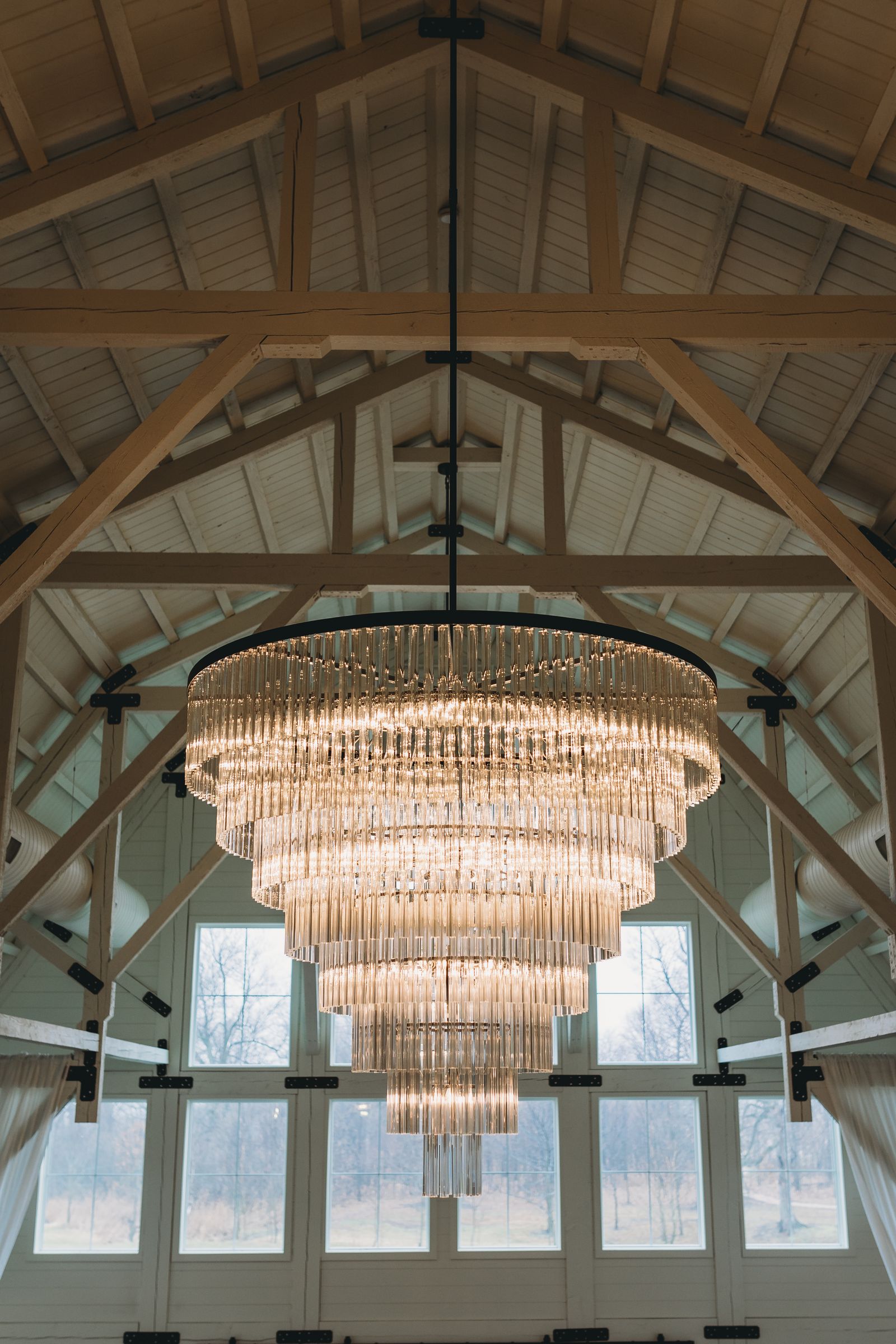
The two rules pull in different directions in a tall room, and the height rule is the one people skip. A 38-inch drum that looks right on paper can read like a pendant under a 20-foot ceiling, because the eye measures it against the wall above it as much as the floor around it. Tiered and multi-ring fixtures fix that by adding height without adding much width. In an open plan, size to the zone the fixture hangs over rather than the whole footprint, so a chandelier over the seating group in a long great room isn't sized as if it also had to light the kitchen.
Chandelier height by ceiling height
| Ceiling height | Fixture height at 2.5 to 3 in per foot | Typical room |
|---|---|---|
| 8 ft | 20 to 24 in | Dining room on a standard ceiling |
| 12 ft | 30 to 36 in | Raised dining room or entry |
| 16 ft | 40 to 48 in | Entry or great room under a vault |
| 18 ft | 45 to 54 in | Two-story foyer |
| 20 ft | 50 to 60 in | Two-story great room |
| 24 ft | 60 to 72 in | Tall great room or stair hall |
Fixture height from 1800Lighting's 2.5 to 3 inches per foot of ceiling. Tiered, linear and cascading fixtures can run well past these numbers on purpose, so treat the table as a starting point.
Mock it up before you order. A circle of cardboard cut to the diameter and raised to the planned height on a painter's extension pole is the quickest check there is. Look at it from the front door, from where people sit, and from the upstairs landing. If it disappears from the door, it's too small.
How Low Should It Hang When There's a Second-Floor Overlook?
In a room with an upstairs landing or bridge, the right height is the one that looks right from both levels, and the upstairs view usually decides it. The clearance minimums over walkways and the usual foyer rule are in our designer chandelier guide. A two-story great room adds three judgment calls on top of those.
Read the height from the balcony. With the second floor at about 10 feet, a person standing at the railing has their eyes roughly 15 feet above the main floor, so a fixture whose body spans 10 to 15 feet off the floor sits right in their line of sight across the room. Some owners want that, a fixture you see eye to eye from the landing. Others want the view to the far windows kept clear, which means hanging the fixture lower so it reads as part of the room below. Decide which before anyone orders chain.
Then think about what the fixture hangs over. Over a walkway it needs walking clearance. Over a seating group or a coffee table it can come lower, because nobody walks there. Over a dining table, the table sets the height and the ceiling doesn't.
Last, get the chain or stems for that height on the order. Many fixtures ship with a fixed amount and extra is a separate order. Others ship adjustable: Arhaus sends its Delsie oval with 24 rods in three lengths, so the drop gets set on site. A fixture that arrives a foot short of the planned height stays there until more chain arrives.
Ladder, Scaffold or Scissor Lift: What Does a 20-Foot Ceiling Take?
A 20-foot ceiling takes a rolling scaffold tower or a 19-foot electric scissor lift, and the room decides which. A ladder belongs on standard and raised ceilings, and in the middle of a two-story room there is no wall to lean one on. Modern Chandelier's guide calls for scaffolding or a lift at 16 to 20 feet and a mechanical lift at 20 to 26.
How a high fixture gets reached
| Access | Ceiling it suits | What the floor carries | Setup | Best for |
|---|---|---|---|---|
| Ladder | Standard and raised ceilings | Two or four ladder feet | Carried in | Light fixtures with a wall or a stable stance within reach |
| Rolling scaffold tower | Two-story rooms, stacked to the height needed | Four locking casters | Carried in by hand and built frame by frame in the room | Heavy fixtures, long assembly at height, rooms a lift can't get into |
| 19-ft electric scissor lift | Up to a 25 ft 3 in working height (Genie GS-1930) | 3,318 lb (Genie's 2019 spec sheet) on solid non-marking tires | Delivered and driven in | Open great rooms with a flat, clear path from the driveway |
| Stair scaffold or tracked atrium lift | Stairwells and over railings | Adjustable legs on the treads, or outriggers on pads beside the stair | The most planning of the four | Fixtures over a stair or an open landing |
Rental prices for the lift are in the cost section further down.
The Genie GS-1930 is a common 19-foot electric rental. The platform rises to 19 feet 3 inches for a working height of 25 feet 3 inches, carries 500 pounds of people, tools and fixture, and rides on solid non-marking tires. It is also 2 feet 6 inches wide and weighs 3,318 pounds on Genie's 2019 spec sheet. So the narrowest point on the route, usually a side gate or an interior door, has to clear it, and every travertine tile or large porcelain slab it crosses carries that weight on four small tires. Ram Board, a heavy-duty breathable floor protection sold in 38-inch by 100-foot rolls, goes down along the whole route, with plywood over it on tile and stone and wherever the machine turns.
A rolling scaffold tower, such as MetalTech's stackable Saferstack sections on locking casters, is the other route, and it is often the better one in a furnished house. It comes in by hand, builds up inside the room, and needs no clear path from the driveway. It takes longer to set up and to move, and it has to be built to the full working height, because OSHA's scaffold rule bars standing a ladder on the platform to gain height. Built toward 20 feet, a tower usually needs outriggers as well, since OSHA requires a scaffold more than four times as tall as its base is wide to be restrained from tipping.
Stairwells are the hard case. A fixture over a stair needs a stair scaffold with adjustable legs set on the treads, or a tracked atrium lift: a compact boom, narrow enough for a standard commercial doorway, that sets outriggers on pads beside the stair. That choice gets made on the walkthrough, not the morning of the install.
How Do You Mount a Heavy Chandelier With No Attic Above It?
From below, through the ceiling, into whatever framing is there, and the ceiling material decides how much of that shows afterward. In a tract house, blocking for a heavy fixture often goes in from the attic and the finished ceiling is never touched. Plenty of custom great rooms in North Scottsdale, Paradise Valley and Cave Creek have nowhere to stand above the fixture. Territorial and pueblo-style houses there carry flat roofs, parapet walls and exposed beams in the great room, as Rosie on the House describes them, and foam is the system most Scottsdale flat and low-slope roofs are built on, according to the Scottsdale roofer Durafoam. Under a flat roof with no accessible attic, or a vaulted ceiling that follows the roof framing, the support goes in from underneath.
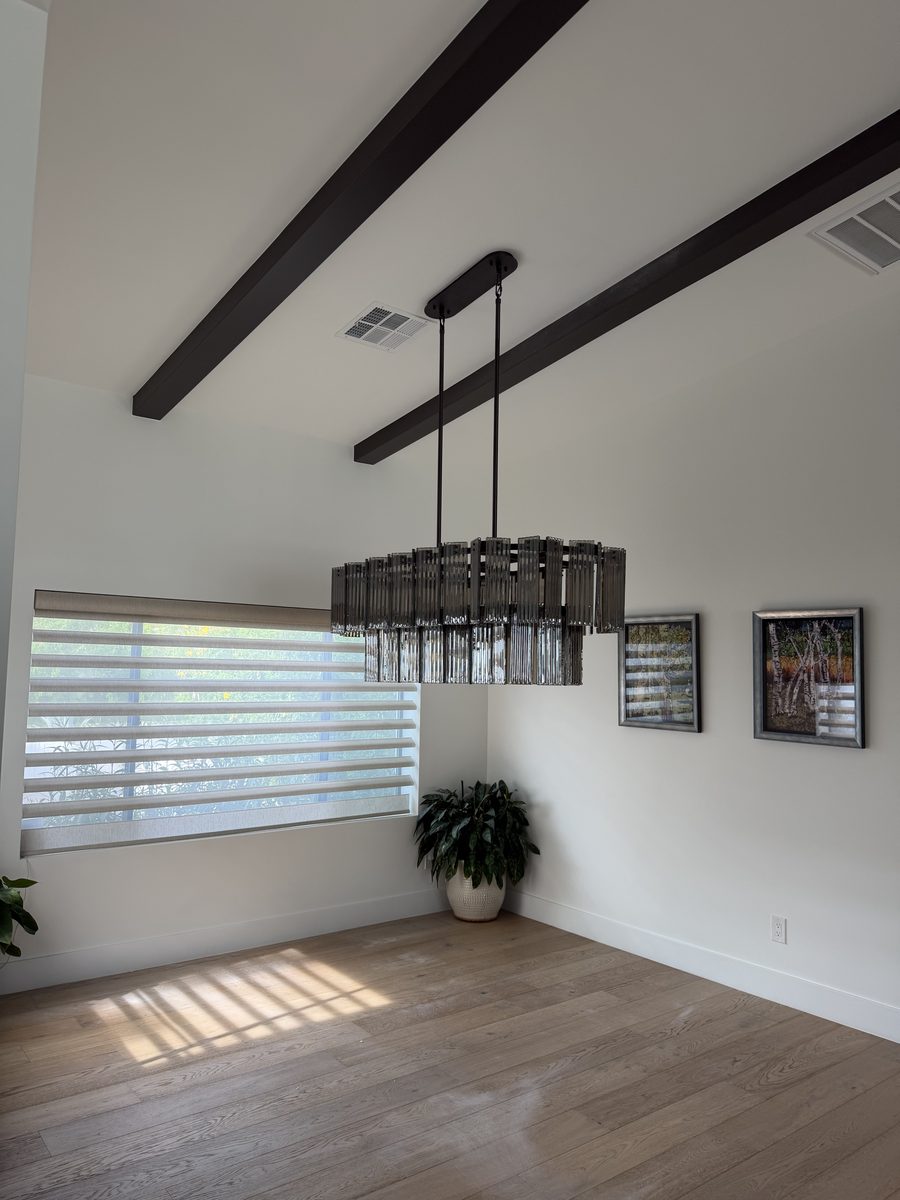
- A drywall vault. The ceiling gets opened at the mounting point, blocking goes in between the framing members, and the patch is finished and painted. That is how the 184-pound fixture in our oversized dining room chandelier job went up: the vaulted ceiling was opened from below at the fixture location, blocking built, then patched and painted. On a smooth ceiling, the patch is most of the schedule.
- A tongue-and-groove wood ceiling. There is no patch-and-paint fallback on finished wood, so the mounting point, the fastening and the wire path are settled before a single plank is touched. On the alabaster linear chandelier in our North Scottsdale job, the wood-plank ceiling meant the layout and fastening had to be right the first time, with the canopy flat against the planks.
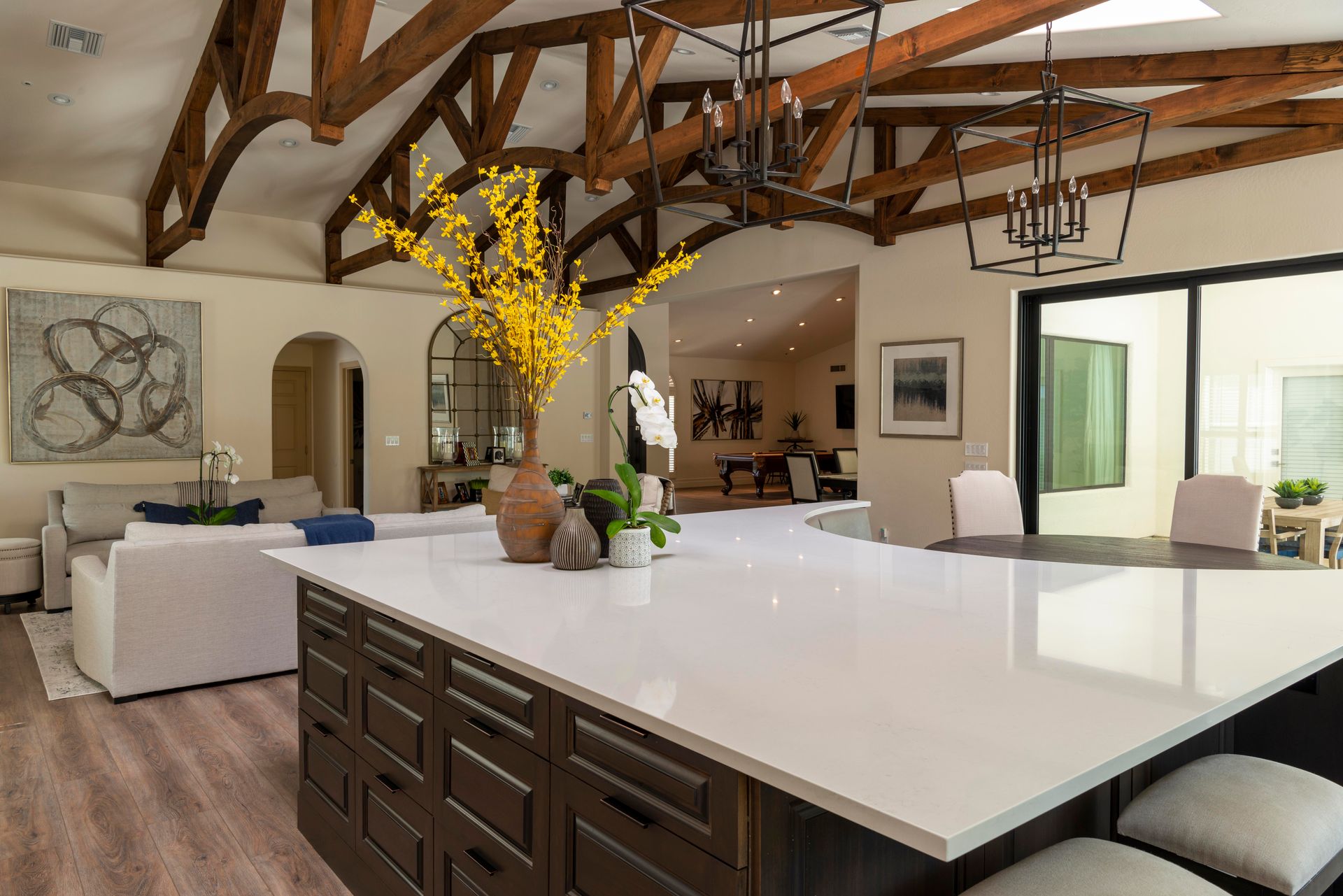
- A solid beam or viga. A solid timber or glulam beam is real structure, and a fixture can often hang from it directly when the mounting point lands on the beam and the power can reach it. Confirm it is structure first: some vigas and beams are decorative, fastened to the ceiling rather than carrying it. The catch is the wire. Running it along or through a finished beam without leaving a visible scar is the planning question, and on some ceilings it decides where the fixture can go. A structural beam, glulam especially, doesn't get notched or bored for a wire without the maker's or an engineer's sign-off.
- A box beam. Many beams in newer houses are hollow boxes of finished boards or drywall, and a hollow box holds nothing on its own. If the fixture has to hang from one, blocking goes inside it first.
- A flat foam roof. The framing bay between the ceiling and the roof deck is shallow and can't be reached from above, so the ceiling is opened under the mounting point, blocking goes in, and the patch closes it. The fixture hangs from that blocking, never from the roof sheathing above it, and no fastener runs long enough to come through the deck into the foam.
Two rules hold across all of them. The fixture can only go where the power can reach, so a new location on a wood or beamed ceiling gets planned around a real wire path, and a new box or wire run is electrical work handled on our contract, to code. And past 50 pounds the fixture needs support of its own, independent of the box, unless the box is listed and marked for the weight. The code section and the ratings of the common braces are in our designer chandelier guide.
Who Changes the Bulbs on a 20-Foot Chandelier?
Whoever comes back with the lift or the scaffold, unless the fixture is chosen so that visit is rare or a motorized lift brings it down to you. Bulbs are the first thing to get right. ENERGY STAR's lamp specification, retired at the end of 2024, required a rated life of at least 15,000 hours for decorative and omnidirectional LED lamps, and that is still a fair floor to shop for: at three hours a night it's more than a decade between changes. Buy the whole set at once from one product line, in 2700K, the warm color the Department of Energy describes for homes, and in 90 CRI or higher, then keep a few spares in the box. A replacement bought years later from a different batch can read slightly off in color next to the rest.
The dimmer matters as much as the bulb. A mismatched LED and dimmer flicker or buzz at the low end, and at 20 feet that is an expensive thing to troubleshoot. Lutron's Caseta, RadioRA 3 and HomeWorks lines are built around dimmers that work with a wide range of LED bulbs, and Lutron publishes an LED compatibility tool that pairs specific bulbs with specific dimmers. Check the lamp against it before anyone climbs. Fixtures with integrated LEDs skip the bulb question but move it to the driver, which means a repair at height if one fails.
For a heavy crystal piece that needs regular cleaning, a motorized lift ends the problem. Aladdin Light Lift makes residential lifts rated for 200 to 1,000 pounds that lower the chandelier for cleaning and bulb changes at the press of a button. What the hardware costs is in our designer chandelier guide. The catch in a great room is space: the lift needs room above the ceiling for its motor, which a flat roof with no attic may not have, so it gets decided while the mounting is still being planned.
Which Chandeliers Are Made for Tall Rooms?
Visual Comfort, Hudson Valley Lighting, Currey & Company, Arteriors, Hubbardton Forge, Schonbek, Bocci and Lindsey Adelman all make pieces that fit a two-story space. The useful filter is what a maker publishes: weights, drop options and sizes made for tall rooms.
- Visual Comfort & Co. The source of the room-dimension sizing rule above. Its 63-inch Talia ring, listed at 83 pounds, is a piece a two-story room can carry.
- Hudson Valley Lighting. Part of the Hudson Valley Lighting Group, which also includes Troy, Corbett and Sonneman, so a chandelier and the sconces around it can come from one company's catalogs.
- Currey & Company. Large-scale chandeliers such as the Saxon Large, and instructions that strongly recommend a professional electrician.
- Arteriors. Designer lighting and furniture. Its Bilal Round chandelier is 52 inches in diameter, a great room size by the rule above.
- Hubbardton Forge. Hand-forged in Castleton, Vermont, with large pieces like the Large Dahlia chandelier that suit the iron-and-timber look of a territorial great room.
- Schonbek. Crystal chandeliers, now owned by WAC Lighting. Crystal at height means a long assembly on the platform and a cleaning plan.
- Bocci 28. Cast-glass pendants hung as a cascade. Bocci builds a random cascade from the shortest and longest drop you give it, up to a technical maximum of 100 feet, and the Victoria and Albert Museum hangs 280 of them in a 30-meter drop.
- Lindsey Adelman. Branching Bubble chandeliers of hand-blown glass globes that can be designed to wander or sprawl to fit the space. The BB.09.39 is 80 inches wide.
Restoration Hardware, Arhaus and Pottery Barn make big pieces too, and they are among the heaviest. Their weights are in our designer chandelier guide. Whatever the brand, ask two things before ordering for a tall room: how much chain or how many stems come in the box, and what the spec sheet says the fixture weighs.
How Much Does High-Ceiling Chandelier Installation Cost in Scottsdale?
Labor alone runs about $900 to $2,200 or more at 16 to 20 feet and $1,200 to $3,000 or more at 20 to 26 feet, per Modern Chandelier's 2026 guide, before any added support for a heavy fixture. A lift adds $123 to $283 a day in rental from Valley yards when it's billed separately, and a ceiling that has to be opened, blocked and patched is its own line at $1,000 to $3,500 or more.
| Line item | 2026 range | What moves it |
|---|---|---|
| Install labor, 10 to 12 ft ceiling | $400 to $900 per fixture | Fixture weight, assembly time, how it hangs |
| Install labor, 12 to 14 ft | $500 to $1,200 per fixture | Same, plus taller access |
| Install labor, 14 to 16 ft | $700 to $1,700 per fixture | Scaffold time and assembly at height |
| Install labor, 16 to 20 ft, two-story foyer | $900 to $2,200+ per fixture | Scaffolding or a lift |
| Install labor, 20 to 26 ft | $1,200 to $3,000+ per fixture | Mechanical lift required |
| Added support, fixture 50 to 75 lb | +$50 to $150 per fixture | Brace or blocking at the mount |
| Added support, 75 to 150 lb | +$150 to $400 per fixture | Blocking sized to the weight |
| Added support, 150 to 300 lb | +$300 to $700 per fixture | Blocking and a plate into the framing |
| Added support, over 300 lb | +$700 to $1,500+ per fixture | Structure behind the ceiling |
| 19 ft electric scissor lift rental | $123 to $283 per day; $308 to $717 per week | Yard, delivery distance, days on site |
| Ceiling opened, blocked, patched and painted | $1,000 to $3,500+ per fixture location | Height, texture or smooth finish, what is in the cavity |
| New box and wiring where none exists | $400 to $800+ per location | Distance to power; done on our contract, to code |
| Motorized chandelier lift, hardware only | $1,149 to $2,999 sale, $2,310 to $6,180 list, per lift | Capacity, 200 to 1,000 lb |
Labor and support rows from Modern Chandelier's 2026 installation cost guide. Lift rates from Motor City Rental in Phoenix, The Home Depot's Thomas Road rental center in Phoenix, and DOZR listings for yards in Avondale, Apache Junction and Queen Creek, read October 2026. HomeGuide's 2025 guide puts a new chandelier on a high ceiling at $700 to $2,000 in labor, inside the 14 to 20 foot rows here. The ceiling, new-box and motorized-lift rows are the same figures as our designer chandelier guide and ceiling fan page.
Weight and height multiply. A 40-pound drum on a 12-foot ceiling is a morning off a ladder. A 200-pound tiered piece at 22 feet is a lift rental, a support add-on and possibly an opened ceiling, which is how one fixture reaches the middle four figures. A second high fixture in the same room, hung on the same rental, is where the cost per fixture drops.
Send Us the Ceiling Height and the Spec Sheet
A photo of the room from the doorway, one from the upstairs landing if there is one, the ceiling height, and the fixture's product link or spec sheet. We'll tell you how it gets up there, what holds it, and what the install costs.
Free Install EstimateWhat Should Be Ready Before Install Day?
A finished spec sheet, a decided hang height and a clear path for the equipment. Every item below is something the owner can settle before the crew arrives.
- The spec sheet. Fixture weight, overall height, diameter, and how much chain or how many stems come in the box.
- The hang height. Decided from the floor and the landing, with extra chain ordered if the fixture needs it.
- The circuit labeled. The breaker for the fixture marked at the panel, and the wall control that will run it chosen, so the right dimmer is on hand.
- The path measured. Side gate, front door and interior openings measured against the lift or scaffold that is coming, and the route from the driveway to the room agreed.
- The floor covered. Travertine, large porcelain and wood get protection along the route and under the work area before any equipment rolls in.
- The room cleared. Furniture out from under the fixture and out of the path, art off the nearby walls.
- The gate told. In a guard-gated community, the delivery and the crew go on the gate list ahead of time, so the lift truck isn't turned around at the gatehouse.
What Do Owners of Two-Story Rooms Ask About Chandeliers?
Can a chandelier hang in front of a two-story window?
Yes, and it is one of the best places for one, as long as it's centered on the glass and sized to read against it. Visual Comfort's foyer guide says a chandelier in front of a window above the front door should be centered and visible from outside. On west-facing glass the fixture sits in front of the sunset for part of the evening, so expect it to read as a silhouette at that hour, and leave room between the fixture and the glass for whoever cleans the window.
How do you clean a chandelier on a 20-foot ceiling?
From the same lift or scaffold it was hung from, with the power off and the lamps cool. For crystal and glass, a spray-on cleaner like Hagerty Chandelier Cleaner drips dry without wiping, with towels spread on the floor below to catch the runoff. Plan on it after monsoon season, when haboob dust settles on every horizontal surface of the fixture. A motorized lift that lowers the chandelier to the floor takes the equipment out of the job entirely. Let it dry completely before the power goes back on.
Can a chandelier and a ceiling fan share a great room?
Yes, with distance between them. Fan blades turning between your eye and a bright fixture throw a flicker across the room, and the moving air can set a long-chained chandelier swaying. Hunter recommends fan blades sit at least 7 feet above the floor, and its downrod chart stops at 72 inches for a 15-foot ceiling, so in a 20-foot room the fan hangs on the longest rod its maker allows, over the seating, and the chandelier takes the center of the volume or the entry.
Do I rent the lift, or does the installer bring it?
The installer should arrange it, and it should be priced in the quote. Whoever orders the lift is responsible for getting it in and out of the house without damage, and the crew that runs one regularly knows what the floor, the gate and the doorways need. Valley rental yards list a 19-foot electric scissor lift at $123 to $283 a day. Ask for access as its own line on the estimate so you can see what it costs.
How much chain should I order?
Enough to set the bottom of the fixture at the height you chose, plus about a foot. The drop is the distance from the ceiling to that height, less the fixture and the canopy. Extra chain comes out link by link on site, while missing chain means another order and another trip with the lift. The spec sheet lists how much comes in the box, and some fixtures sell extensions separately, so compare the two before the order goes in.
What Else Is Worth Doing While the Lift Is in the Great Room?
Anything else that lives above about 12 feet in the same room or the next one. The lift or the scaffold is the expensive part of every high job, and once it is standing, the second and third task on it cost a fraction of their own trip. Work added to the same estimate commonly comes in 25 to 50 percent below what it costs as a separate visit, as long as it's agreed before the equipment arrives.
- The great room fan. A fan on a long downrod in the same volume goes up from the same platform. See ceiling fan installation.
- The two-story wall. Repainting the tall wall above the landing is a scaffold job on its own. With the scaffold already up, it is a painting day. See interior painting.
- A cove in the tray or ledge. If the room has one, a warm cove layer makes the chandelier one light among several instead of the only one. See what makes cove lighting look built in.
- The other high fixtures. Entry pendants, stair sconces and the fixture over the landing, hung and leveled on the same rental. See light fixture installation.
- Drapery hardware on the tall glass. Rods and brackets on two-story windows go up from the same platform. See handyman services.
- The high punch list. Relamping recessed lights at 18 feet, smoke alarm batteries, a rattling register cover. See punch list work.
- Cracks at the top of the wall. Hairlines where the drywall meets the ceiling get taped and textured while someone can reach them. See drywall repair.
The North Scottsdale ring chandelier and the rest of our lighting work are in the project gallery.

Written by Harrison Norem, owner of Norem Contracting and a licensed Class B general contractor, Arizona ROC #365090. Fifteen years across the trades, including framing, drywall, finish work and fixture installation in the Phoenix metro. More about Harrison.