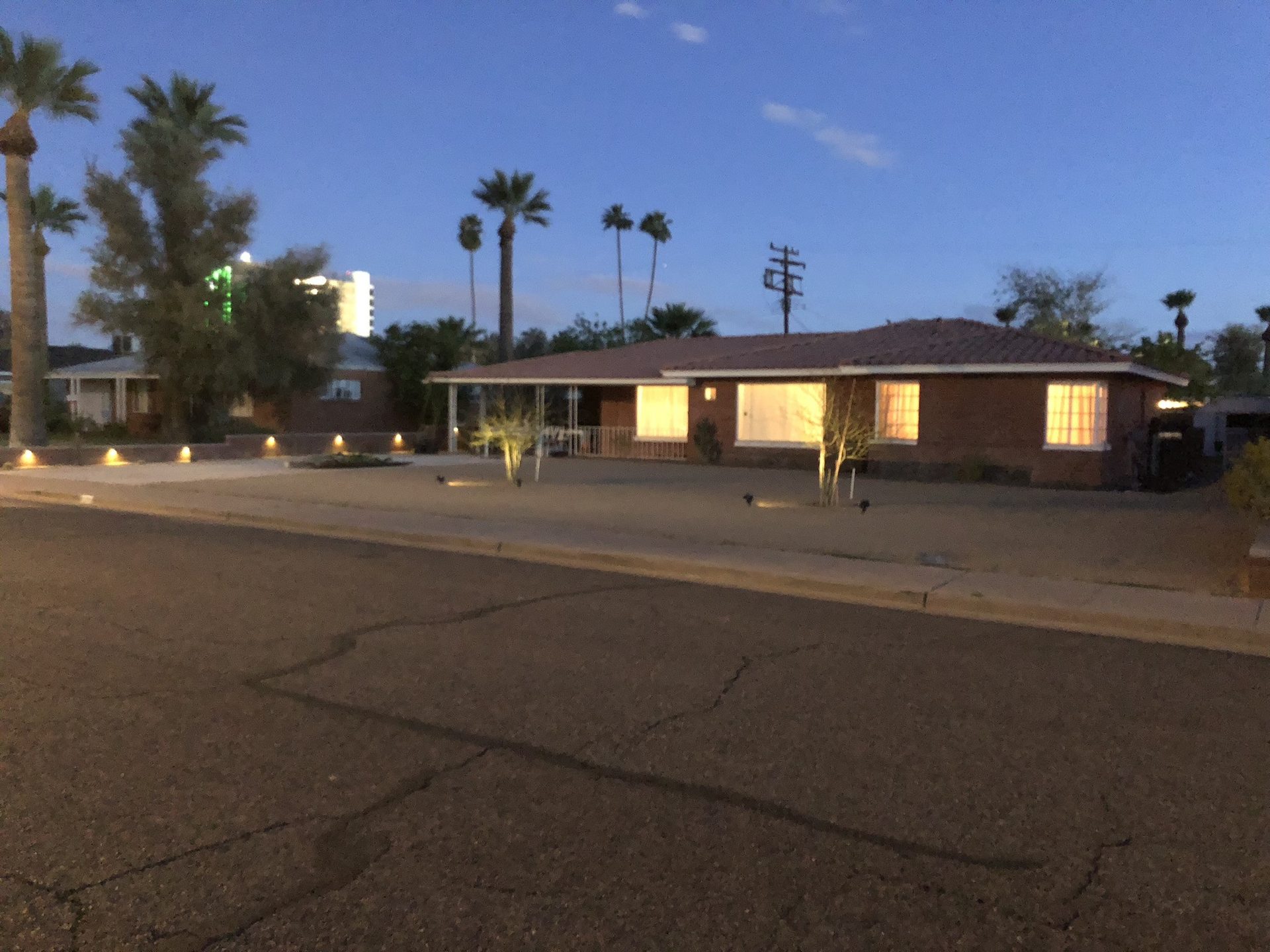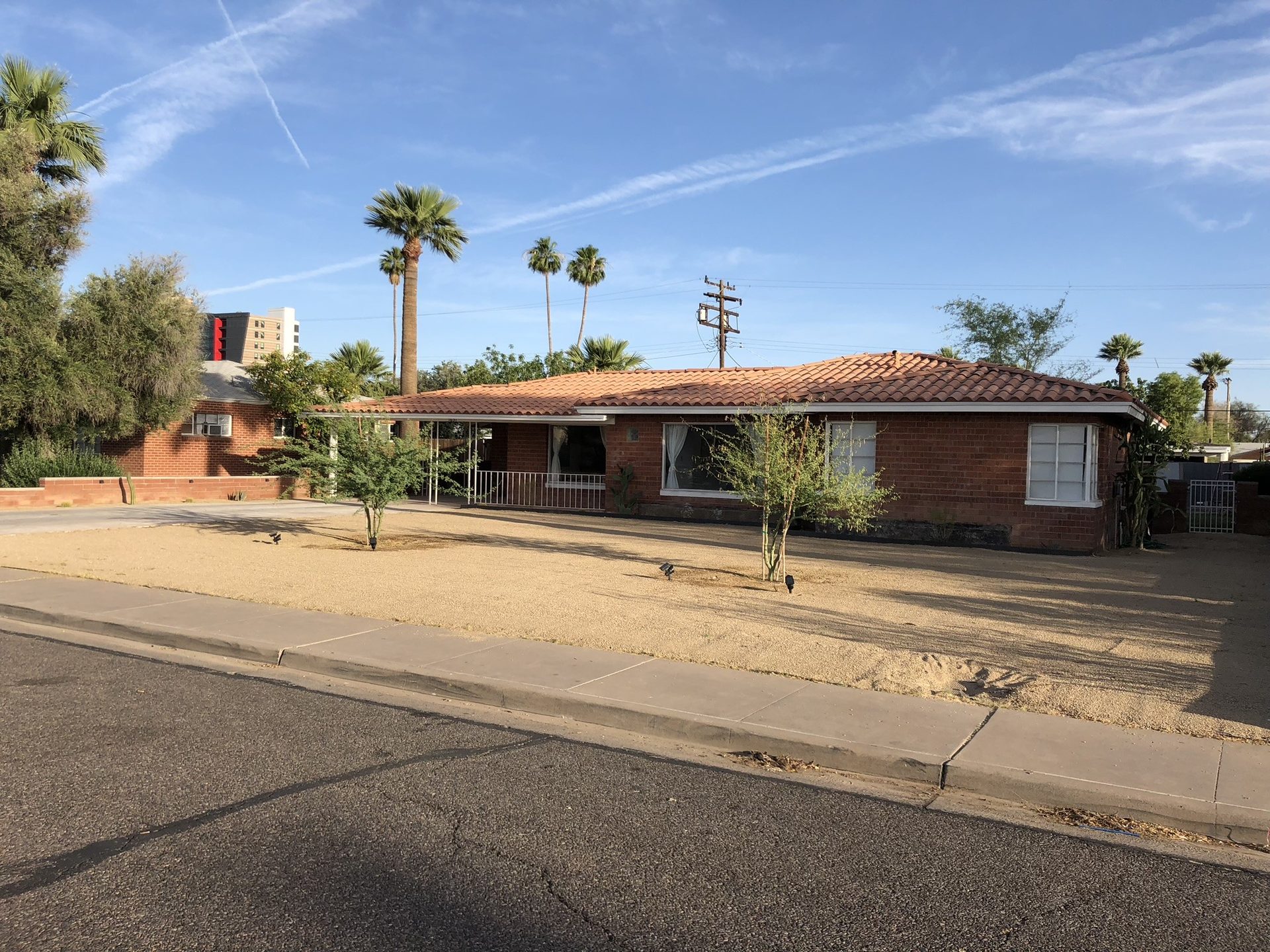
The City of Phoenix pays $2 per square foot to remove at least 250 square feet of live grass, and nothing in its published eligibility rules, terms and conditions, flyer, project form or online pre-application questionnaire excludes a lawn watered by SRP flood irrigation. The rules turn on the owner and the grass: you own the house and receive a Phoenix water or city services bill, the lawn is at least 75 percent live in the application photos, and no grass comes out until the Water Conservation Office reviews the application you file through myPHX311 and emails you a Notice to Proceed. On a 2,000 square foot flood lawn that's $4,000 back, and it sets the order of the job: the flood water keeps coming until the photos are taken and the notice is in hand.
Our post on converting a flood-irrigated yard to desert landscaping covers the trees, the regrade and the plant palette for a lot coming off SRP water, the grass-to-desert front yard we converted in Phoenix shows the conversion from turf removal through lighting, and the service is on our desert landscaping in Phoenix page. That leaves the incentive: what Phoenix's own documents require, how a bermed, flood-fed lawn meets them, and where $2 a square foot lands against the cost of the job.
Does a Flood-Irrigated Lawn Qualify for the Phoenix Grass Removal Incentive?
Phoenix's written rules don't exclude it. The residential grass incentive page lists eight eligibility requirements, the terms and conditions run fourteen items, and the October 2024 program flyer and the project description form repeat the same rules. The city's online pre-application questionnaire asks eight yes-or-no questions. Two are about the grass (at least 250 square feet of live grass, at least 75 percent live or dormant), one is about you (the homeowner and the city services account holder), and five are about the paperwork: two photos from different angles, the Square Foot Measurement Tool, the Project Description Form, the Affidavit of Lawful Presence and an IRS W-9. None of those documents or questions mentions flood irrigation, SRP, canal water, or where the lawn's water comes from.
Other Valley cities wrote it the other way. Chandler's rebate policy says "Areas served by flood irrigation are not eligible," and it requires an active Chandler water utility account. Mesa's grass-to-xeriscape program says "Any grass areas watered by wells or flood irrigation water are not eligible," and that only landscapes watered by potable water measured through a city water meter qualify. A flood lot in Chandler or Mesa gets nothing from its city for the lawn, and a flood lot in Phoenix is held to the same requirements as any other Phoenix lawn. Our landscaping in the Phoenix metro page puts all six Valley programs side by side.
The program does state its purpose. The flyer says the city offers the incentive to help "residential City of Phoenix water customers" remove grass in favor of a low water-use landscape "to reduce their water use and increase efficiency." The terms also let the Water Services Department decide whether an incentive is authorized and payable right up until it's issued, and the Notice to Proceed is the city's approval of your application. Describe the yard as it is, flood water and berms included, so that approval is given on the real conditions.
Some flood lots are split. The front lawn may run on sprinklers off the house meter while the back yard floods, or the reverse. Under Phoenix's rules both are grass, and both count toward the same application if they're coming out. The terms allow one incentive payment per approved application and say the applicant hasn't received another incentive for the same property site, so measure the front and the back together and apply once rather than in two rounds.
Who Is Eligible, and What Does the City Check Before It Says Yes?
An owner with a Phoenix water account, a lawn that's mostly alive and at least 250 square feet, and a replacement plan that uses less water. The full list, as the city writes it, and what each rule means on a lot that floods every couple of weeks:
Phoenix's requirements on a flood lot
| Requirement | What Phoenix says | On a flood lot |
|---|---|---|
| Who applies | The current property owner, who is a Phoenix Water Services customer receiving a water bill or city services bill | The city services bill for the house is the proof. The SRP irrigation bill isn't part of the application |
| Rentals | Landlords don't need a water services account number; a Rental Properties Form is added | The form captures the address and the tenant's information |
| Grass condition | Alive and healthy at a minimum of 75 percent density, dormant grass included; bare soil or weeds under 25 percent | Photograph it while the flood schedule is still running |
| Size | At least 250 square feet removed; over 5,000 approved case by case, funds permitting | A big back lawn can pass 5,000 square feet, and everything over that line depends on funds |
| What replaces it | Plants from the Low-Water-Use/Drought-Tolerant list; no bare soil; no water features or pools in the removal area | The ground under a grassed berm is part of the removal area and can't be left as dirt |
| HOA and historic districts | The new landscape has to comply with HOA covenants; the flyer says applicants in a registered historic district contact the Historic Preservation Office before applying | Check both before the design is final |
| Permanence | Grass can't be reinstalled while you own the property; the city may require a refund if the terms are violated | A lawn you plan to keep somewhere on the lot stays out of the removal area |
| One incentive | One payment per approved application, and no other incentive for the same property site | Front and back are best measured and applied for together |
| Dust | Every project complies with Maricopa County Rule 310.01 | A stripped lot gets its granite or ground cover soon after the grass comes out |
From the city's program page, terms and conditions and flyer, read October 17, 2026. The city says all guidelines and requirements are subject to change at any time.
If the house is in a registered historic district, the flyer asks you to contact Phoenix's Historic Preservation Office before you apply. Our desert front yard for a Coronado Historic District bungalow covers what that review can involve for a front yard.
How Do You Apply Through myPHX311, Step by Step?
Online, with five items, before any grass comes out. The city says applications go through the myPHX311 portal only and are not to be mailed or emailed. In order:
- Check readiness. The city's pre-application questionnaire walks the same eight qualifiers, then sends you to myPHX311 and tells you, in capital letters, not to start work until you're issued a Notice to Proceed.
- Measure the grass. Draw the removal area on an aerial image with the city's Square Foot Measurement Tool and note the estimated square footage. Grassed berms are part of the lawn on that image.
- Photograph it. Two photos from different angles showing at least 75 percent density of live, healthy grass. Before and after photos of grass already removed don't count.
- Describe the replacement. The Project Description Form asks what will replace the grass and says the proposal "should result in less water use." Be specific, because the completion photos have to match it.
- Sign the two forms. An Affidavit of Lawful Presence with a copy of the ID you used, and an IRS W-9. Both are PDFs, physically signed, with names that match the ID exactly. Photos of the forms don't qualify, and other files go in as jpeg or PDF (the city specifies jpeg, not jpg).
- Submit in the myPHX311 portal. Rentals add the Rental Properties Form.
- Wait for the Notice to Proceed. Staff review the photos and description and measure the area from aerial imagery. If the numbers don't line up, they may ask for a video call or a site visit. Review can take up to three weeks.
- Do the work. You have six months from the date on the notice.
- Send the finish photos. At least two photos of the completed project and a copy of the notice go to wsd.incentives@phoenix.gov.
- Get paid. Staff email the approval, and the check comes by mail. The city says to allow one to two billing cycles.
The Water Conservation Office answers questions at 602-261-8367. The program launched in October 2024 with a $5 million budget that included money from Arizona's Water Infrastructure Finance Authority, and the city pays first come, first served while funds last. The terms also say incentive funds have to be reserved before the conversion starts.
Measuring a bermed lawn
Staff check your square footage against aerial imagery and the photos, and the flyer says that if your number is indiscernible or significantly different from theirs, a video call or an onsite inspection may follow. On a flood lot, trace the outer edge of the live grass, berms included where they're grassed, and leave out what isn't lawn: walks, the driveway, planting beds and the bare rings under citrus and shade trees. That last part matters for the density rule. Bare soil or weeds have to stay under 25 percent of the removal area, so a line drawn loosely around a grove can pull in enough bare ground to fail it. Draw tight around the grass so the photos and the measurement agree.

When Should the Flood Water Stop: Before or After the Notice to Proceed?
After. The application photos have to show at least 75 percent live grass, and any work done before the notice isn't eligible, so the lawn needs its water until the notice is in hand. Phoenix counts dormant grass, which helps a flood lot in winter, when SRP's deliveries drop to about every 28 days and a Bermuda lawn goes dormant. A dead lawn photographs as ineligible. If the lawn has already died back, the incentive is gone and the job is a straight conversion, the way our dead-lawn front yard xeriscape with a block planter and slat screen went.
SRP's calendar sets the rest of the timing. SRP bills irrigation in mid-November for the coming calendar year, due the first week of December, and its refund guidelines make the water delivery fee and basic charge nonrefundable once any water is ordered or delivered in that year. The trees set a third clock: a tree grown on flood water needs deep drip running before the deliveries end, which our flood-to-desert post explains. A workable order for a flood lot:
- Late summer or early fall: apply.The lawn is green from the 14-day summer deliveries, which makes the photos easy. Nothing gets dug yet.
- Notice in hand: temporary drip on the keepers.The six-month clock starts. Surface tubing goes out at the canopy edge of the trees you're keeping, outside the areas that will be regraded, and runs while the flood deliveries continue, so the trees aren't cut off cold.
- Kill the lawn while it's still growing.If the Bermuda is going to be sprayed, University of Arizona Cooperative Extension's turf tip on bermudagrass says to treat it when it's "growing like a weed" and not water stressed, expect it to die in 8 to 10 days, and treat again whatever stays green. On a flood lot the deliveries keep it growing, so that happens after the notice and before the last delivery. Bermuda slows as it heads toward winter dormancy, which is one more reason to apply early in the season. Keep the spray off the citrus and anything else that stays. Fabric won't stop Bermuda: rooted Bermuda has to be grubbed out rather than scraped, or it comes back through the granite.
- Then the berms and the grade.From the day the berms come out, skip every remaining order: "Skip next delivery" in SRP My Account, or for Tempe's service a call to 480-350-8361 at least 24 hours ahead. A lot with no berms can't hold a delivery, and SRP's shareholder page says to "contain all the water you order on your property." Then the grade is reset to drain, permanent drip goes in after final grade, and the granite and plants follow.
- Before the new year's first delivery: decide on SRP.Keeping the account works only if the trees keep bermed basins that hold the whole order. Otherwise the trees are on drip, and the account stops before one order makes the year's base charges nonrefundable.
Applying for the incentive doesn't require cancelling SRP, and Phoenix's rules say nothing about it either way. The bermed-basin condition is strict because SRP's shareholder page warns that water theft, flooding and the resulting property damage "may be punishable as felonies or misdemeanors or could result in a civil lawsuit."
What Can Replace the Grass on a Flood Lot?
Anything that uses less water and leaves no bare soil. The city requires plants from the Low-Water-Use/Drought-Tolerant plant list and points to AMWUA's Plants for the Arizona Desert guide for it, prohibits bare soil in the removal area, and keeps water features and pools out of it. Its program page names desert landscaping, green stormwater infrastructure and artificial turf as ways to fill the space, and Phoenix lets turf count toward the replacement where Chandler's program doesn't. If part of the yard is for kids or a dog, our artificial turf installation in Phoenix page covers that piece.
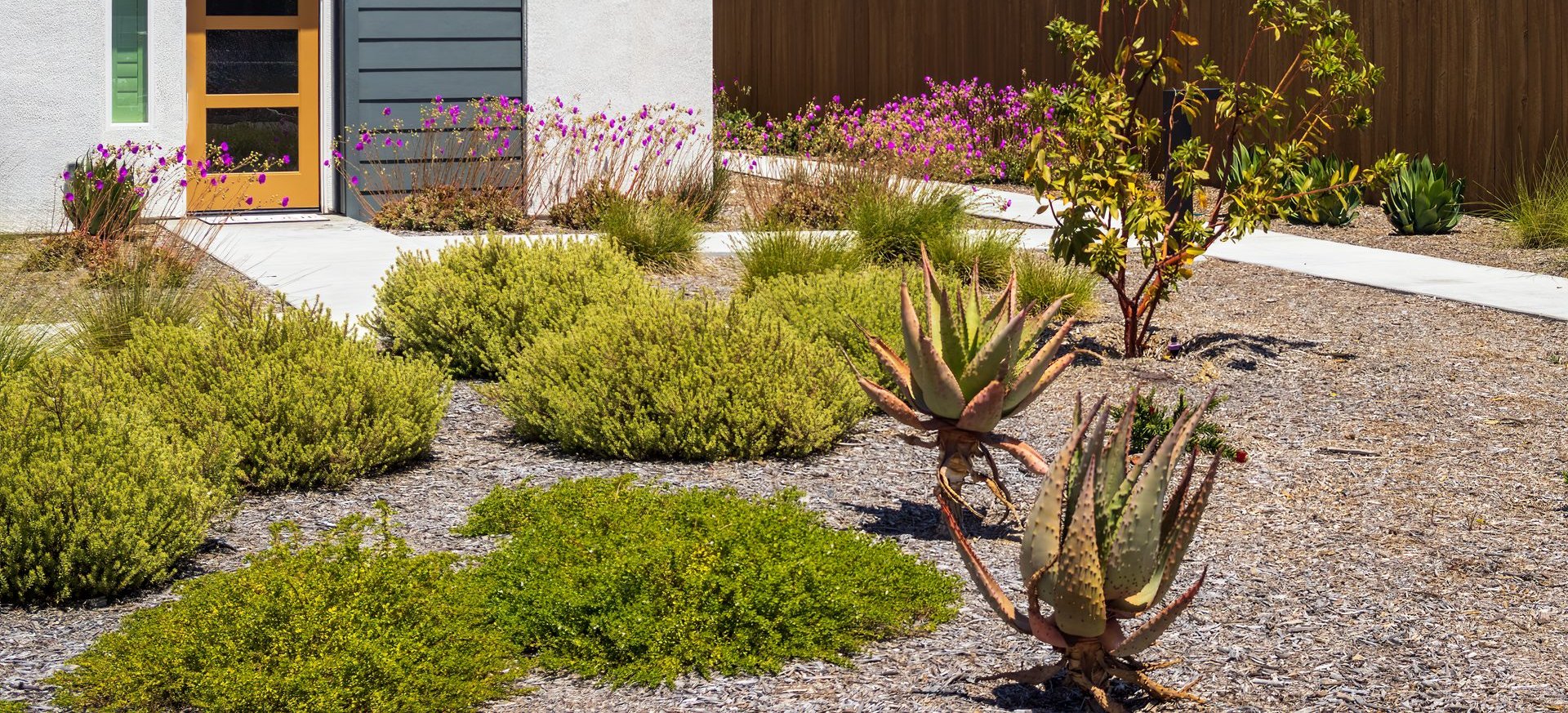
Three details are particular to a flood lot. The first is the berms. If they carry live grass, they're part of the grass you're removing, and the ground they leave behind is part of the area that can't be left bare. The second is the low ground. A flood lot is graded to hold water, and Phoenix describes green stormwater infrastructure as plant or soil systems that store, infiltrate or evapotranspirate stormwater, with stormwater harvesting basins and bioswales among its examples. A shallow planted basin can keep some of that old grade working for rain if it sits beyond the first 10 feet from the house, drains before the county's three-day mark for mosquito breeding (water that "ponds and stands for more than three days"), and never sends water toward a neighbor. The rest of the lot falls away from the house, at least 6 inches in the first 10 feet under the 2024 IRC's drainage section, and the stucco weep screed stays at least four inches above the new grade.
The third is dust. The program requires compliance with Maricopa County Rule 310.01, and the county's Rule 310.01 page lists vegetative ground cover, dust suppressants and surface gravel as the ways to stabilize disturbed ground. The same page calls for stabilizing more than 500 square feet of disturbed ground that sits unused over 15 days, and the county's Rule 310 page applies the dust rule "regardless of the size of the site," with a dust control permit for disturbing 4,356 square feet or more. A big flood lawn can cross that line, so the stripped ground gets its granite soon after the grass comes out.
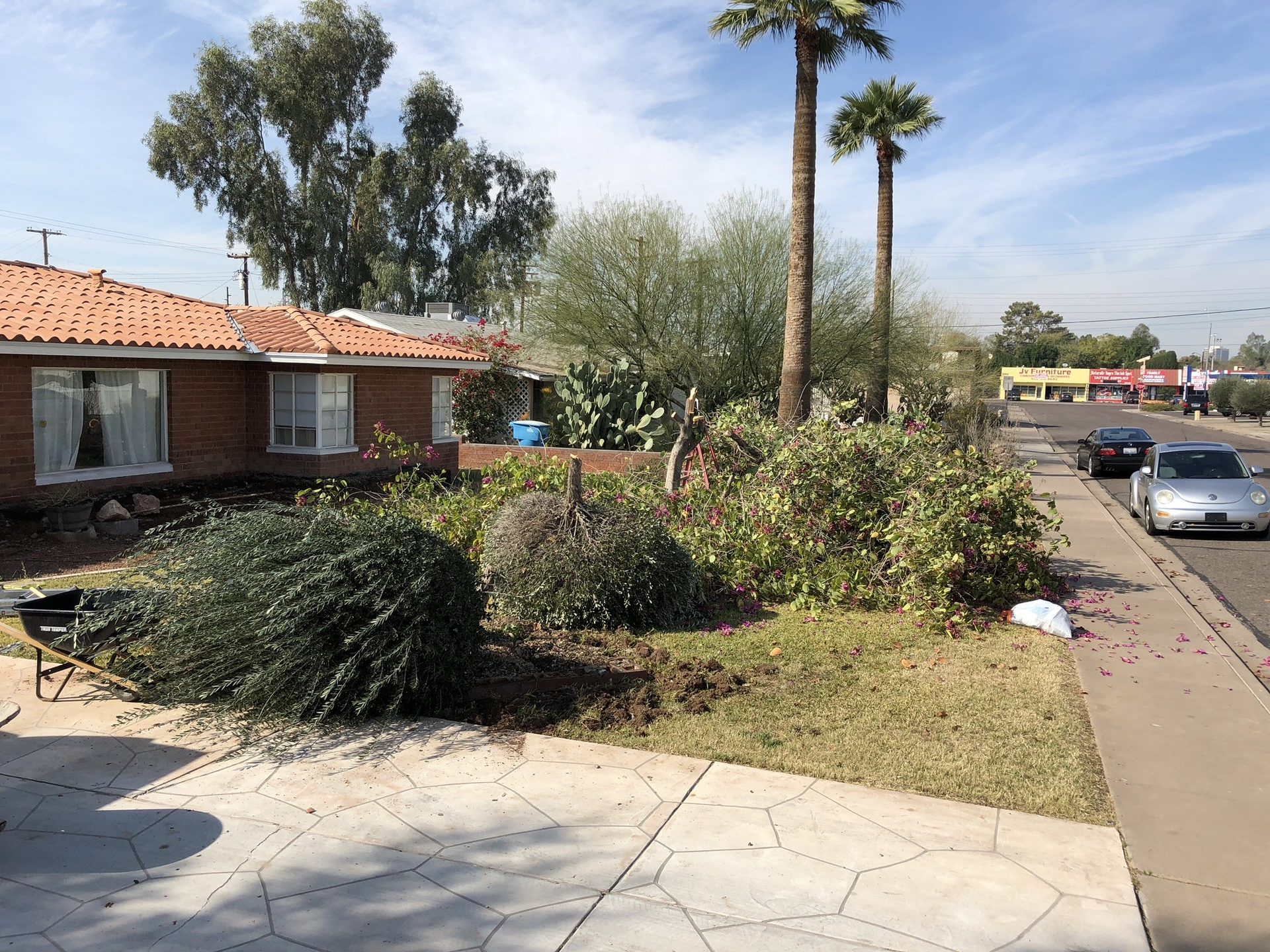
Our grass-to-desert front yard in Phoenix included turf and root removal, a grade set so water runs away from the house, decomposed granite over a weed barrier, golden barrel, agave, prickly pear and ocotillo, metal edging, drip on a timer and low-voltage lighting. The order on any lawn runs grade first; then the drip and lighting trenches and the edging; then fabric and granite, screeded and compacted; then the plants and their emitters. Granite depth is measured after it's screeded and compacted, and a ton covers roughly 80 to 100 square feet at two inches. A flood lot adds the berms and a harder look at the trees.
What Happens to the Berms, the Ditch and the Yard Valve During the Conversion?
Your own yard valve can close. The shared ditch, pipe and standboxes stay in place. The incentive pays for removing grass, and it gives no one the right to change the irrigation system the lawn sits on. Downstream of SRP's delivery gate, the ditches, pipe, standboxes and valves on an SRP lot are a private system owned by the neighborhood's irrigation customers, and SRP's notice of water rights says those parts "may not be removed or changed without express written permission from all private system owners."
Look at what each berm borders before it comes out. SRP's manual says block walls are porous and should be sealed or have a berm beside them to keep irrigation water from flowing through, so a berm along a shared wall may be holding back a neighbor who still floods. A berm beside a ditch, a standbox or a valve is part of how water reaches the next lot, and it stays until the system's owners agree in writing.
Before a machine digs, call 811. Call after the Notice to Proceed rather than at application, because under A.R.S. 40-360.22 the marks are valid for fifteen working days. The same statute gives the utilities two working days to mark their lines. The Arizona Corporation Commission's pipeline safety office says to call 811 or go to Arizona811.com at least two working days before digging, and the locate is free. Arizona's Blue Stake rules call for hand tools within 24 inches of a mark. That covers what the utilities and the city own and operate. It won't find the flood pipe: SRP says private irrigation systems are not marked by Blue Stake, and that the owner or the hired contractor has to locate and protect them before work starts. SRP's residential irrigation owner's manual offers a map of your neighborhood system and a free walkthrough with a Field Services Liaison, and the line gets exposed by hand where it runs. Work right at a shared line belongs between deliveries or in SRP's winter dry-up, which its canal maintenance page lists for Jan. 3 to Feb. 7, 2027 on the north side of the Salt River and Nov. 20 to Dec. 24, 2026 on the south side.
For the regrade, see our landscaping in the Phoenix metro page. Drip for the plants you keep gets a filter and a 25 to 30 psi regulator at the head of each run, and a backflow device at least 6 inches above the highest emitter for an anti-siphon valve or 12 for a pressure vacuum breaker. Setting up the drip and a controller is in our sprinkler and irrigation repair guide.
How Much Does the Incentive Take Off a Flood-Lot Conversion?
Between about an eighth and two-fifths of the job. A Valley grass-to-desert conversion runs $5 to $15 per square foot installed, so $2 a square foot covers 40 percent at the bottom of that band and about 13 percent at the top. Flood lots tend toward the upper half, because the berms come out, the lot has to be regraded to drain, and the mature trees need drip whether or not anyone wanted irrigation.
What the incentive pays, and what's left
| Grass removed | Incentive at $2 per sq ft | Job at $8 per sq ft, net | Job at $12 per sq ft, net |
|---|---|---|---|
| 1,000 sq ft | $2,000 per project | $8,000 job, $6,000 net, $6.00 per sq ft | $12,000 job, $10,000 net, $10.00 per sq ft |
| 2,500 sq ft | $5,000 per project | $20,000 job, $15,000 net, $6.00 per sq ft | $30,000 job, $25,000 net, $10.00 per sq ft |
| 5,000 sq ft | $10,000 per project | $40,000 job, $30,000 net, $6.00 per sq ft | $60,000 job, $50,000 net, $10.00 per sq ft |
$8 a square foot is the middle of the Valley conversion band on our landscaping page. $12 is a point in the upper half, where flood lots tend to land. Incentive amounts follow the city's published $2 per square foot rate.
At the small end, the 250 square foot minimum pays $500, and 300 square feet, $600, is where the W-9 and 1099 rules start. A yard that small prices as a project rather than by the foot: a 400 to 600 square foot front yard with the lawn out, granite in, six to eight plants and a drip line on a timer lands between $3,500 and $5,000 in this market. At the large end, anything past 5,000 square feet is approved case by case, funds permitting, so the part over that line isn't a number to count on.
Where a flood-lot job lands inside that band comes down to the lines below, at Phoenix-area prices for 2026. The two that move most on a flood lot are the regrade and the drip, because a lot built to hold canal water often has neither a drainage grade nor an irrigation system under it.
| Scope | Phoenix 2026 installed | On a flood lot |
|---|---|---|
| Front yard conversion, project total | $5,000-$12,000 per yard | A 600 to 1,200 square foot front yard with demo, granite, a dozen plants, two trees, drip and edging |
| Grass removal, grubbing and haul-off | $0.75-$1.50 per sq ft | Includes disposal. Rooted Bermuda has to be grubbed out rather than scraped, or it comes back through the granite |
| Site prep and regrading | $0.40-$2.00 per sq ft | A real regrade runs $2,000 to $5,000, and a lot built to hold water usually needs one |
| Decomposed granite, 2 in deep | $1.50-$3.00 per sq ft | Covers the removal area so no soil is left bare |
| Drip irrigation | $250-$900 per zone | A full property on three to five zones with trenching is $900 to $2,500, the likely row for a lot with no system |
| Desert plants, installed | $55-$185 each | From the low-water-use list the city requires |
| Desert trees, installed | $200-$1,400 each | Fifteen gallon to 36 inch box |
| Low voltage landscape lighting | $150-$350 per fixture | The wire goes in before the granite |
Researched Phoenix market rates for 2026, as published on our landscaping page. The incentive comes off the total once the city approves the completion photos.
Send Us the Lawn
Two photos of the lawn, one of the berm and the valve at your lot line, and a rough square footage. We'll tell you what the incentive covers, what the conversion costs, and how to order the work around the Notice to Proceed and the SRP schedule.
Free Lawn EstimateWhat Do Phoenix Owners Ask About the Grass Incentive?
Do I have to cancel SRP flood irrigation to get the Phoenix grass incentive?
No. Phoenix's rules don't ask you to cancel SRP service, and the grass has to be at least 75 percent alive when you apply, so the flood water keeps coming until the Notice to Proceed is issued. Afterward, the account stays only if the trees keep bermed basins that hold the whole order. Once the berms are gone, every remaining delivery gets skipped.
Does dormant winter grass count for the Phoenix grass removal incentive?
Yes. The city says the grass must be alive and healthy at a minimum of 75 percent density of the area to be removed, dormant grass included, with bare soil or weeds under 25 percent. A dormant lawn counts. A dead one does not.
Can a landlord apply for a rental house?
Yes. Phoenix says landlords don't need a water services account number to apply for a rental property. The landlord submits the Rental Properties Form, which captures the address and the tenant information, along with the regular forms.
Is artificial turf allowed as the replacement in Phoenix?
The program page names artificial turf among the replacement options, alongside desert landscaping and green stormwater infrastructure. Any plants have to come from the low-water-use plant list, and no bare soil can be left in the removal area.
How long does it take to get the check?
Review for the Notice to Proceed can take up to three weeks, and you then have six months to finish. After you email the completion photos and a copy of the notice, staff review them and email the approval, and the city asks you to allow one to two billing cycles for the check to arrive by mail.
Is the Phoenix grass removal incentive taxable?
The city requires a W-9 for an incentive over $600, and its terms say the IRS requires a Form 1099 for recipients of $600 or more unless exemptions apply. At $2 a square foot, that line is 300 square feet. The city is not responsible for any taxes, so ask your tax preparer how it applies to you.
Can I do the conversion myself and still get the incentive?
Phoenix's rules don't require a contractor. What the city checks is the application before work starts and the completion photos after, and its terms make the quality, maintenance and appearance of the conversion the applicant's responsibility. The replacement still has to use plants from the low-water-use list and leave no bare soil, and nothing can start before the Notice to Proceed.
What Belongs in the Same Conversion While the Lawn Is Coming Out?
A grass-removal job already pays for the demolition crew, the haul-off and the regrade. Add-ons that use that same setup typically come in 25 to 50 percent under their standalone price when they're on the contract from day one, and a six-month clock on the Notice to Proceed is a good reason to plan them together instead of in pieces.
- Drip for every tree you keep. The flood water is what fed them. See our sprinkler and irrigation repair guide for zones and the seasonal schedule.
- Lighting in the open trench. The wire goes under the granite, not over it. See landscape lighting for a xeriscape, solar or wired.
- A patio or walkway where the lawn was. The excavation and the compaction are already happening. Thatch and the organic layer come off, the subgrade dries out after the last delivery, and it's compacted before the base goes down. See concrete patios and walkways.
- Shade over the new patio. Footings set before the surface goes down cost far less than cutting them in later, once the shared irrigation line has been located and the holes near it are dug by hand. See patio covers and ramadas.
- A green patch for kids or a dog. Phoenix counts turf toward the replacement. See artificial turf installation.
- A new fence or gate on the back line. The access and the equipment are already in the yard. If the shared line runs along the back, it gets located first, since 811 won't mark it. See fencing.
- The whole yard on one plan. Front and back measured once, one application, one schedule. See landscaping in the Phoenix metro.
Text us photos of the lawn and the valve at your lot line, or call (602) 492-1815, and we'll get you a quick quote.

Written by Harrison Norem, owner of Norem Contracting and a licensed Class B general contractor, Arizona ROC #365090. Fifteen years across the trades, including grass-to-desert conversions, grading, drip irrigation and hardscape, across the Phoenix metro. More about Harrison.