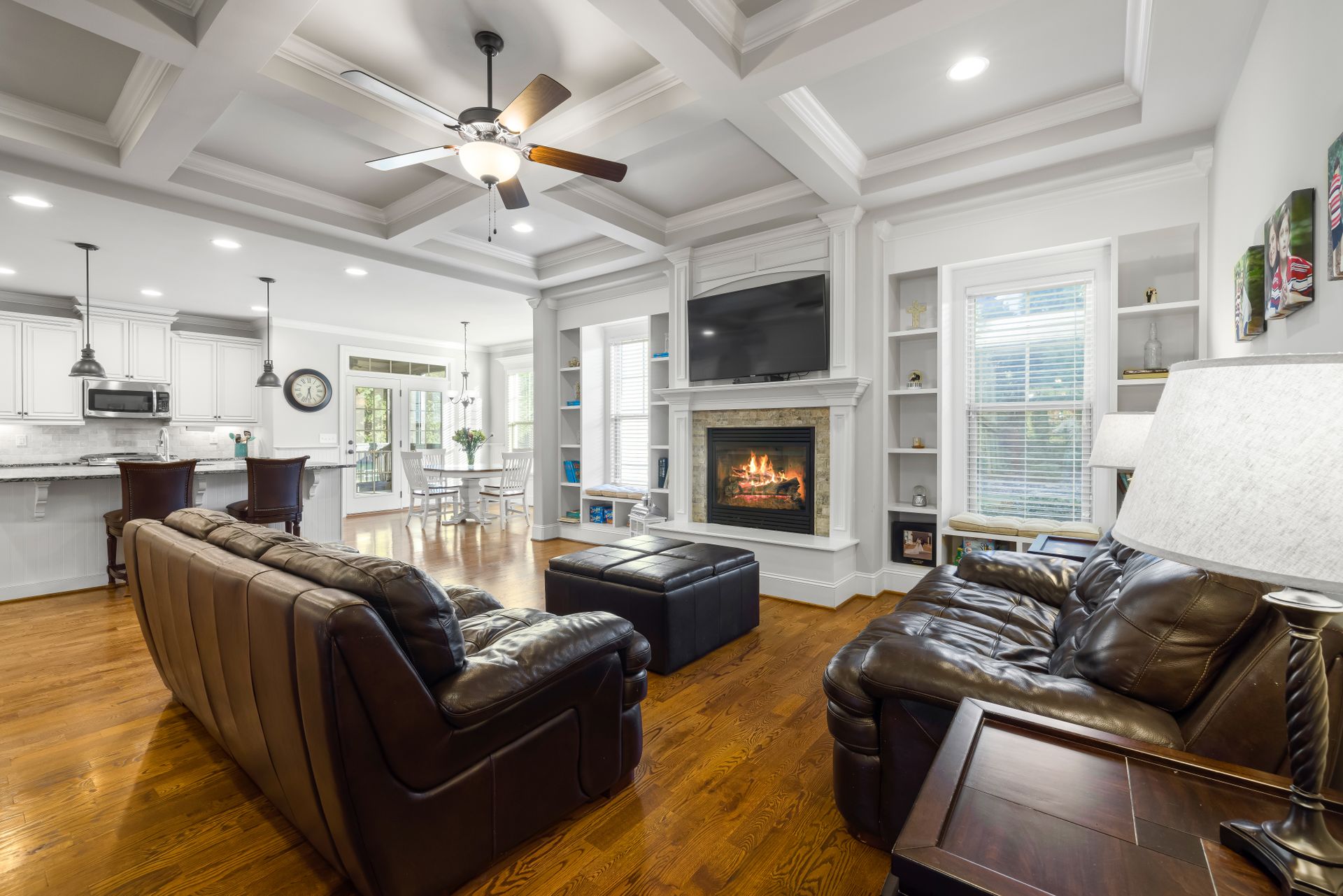
Replacing a ceiling light with a fan in the Phoenix area usually costs $175 to $350 in labor when the ceiling box is already fan-rated and $250 to $500 when it isn't, because a box made for a light is not listed to carry a spinning fan. It gets replaced with a fan-rated box or a brace like Westinghouse's Saf-T-Brace, which fits joists 16 to 24 inches apart and supports fans up to 70 pounds. The wiring is almost always already there. What decides the rest of the job is whether the fan and its light share one wall switch or get two.
Straight fan-for-fan swaps, remote codes, wobble and the full price chart are on our ceiling fan installation page. A conversion is a different job, and most of what changes sits above the drywall.
Can Any Ceiling Light Be Swapped for a Fan?
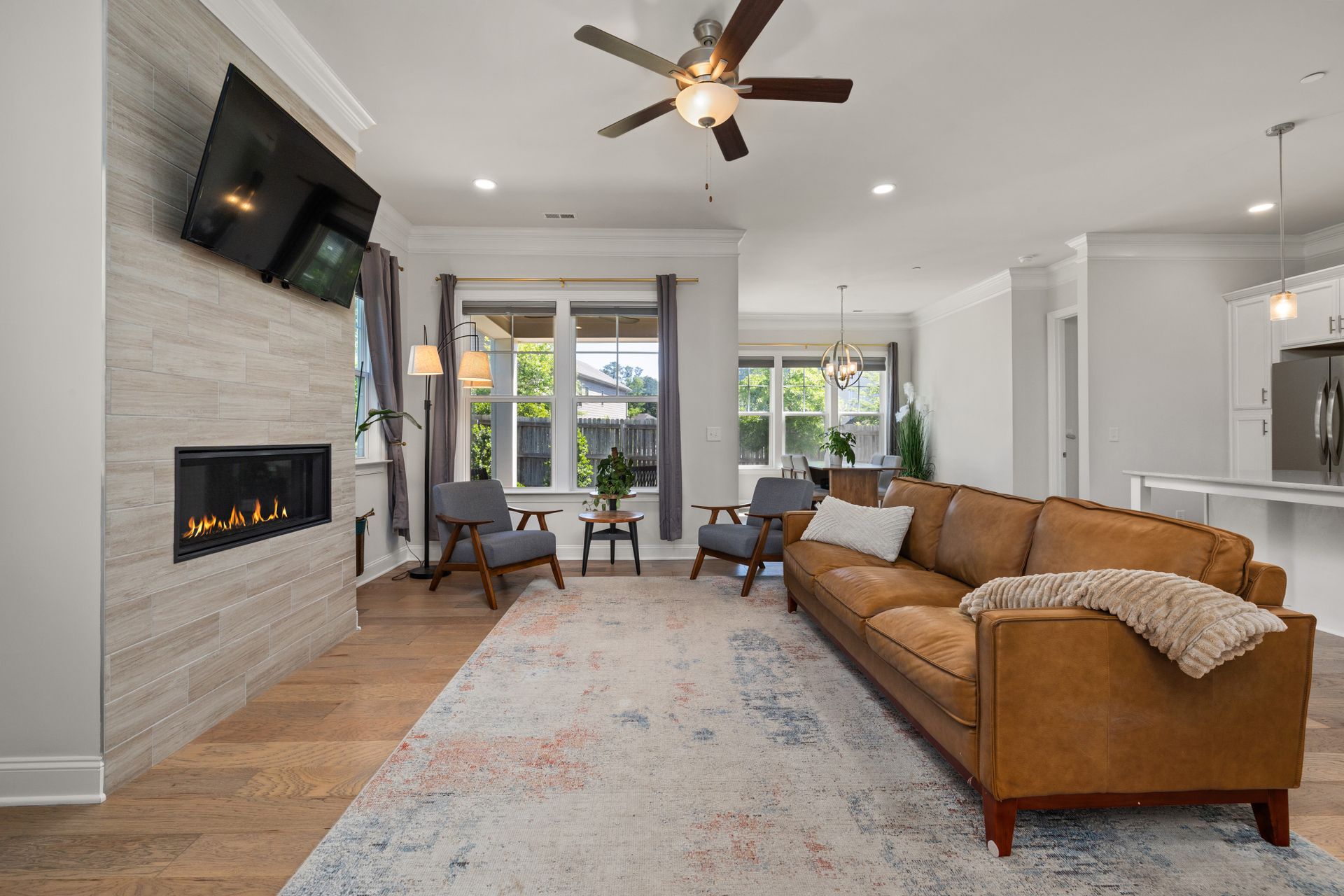
Most can. Three things rule a spot out or change which fan goes there: the ceiling height, the box, and water. Hunter, the fan maker, wants blades at least 7 feet above the floor and about 8 to 9 feet for the best airflow, with at least 8 inches between the blades and the ceiling. On an 8-foot ceiling that leaves room only for a low-profile fan that mounts flush, which Hunter designs for rooms with ceilings around 8 feet high. On a 9-foot ceiling a standard mount fits, and above that the fan hangs on a downrod.
The box is the check that moves the price. Water is the one that rules a spot out: a light inside the tub or shower zone of a bathroom usually can't become a fan at all, and the bathroom question in the FAQ has the distances. After that it's placement. A light centered over a bed or a seating group is usually where a fan belongs anyway. A light pushed into a corner, over a cabinet run or close to a tall door is a spot to rethink before the fan is bought.
How Do You Know Whether the Box Can Hold a Fan?
Take the light down and read the box. A box that can carry a ceiling fan has to be listed and marked as suitable for fan support, and the National Electrical Code, at 314.27(C), caps any fan box at 70 pounds of fan. A box listed for a fan heavier than 35 pounds has to carry its maximum weight in that marking. No marking means it isn't a fan box, whatever it looks like.
Under a builder light you usually find a round or octagon box made for a fixture that hangs still. Some are nailed or screwed to the side of a framing member, which is solid for a light and still not listed for a fan. Others are old-work boxes held to the drywall by clips or ears, added after the ceiling went up, and those are not made to hold a fan. In Valley tract houses the ceiling usually hangs from trusses 24 inches on center, so the box often sits between two members with nothing solid directly over it.
A clear photo of the light and the ceiling around it is enough for us to tell you which way the job is likely to go. The box itself gets confirmed once the light is down, with the breaker off and the circuit tested dead.
What Goes In When the Box Isn't Fan-Rated?
Usually a fan brace through the existing hole, so the ceiling never gets opened. Westinghouse's Saf-T-Brace is the common one: it slides in through the opening, expands between the framing until it locks, and carries a fan-rated box. Westinghouse rates its 0110000 brace for joists between 16 and 24 inches apart and for fans up to 70 pounds, and sells it for installs without access to the attic.
Two other routes depend on what's above. When the old box sits right against a joist, a fan-rated pancake box screwed into that joist does the job with less hardware. When there's an attic over the room, wood blocking can go in from above, which is the stoutest support of the three. Heavy light fixtures hit the same limit at 50 pounds, and our oversized chandelier job shows the blocking that goes in when nothing in the ceiling can carry the load.
Phoenix adds its own reason to stay out of the attic. A Phoenix insulation contractor puts summer attic temperatures at 140 to 150 degrees, so any work up there gets scheduled for early morning, and a brace from below takes the attic out of the job. That's a big part of why the through-the-hole brace is the usual choice on a conversion here.
Can a Fan Go Where There's No Light, or No Attic Above?
Yes to both, with very different amounts of work. No attic is the common case in a downstairs room under a second floor, a vaulted room or a room under a flat roof, and a through-the-hole brace handles it: the brace, the box and the fan all go in from below, through the opening the light leaves behind. Nobody has to crawl anywhere.
No light at all is the bigger job. A fan where there's no box needs a new fan-rated box, a new cable from a switch location, the wall switch itself, and a patch wherever the cable had to be fished through. Our service page prices that at $400 to $800 or more, and it usually takes a half day or longer instead of a short visit. It's electrical work, done on our contract, to code. If you have a choice of rooms, converting an existing light first is the cheaper way to get air moving.
One Wall Switch or Two: How Will the Fan and Light Be Controlled?
Usually by one wall switch that powers the fan and its light together, with pull chains or a remote picking the speed and turning the light on or off at the fan. Most ceiling lights are wired for one switch: a two-wire cable (two insulated conductors plus a ground) carries a single switched circuit to the box. Decide before buying the fan, because two switches means new wire gets pulled.
Two separate wall switches, one for the fan and one for the light, need a three-conductor cable between the switch box and the ceiling. That means new wire through the wall and the ceiling, sometimes with an access hole to patch, and it's electrical work done on our contract, to code. New wire on a bedroom or living-room circuit also brings that circuit under the code's arc-fault (AFCI) rule, so an older circuit gets that protection as part of the job.
Ways to control a converted fan
| Setup | Wiring needed | What the wall controls | Good to know |
|---|---|---|---|
| Existing switch and pull chains | The two-wire cable already there | Power to the fan and light together | Speed and light are set at the fan |
| Remote receiver in the canopy | The two-wire cable already there | Power only; the remote does the rest | The switch stays on; the receiver's code is set before the fan goes up |
| Lutron Caseta fan speed control | Existing cable plus a neutral in the switch box; a fan with a light kit also needs a separate switched wire for the light | Fan speed only, not the light | For one AC fan; Lutron says it can't control a light kit and is not for DC fans or fans with a remote or built-in control module |
| Bond Bridge | None new | Nothing new; an app runs the fan's own remote | Works with most remote-controlled fans, plus Alexa, Google Home and SmartThings |
| Two wall switches | New three-conductor cable to the switch box | Fan on one switch, light on the other | The most labor; a dimmable light kit on its own switch can take a dimmer rated for it |
Product limits from Lutron's PD-FSQN specification sheet and Bond's product page. Prices for each setup are in the cost section below.
A standard dimmer never goes on the fan, since Leviton warns it can damage the motor. If the light being replaced was on one, that dimmer comes off the fan's circuit. If the goal is app or voice control without opening a wall, a Bond Bridge or a fan that ships with its own app gets there on the wire you already have.
What Size Fan and Downrod Does the Room Need?
Size the blades to the floor area and the downrod to the ceiling height. Hunter's sizing guide puts a 42-inch fan in a room up to about 10 by 10 feet, a 52-inch fan in one up to 10 by 20, and a fan over 56 inches in a living room or great room up to 20 by 20. A room bigger than that is a two-fan room, or one fan of 60 inches and up, which is how our ceiling fan page sizes it too. The downrod then drops the blades to the 8 to 9 feet Hunter recommends. These are Hunter's lengths by ceiling height:
Hunter's downrod lengths by ceiling height
| Ceiling height | Downrod length |
|---|---|
| 8 ft | None; a low-profile, flush-mount fan |
| 9 ft | The standard rod included with many fans |
| 10 ft | 12 to 18 in |
| 11 ft | 18 to 24 in |
| 12 ft | 36 in |
| 13 ft | 48 in |
| 14 ft | 60 in |
| 15 ft | 72 in |
From Hunter's downrod guide and its sizing page. On a vaulted ceiling, measure at the mounting point, not the low wall.
A vaulted great room needs a longer rod. Hunter's downrod fans hang on slopes up to 34 degrees without an adapter, and a steeper vault takes an angled-ceiling adapter so the fan hangs plumb. A covered patio, or an Arizona room that isn't fully enclosed and cooled, needs a fan rated for it: Hunter's line is that a damp-rated model works where rain never reaches the fan, and a wet-rated one is the better choice near the edge, where wind-driven rain can.
AC or DC Motor, and How Much Should You Spend on the Fan?
Pick the motor by how you want to control the fan. An AC motor works with a wall speed control like Lutron's Caseta fan control. A DC motor doesn't: Lutron's spec sheet rules out DC motor fans, and DC fans run from their own remote or app instead, which is how Big Ass Fans ships the Haiku L ("Remote included. App-enabled."). For running cost, look for the ENERGY STAR label rather than the motor type on the box. ENERGY STAR says certified ceiling fans are up to 44 percent more efficient than conventional fans, through improved motors and blade designs.
Prices we read in October 2026 show how wide the range runs. Hunter's DC fans go from $109.99 for the 44-inch Eleve to $549.99 for the 72-inch Downtown. Among Minka-Aire's fans, the 52-inch Dyno lists at $269, the Light Wave at $399 and the 96-inch Xtreme at $989. Big Ass Fans lists the Haiku L at $849 to $999 before discounts, and Casablanca's Stealth DC with an LED light is $999.99. Spend where you will notice it: a quiet motor and a good remote over a bed, the right span and the right rating on a patio.
Which brand is better comes down to the motor, the control and the warranty more than the name on the box. Hunter, which also sells Casablanca, covers the widest spread, from the Eleve to the Stealth. Minka-Aire runs from everyday sizes up to statement pieces like the 96-inch Xtreme. Big Ass Fans' Haiku L sits at the top, with a permanent-magnet EC motor, a remote and an app. Hampton Bay at The Home Depot and Harbor Breeze at Lowe's fill the budget tier: Harbor Breeze 52-inch fans ran $69.98 to $159.98 at Lowe's, and The Home Depot listed Hampton Bay's 52-inch Banksville DC fan with a remote at $84.97. On a budget fan, check the same three things as on an expensive one: the weight with the light kit, the rating for the room, and whether the control you want works with its motor.

What Happens on the Day the Light Becomes a Fan?
Most conversions on existing wiring are a same-visit job, even when the box needs a brace, and the order of work rarely changes.
- Power off and proven off. The breaker goes off and the circuit gets tested dead at the box, not just at the wall switch.
- The light comes down and the box gets read. Its marking, how it's mounted, and whether the cable is two-wire or three-wire. In a house from the mid-1960s to the 1970s, the check includes whether the branch wiring is aluminum, which needs connectors made for it.
- Support goes in. A brace through the hole, a fan box on a joist, or blocking from the attic, whichever the box check called for.
- The fan's bracket mounts to the fan-rated box. The fan hangs from the bracket; the canopy only covers it.
- Wiring and controls. The conductors are joined to the fan or its receiver, and a remote's code gets set before the canopy closes over it.
- Blades on, then tracking. Each blade checked to within about an eighth of an inch of the others, tip to tip, before any balancing weight comes out of the box.
- Every speed, both directions. Counterclockwise viewed from below is the summer setting, and the light kit gets tested on whatever control runs it.
- The ceiling. If the old base left an outline or a torn edge, the patch gets scheduled now rather than discovered later.
What Does a Light-to-Fan Swap Cost in Phoenix?
About $175 to $350 in labor on a box that's already fan-rated and $250 to $500 when a brace or fan box goes in, plus the fan, a wall control if you want one, and a downrod on a high ceiling. A second wall switch on a new wire run is the biggest add. For cross-checks, Angi's Phoenix page, updated June 2026, puts a typical ceiling fan installation at $137 to $350 with a $240 average, and Homeyou's Phoenix estimate, updated September 2026, puts it at $444 to $673 with a $164 to $274 fan included.
| Line | Phoenix range, 2026 | What moves it |
|---|---|---|
| Light to fan, box already fan-rated | $175 to $350 per fan, labor | How the fan and light will be controlled |
| Box not fan-rated: brace or fan box added | $250 to $500 per fan, labor and box | A brace through the hole, a box on a joist, or blocking from the attic |
| Fan-rated wall control, smart switch or remote receiver | +$75 to $200 per control | Control type; never a standard dimmer |
| Second wall switch on a new three-wire run | $288 to $524 per switch (national) | The route from the switch to the ceiling, and any access patch |
| Downrod for a high ceiling | +$40 to $150 per fan | Length and finish |
| High, vaulted or two-story ceiling | $350 to $750+ per fan | Scaffold or lift, plus an angled mount on a steep vault |
| Ceiling patch and texture match where the light was | $250 to $500 flat, under about 2 sq ft | Texture type and whether the repair gets painted |
| The fan itself, retail | $109.99 to $549.99 per fan (Hunter DC); $269 to $989 (Minka-Aire models); $849 to $999 list (Haiku L); $69.98 to $159.98 (Harbor Breeze 52 in) | Span, motor, light kit, smart features |
Labor, control, downrod and high-ceiling rows match our ceiling fan installation page; the patch row is from our drywall repair page. Second-switch range from Fixr's national ceiling fan cost guide (January 2025). Fan prices from Hunter, Minka, Big Ass Fans and Lowe's product pages, October 2026.
Most of the spread is in the box and the switch. A conversion on a fan-rated box with pull chains is the bottom of the chart. A conversion that needs a brace, a second switch and a patch lands several hundred dollars higher before the fan is counted, and that's worth knowing before you choose two switches over a remote.
Send a Photo of the Light You Want Gone
A photo of the light and the ceiling around it, the room size, the ceiling height, and the fan if you've already picked one. We'll tell you whether the box is likely to need a brace, how the controls can work on your wiring, and what the conversion costs.
Free Fan EstimateWhich Rooms Are Worth Converting First?
The rooms where people sit or sleep for hours with the AC running. The U.S. Department of Energy says a ceiling fan lets you raise the thermostat setting about 4 degrees without hurting comfort, and that pays most where people stay put: bedrooms first, then the family room or great room. Fans cool people, not rooms, so a fan in a room nobody uses saves nothing.
A vaulted great room costs more to convert, because of access and the downrod, and it's also where a fan does the most work. A covered patio light can become a fan too, as long as the fan is rated for the spot and the box is fan-rated and listed for a damp or wet location. An Arizona room is a good candidate once the fan is rated for the space. Our guide to converting an Arizona room covers what the room itself needs before it's comfortable year-round. West-facing rooms get the fan and also a look at the glass, since a fan does nothing about the sun load coming through a west window. Sun screens, tint and weatherization compares the fixes for that.
What Happens to the Ceiling When the Light Comes Down?
Usually a small repair. The old fixture's base often covered a wider circle than the fan's canopy will, so taking it down can leave a paint outline, screw holes and texture that stops in a ring around the box. A brace slipped through the existing hole leaves the opening as it was, but an old box pulled out of a textured ceiling can take some of the ceiling with it.
The fix is a patch with the texture matched, primed and painted, which our drywall repair page prices at $250 to $500 as a flat rate for anything under about 2 square feet. Painting the whole ceiling instead of just the patch is the version that never shows. On a smooth ceiling, with no texture to hide the edge of a repair, it's usually the only one that works. In an older house with a popcorn ceiling, the texture gets tested before anyone disturbs it, and the drywall page explains why the build year alone doesn't settle the asbestos question.
Which Questions Come Up Most on a Light-to-Fan Swap?
What is a fan canopy?
The canopy is the cover at the top of the fan that hides the mounting bracket and the wiring between the ceiling and the fan. Hunter describes it as a decorative cover that attaches to the hanger bracket. On a remote-controlled fan the receiver usually rides up inside it, which is why the remote's code gets set before the canopy goes up. When a light becomes a fan, the canopy is often smaller than the old light's base, and that difference is where most ceiling touch-up comes from.
Can I keep my existing dimmer?
Not on the fan. A standard dimmer is made for lights, and Leviton says a dimmer can damage the motor in a ceiling fan; Hunter also names light dimmers as a common cause of fan hum. The dimmer comes off and a fan-rated control or a plain switch goes in. If the fan and light end up on separate switches and the light kit is dimmable, the light's switch can be a dimmer rated for that kit.
Can a ceiling fan go in a bathroom?
Yes, outside the tub and shower zone. A fan with a light kit has to keep every part, blades included, out of a zone 3 feet out and 8 feet up from the top of the tub rim or shower threshold, under every edition of the electrical code Valley cities enforce. The 2023 edition, which Phoenix adopted in 2025, also keeps the metal parts of a fan with no light out of that zone. Outside that zone, choose a fan its maker rates for damp locations. A paddle fan does not replace the bathroom exhaust fan, which is what removes the moisture.
Why does a new fan hum?
Usually the control or something loose. Hunter's list of causes for a fan that hums, buzzes or clicks is loose parts, an incompatible wall control, improper installation, or an issue with the motor housing or light kit, and its support pages note that variable fan speed controls often create a hum. Check the canopy and light-kit screws first, then the control. After a conversion, make sure no light dimmer was left on the fan's circuit.
Does a heavy fan with a big light kit need extra support?
It needs a box rated for the combined weight, and past the box's rating it needs support of its own. Look up the fan's weight with its light kit on the spec sheet, then read the box: a fan box may carry no more than 70 pounds of fan, and one listed for a fan over 35 pounds must state its maximum weight in its marking. A fan heavier than that marked rating gets support fastened to the framing, with the box left to hold the wires.
What Else Is Worth Doing While the Power Is Off at the Ceiling?
The small electrical and ceiling work in the same rooms. The circuit is off, a ladder is in the room and the ceiling may be getting a patch anyway, so this is the cheapest moment for it. Folded into the same visit, add-ons usually come in 25 to 50 percent below their price as separate trips, as long as they're on the estimate before work starts.
- The other bedrooms. A matching fan in each bedroom costs less per fan when they go up together. See ceiling fan installation.
- The hallway and dining fixtures. A new fan makes the dated flush mount next to it look older. See light fixture installation.
- Switches, outlets and cover plates. New controls on the wall look out of place beside yellowed ones. See lighting and electrical work.
- The ceiling, start to finish. Patch the old fixture marks and repaint the whole ceiling while the drop cloths are down. See drywall repair.
- The west windows. A fan helps the people, and screens or tint stop the heat at the glass. See sun screens and window tint.
- The odd jobs. A sticking door, a loose towel bar, a smoke alarm that chirps. See handyman services.
Finished fan and fixture work from around the Valley is in the project gallery.

Written by Harrison Norem, owner of Norem Contracting and a licensed Class B general contractor, Arizona ROC #365090. Fifteen years across the trades, including ceiling fans, fixtures, drywall and finish work across the Phoenix metro. More about Harrison.