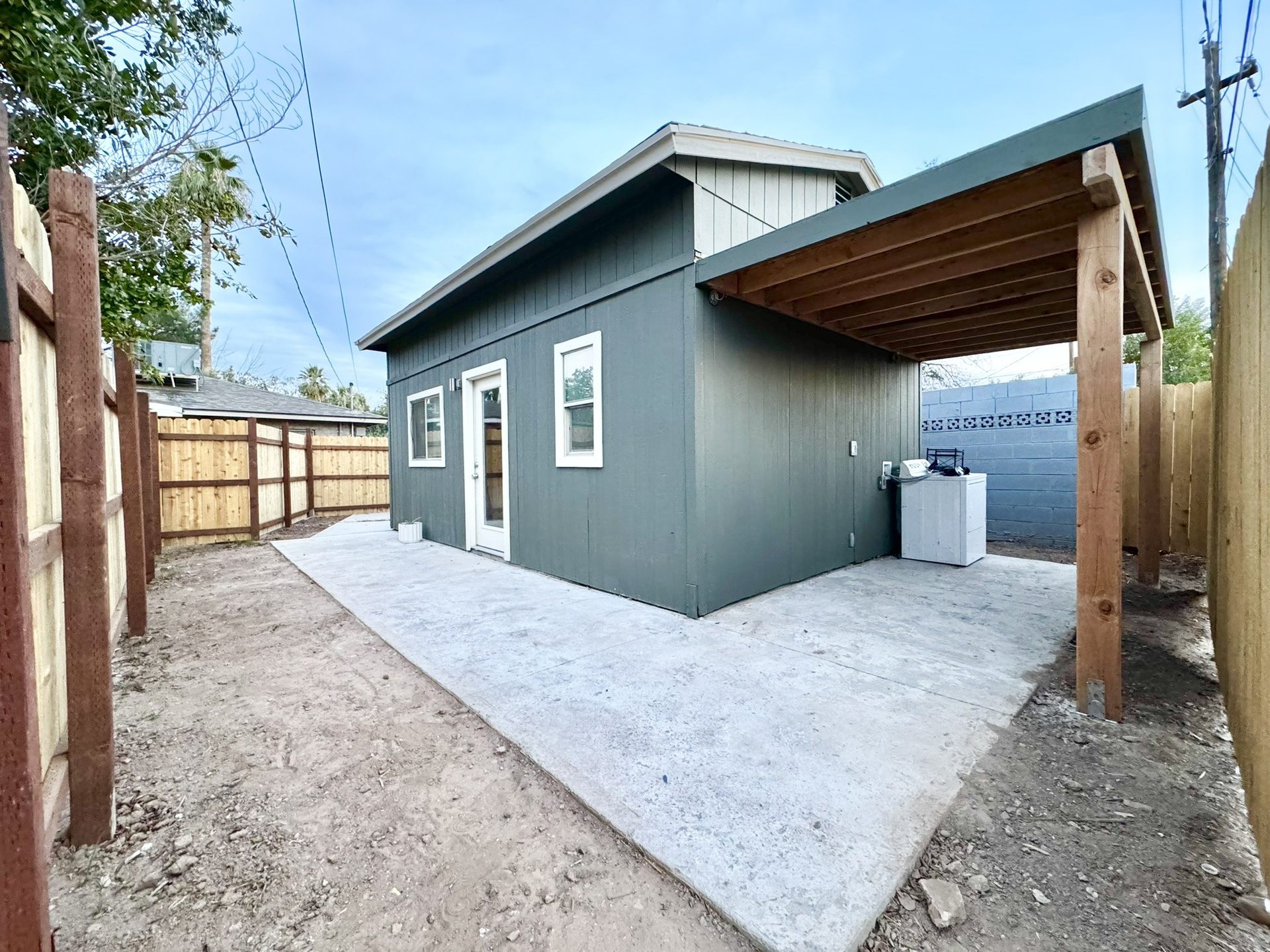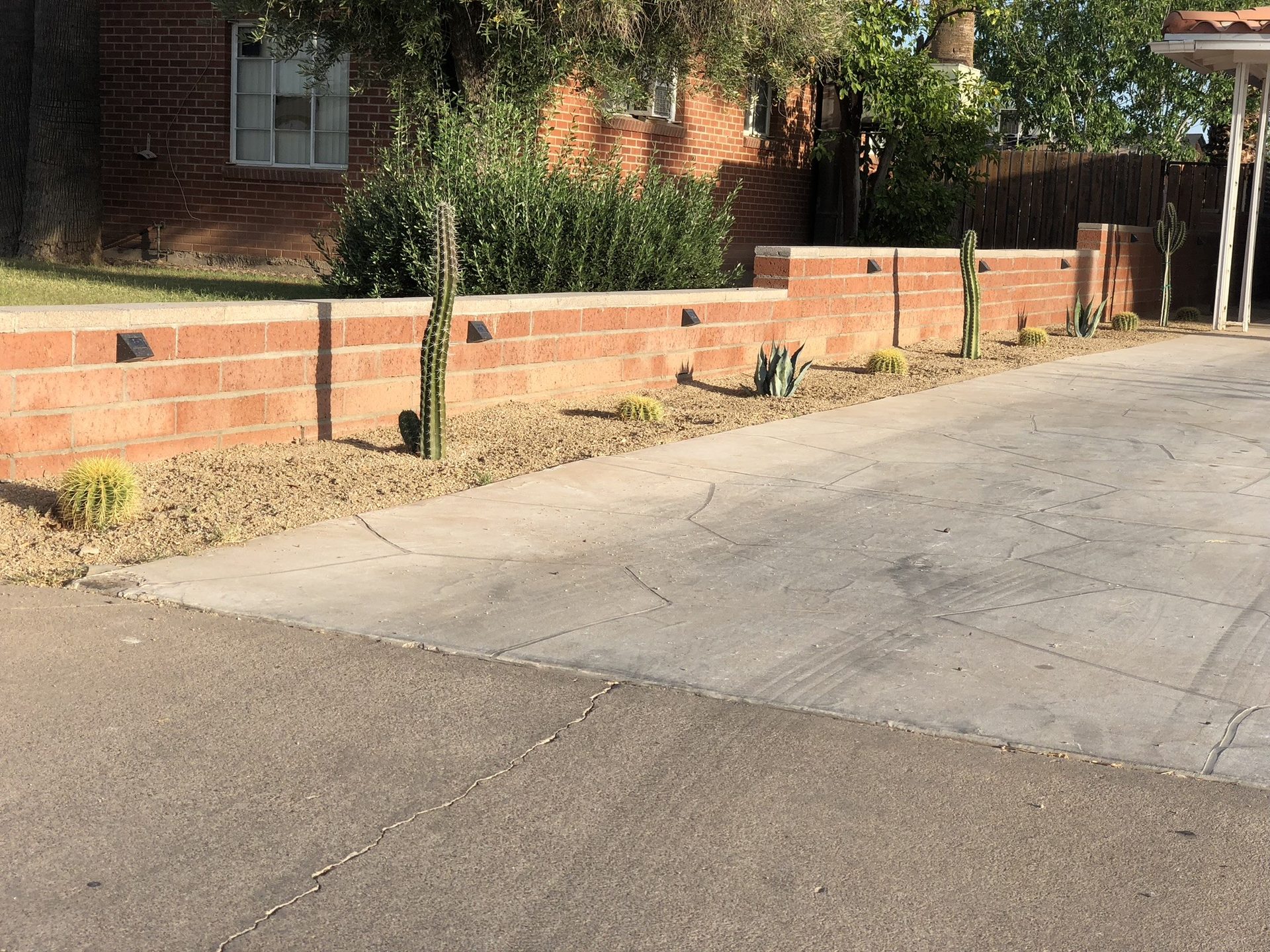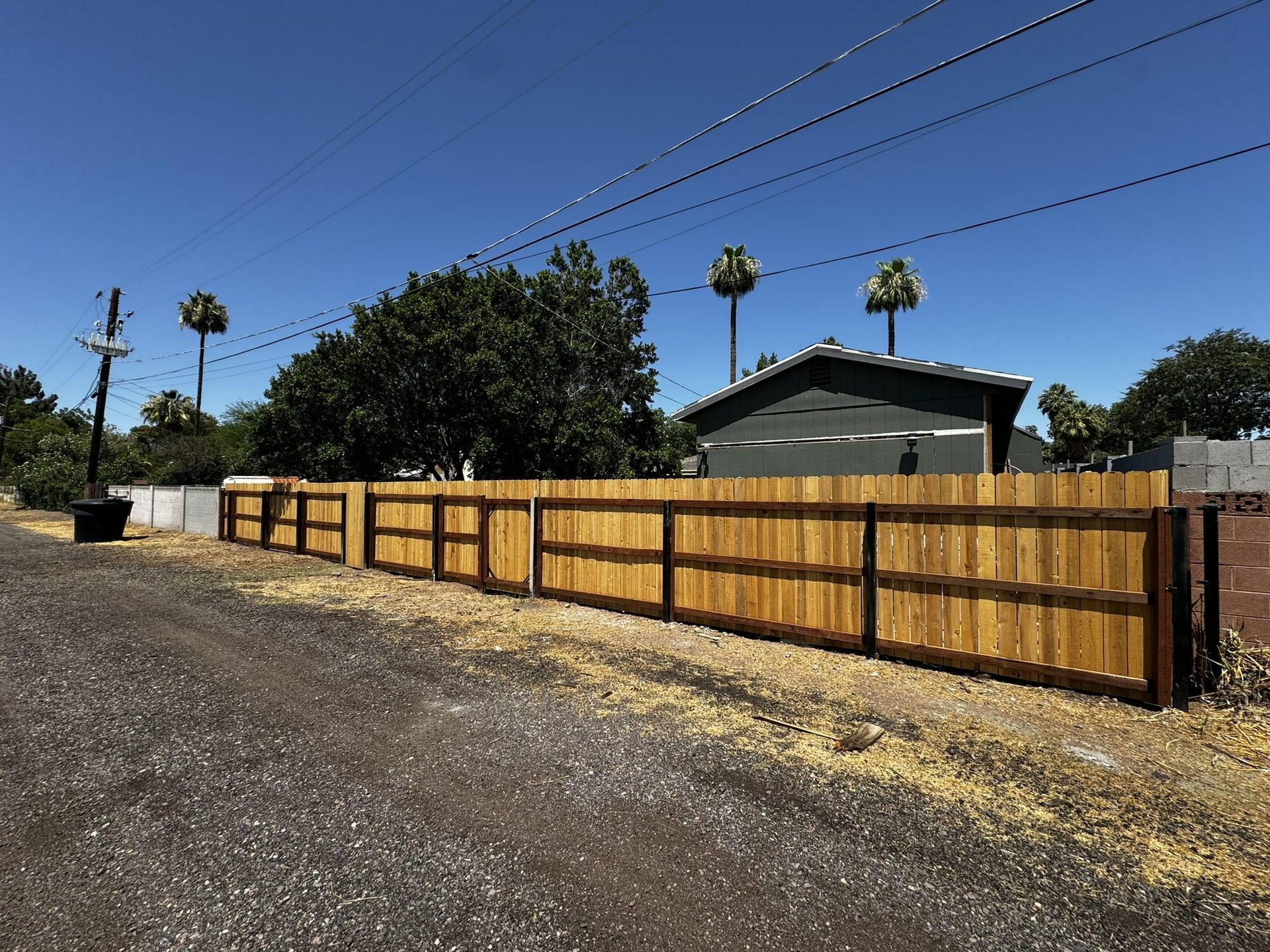
A six-foot dog-ear wood privacy fence runs about $25 to $40 per linear foot installed in the Phoenix metro, and most backyards land between $28 and $35. On a 150-foot run, which is a common Phoenix backyard, that works out to roughly $3,750 to $6,000. Dog-ear is the fence you already see down every alley in the Valley: flat pickets with the top two corners cut off at 45 degrees, butted tight, fastened to a rail frame. It is the value pick for privacy here because it buys the same six feet of screening as a block wall for a fraction of the money.
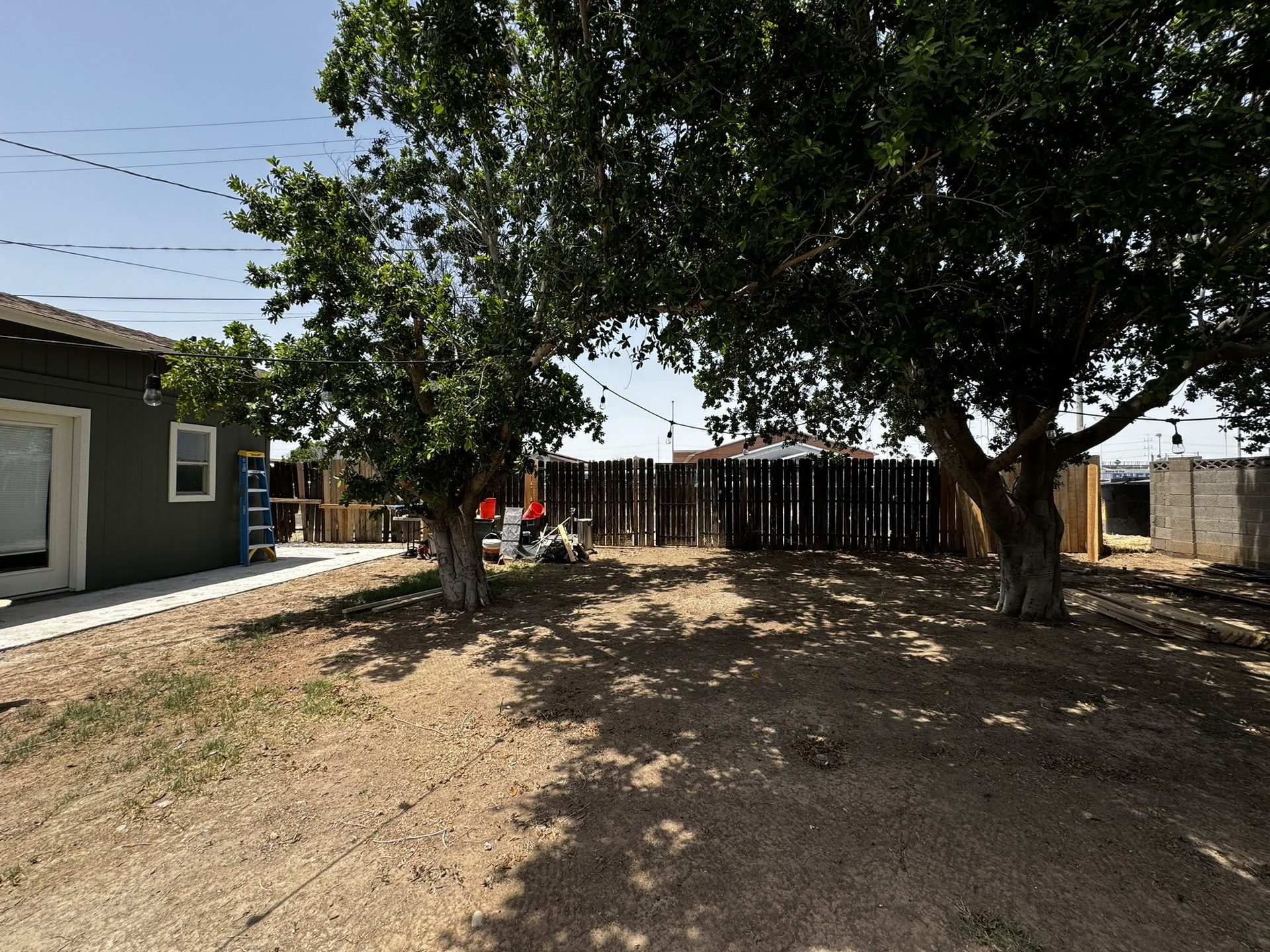
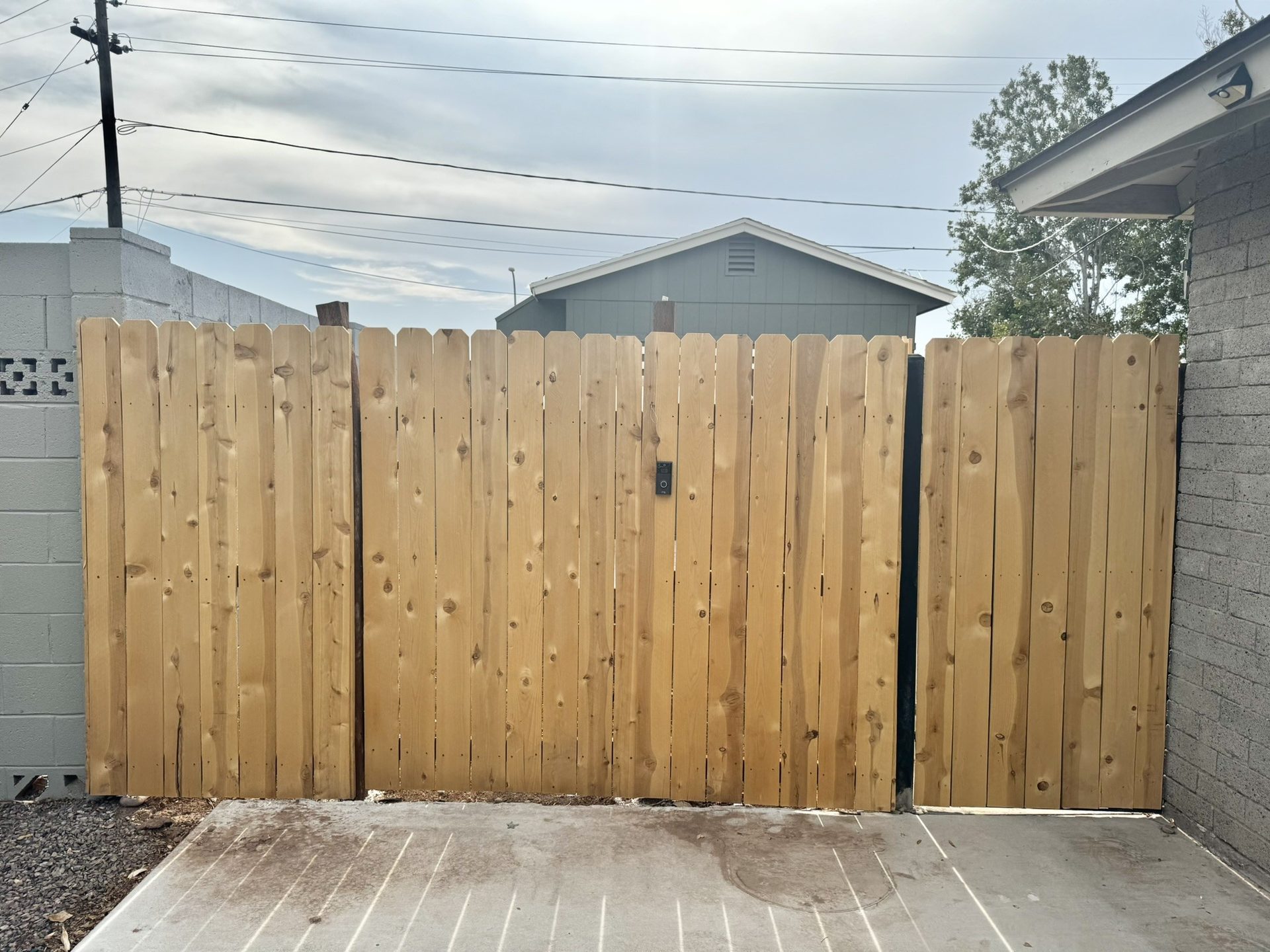
We built one in Tempe along a back alley: incense cedar pickets on a pressure-treated frame, hot-dipped galvanized fasteners, post holes pre-soaked before we dug into caliche. The photos on this page are from that job. What follows is what that fence costs, what sets the price, and what decides whether it still looks like that in ten years. For the service itself, start with our Phoenix fence installation page.
What Is a Dog-Ear Fence?
A dog-ear fence is the simplest board fence there is: flat vertical pickets with the top two corners cut off at 45 degrees, butted edge to edge against horizontal rails. The cut corners are why it is called dog-ear, and they are most of what separates it visually from a plain square-top fence. It is on every alley in Phoenix because it is the cheapest way to a solid, opaque screen with no gaps to see through.
Three structural parts, plus two that matter more than they look. Posts set in concrete, horizontal rails spanning post to post, and pickets fastened to the rails. Then a cap over the picket tops and a kickboard along the bottom. A standard picket is 5/8 or 3/4 of an inch thick, either 3-1/2 or 5-1/2 inches wide, and six feet tall.
One honest note about the cut. Fencing pages often say the dog-ear sheds water off the end grain. Only the corners come off, so the top of the picket is still a flat end-grain face. What the cut does is remove a sharp corner and hide small height differences between boards, and in Phoenix the top of the picket is not what fails anyway. Board-on-board and shadowbox overlap their pickets instead of butting them, which looks better from both sides and uses roughly 50 percent more boards. The Tempe project itself is written up in its own post.
Does a Wood Fence Hold Up in Arizona Sun?
Yes, and for a specific reason. What kills wood fences in most of the country is rot driven by humidity, and Phoenix does not have that problem. What Phoenix has instead is extreme dryness, ultraviolet light, monsoon wind and caliche.
The organizing number comes from the USDA Forest Products Laboratory: equilibrium moisture content in Phoenix in June is about 4.6 percent. Lumber arrives at the yard somewhere between 12 and 19 percent. Every board you buy is heading toward that June figure whether you planned for it or not, and it shrinks on the way. June is the annual low, and monsoon humidity pushes it back up, so the wood cycles up and down instead of drying once and settling. That cycling is what cups boards.
So the real risk list here is shrinkage and cupping, ultraviolet breakdown of the surface, and water trapped at the base of the post where irrigation and caliche put it. Rot out of the air is not on it. Those three plus wind are what the rest of this page is organized around, and wind is usually the revealer rather than the cause. A monsoon cell does not snap a sound post. It finds the post that had already gone soft at the soil line and takes the run down with it.
Wood Fence or Block Wall: Which One Should I Put Up?
Block outlasts wood in Phoenix and wood costs a fraction of block. That trade is the decision. A six-foot standard block privacy wall runs roughly $60 to $95 per linear foot in this market against $25 to $40 for a dog-ear wood fence, so the same 150 feet of privacy is about $9,000 to $14,250 in block and about $3,750 to $6,000 in wood.
Block earns its reputation. It lasts longer and it deadens sound better, and it has been the Valley default since the 1950s. Wood wins on up-front cost and on repairs: it goes in over a few days rather than a week plus cure time, and when something fails you replace one picket or one post instead of opening a wall.
Two situations where we will point you the other way. If the real goal is making freeway or arterial noise quieter, wood is the wrong product and we will say so. Selling you a fence that disappoints costs us more than losing the job does. And check your CC&Rs first, because a lot of Phoenix subdivisions were platted around block and some require it outright. If the real question is the wall you already have, read adding height to a block wall and who owns a shared block wall.
What Is the Best Wood for a Fence in Arizona?
Cedar heartwood for the pickets, pressure-treated lumber for the frame. Those are two different jobs and they want two different materials, which is why a good fence in Phoenix is almost never one species throughout.
The Forest Products Laboratory rates incense cedar heartwood as resistant to very resistant to decay, and that is why it is the picket of choice. Only the heartwood carries that rating. The creamy white streaks running through a cheap picket are sapwood, which carries none of it and goes soft first, so grade matters more than the species name on the sign. The trap worth naming is pickets sold under cedar-sounding brand names that are whitewood with a cedar-toned stain on them. Read the species on the tag. The color of the board tells you nothing.
One myth worth killing with a state source. University of Arizona Cooperative Extension is direct about it: redwood, cypress, cedar and very pitchy pine have some resistance but are not immune to termite attack, and termites are Arizona's number one urban pest. No picket you can buy is termite-proof. On the Tempe fence the pickets were incense cedar dog-ear and the posts and rails were pressure treated. We do not call that a cedar fence, because it is not one.
Can Fence Posts Be Cedar, or Do They Have to Be Pressure-Treated?
Pressure-treated, because a post lives in the ground and a picket does not, and the preservative industry prices that difference into the lumber. In the copper-based chemistries most Phoenix retail lumber now carries, ground-contact stock holds roughly 0.15 pounds of preservative per cubic foot against about 0.06 for above-ground stock, and the treater's own residential warranty lists fence posts under ground contact.
Here is the number that catches people out. A pressure-treated fence picket off the rack is typically treated to around a third of what the same manufacturer says a post needs. A treated picket standing in dirt is being used outside its own rated class, and that is a fence that leans in a few summers.
Cedar heartwood is good at resisting decay above grade. It is not the equal of ground-contact treated lumber sitting in a wet caliche hole. That is also why a kickboard exists: it puts a sacrificial pressure-treated board closest to the soil and holds the cedar pickets up out of it, which satisfies the University of Arizona Extension rule that exterior woodwork should sit a minimum of six inches above grade.
How Do You Set Fence Posts in Caliche?
You soften it with water before you dig, and then you let what the hole hits decide what the concrete has to do. Caliche is soil cemented together by calcium carbonate, anywhere from loose nodules to a rock-hard slab inches thick, and water does not move down through it. So water sits in the hole against the bottom of your post for days after a monsoon cell. One of the driest metros in the country manufactures a small, persistent reservoir at exactly the elevation where a wood post is weakest.
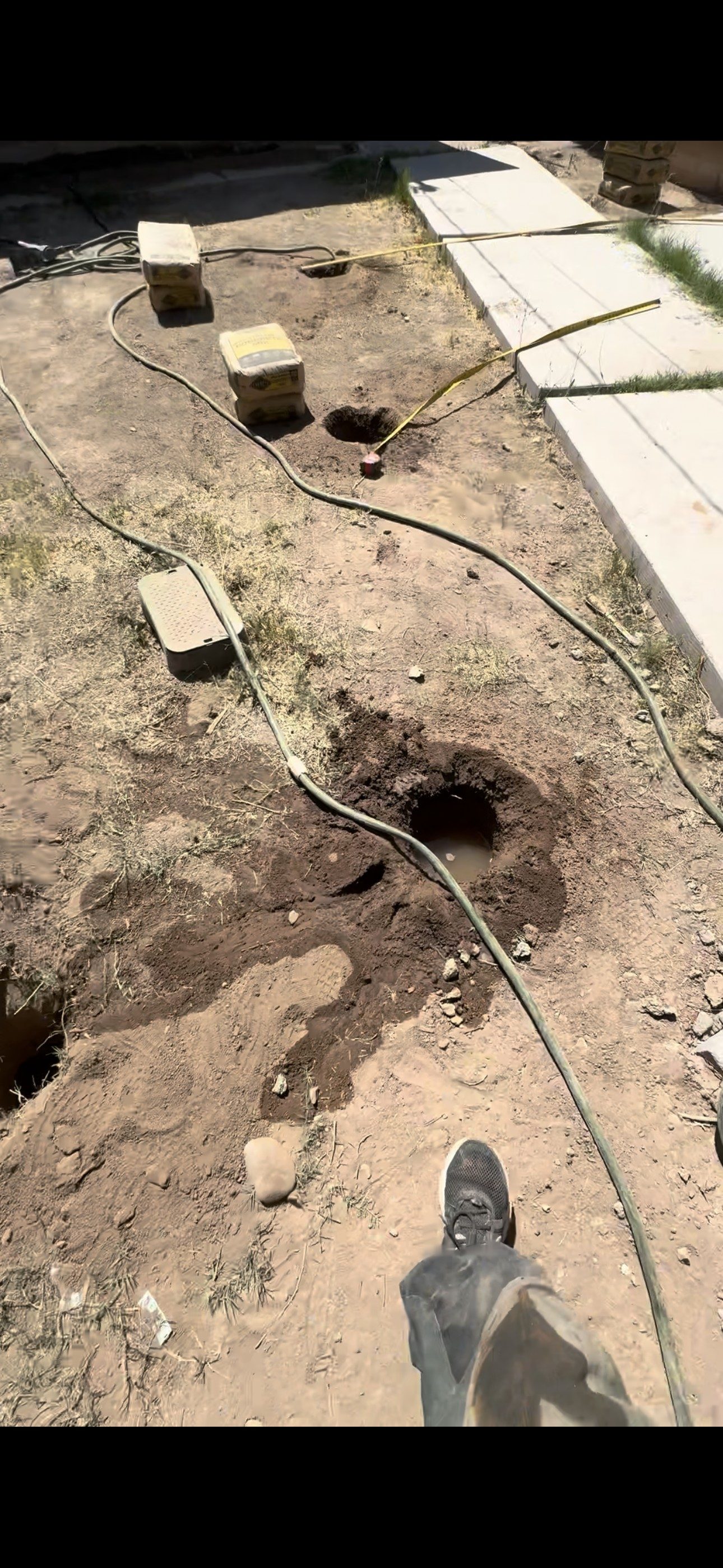
On the Tempe job we pre-soaked the holes before digging. A hole that will not drain does three things: wood posts get collar rot at the soil line, metal posts corrode at the waterline, and footings work loose as the soil around them wets and dries.
The specs that answer it are set on install day. A hole about three times the post width. A third to a half of the standing height buried, so an eight-foot post goes two feet down and leaves exactly six feet above grade. Then the part most pages get wrong: a gravel base under the post only helps if the hole gets through the caliche into soil that drains. Where it does not, gravel is a sump held against the end grain, so the post gets fully encased in concrete with the collar crowned and sloped away, and the water runs off the top instead of sitting against the wood. Which one you get is decided by what the hole hits, and that is known on dig day rather than on bid day.
You can test your own yard before anyone bids it. Fill an empty hole with water and watch it. If the level drops at least four inches in four hours, drainage is workable.
Are Wider Fence Pickets Cheaper Per Foot?
Yes, and it is the most useful non-obvious number here. At the Home Depot on Thomas Rd in Phoenix, a 5-1/2 inch incense cedar dog-ear picket costs $3.48 and covers a linear foot of fence for $7.59. The 3-1/2 inch version of the same species from the same mill costs less per piece at $2.98, but it covers that same foot of fence for $10.22.
That is roughly a 35 percent penalty for the narrower board, because you need far more of them to cover the same run. Cheaper per piece is not cheaper per foot of fence, and per foot of fence is the only unit that matters across 150 feet of property line. Wider boards also mean fewer fastener lines and fewer joints that can open up later.
Material prices on this page were read at the Home Depot on Thomas Rd in Phoenix, 85018, on September 21, 2026.
How Much Does a Dog-Ear Wood Privacy Fence Cost Per Foot in Phoenix?
About $25 to $40 per linear foot installed, with most Phoenix backyards landing between $28 and $35. That is a six-foot fence built on site with cedar dog-ear pickets, pressure-treated posts set in concrete, pressure-treated rails, and the cap and kickboard that keep the wood up off the dirt.
Dog-ear wood privacy fence, Phoenix metro, 2026
| Line item | This job, the Tempe alley fence | Typical Phoenix range | Source |
|---|---|---|---|
| 6-ft dog-ear fence, built on site, installed | Built to this spec. No dollar total was recorded | $25 to $40 per linear ft, most backyards $28 to $35 | Three independent 2026 Phoenix fence-cost sources |
| Same fence, materials only, at Phoenix retail | Same picket, post, rail, cap, kickboard and fastener spec | About $19.81 per linear ft before waste, about $23 after 10 percent waste and tax | Our arithmetic on live unit prices, not a published figure |
| Incense cedar dog-ear picket, 5/8 x 5-1/2 in x 6 ft | The picket class used on this fence | $3.48 each, which is $7.59 per linear ft of fence | Home Depot Thomas Rd, Phoenix, 2026-09-21 |
| Narrow 3-1/2 in cedar picket, same species, same mill | Not used | $2.98 each, but $10.22 per linear ft of fence | Home Depot Thomas Rd, Phoenix, 2026-09-21 |
| Pressure-treated rails, three per bay | Pressure-treated, three rails | About $2.99 per linear ft | Home Depot Thomas Rd, Phoenix, 2026-09-21 |
| Pressure-treated 4x4x8 post, set in concrete | Used, set in concrete | $19.98 each, about $2.50 per linear ft at 8 ft spacing | Home Depot Thomas Rd, Phoenix, 2026-09-21 |
| Fast-setting concrete, 50 lb bag | Holes pre-soaked before digging caliche | $7.97 a bag, 3 bags bought per post, about $2.99 per linear ft | Bag count computed for a 10 in hole with a 4x4 in it |
| Hot-dipped galvanized fasteners, whole run | Used, because cedar tannins corrode cheap fasteners | About $0.70 per linear ft, covering picket nails, rail screws and the cap and kickboard fixings together | Home Depot 2026-09-21; cedar industry fastener guidance |
| Top cap over the pickets | On this fence | $3 to $6 per linear ft installed | Material read 2026-09-21 plus labor; 2026 add-on pricing |
| Bottom kickboard | On this fence | $3 to $13 per linear ft installed | 2026 published kickboard pricing |
| Walk gate, 3 to 4 ft, matching pickets | Not recorded on this job | $250 to $800, typically $400 to $550 | 2026 national install averages; Phoenix gate pricing |
| Double or drive gate, 10 to 12 ft | Two matching driveway gates were part of this job | $500 to $1,800, typically $750 to $1,100 | 2026 national install averages; Phoenix gate pricing |
| Caliche in the post holes | Holes pre-soaked with water before digging | Adds to post-setting labor, and a hard caliche cap adds far more than loose nodules do | Fence-industry cost analysis, March 2026 |
| Removing and hauling the old fence | The old leaning alley fence came out first | $3 to $7 per linear ft | Phoenix fence cost pages, 2026 |
| Stain or ultraviolet sealer, both sides | Not recorded for this job | $1.50 to $4.00 per linear ft per side, re-coat every 2 to 3 years | 2026 published staining rates; high-UV trade consensus |
| City of Phoenix building permit, 6 ft backyard fence | This job was in Tempe, which sets its own rule | Required. The fee comes off the city's current schedule | City of Phoenix, Required Permits for Fences and Retaining Walls |
| Whole project, 150 linear ft | Run length not recorded on this job | $3,750 to $6,000, typically about $4,600 | Computed from the per-foot band; Phoenix average $4,442 |
| 6-ft block privacy wall, for comparison | Not applicable | $60 to $95 per linear ft | Phoenix masonry pricing, July 2026 |
How Much Is 100, 150 or 200 Feet of Privacy Fence in Phoenix?
Off that per-foot range: 100 feet is about $2,500 to $4,000, 150 feet about $3,750 to $6,000, 200 feet about $5,000 to $8,000, and 300 feet about $7,500 to $12,000. A 50-foot run is the exception at roughly $1,400 to $2,300, which sits above what the per-foot band alone would give, because mobilization, layout and the permit are the same work whether the run is 40 feet or 200. The add-ons above are priced separately on purpose. Folding them into one per-foot number is how bids stop being comparable.
What Is Labor vs. Materials on a Phoenix Fence Quote?
Materials alone for a properly built cedar dog-ear fence come to about $20 to $23 per linear foot at Phoenix retail, so on a $28 to $35 bid the labor, the equipment, the permit and the overhead are sharing what is left. That is also why a bid down at $20 a foot installed has to be giving something up somewhere.
Walk the build-up at live unit prices: cedar pickets $7.59, three pressure-treated rails $2.99, the pressure-treated post $2.50, concrete $2.99, kickboard $1.52, top cap $1.52, and hot-dipped galvanized fasteners about $0.70 for everything on the run. That is $19.81 before waste and tax, about $23 after. The arithmetic is ours, run on current Phoenix unit prices, assuming posts eight feet on center and 10-inch holes.
The concrete is where most online calculators go wrong. A 10-inch hole two feet deep with a 4x4 in it takes about 0.92 cubic feet, and a 50-pound bag of fast-setting mix yields about 0.375, so you consume two and a half bags a post and buy three. At 30 inches deep it is just over three. Either way nobody sets a fence post with one bag.
So a low bid is usually one of these: not cedar, a pre-built panel instead of a stick-built fence, two rails instead of three, no cap or kickboard, untreated posts, or fasteners that will streak the boards black inside a year. A $22 bid and a $32 bid are not the same fence, and the difference shows up in year three rather than on handover day.
One stale number to ignore. A $17 to $27 per foot figure circulates widely in Phoenix search results and traces back to a page dated June 2022. It is not a current rate, and a bid built on it is a bid built on four-year-old lumber prices.
Do You Need a Permit to Build a Fence in Phoenix?
For a six-foot backyard privacy fence in the City of Phoenix, yes, and that much is not in dispute. The city's permit guidance for fences and retaining walls and its residential fence zoning handout agree on it. Above seven feet, structural design calculations come with the permit.
Below three feet the two city documents do not line up with each other, and both are dated 2013. So if you are putting in a short front-yard fence, ask the city rather than take a number off a website, ours included.
The height limits sit in Phoenix Zoning Ordinance 703.A. Forty inches in a required front-yard setback, six feet in a rear or side yard, and up to eight feet in side and rear yards abutting an arterial street. A front yard adjacent to an arterial street can go to 54 inches with a use permit. Height is measured from the higher of the adjacent finished grade elevations, averaged within fifty feet, which matters on any lot that is not flat. Separately, visibility triangles at street intersections and driveways allow nothing over three feet under Phoenix City Code 31-13. The practical consequence is that a six-foot privacy fence across a front yard is not a job in Phoenix.
One detail decides layout before a post goes in. The six-foot limit is measured to the uppermost part of the fence, which is the top of the cap and not the top of the picket, so the kickboard, the picket and the cap have to total six feet or less between them.
These are City of Phoenix rules only, and the difference between cities is real. In Tempe a permit is required for a fence, gate or wall over six feet, so the same six-foot backyard fence that needs a permit in Phoenix does not need one in Tempe. Mesa, Chandler, Scottsdale, Gilbert, Glendale and Peoria each set their own. We confirm the rule for your address before we price anything, and we pull the permit under ROC #365090 before work starts.
Can I Build a Privacy Fence Myself in Arizona?
Parts of it, and the first thing worth being clear about is what Arizona's licensing statute governs. A.R.S. 32-1121(A)(14), the handyman exemption, is about who you can legally pay: it covers an unlicensed person only when the aggregate contract price is under $1,000 and the work does not require a local building permit. Both have to be true. A six-foot fence in Phoenix requires a permit, so on that job the exemption is off the table at any price, and at $25 to $40 a foot almost any real run clears $1,000 anyway. That is a rule about hiring, not a rule about what you may do on your own house.
Where do-it-yourself makes sense: re-coating the fence, swapping individual pickets on a sound frame, re-fastening a loose rail, and adding an anti-sag kit to a gate that has started to drop. Those are good weekend jobs.
The part homeowners underestimate is the post holes. Agricultural extension sources describe augers binding on rock and kicking hard enough to break arms and ribs, and a rented auger often does not have the down pressure to get through caliche at all. It is the most dangerous tool on the job and the one most likely to fail to dig the hole. Gates are the other trap: the diagonal brace runs from the bottom hinge-side corner up to the top latch-side corner so it works in compression, and run the other way it is a leading cause of early sag.
The order a fence goes in
- Locate and lay out. Arizona 811 for the public utilities, a separate sweep for the private irrigation and lighting, then a string line off the longest straight run with post centers marked from it.
- Dig and set. Pre-soak the caliche, dig to full depth, set the posts plumb and braced in concrete, and crown the collar so it sheds away from the wood.
- Let the posts set before anything hangs on them. Fast-set is buildable in about four hours and standard mix wants overnight. This is the step that gets skipped when a crew is trying to finish in a day.
- Frame and clad. Rails, then pickets, then the cap and the kickboard. Every field cut in treated lumber gets brushed with a copper-naphthenate end-cut preservative, because the cut face is untreated wood.
- Gates last, hung to the fence line as built, not as drawn.
What Goes Wrong With Wood Fences in Phoenix, and How Soon?
Ranked by what takes fences down here: post collar rot at the soil line first, then picket cupping and splitting, then fastener corrosion, then gate sag, then irrigation damage. Every one is a detail decided on install day. None of them is a property of wood.
Post collar rot is the number one killer. The fence looks fine everywhere, one post goes soft, and the whole run leans after a monsoon. Snap that post and the rot is a band at and just below grade while the top and the bottom are sound. It is the same physics that takes down carport posts in a monsoon.
Fastener corrosion is the most visible failure. Cedar tannins react with iron and moisture and streak the boards blue-black. The cedar industry's guidance is hot-dipped galvanized, aluminum or stainless, which is why the Tempe fence went together with hot-dipped galvanized hardware. Hot-dipped resists the staining; stainless prevents it.
Irrigation-driven rot is the most Phoenix-specific failure. Keep spray heads at least two feet off the fence line and prefer drip near the boards; sprinkler and irrigation repair covers that side. Landscape rock bermed against the kickboard is the same mistake in another form, because it bridges the six-inch clearance, holds moisture against the wood, and gives termites a covered approach.
The bad-install tells you can check in ten minutes: concrete finished flat or dished at the post instead of crowned, only two rails on a six-foot fence, a single fastener per picket per rail, staples instead of nails, pickets touching dirt with no kickboard, rust or black streaks after one season, untreated saw cuts, and a gate with no brace or a brace running the wrong way.
Why Did Gaps Open Up in My Brand New Privacy Fence?
The wood dried out and shrank across its width after it went up. Wood only moves below about 30 percent moisture content, and it moves in proportion to how far it travels, so a picket that arrives at 19 percent and settles toward a 4.6 percent June gives back roughly half of incense cedar's tabulated tangential shrinkage. On a 5-1/2 inch board that is about an eighth of an inch. A board that goes up wetter than that gives back more.
Run it across a bay and the privacy argument gets concrete. An eight-foot bay holds about seventeen pickets, so an eighth of an inch each is around two inches of new gap in a fence you bought specifically so nobody could see through it.
That is why lumber gets acclimated on site before it goes on the frame rather than nailed up off the truck. On the Tempe job the cedar sat on site before it went up. It also decides the install gap, which almost nobody mentions: green boards go butted tight because they are going to shrink, and boards that have already dried on site get a slight gap so they do not buckle against each other when monsoon humidity swells them back.
Four things make it worse: thin 5/8 inch pickets, a single fastener per rail that lets the board pivot and cup, only two rails on a six-foot fence, and a west-facing run where the sun side dries first and the board cups toward the sun.
How Long Does a Wood Fence Last in Phoenix?
Phoenix companies put a wood fence anywhere from five to twenty years, and two of the three sources behind that spread sell block, so nobody in this market is a neutral witness. Where a given fence lands is decided by the post detail, the fasteners, and whether it gets re-coated.
Maintenance is the variable you control. Stain manufacturers put five to eight years on a vertical surface, and the trade consensus for high-ultraviolet climates is a lighter re-coat every two to three years. The gap between those two numbers is the maintenance reality. Budget roughly $1.50 to $4.00 per linear foot per side to have it done professionally.
One thing worth doing before you rely on any of it: read the warranty on whatever you are buying. Weathering exclusions, replacement-material-only remedies that pay no labor, and exclusions for wood repeatedly wetted by irrigation are all common, and they are exactly the terms that decide whether a warranty is worth anything in this climate. The vinyl warranties people reach for as the maintenance-free answer carry their own exclusions. No material in this market comes with a warranty that saves you from a bad install. The install detail is the protection.
Get a Real Number for Your Fence Line
Pace the run, photograph the property line, and tell us whether there is a gate in it. What comes back is a per-foot number, the gates priced separately, and whether your city wants a permit at that height.
Request Free EstimateWhat Else Do Homeowners Ask Before a Fence Goes In?
These come up on walkthroughs once the price question is settled, and they are all about how the fence gets built, not who builds it.
How deep do fence posts need to be in Phoenix?
A third to a half of the height standing above ground, in a hole about three times the post width. On a six-foot fence that is a hole at least two feet deep, and we go deeper where the caliche lets us. An eight-foot post buried two feet leaves exactly six feet standing, which is why that is the common combination.
How far apart should the posts be on a six-foot wood fence?
Eight feet on center is the common spacing, because an eight-foot rail then reaches from the center of one post to the center of the next and the joint breaks on the post. Plenty of Phoenix installers tighten it to six feet on exposed runs, because a six-foot solid fence is a sail in monsoon wind. Either way the short bay goes at the end of the run rather than stretching the spacing to make the math come out.
How close to the property line can a fence go in Arizona?
There is no single Arizona answer, because the setback comes from your city's zoning and from your subdivision's plat and easements rather than from state law. Two things decide most Phoenix yards: a public utility easement along the back or side needs written approval from every utility in it before a fence permit issues, and a corner lot next to a key lot has its own street-side setback. Both get checked against the plat before the line is strung.
How long should a new cedar fence dry before it gets stained?
Stain wants dry wood, and new cedar usually needs a few weeks of Phoenix weather before it will take a finish properly. The competing pressure is ultraviolet light, which starts breaking down the surface of unprotected wood quickly here, so the practical window is short. Follow the finish manufacturer's own moisture guidance on the label, since applying over wood that is too wet is what voids most stain warranties.
Does Arizona 811 mark sprinkler lines and landscape lighting before post holes get dug?
No. The marking service locates public utilities. Private, customer-owned lines are not covered, which in a Phoenix backyard means drip and lawn irrigation around the perimeter, low-voltage landscape lighting, pool equipment lines, and any gas run out to a grill or fire pit. Those are exactly what a post hole finds, so they get located separately before anyone digs.
Which side of the fence do the rails face?
By convention the smooth picket face goes toward the neighbor and the rails face the owner's yard. Worth knowing that the phrase good-neighbor fence gets used two ways in the trade, sometimes for this rail convention and sometimes for a shadowbox that looks the same from both sides, so it is worth agreeing which one you mean. There is one case where it is not a preference: if the fence is serving as a pool barrier, the horizontal members have to be on the pool side or they are a climbing ladder.
Can a dog-ear wood fence double as a pool barrier?
It can, but it stops being a cosmetic fence at that point. A pool barrier carries its own height, gap, spacing and gate requirements, and the rule that catches wood fences is that horizontal members close enough together to climb have to be on the pool side. Many homeowners are better served by a separate code barrier inside the wood fence. That comes up on the walkthrough, not after the fence is up.
What is the difference between dog-ear, board-on-board and shadowbox?
Dog-ear pickets butt edge to edge in a single layer, which is the cheapest way to a solid screen. Board-on-board overlaps the pickets so there is no gap to open up as the wood shrinks, and shadowbox alternates them front and back so the fence looks finished from both sides and lets some air through. Both of the overlapping styles use roughly 50 percent more pickets, which is most of why they cost more per foot.
What Else Is Worth Doing While the Fence Line Is Open?
A fence job puts a digging crew, a concrete mixer and a wide-open property line on your lot for several days, and that strip of dirt is the one every other yard system runs through. Work agreed while the fence is being quoted commonly comes in 25 to 50 percent under what the same job costs as its own trip later:
- Move the sprinkler heads off the fence line while the ground is already open, since overspray against the boards is what most treated-wood warranties exclude by name. See sprinkler and irrigation repair in Phoenix.
- Pour the patio while equipment can still reach the yard through the gap in the fence line. See concrete patios.
- Run low-voltage landscape lighting in the same trench, so nobody has to open the yard twice. See landscape lighting for a desert yard.
- Deal with the block part of the boundary in the same visit, so the whole perimeter finishes at one height. See adding height to a block wall and shared block wall repair.
- Coat the new fence and anything else that is due in one visit, since the sprayer and the masking are the same setup. See exterior painting.
- Reset rock and plantings back off the kickboard, since granite bermed against the bottom board is what feeds the termites. See desert landscaping.
- Refinish the existing iron gate so it matches the new fence line instead of sitting beside it looking older. See wrought iron gate painting.
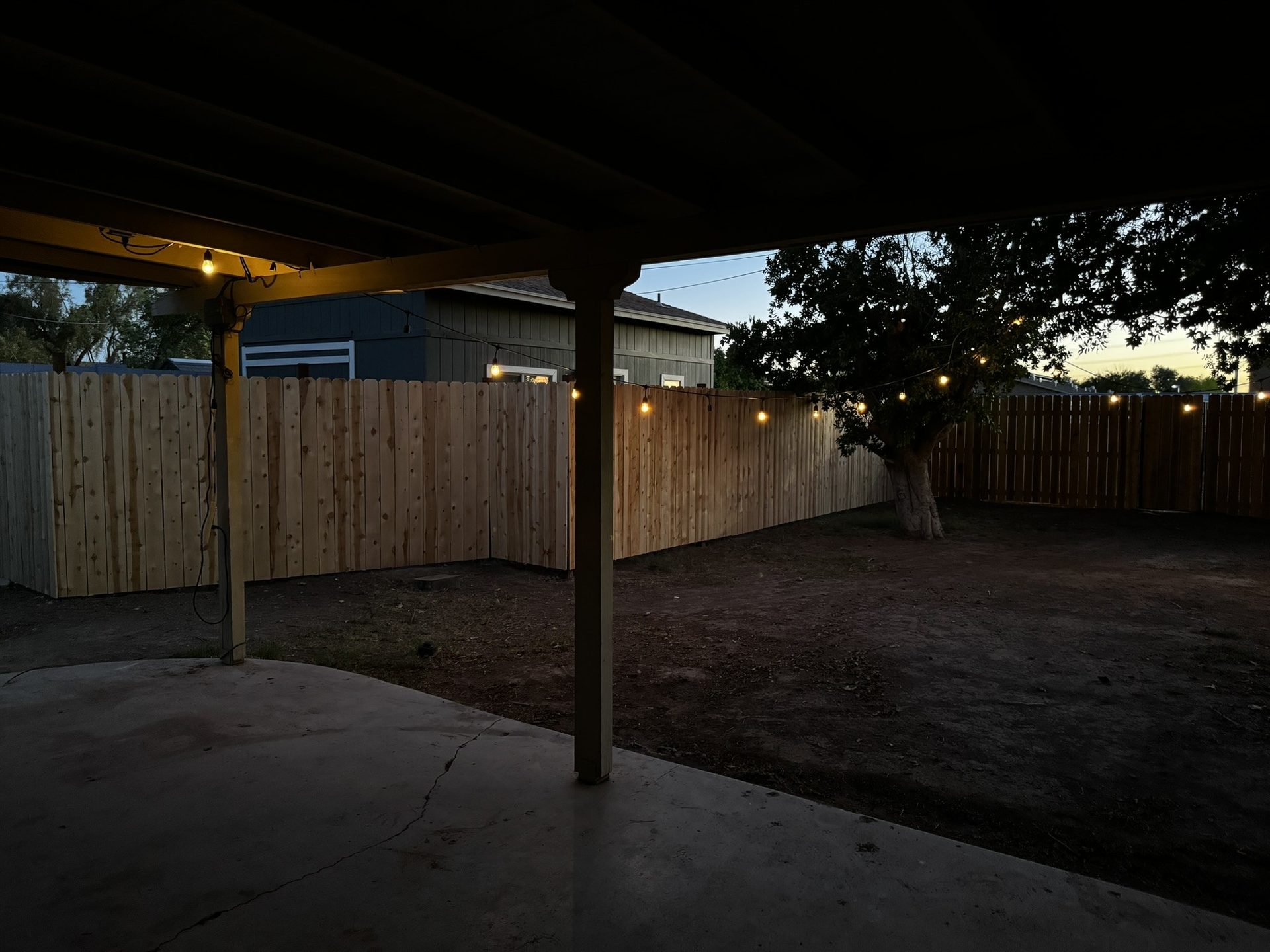
Tell us which of these you want before the posts go in. Once the concrete is set and the pickets are on, each one is its own trip at its own price. If you want the whole perimeter priced as one job, that is what our fence installation page covers, and there are more finished runs in the project gallery.

Written by Harrison Norem, owner of Norem Contracting and a licensed Class B general contractor, Arizona ROC #365090. Fifteen years across the trades, including privacy fences, gates and block work across the Phoenix metro. More about Harrison.