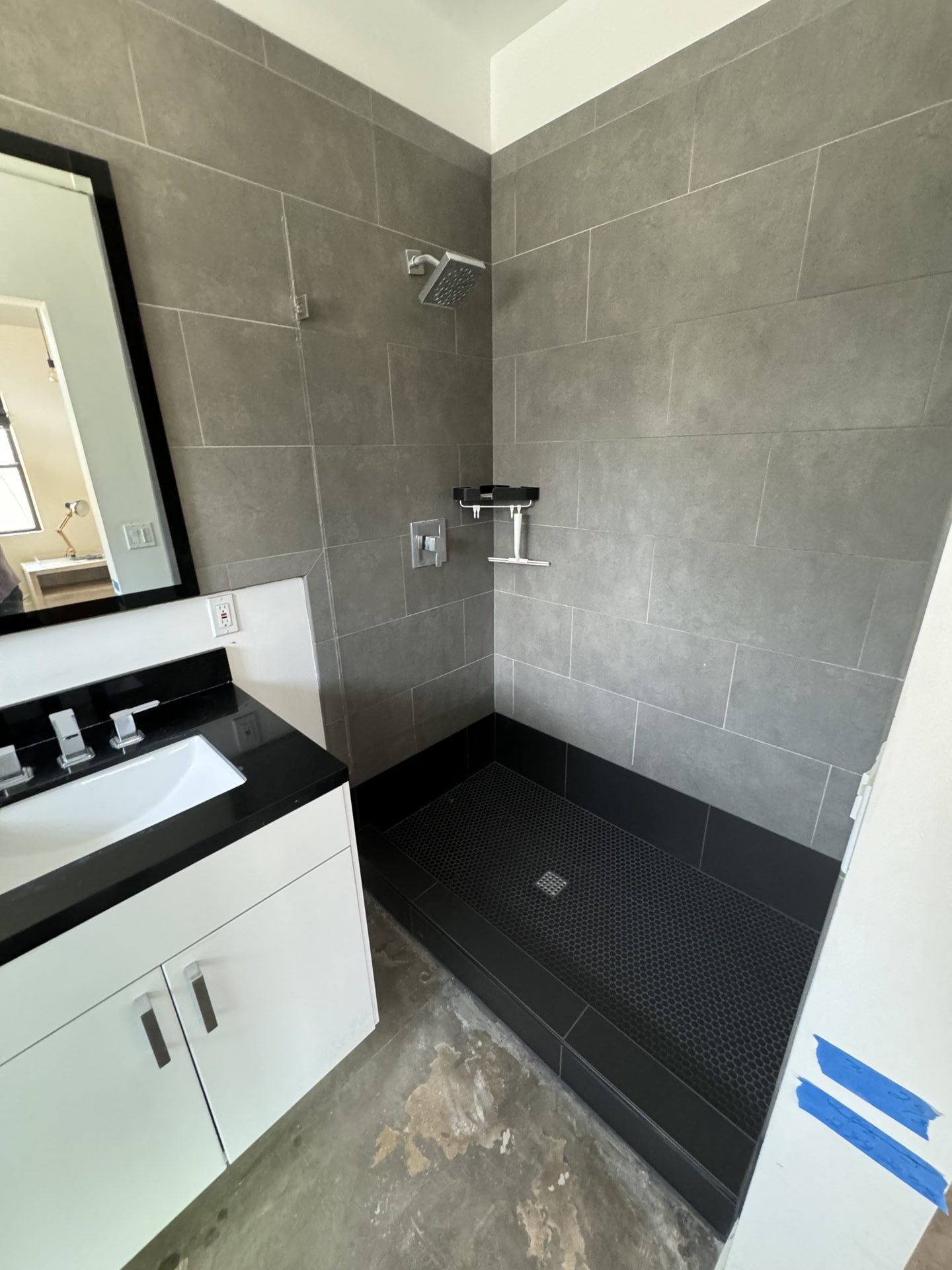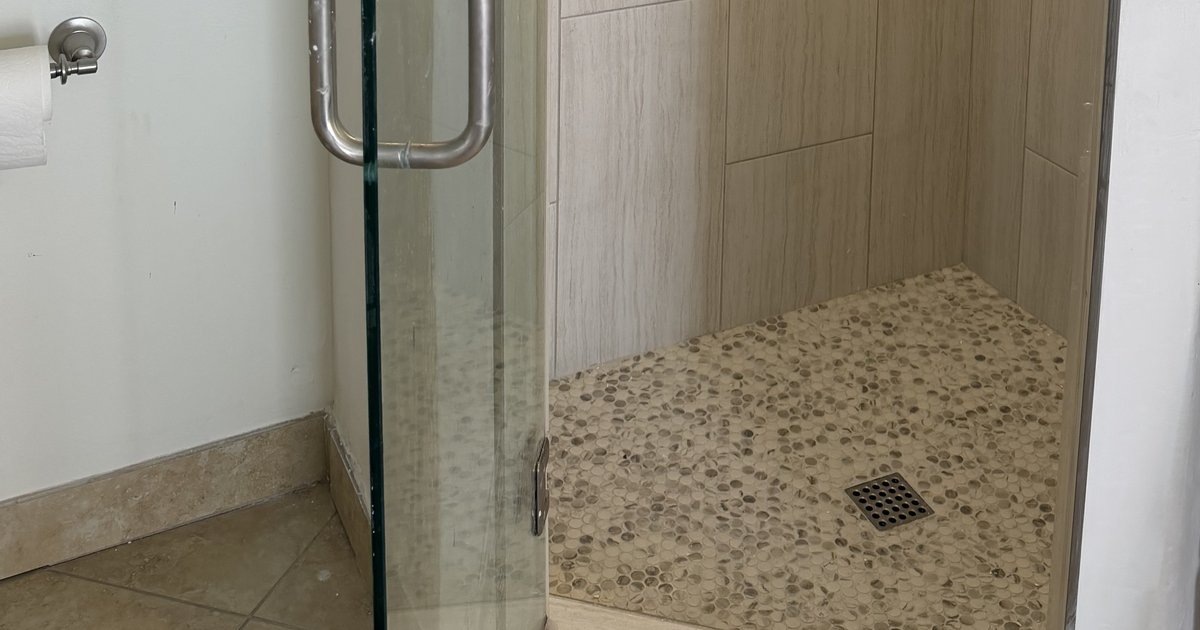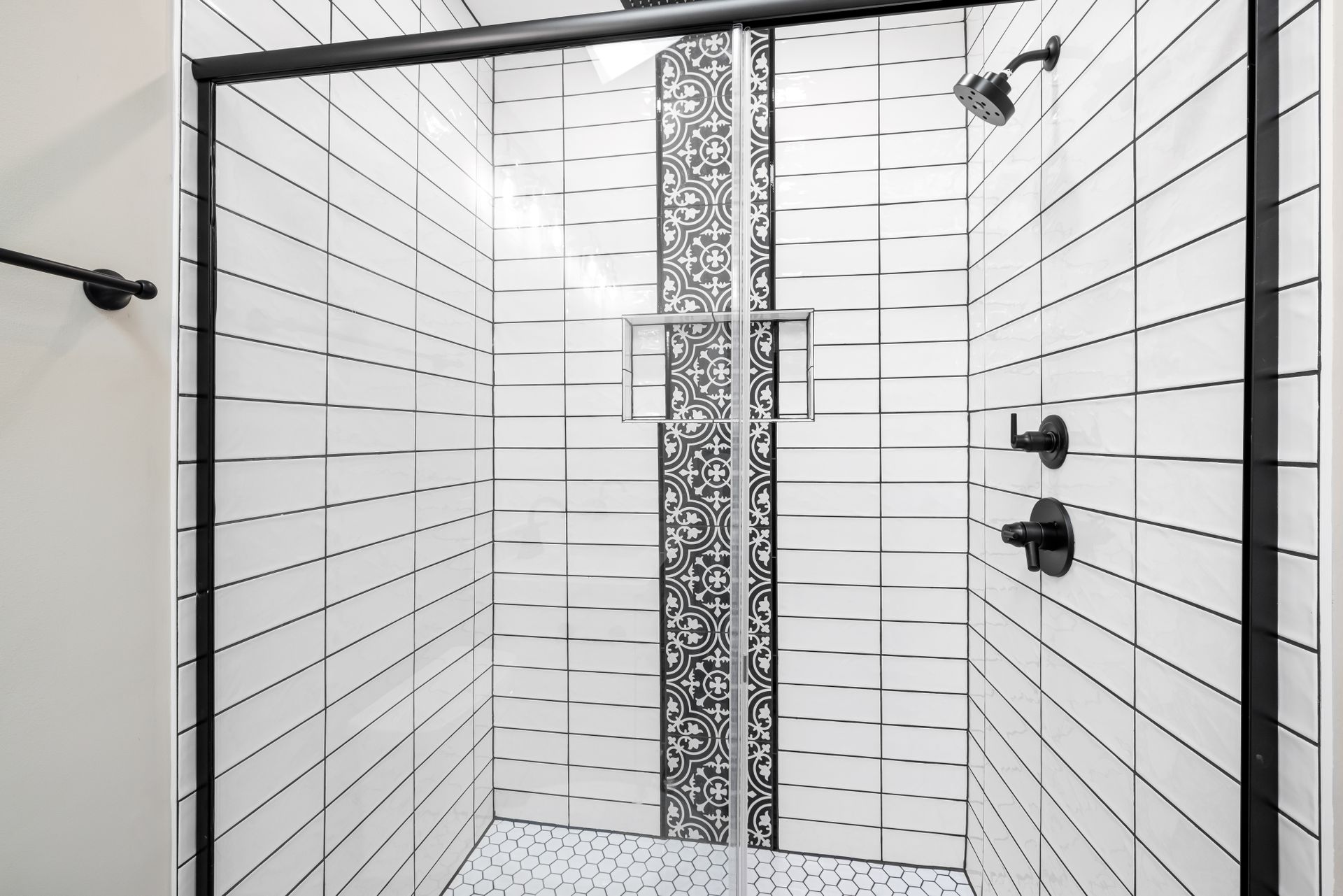
A proper shower retile takes the old tile and backer off to the studs and builds new waterproofing before new tile goes up, because tile set over tile buries whatever made the shower worth redoing. In Phoenix a walls-only retile over a sound pan runs about $3,000 to $6,500 for a standard 60-inch surround, a full gut and retile with a new pan $6,000 to $12,000 and up, and a regrout alone $400 to $960. The pan has to go too when the floor tile sounds hollow or water shows up outside the shower.
Most people who call about a shower retile are describing one of three different jobs, and the price spread between them is wide. Telling them apart comes down to what can stay and what has to go. If you already know the pan is leaking, the reverse question, rebuilding the pan while saving the wall tile, has its own page: shower pan rebuild and leak repair.
What Does "Retiling a Shower" Include?
It covers three jobs: a regrout, which keeps the tile and replaces the grout; a walls-only retile, which strips the walls to the studs and keeps the pan; and a full retile, which takes out the walls and the pan together. The right one depends on whether the shower leaks, whether the tile is still bonded, and what the floor is built on.
The three scopes, side by side
| Regrout | Walls to the studs | Full retile with a new pan | |
|---|---|---|---|
| What comes out | The grout, and the caulk at every corner | Wall tile, backer board and old waterproofing | Everything down to the studs and the slab |
| What stays | Tile, backer, pan, valve, glass | The pan, usually the valve, sometimes the glass | The drain location and, often, the valve |
| New waterproofing | None | On the walls, lapped onto the pan | Walls and floor as one system |
| When it fits | No leak, tile bonded, the grout is the only problem | Dated or damaged wall tile over a pan that passes a flood test | A leaking or old pan, hollow floor tile, water outside the shower |
| Shower out of service | One or two working days plus the grout's cure | About seven to ten days | About ten to fourteen days |
Dollar figures for each scope are in the cost section further down.
Can New Tile Go Over the Old Shower Tile?
The tile industry allows it under conditions, and in a shower being redone because something went wrong, we don't do it. The Tile Council of North America says tiling over existing tile is commonly done when the floor height or wall thickness permits and the old tile is well bonded, sometimes after the glaze is abraded, with a bond test to confirm. The TCNA Handbook covers it in details TR712 and TR713. Custom Building Products lists existing ceramic tile as a substrate for RedGard once it is scarified. Mapei goes the other way for its AquaDefense membrane: do not use it over glazed tile.
The problem in a shower is what tile over tile hides. If the walls are being redone because grout keeps cracking, a tile is loose, or there is a stain on the other side of the wall, the cause sits behind the old tile, and new tile seals it in. Nobody can check whether the old backer is wet or whether any waterproofing was ever there.
Then there is thickness. A second layer of tile and thin-set moves the wall face out, and everything that comes through the wall has to follow. The valve trim no longer reaches. Moen sells 1-inch and 2-inch handle extension kits for its Posi-Temp valves (parts 96945 and 96955), and Delta's RP77991 kit adds up to 1-3/4 inches for its 13 and 14 Series. The shower arm flange, the niche edges and the glass dimensions all change too. Taking the walls to the studs costs a day of demolition and avoids all of it.
When Can the Walls Be Redone Without Touching the Pan?
When the shower floor is a sound factory base, nearly always, and when it is a tiled mud pan, only if the pan passes a flood test and the liner survives the wall demolition. Walls-only retiles work best over a prefab base.
A factory base, acrylic, fiberglass or solid surface, has a flange that turns up the wall behind the backer board. The old backer comes off down to that flange. The new backer goes on in front of it and stops about a quarter inch above the base so it can't wick water, and the membrane runs down the board to that gap. The gap gets silicone, not grout, so water runs into the base instead of behind it. Stand in it and rock from heel to toe: a base that flexes or creaks has lost its support underneath and should come out with the walls. On a solid-surface base, look for a crack radiating from the drain. If it has no cracks, no flex and no staining around it, it can stay.
A tiled mud pan is harder. Its waterproofing is a liner buried under the floor tile, and the code requires that liner to run up the walls at least 2 inches above the finished threshold, behind the wall backer. Strip the walls and the liner's turn-up is exposed above the mortar bed, and any nick in it during demo is a new leak. So the pan gets a flood test before anyone commits to saving it: the drain plugged, water held at the threshold, and moisture readings outside the shower, at the curb and the walls around it, before and after. Some drop is normal on a tiled pan as the grout and mortar soak up water. Dampness outside is what fails it. The code minimum is 15 minutes. We hold water overnight.
The curb belongs to the pan. On a mud pan the liner wraps up and over the curb under its mortar and tile, so stripping the curb puts tools right at the liner. In a walls-only job the curb usually keeps its tile, and the new wall tile is chosen to sit well beside it.
On a single-story Phoenix slab the evidence of a failing pan rarely shows as a ceiling stain, because there is no room below. It shows in the next room, as damp drywall or a stained baseboard. On the Scottsdale shower we rebuilt to the slab, the leak had already reached the drywall and the next bathroom.
When Does the Pan Have to Come Out Too?
When it fails a flood test, when moisture readings around the base run high, when the floor tile sounds hollow, or when water is showing up outside the shower. Each one points to water under the floor tile, and new walls over a wet pan don't fix it.
- Hollow floor tile. Tap the shower floor with a screwdriver handle. A dull, hollow note means the tile has let go of the bed under it and the material behind it has failed.
- Water outside the shower. Stained or swollen baseboard, damp drywall in the room next door, or a musty smell that never leaves.
- White mineral salts at the base. In Phoenix, hard water leaves a white haze on most shower floors, but chalky deposits pushing out of the grout lines at the bottom course mean water is moving through the assembly.
- Grout that cracks at the same corner no matter how often it is redone.
The full list of signs, and why re-caulking doesn't fix them, is in why a shower pan leaks into the wall. Age matters as well. Pans have a finite service life, and new wall tile over an old one is a bet that the pan lasts as long as the tile.
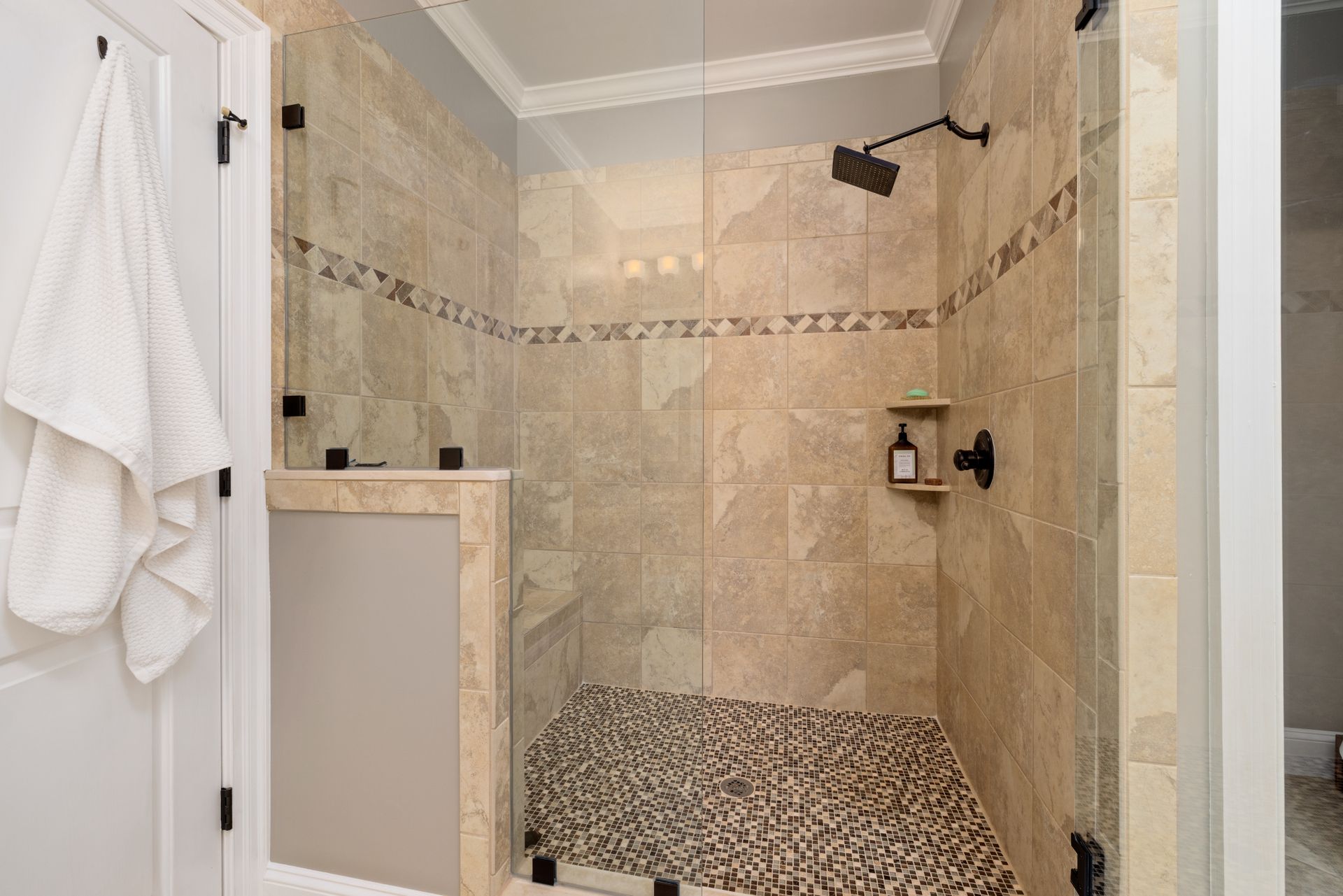
When Is a Regrout the Right Job, and Which Grout Goes Back In?
A regrout is right when the shower doesn't leak, the tile is still bonded, and the only complaint is grout that is stained, crumbling or cracked. The old grout is ground out of every joint, the joints are cleaned, and new grout is packed in. Every inside corner and the joint where the walls meet the floor get 100 percent silicone instead of grout, because those joints move.
What goes back in matters more in Phoenix than in most places, because hard-water scale settles into porous cement grout. These are the grouts we reach for on a regrout, with what their data sheets say:
- Custom Building Products PrismA cement grout that needs no sealer. Its data sheet allows intermittent water exposure after 3 days.
- Custom Building Products Fusion ProA single-component, ready-to-use grout that doesn't need sealing. The data sheet asks for 7 days before intermittent water exposure, such as a shower.
- Mapei Ultracolor Plus FAA fast-setting grout that typically needs no sealer. No immersion for at least 3 days.
- Laticrete SpectraLock Pro PremiumAn epoxy grout that never needs sealing. At 70 degrees it reaches full stain resistance in 7 days and full cure in 14.
A standard cement grout such as Custom's Polyblend Plus also works. Its data sheet wants the room above 50 degrees for at least 72 hours to cure, and a penetrating sealer, Aqua Mix Sealer's Choice Gold is one Custom names, helps it shed stains. For the silicone, Custom's Commercial 100% Silicone is made to match its Prism and Polyblend grout colors, so the corners don't stand out.
A regrout doesn't fix cracked tile. One or two cracked tiles can be cut out and replaced if spares from the original job are still around. If the tile is discontinued, the regrout is a good moment to decide whether a few mismatched replacements are acceptable or whether the walls are due.
Skip the regrout if the shower is leaking. New grout over a failed pan doesn't stop the leak.
What Goes Behind the New Tile?
A tile backer the code accepts and a waterproofing layer, installed the way their makers publish. Ordinary drywall and green board are not shower substrates. The code section that lists what is allowed is quoted on our bathroom remodeling page.
The backers split into cement, gypsum and foam. USG's Durock cement board isn't hurt by water, but USG itself says it is water-durable rather than waterproof, so it needs a waterproofing layer: a membrane over it, or in the older method a moisture barrier behind it, never both. James Hardie's HardieBacker with HydroDefense is sold as a waterproof cement board that passes ANSI A118.10, with the joints and fasteners sealed. Georgia-Pacific's DensShield is a glass-mat gypsum board with a moisture barrier built into its face. Its maker says not to add a barrier behind it, and the joints get mesh tape set in thin-set. The foam boards, Johns Manville's GoBoard, Schluter's KERDI-BOARD and Wedi's Building Panel, are light panels with the waterproofing built in, and their seams get sealed the way each maker specifies. KERDI-BOARD's joints, for example, are covered with KERDI-BAND.
You can usually see what is behind your own tile before anyone quotes. Pull the handle and the trim plate, usually a set screw and two screws on a single-handle valve, and look at the cut edge of the wall around the valve body. Gray cement board, a mortar bed over metal lath, a foam panel, or green or white gypsum board each tell you something. Green board in a shower wall answers the retile question on its own: the walls come out.
The membrane goes over board that needs one. RedGard and Laticrete's Hydro Ban are liquids rolled or brushed onto the board, both in two coats. Schluter's KERDI is a sheet set in thin-set, and Mapei's AquaDefense is a liquid, also two coats, that can be tiled 30 to 50 minutes after the second coat, once it is dry to the touch. Whatever the system, every seam, inside corner, screw head and pipe penetration gets treated the way the manufacturer publishes.
Which Tile Makes Sense for a Phoenix Retile?
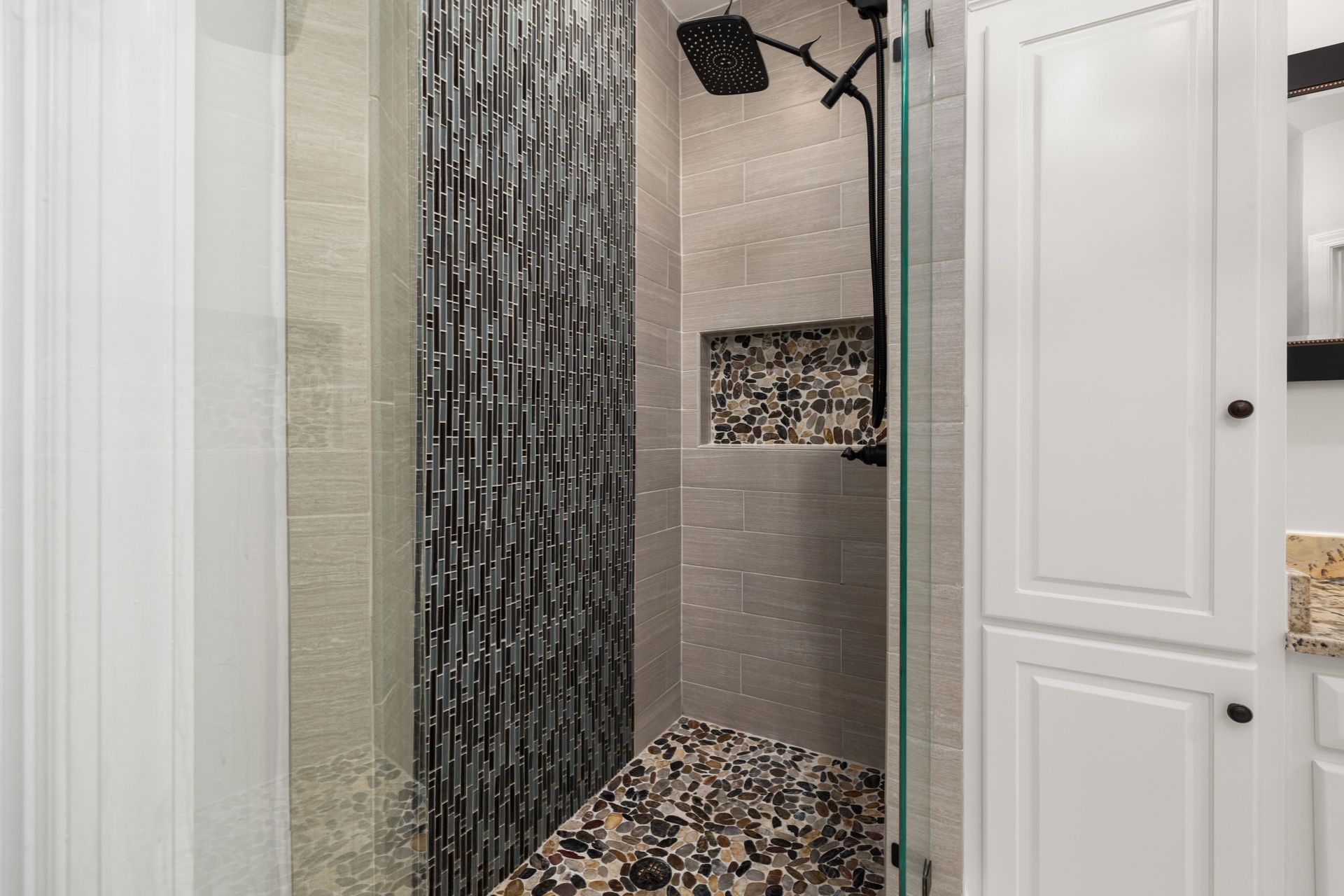
Porcelain, for most showers. It absorbs almost no water, it doesn't etch, and it comes in large formats that cut the number of grout lines holding hard-water scale. Natural stone is a choice you make for the look, knowing it needs more care.
Many Valley showers built in the 2000s are tumbled or honed travertine, and that is often why the owner is calling. Travertine is calcium carbonate. The Natural Stone Institute warns that cleaners with lemon, vinegar or other acids can dull or etch it, which rules out vinegar and acid-based scale removers. Its natural holes are filled with cement or resin at the factory on most honed and polished tile and often left open on tumbled tile, and in an older shower some of the filled pits are open again. Before retiling, ask whether the stone can be restored: holes refilled with a color-matched filler, the surface honed to remove etching, and the stone resealed. If the shower doesn't leak and the tile is bonded, that is usually cheaper than a retile.
For the edges, Schluter's JOLLY is a profile for outside corners and the exposed tile edge, and its RONDEC gives a rounded edge with a quarter-inch radius. Both take the place of bullnose tile. If the old tile is discontinued and only part of the shower is being redone, a deliberate contrast reads better than a near miss, a point the shower pan leak post makes too. For a shower with no grout lines at all, tadelakt plaster is the other option, covered on our interior plaster finishes page. It is lime, so like travertine it can't take vinegar or acid scale removers.
How Much Does It Cost to Retile a Shower in Phoenix?
A regrout runs $400 to $960 per shower, a walls-only retile over a sound pan about $3,000 to $6,500 for a standard 60-inch surround, and a full gut and retile with a new pan $6,000 to $12,000 and up. Between those sits the pan work with the wall tile saved, which runs $2,500 to $4,500 for the pan and bottom row and $3,500 to $6,000 for a full pan rebuild.
| Scope | Phoenix range, 2026 | What moves it |
|---|---|---|
| Re-caulk every silicone joint | $120 to $175 per visit | Shower size and how much old caulk has to be cut out |
| Regrout, shower walls and floor | $400 to $960 per shower | The grout chosen; epoxy sits at the top. Adding the bathroom floor in the same visit can take it to $2,800. |
| Walls to the studs, sound pan kept, 70 to 90 sq ft | $3,000 to $6,500 per shower | Tile format and price, tile height, a niche, and whether the valve is replaced; resetting the existing glass is included |
| Pan and bottom row rebuilt, wall tile saved | $2,500 to $4,500 per shower | How far water wicked up the wall, matching the bottom row |
| Full pan rebuild, new bonded membrane | $3,500 to $6,000 per shower | Pan size, tile format, drain type, curb or curbless |
| Full gut and retile, walls and pan | $6,000 to $12,000+ per shower | Hidden water or rot damage, wall tile choice, upgrades added while open |
| Wall tile setting labor, tile supplied | $8 to $18 per sq ft, labor only | Layout, cuts around the valve and niche; backer and membrane prep folded in |
| Old tile removal | $2 to $5 per sq ft | Mortar-set tile and wire lath come off harder than tile on board |
| Tiled niche | $150 to $300 each | Size and the tile lining it |
| Tiled bench | $300 to $600 each | Corner seat or full-width bench |
| Reset the existing glass | $350 to $750 per enclosure | Whether the panels survive demo, new hinges, clips and seals, and whether the new walls land in the same plane as the old ones |
| New pressure-balance valve and trim | $300 to $650 per valve, installed | Valve brand and trim; the wall is already open. A straight valve swap averages $362 in Phoenix. |
A standard 60-inch surround is 70 to 90 square feet of wall tile depending on height. Stone, tile to the ceiling and small-format mosaics push each band toward its top. For the rest of the bathroom priced line by line, see our bathroom remodel cost guide.
The walls-only band is built up from its parts: 70 to 90 square feet of setting labor at $8 to $18, tile removal at $2 to $5 a foot, porcelain at a few dollars to a dozen a foot, backer and membrane, a haul-away, and resetting the glass. Saving the pan is what keeps it well under the full gut, which is why the flood test comes before the quote is final. For comparison, Angi's 2026 Phoenix data puts the average shower tile job at $2,789, most between $1,859 and $5,165, with tile removal another $2 to $5 a square foot. The walls-only band above also carries new backer and membrane and the glass reset. Finished showers are in our project gallery.
Send Us the Shower
A photo of each wall, one of the floor, and one of the wall or baseboard on the other side. Tap the floor tile and tell us what it sounds like. We'll tell you which of the three scopes the shower is in and what it lands at.
Free Retile EstimateHow Long Is the Shower Out of Service?
A regrout takes one or two working days plus the grout's cure, three to seven days depending on the product. A walls-only retile takes about seven to ten days, and a full retile with a new pan about ten to fourteen, grout cure included.
The waits come from cure times, not labor. On a walls-only job the walls come off on day one, the backer and membrane go up next, and the tile, the grout and the trim-out follow, with the grout's cure before the shower takes water again. Membrane timing depends on the product: Mapei's AquaDefense can be tiled once it is dry to the touch, and Schluter says no wait is needed between KERDI and tile. With a new pan, the pan gets its own flood test before tile goes on. Schluter asks for 24 hours before a KERDI flood test, Laticrete says Hydro Ban can be tested in about 2 hours at 70 degrees or warmer, and RedGard is tested once both coats are dry. The Scottsdale rebuild ran 13 days door to door with a mortar-bed pan, six or seven of them with a crew in the house.
If the glass has to be replaced instead of reset, add the glass lead time: frameless panels are measured on the finished tile, then fabricated.
Does the Shower Valve Have to Change When You Retile?
Not always. A pressure-balancing or thermostatic valve in good condition can stay, as long as its depth suits the new wall and the trim you want fits its body. It changes when it is an old two- or three-handle valve, when hard water has scaled the cartridge past saving, or when the new wall build puts the trim out of reach.
Depth is the detail. The plaster guard that comes on a new valve is marked for the finished wall thickness, and the trim plate is designed to land flat on tile at that depth. When the new wall comes out thicker than the old one, an extension kit makes up the difference. When it comes out much thicker, or the valve is old enough that parts are hard to find, replacing it while the wall is open is the cheaper path. A replacement has to be a pressure-balancing, thermostatic or combination valve under the code Phoenix has adopted, and trim has to match the valve's brand and series, which is worth knowing before you fall for a trim in a showroom.
Questions Scottsdale and Phoenix Homeowners Ask About Retiling a Shower
Can I retile just the shower floor?
Sometimes, but usually the question is about the pan. On a tiled shower the floor tile, the mortar bed under it and the waterproofing are one assembly, and floor tile that is failing is usually failing because the pan is wet. New tile on the same wet bed fails again. When the floor is the problem, the fix is a pan rebuild, often with the wall tile saved, which our shower pan rebuild page prices by scope.
Can travertine be refinished instead of replaced?
Often, if the shower doesn't leak and the tile is still bonded. Open holes get refilled with a color-matched filler, etch marks from acidic cleaners are honed out, and the stone is resealed. It keeps the look, costs less than a retile, and avoids demolition. Stone that is cracked, loose or sitting on a wet pan is a retile.
How long does new grout need before the shower can be used?
It depends on the grout. Custom's Prism allows intermittent water after 3 days, Mapei's Ultracolor Plus FA asks for no immersion for at least 3 days, and Custom's Fusion Pro asks for 7 days before shower use. Laticrete's SpectraLock Pro Premium epoxy reaches full stain resistance in 7 days at 70 degrees.
Is it worth retiling a shower before selling?
Usually not if you are listing in the next few months. A deep clean, a regrout, a full re-caulk and descaled glass show nearly as well for a fraction of the money. A leaking shower is different, because a buyer's inspector will find it.
Does the bathroom floor have to come up for a shower retile?
No, not for a regrout or a walls-only retile, and usually not for a pan rebuild. The bathroom floor stays and is protected. It gets involved when a rebuilt curb takes the floor tile against it, or when water from a failed pan has already damaged the floor outside the shower.
For a selling decision, our Arizona BINSR guide lists which repairs buyers ask for and which a seller can leave alone.
What Else Makes Sense While the Shower Walls Are Down?
Work that can use the stripped walls, the masked room and the tile work already scheduled for the week. Tied into that schedule, it commonly comes in 25 to 50 percent below what it costs as a separate trip, as long as it is written into the quote before demolition.
- The toilet and the vanity. Both are short jobs that share the same setup and cleanup. See bathroom remodeling.
- The fan and the light over the shower. With the shower walls open, wiring a damp-rated light or a fan ducted outside is a small addition. See electrical work and light fixture installation.
- The bathroom floor. If the floor tile is the same age as the shower tile, doing both avoids a new shower beside a tired floor. See flooring.
- The drywall outside the shower. A stain or soft spot on the wall next door gets cut out and patched while the shower wall is open from the inside. See drywall repair.
- Any rotted framing. Studs or a bottom plate that stayed wet get replaced before new backer goes on. See framing and structural work.
- Paint for the room. New tile makes old paint look older. See interior painting.
Get each one priced as its own line on the retile quote, before the walls come down.

Written by Harrison Norem, owner of Norem Contracting and a licensed Class B general contractor, Arizona ROC #365090. Fifteen years across the trades, including tile, shower waterproofing and bathroom remodeling, across the Phoenix metro. More about Harrison.