Short-Term Rental Repairs Phoenix Metro
Work that fits between checkout and check-in, on one contract.
We are a licensed Arizona general contractor, ROC #365090. We carry the contract for your job, and everyone who works on your property is licensed for the work they are doing.
Send photos and the gap and you get back a written scope, a fixed number and a named arrival window. Every line is priced on its own, photographed before and after, and invoiced the day the work finishes, so the paperwork holds up in a damage claim.
What you get with Norem
- Same-day service. Most scopes come back the day your photos arrive.
- Tailored recommendations from real short-term rental management experience.
- Deep expertise in the Airbnb algorithm and the short-term rental industry.
- Full interior reset, every 24 months.
- ROC #365090 Arizona Class B
- Licensed & Bonded Insured in Arizona
- 5.0 on Google Homeowner reviews
- Named arrival window Booked to your calendar
What we do on a Phoenix rental
Every line below runs under our contract and our permit. Nothing here gets handed off for you to manage from another state.
Turnover Repairs
The defects a guest photographs on arrival, cleared in one visit.
- Drywall patching, textured and painted to match
- Interior doors, closet tracks, hinges and lever sets
- Light fixtures, ceiling fans and bath vents
- Blinds, curtain rods and window coverings
- Caulk and grout reset in every wet area
Damage & Make-Safe
Hold the property rentable tonight, repair it in the first empty window.
- Board-up and temporary weathertight covering
- Water off at the valve, a circuit isolated at the panel
- Water damage repair, drywall through paint
- Dated photo set, before and after on every line
- Itemized claim-ready invoice with the incident date
Resets & Capacity
The blocked-week work that resets how the property photographs.
- Full interior repaint, walls with ceilings and trim
- Waterproof vinyl plank flooring through the house
- Bedroom conversions, casitas and guest house builds
- Laundry hookups, exterior paint, fencing and patios
Not sure whether your job fits a turnover gap or needs a blocked day? Send your cleaner's photos and the dates you have, with the checkout and check-in times. We will tell you which slot it belongs in and what it runs before you take a night off the calendar.
How does a repair visit on a booked property run?
A normal visit, from the message to the invoice.
-
1 You send the list and the gap
Photos, a short description of each item, and the dates you have. Your cleaner's photos are usually enough. Send any incident date too, because it belongs on the paperwork.
5 minutes
-
2 Scope, fixed number, named window
A written scope with a price per line, the arrival window, and the change-order rule stated before we start rather than discovered on day two.
Same day, most jobs
-
3 Access sorted once
A one-time code on your keypad or a lockbox. We confirm we are in and confirm the property is locked when we leave.
On arrival
-
4 Work, photographed as it goes
Before, during and after on every line. On a damage job they are dated and show both the defect and the repair.
Half day to one day
-
5 Reset to guest-ready
Dust contained, furniture back where it was, floors clean, nothing left in a closet. Your cleaner should not be picking up after us.
Last 30 minutes
-
6 Invoice and photo set
Itemized, on our letterhead with the ROC number, incident date on any line that has one, sent the day the work finishes rather than at the end of the month.
Same day
The service here is the building work. We do not take over your listing, your pricing or your guests, and everything priced below is work we do for Phoenix homeowners and landlords. What changes on a rental is the schedule, the paperwork and the failure mode: a code complaint, an appraisal that will not clear, or an unpermitted casita found by somebody who went looking.
Can you get it fixed before my next check-in?
Usually yes, if it is a single-trade job and we hear about it before the gap closes. Send photos and the gap: the dates, the checkout time and the check-in time, not "sometime next week."
The platform default is an 11am checkout and a 3pm check-in, four hours your cleaner already owns most of. So there are three real slots, and we will tell you which one your job belongs in:
- Inside the turnover gap. Two-hour work with no cure time and no second coat. A door, a light fixture, a blind or a curtain rod, a keypad, a fill-and-touch-up behind furniture.
- One deliberately blocked day. One night off the calendar and a two-person crew clears a real list, almost always cheaper than five turnover visits.
- The orphaned midweek nights. Sunday to Tuesday gaps that were going to be discounted anyway. If the job is not urgent, that is the cheapest day you own.
The commitment is narrow and it is the one worth making: we arrive inside the window we named, or we call before it opens rather than after it closes. A cleaning schedule is locked weeks ahead and does not refund, so "sometime Tuesday" costs you a cleaner visit and possibly a night.
What we will not do is work in the house while a guest is in it, the one exception being a make-safe, covered further down.
What breaks in a Phoenix short-term rental, and how often?
Less drama than the internet suggests and far more volume. What wears a rental out is a complete reset every few nights by people who did not buy the house.
The wear pattern is consistent. Drains take things that are not supposed to go down them. The air conditioning runs at a duty cycle a homeowner unit never sees, because guests set it where they want and leave, and July does not care. Fixtures get used hard and put back wrong: towel bars pulled out of drywall, closet doors off track, cabinet hinges loose, blind mechanisms snapped. Wall corners and door edges take luggage, the vaulted ceilings common in Valley stock collect marks nobody can reach, and pest control is a standing line item.
Underneath the occasional large incident sits a rolling backlog of small defects nobody bills anybody for. A chipped door casing, a stained grout line, a bathroom fan gone loud, a slider that sticks, three dings in the hallway. None is worth a trip alone, and together they are what a guest photographs on arrival. That is what our punch list service exists for, and why we bundle rather than charge five trip fees.
By trade that is drywall repair, handyman work, flooring and bathroom work. What is different is the frequency, and the fact that every one of those defects sits in front of a camera roughly every other day.
Working for an absentee owner adds one habit: we tell you what we saw that you did not ask about. A water heater weeping, a stain spreading under a vanity, a slider off its track that the next guest will force. Nobody else who walks the property has reason to look at the building. If it sits empty rather than earning, that is home watch, a recurring schedule rather than repair work.
One request that saves everybody money: keep the paint. A labeled jar of each room's color in a closet turns a scuff repair into ten minutes.
Will your invoice hold up when I file the damage claim?
What we control is the document. The money comes back when the paperwork is specific, dated and itemized, and not when a vendor sends a lump sum. Labor in particular gets refused when buried. A line reading "repairs, $1,800" is a bill. "Bedroom two ceiling, odor seal and repaint following the March 14 incident, $500" is evidence.
So every invoice on a damage job carries the same six things: the property address, the incident date on each line that has one, a plain description of what was damaged and what was done, a price per line rather than a total, what the labor covered and the time on site where the cost is labor, and our license number on the letterhead. The dated photo set goes with it.
What a claim-ready invoice looks like, with the figures on the price chart further down.
| Line | Why it is written that way |
|---|---|
| Bedroom 2 interior door, split at the latch. Prehung replacement, hung, casing repaired, primed and painted. | Which room, which door, what failed, what was installed, priced per door. |
| Living room drywall, two impact holes approximately six inches. Patched, textured to match, primed and painted. | Size and count, priced per patch. "Wall damage" gives an adjuster nothing to check. "Two six-inch holes" does. |
| Bedroom 2 ceiling, odor seal coat and two finish coats following the March 14 incident. | The incident date, on the line. The detail that disappears inside a lump sum. |
| Invoice total | The total comes last, after the lines that explain it. |
Where the cost is mostly labor, the line names the work and the time on site behind the number rather than a rounded figure.
What we do not control is the outcome. We will not tell you a platform or an insurer will pay, and we cannot tell you which lines your accountant treats as a repair and which as a capital improvement. We can itemize clearly enough that your CPA sorts it without calling us, and put a license number on the page so an adjuster reads a contractor's scope.
Something broke mid-stay. What happens tonight?
If the property is unsafe or unusable, that is a make-safe, the one thing we will do with a guest in the house, coordinated with you and announced to them. Board-up on a broken window or door, a temporary weathertight covering, water off at the shutoff valve, a circuit isolated at the panel, a room closed off. The point is to hold the property where the current stay is not refunded and the next reservation is not canceled.
The permanent repair then goes on the schedule for the first empty window, priced separately, which keeps a $300 emergency from turning into a five-day closure while a replacement window is on order.
If you need the permanent fix expedited, we price the rush as its own line rather than folding it into the number, because an owner filing a claim usually needs an expediting cost approved before the work happens and a rush premium inside a lump sum cannot be approved separately.
Your nightly rate decides whether a rush is worth buying. At $150 to $200 a night, a five-day repair window is $750 to $1,000 of revenue that does not come back, on top of the repair. In golf season at $300 a night, a week down is $2,100. Run that first and the rush line answers itself.
What is a pre-season punch list, and when do I book it?
One visit that clears every defect a guest could photograph, booked before the season it protects. For a Phoenix rental that means October through December, ahead of the winter and spring stretch that carries the year.
It earns its money because of the arrival ritual: guests photograph anything already broken so they cannot be blamed for it later. Some of those photos turn into a message, some into a star deduction, and low ratings put a listing at risk, so a cluster of small defects costs far more than a chipped casing looks like it should.
What we walk and price: every door and its hardware, closet tracks, cabinet hinges and pulls, toilet mounts and seats, aerators and slow drains, caulk lines in every wet area, grout gone dark or open, anything anchored to drywall, blinds and curtain hardware, hallway walls, lights and switch and outlet covers, smoke and carbon monoxide detectors, bathroom fans, exterior gates and latches, and the slider everybody uses and nobody maintains.
It is priced as a bundle rather than a stack of trip charges, the only way a list of fifteen $40 problems is worth solving. Our punch list page shows how a list gets bundled to a budget.
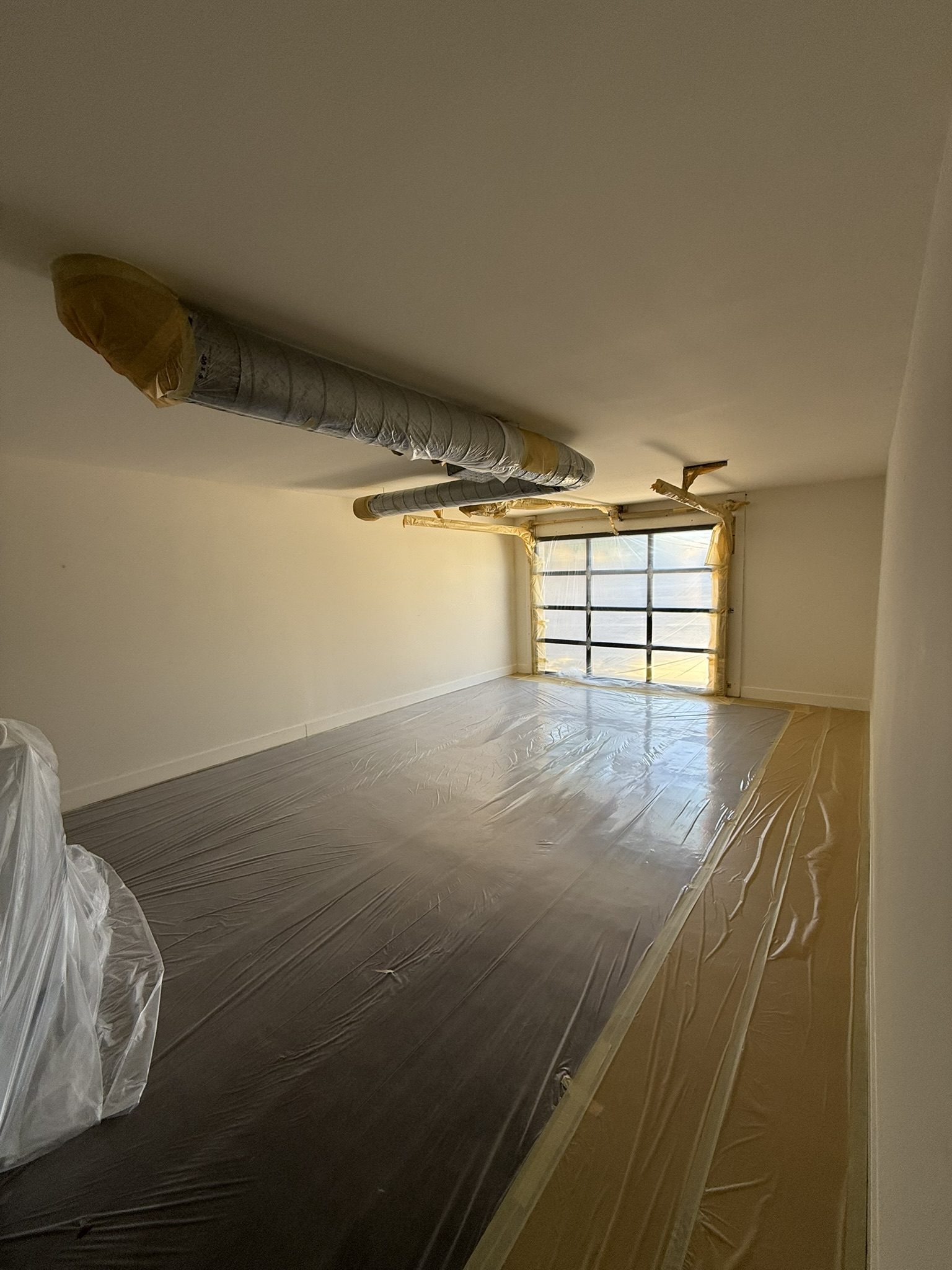
A Phoenix interior masked and floor-protected before spraying. The setup is the expensive part of a paint day, which is why the accumulated patching, the trim and the touch-up list all fold into the same visit.
What should I spec so it survives a turnover every few nights?
The useful test is "what has never shown up in a bad review," a lower bar than "what is nicest" and a better one.
Floors. Hard surface everywhere; carpet in a rental is a consumable. Waterproof vinyl plank takes water and luggage wheels, and a damaged plank replaces mid-floor without redoing the room.
Counters. Replaceable over premium. Butcher block or a good laminate gets a damaged section swapped rather than the whole top replaced. A chip in stone gets filled with color-matched resin and the fill shows in a close photograph, so put the stone in when the renting is over.
Walls and ceilings. Scrubbable paint in eggshell or satin on walls and semi-gloss on trim and doors, not flat, because corridor walls need washing and touch-ups in satin still blend. Keep the ceiling texture consistent so a future patch can be matched. On a two-story vault, decide now whether you will ever get up there: that decides whether marks up high are a repair or a repaint.
Doors and hardware. Solid-core interior doors where you can, commercial-grade lever sets and hinges, and a stop on every door that can reach a wall. The builder-grade knob is the first thing worth replacing.
Wet areas. Standard-depth drop-in or undermount basins rather than vessel sinks. Vessel bowls splash, and in Phoenix water they collect calcium in a ring nobody can scrub off, a cleanliness complaint about a surface that is technically clean. Sealed or darker grout everywhere, and a tiled niche or real shelving in the shower, or guests line the tub edge with bottles.
Cords, which are an electrical problem in a decorating costume. Televisions on a recessed receptacle behind the set with in-wall rated HDMI, hardwired sconces instead of table lamps, receptacles behind the furniture that needs them. Visible cords are what makes a rental photograph read as amateur, and fixing them is fixture and outlet work, not styling.
Windows. Layer blinds and curtains on the same window. Blinds give the guest control and privacy, curtains give the room the softness that photographs, and in a west-facing Phoenix room the pair takes heat load off the air conditioner.
What does the outside of the house have to do with my nightly rate?
More than anything inside it. The cover photo does most of the work in a listing, and in Phoenix that is usually the front elevation or the backyard, which makes the exterior a construction budget rather than a photography budget. The work that changes what that photo can be, in rough order of return:
- The front yard. A dead or patchy lawn is the fastest way to make a good house look neglected. Desert landscaping with real trees, graded granite, edging and a clean walkway changes the photograph completely and, once established on a drip system, runs on a fraction of a lawn's water. It is regularly the largest exterior line and the one that shows first.
- Paint. A two-color exterior repaint decides whether the property keeps pace with the block or falls behind it.
- The entry. The front door, the light beside it, the numbers, and the surface you stand on. Small scope, and it is the thing in the frame.
- The backyard. A patio cover or ramada and a real patio slab turn an unusable July yard into the shot. Shade decides whether an outdoor space appears in photos or in complaints.
- Gates and fencing. Privacy fencing and driveway gates read as security in a photograph and work as noise and sightline control in real life.
When we finish, we photograph the work in daylight and send you the images. Straight-on, midday, cords out of the shot, not a progress snapshot with a truck in the frame.
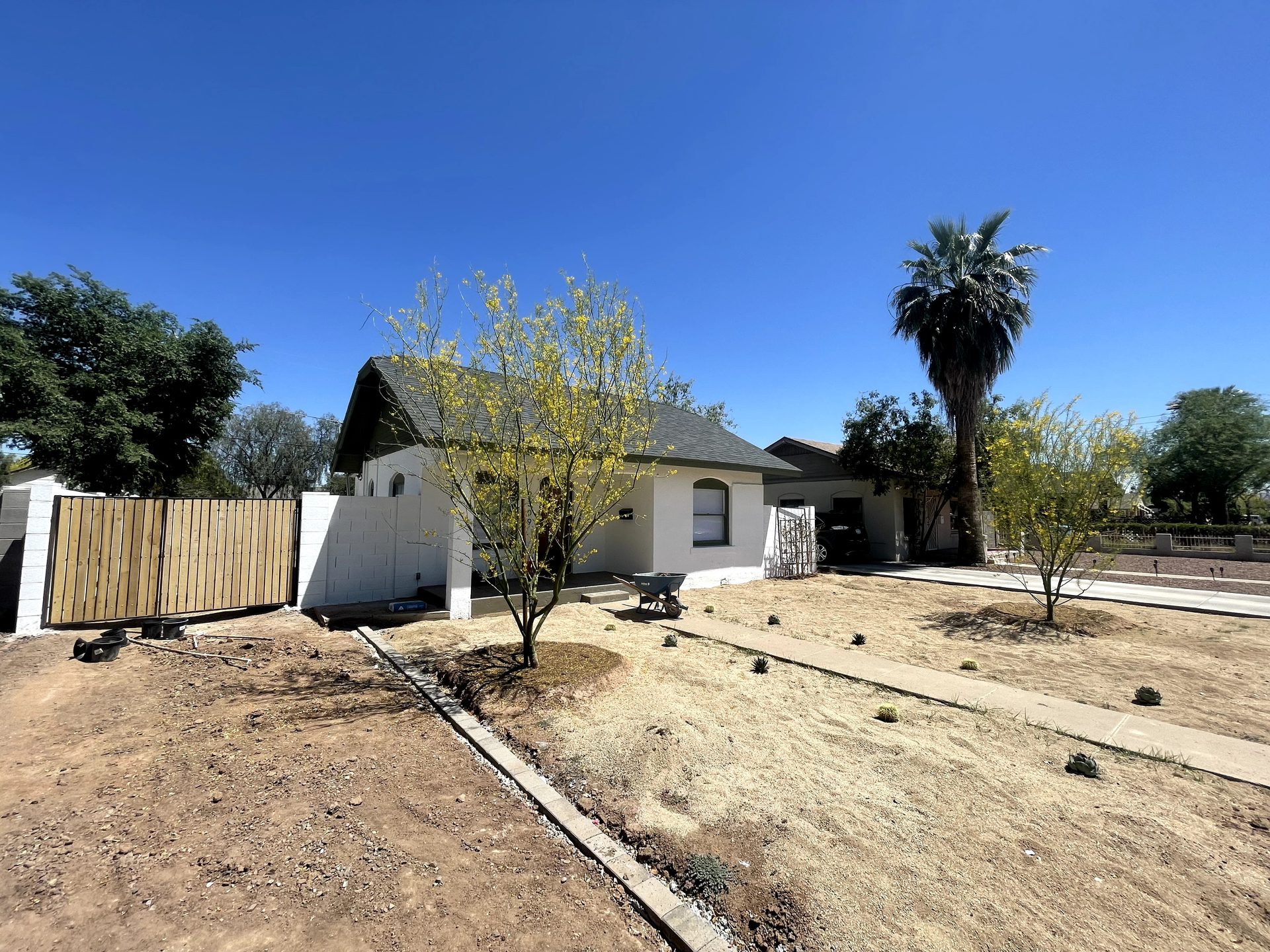
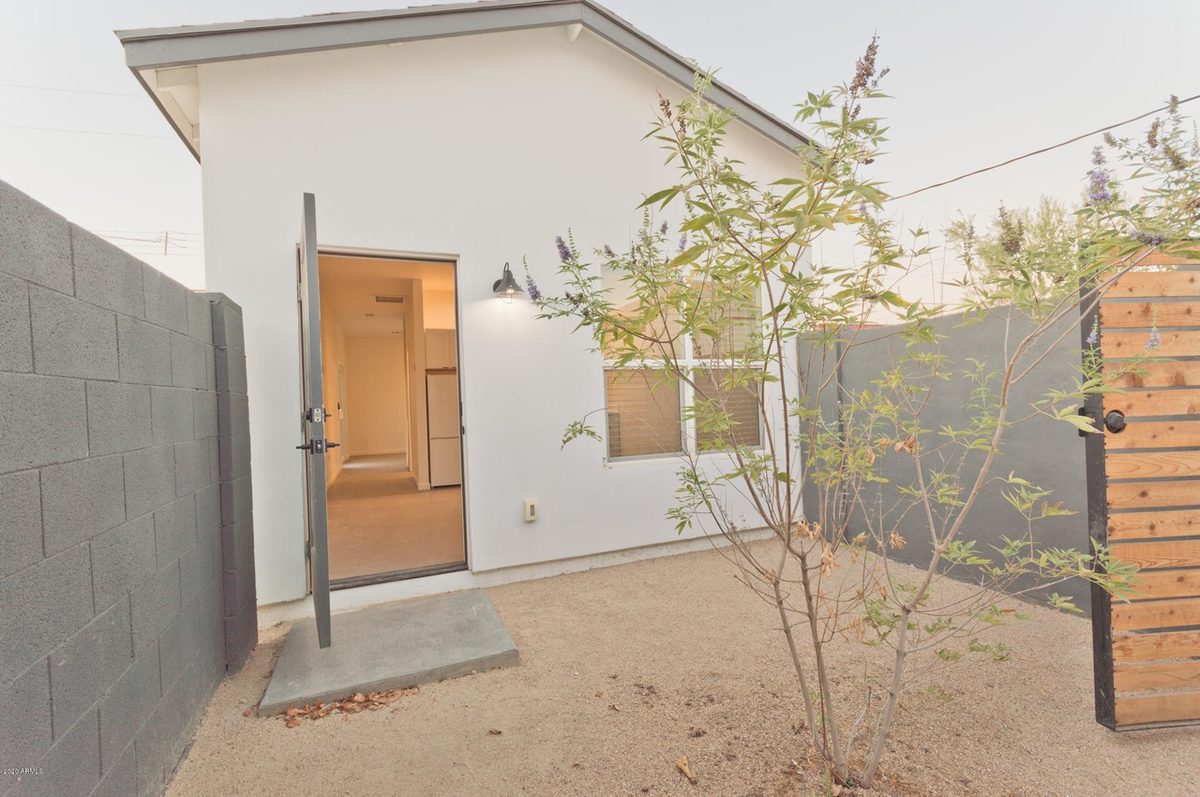
A Coronado Historic District front yard after conversion from grass to desert planting, with a poured walkway and new trees. This is the shot a listing leads with, and it is entirely construction.
Which upgrades change what shows up in a search, and which ones do not?
Guests filter before they browse: dates, a location and a number of people cut the visible inventory before anybody looks at a photograph.
In the filter, and therefore worth building: the number of guests the property sleeps, the number of bedrooms, whether pets are allowed, whether there is on-property parking, and bed types. Each is a checkbox on the search side and a construction question on yours. A property that sleeps 6 does not appear in a search for 8, and describing the extra capacity in your text does not fix it.
Not in the filter: a hot tub, a grill, a fire pit, a desk monitor, most of what gets sold as an amenity upgrade. They help somebody choose you once they are already looking at you, which is much weaker than being visible at all.
Two consequences, and they both cost us work. A second bathroom almost certainly will not pay for itself in bookings, because bathroom count is not something a guest types into a search box. And a pool or a hot tub is not a booking engine: the correlation people quote mostly tells you that bigger, better-located properties have pools. What we do is the work around water: barrier fencing and self-closing gates, a new paver or travertine deck, removing half-walls and planters that crowd it, an equipment screen, shade, and the pad and circuit for a tub you have already decided to buy.
The qualifying question is your occupancy. Booked 90 percent of nights already, an amenity will not raise your rate much, so your money belongs in eliminating downtime and defects. At 50 or 60 percent, visibility to a bigger pool of searches is worth real money: one extra booked night a month pays for a lot of construction.
Should I add a bedroom, build a casita, or split the property into two listings?
All three are capacity plays at very different price points, in order of cost.
Convert a room you already have. A den, an office or an oversized dining room becomes a bedroom when it has a door, a smoke alarm tied into the rest of the house, at least 70 square feet, and a sleeping room's required emergency escape opening. Buyers and appraisers also expect a closet, though the code does not. That escape opening decides the job, and it is a permit conversation with your city, because a window not sized for it does not make a bedroom whatever the listing says. If the wall is holding something up we find that out before anyone commits to a layout; our framing and structural page covers it. If it is bearing, a structural engineer's evaluation runs $400 to $700 in this market and a stamped set for the beam $800 to $1,500, which the city wants before a permit.
Build the capacity properly rather than cheaply. Rollout beds and sleeper sofas are a mess to reset between stays, eat storage the property does not have, and are not a good way to sleep. A framed bunk room or a converted bedroom with a real door crosses the search filter and costs nothing per turnover.
Build or convert a casita. The biggest lever and the biggest number. We built a 400 square foot guest house in Tempe that came in around $115,000 all in. Full detached builds with a real kitchen and bath run $150,000 to $300,000 depending on utility runs and finish level. Both numbers, and the seven ways the same casita gets priced, are on our guest house cost page and the guest house build story.
Split one property into two listings. If you already have a casita or a convertible garage, two listings often beat one. The work is specific: a separate entrance and path, separated or sub-metered utilities, a second laundry, a dividing fence and gate so each side has its own outdoor space, exterior lighting, and enough sound separation that neither guest hears the other. Build it to long-term-tenant durability even if it starts as a nightly rental.
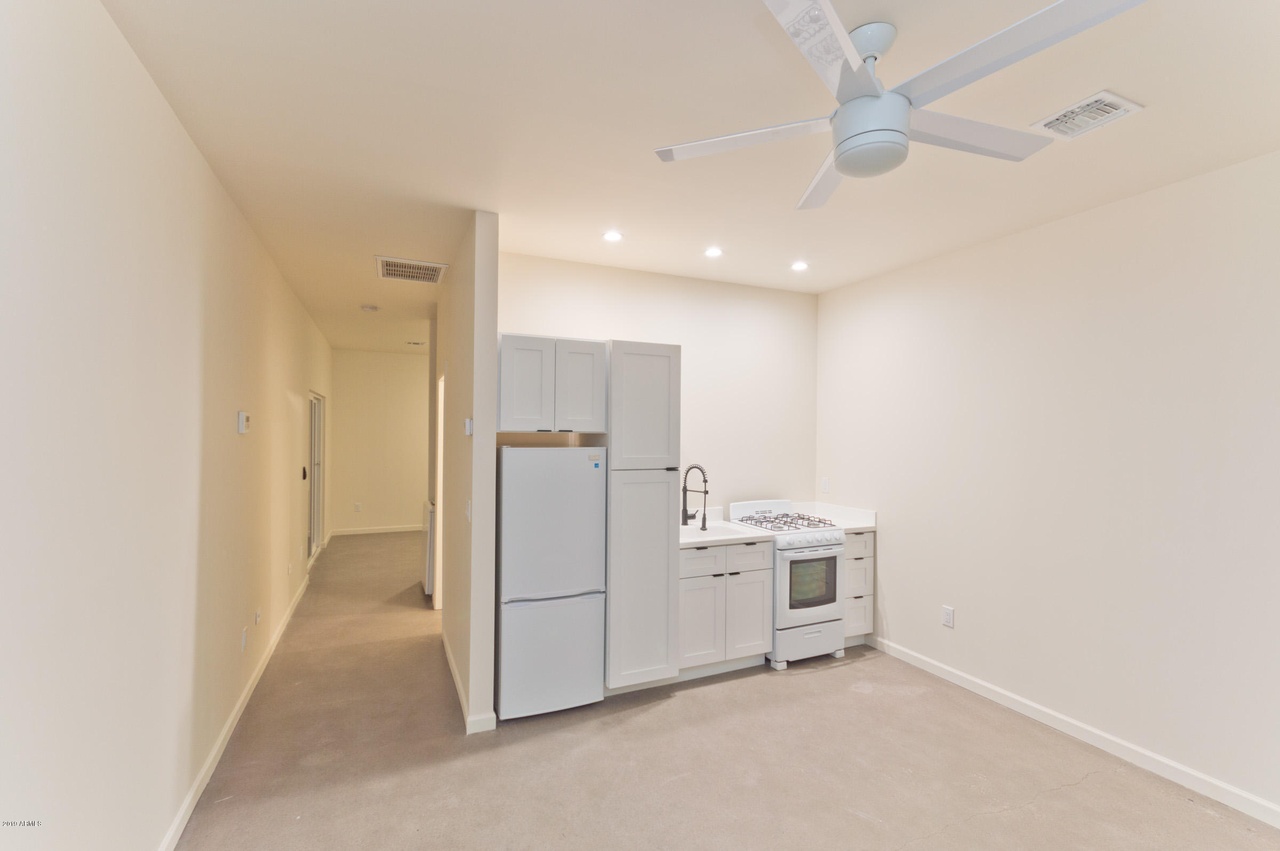
The kitchenette in our 400 square foot Tempe guest house. A real range, sink and cabinet storage are what separate a unit that can carry a long-term tenant from one that only works as a nightly rental.
Who do I call for a job that crosses three trades?
Us. One contract covers all of it.
Take a real example. The only laundry is in the casita you want to rent separately, so the main house needs its own washer and dryer, and the obvious spot is a closet on an exterior wall. That is a plumber for the supply and drain, an electrician for the 240-volt circuit, a framer to open and rebuild the closet, somebody to cut and flash the vent, and drywall and paint to close it up. Five trades, five schedules, five deposits, and if the drain run is wrong the electrician has already been and gone.
We built exactly that job in Phoenix: a bedroom closet turned into a working laundry with a recessed washer box, a dryer vent through the wall, a dedicated 240-volt circuit, and the drywall, texture and paint put back so you cannot see where the closet used to be. The full write-up walks through it step by step. Adding a laundry hookup where none exists runs $2,500 to $6,500 in this metro, driven mostly by how far the drain has to travel and whether the panel has a spare slot.
Same answer for anything crossing a licensed trade boundary: a bathroom that moves, a wall that comes out, a mini-split for a converted garage, an outdoor circuit, a second entrance. And if you have a friend who does the drywall and paint at cost, say so at the quote stage. We will price the licensed portion on its own and hand the property back at a stage your friend can finish from.
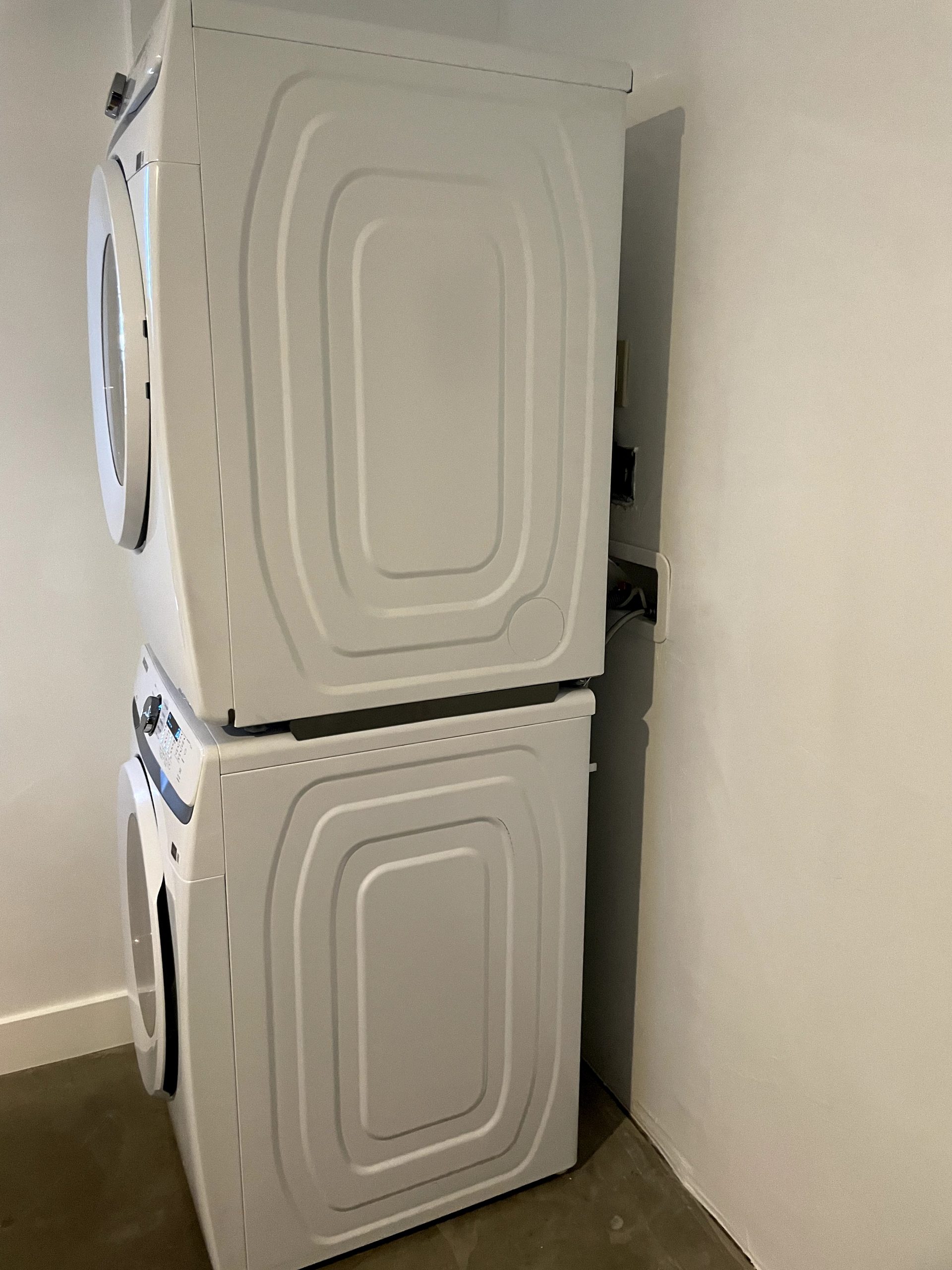
The finished laundry alcove: recessed washer box, dryer vent, 240-volt outlet, drywall and paint closed back up. Plumbing, electrical, framing and finish on one contract rather than four phone calls.
Short-Term Rental Repair Price Chart, Phoenix 2026
2026 Phoenix pricing for licensed, insured work, with time on site so you can hold it against your calendar. Every one is quoted by the job, so the number you approve is the number on the invoice. A rental pays what anyone pays: the scheduling, the photo set and the itemization are not a surcharge.
| Job | Price | Time on site | What drives the price |
|---|---|---|---|
| Trip charge, anything that leaves the shop | $45-$100 per visit | Under 2 hrs | Travel and setup, billed on top of labor by most Phoenix handyman outfits. Five separate trips is a bad way to buy one afternoon of work. |
| Small-repair visit, quoted by the job | $180-$660 per visit | Half or full day | A half day of labor runs $180 to $330 and a full day $350 to $660, labor only, trip and setup paid once either way. How many items fit depends on whether they sit in one room or across the house. |
| After-hours or same-day emergency premium | +25% to +100% on the labor | Same day | How far outside normal hours the call falls. Same-day and evening runs the light end; overnight, weekend and holiday the top. The question is whether the fix can wait for the next checkout. |
| Drywall patch, textured and painted | $200-$650 per patch | Same day with setting compound, or a return visit to paint | Size. A fist-sized hole sits at $200 to $350; a larger patch needing backing runs $350 to $650. Matching texture into an older knockdown is the skill you are paying for. |
| Ceiling drywall repair, textured and painted | $240-$845 per repair | 1 day | Overhead work and texture blending add 20 to 30 percent over the same patch on a wall. A two-story vault means staging, which is most of the labor. |
| Water damage repair, drywall through paint | $350-$2,000+ per event | 1 to 3 days | How far the water traveled and whether the source is fixed. Drying is calendar time even when nobody is on site. |
| Interior door, prehung, hung and painted | $400-$900 per door | 2 to 3 hrs each | Slab against prehung, and whether the jamb is sound. Lever sets and hinges add $65 to $150 a door. |
| Light fixture, fan or sconce installation | $100-$300 per fixture | Half day for a house | A ceiling fan on an existing fan-rated box runs $150 to $300, priced in full on our ceiling fan installation page. Batching fixtures onto one trip is the clearest saving on this chart. |
| Blinds, curtain rods and window coverings | $65-$150 per window, labor | Half day | Wide rods, floor-length panels and layered blinds cost more in hardware than in labor. |
| Interior repaint, walls only | $1.50-$3.00 per sq ft of floor area | 2 to 4 days | Wall height, how much patching comes first, and whether the house is empty. An empty rental sprays fast. |
| Interior repaint, walls with ceilings and trim | $3.00-$4.50 per sq ft of floor area | 4 to 6 days | The full reset version. Ceilings roughly double the masking and add staging on any vaulted room. |
| Single bedroom repaint, bought on its own | $500-$1,200 per room, standalone | Half day | The same room inside a larger job runs roughly $200 to $450, the walls-only rate on 144 square feet with no separate trip. That gap is the argument for the blocked day. |
| Vinyl plank flooring, supplied and installed | $4.50-$10 per sq ft | 2 to 4 days | Material grade first, then subfloor prep and how many doorways the run crosses. |
| Laundry hookup where none exists | $2,500-$6,500 per installation | 4 to 8 days | Distance to the drain first, then the panel, then the vent. Supply, drain, vent, box, 240-volt circuit, drywall and paint. Hookup alone, with no framing or finish, runs $600 to $2,600. Appliances not included. |
| Load-bearing question answered in writing | $400-$700 per evaluation | 1 to 2 hrs | A structural engineer's site visit and letter. If the wall is bearing, a stamped set for the beam runs $800 to $1,500 on top, and the city wants it before a permit. |
| Non-load-bearing wall removal, back to finished | $6,000-$12,000 per wall | 3 to 5 days | Demo, haul-off, framing repair, drywall, texture and paint, plus rerouting whatever electrical is in it. A bearing wall with an engineered beam runs $10,000 to $20,000. |
| Casita, 400 square feet, detached | $110,000-$200,000 per build | Set by the permit and utility runs | About $270 to $500 per square foot across Phoenix builders. Utility runs and finish level move this more than square footage does. |
| Full guest house build with kitchen and bath | $150,000-$300,000 per build | 4 to 12 months | The procurement route moves this by six figures before a stud goes up. Permits, utilities and city fees are the rest. |
A trip charge of $45 to $100 sits under every standalone visit, so the arithmetic favors one bundled list over five separate calls. Send us photos and your open dates and you get a number back, free.
One more line to add to any number on the chart: the night you block, which is your nightly rate on top of the invoice. It still usually favors one blocked day with a full crew over four turnover-gap visits. Ask for both versions and pick.
One more line to add to any number on the chart: the night you block. At $150 a night that is $150 on top of the invoice, at $300 in golf season it is $300, and it still usually favors one blocked day with a full crew over four turnover-gap visits. Ask for both versions and pick.
The bigger number on a rental is the blocked night. Once you have taken a day off the calendar you have already paid the expensive part, so adding a second and a third job to that day costs labor and material only. That is why a single bedroom repaint is roughly $200 to $450 inside a larger job and $500 to $1,200 on its own visit. Same room, same paint. The difference is what the calendar already absorbed.
The Two-Year Reset, Line by Line
Run a rental long enough and you land on the same cycle: rather than repairing on failure, you reset the whole interior roughly every 24 months. That cost on a 1,200 square foot Valley rental, built from the rates above:
| Line | Cost | What is in it |
|---|---|---|
| Full interior repaint, walls with ceilings and trim | $3,600-$5,400 at $3.00-$4.50 per sq ft | The largest line, and the one that resets how the property photographs. Walls only drops it to $1,800 to $3,600. |
| Accumulated drywall, four to six patches | $800-$2,100 at $200-$350 per patch | Same patch price, no trip charge on each, and the painter is already set up. |
| Two interior doors and hardware | $930-$2,100 at $400-$900 per door plus $65-$150 hardware | The doors that took two years of luggage and slamming. Lever sets and hinges at the same time. |
| Caulk and grout reset, kitchen and both baths | $650-$1,100 one visit | Every wet-area joint cut out and replaced, grout cleaned and sealed. A full-bath caulk reset runs $300 to $470 in this market; two baths and a kitchen in one visit land here. |
| Fixture and hardware refresh, five to eight items | $500-$2,400 at $100-$300 each | Light fixtures, fans and bath vents at $100 to $300 each; towel bars and closet hardware ride along, batched onto one trip so the trip charge is paid once. |
| Where the reset lands | $6,500-$13,100 every 24 months | Roughly $270 to $550 a month set aside. Add flooring in the cycle where it comes due and the top moves. |
On a schedule rather than on failure, it keeps the property from needing everything at once in the month you decide to sell, and fits one blocked week instead of eight turnover visits.
How much should I be budgeting for maintenance in a year?
The rule of thumb is 1 percent of the property's value per year, and for a short-term rental that is a low estimate. On a $600,000 Phoenix house it is $6,000 a year as the floor. You will also see spreadsheets that budget by square footage, something like a dollar per square foot per year; that number is built for an owner-occupied house and does not survive a property turning over every few nights.
Hold the number by splitting it. The reset above is the planned layer; on top sits the event layer, which is the drain, the door, the appliance, the failed valve, the guest incident.
If you want that structured, we can set up a scheduled visit program: an agreed number of visits a year at a per-visit rate you know in advance, each photographed and itemized, booked into your low-season windows so nothing lands in Spring Training. Other owners just want someone to call when something breaks. The pricing is the same either way.
The useful way to hold the number is to split it. The reset above is roughly $270 to $550 a month set aside. On top sits the event layer: the drain, the door, the appliance, the failed valve, the guest incident. Between the two, 1 percent of value is a reasonable start and it is not generous.
When should this work get done?
Phoenix has a very sharp calendar and it works in your favor if you plan against it.
Never during peak. January through April is golf season, Spring Training and the event stretch that carries the annual number. A week of downtime in March costs multiples of a week in July, so if it is not urgent it waits.
Pre-season readiness books October through December. Punch lists, paint, exterior work, anything that has to be finished and photographed before the demand arrives. Book early, because so does everyone else.
Multi-day work books June through September. Summer is the dead season in a hotel-substitute market, and the flooring, the repaint, the bathroom and the casita all belong there. Owners who close the listing for part of the summer already have the window.
Orphaned midweek gaps are free days all year. A Sunday-to-Tuesday hole that was going to sell at a discount costs almost nothing to block.
The other half of scheduling is heat, a constraint rather than a preference. Exterior paint has a surface temperature ceiling a July wall in direct sun passes by mid-morning, so summer exterior work starts early and follows the shade around the house. Attic work gets done at first light. Any interior job in an empty house in summer needs the air conditioning left on, because adhesives, caulk and paint all behave badly at 100 degrees inside a closed house.
How do I keep the neighbors from filing the complaint that ends my permit?
Enforcement in this town is complaint-driven, and the complaint comes from the person next door. Almost every trigger is a building problem before it is a rules problem, so most of it is fixable with construction rather than house rules.
Noise that leaves the property. A rule saying no audio audible from outside the house is unenforceable at 11pm from another state. What works is mass and separation: a solid perimeter block wall or a raised one where it is low, privacy fencing on the open sides, solid-core exterior doors with weatherstripping, and outdoor space oriented away from the nearest bedroom window.
Cars. Street parking overflow is one of the loudest neighbor complaints in Phoenix and it has a construction answer: a widened driveway or a defined on-lot parking pad so a group of five is not stacking down the block. Flatwork is cheap next to a complaint file, and on-property parking is a search filter too, so it earns twice.
Bins. A high-turnover rental generates far more waste than a household, and in central Phoenix the cans often sit in a shared alley that a full house fills in two days. A screened enclosure sized for what your property produces keeps them out of the photograph.
Light and gates. Exterior lighting aimed at your own walls and paths rather than across a fence line. Securing side gates keeps a group out of a side yard nobody can see and funnels arrivals to a single covered entrance, which is what makes a doorbell camera worth having. A Tempe job combining privacy fencing, a dividing fence and driveway gates shows that package built.
My guest house was built without permits. Can that be fixed before I sell or refinance?
Usually, and better started before a buyer's appraiser finds it. The situation is common in older Phoenix stock: a casita, a garage conversion or an addition finished by somebody who skipped the permit, sometimes sound work, invisible until the day it is not. What surfaces it is almost always an appraisal written as contingent on obtaining permits and a final certificate of occupancy, a neighbor's code complaint, or a disclosure form where the honest answer about permits is no.
The path has real steps. As-built drawings of what is there now. A retroactive permit application to the city with jurisdiction. An inspection that finds what does not comply, usually egress, electrical, and whether anything structural was cut. Then the corrective work, re-inspection, the final and the certificate. Expect it to run longer than the city's stated review times, because each correction cycle adds a round, and expect physical work rather than paperwork alone.
Our part is the corrective construction and the coordination: pulling the permit, being the licensed party of record, doing the framing, electrical and finish work the inspector calls out, and driving it to the final rather than handing you a list. Our Phoenix remodel permits page covers what triggers a permit in the first place. Nobody can tell you what the correction list holds until an inspector has seen it, and finding out now costs far less than during escrow.
My casita revenue is down. Is it worth renovating, converting, or getting out?
Valley short-term rental revenue has been under pressure, small units and casitas hardest because that is the most crowded end of the market. Most owners are defending a margin rather than adding a door. Three paths, and we do different work in each.
Differentiate. Only worth the money if your occupancy has room in it. In a crowded casita market the gap between a unit booking at the bottom tier and one booking at the top is design and photographs rather than amenities. That work is the exterior, the cover shot, the finish level inside, and eliminating whatever reads as cheap in a photograph.
Convert to a long-term or mid-term tenant. Plenty of Phoenix casitas that started as nightly rentals now hold a tenant. De-theme the interior, swap consumable furnishings for tenant-grade finishes, restore a real kitchen if it was cut to a kitchenette, add laundry, sub-meter the utilities, and repair the accumulated wear in one pass. It is the two-year reset with a kitchen and laundry attached.
Prepare to sell. Less work than people expect. The inspection items, the deferred repairs, the exterior, and nothing purely a taste upgrade. Our Arizona BINSR guide covers what a buyer's inspection turns up and what is worth fixing before you list. If the property has unpermitted work, deal with that first: it is the one item that can end a sale rather than adjust a price.
What travels between all three is documentation. Permitted work, itemized invoices and a maintenance record are among the few things about a rental that transfer to a buyer or an appraiser. Cash handyman work does not.
When we will tell you not to do the work
Some of the requests rental owners bring us are ones we would talk you out of. It costs us the job, and an owner who spends money on the wrong thing does not come back.
| What you are asking for | What we would do instead |
|---|---|
| A second bathroom, to get more bookings | Bathroom count is not a search filter, so it will not put you in front of more people. Build it for comfort or resale. For bookings, the same money in capacity or the cover photo does more. |
| Stone counters in the rental kitchen | Butcher block or a good laminate. A guest chips stone eventually, and a resin fill reads as a flaw in a listing photo. Replaceable beats premium in a house full of strangers. |
| A hot tub or pool because they drive revenue | If you have already decided, we build the pad and circuit for a tub and the shade and screening for either. We will not tell you the tub buys bookings. |
| Gut the kitchen because it looks dated | If the boxes are sound, refinishing the doors and fronts in place changes the photographs for $70 to $90 a door in this market, roughly $2,000 to $3,500 for a typical kitchen and three to five days of work. |
| Capacity via a sleeper sofa and rollout beds | A framed bunk alcove or a proper bedroom conversion. Furniture capacity charges you in cleaning labor, lost storage and mixed reviews on every stay. |
| An amenity upgrade when you are booked 90 percent of nights | Nothing, yet. At that occupancy you cannot raise the rate much without losing nights, so downtime and defects are the only lever left. |
| Any real work while a guest is in the house | A make-safe now and the repair in the first empty window. A crew working around a paid stay produces a review that costs more than the repair. |
| A full renovation on a property you are selling within 90 days | The inspection items, the exterior and a clean paint. Buyers do not reimburse taste and an appraiser will not either. |
The test we apply: does this change what a guest sees before they book, does it stop a defect that is costing you stars, or does it remove downtime? If a job does none of the three, it is a want rather than an investment.
Should you handle the small stuff yourself?
Some of it, and it will save you real money. The split comes down to what a failed attempt costs on a booked calendar.
Worth doing yourself, if you are within driving distance and reasonably handy: touch-up paint from labeled jars, replacing a blind or a shower curtain rod, swapping a keypad or its battery, resetting a closet door on its track, clearing a slow sink, replacing a toilet seat or a supply line, and restocking consumables. A spare of every lock, keypad and blind model you standardized on turns most of these into a ten-minute job.
Not worth doing yourself: anything needing a permit, anything a guest will photograph up close, and anything on a day where a failed attempt costs you a night. A patch that dries visible, a door that binds, a paint line that wanders. Matching texture into forty-year-old knockdown is a skill, and a visible patch is the usual reason a repair gets done twice.
The other category is anything where you cannot be there. A $60 problem needing a person on site becomes a flight or a favor, which is why a standing trade relationship is worth having: somebody already has the code and can go look.
Is your contractor licensed for this in Arizona?
Worth checking on a rental more than on your own house, because the consequences reach further. Norem Contracting holds an Arizona Class B General Residential Contractor license, ROC #365090, licensed, bonded and insured. Ask us for the number and look it up on the ROC site; we would rather you did.
The test that matters for a cheap bid is the handyman exemption. Arizona lets an unlicensed person take work only under A.R.S. 32-1121, which stops at $1,000 for the entire job, labor and materials together. It does not apply where a building permit is required, and it cannot be split into smaller invoices to stay under the cap. A single fixture swap sits inside it. A repaint, a floor, a laundry hookup, a bathroom or a casita does not, so somebody bidding those without a license number is outside what they can legally take at any price.
Three reasons that matters more on a rental. Enforcement here is complaint-driven, and an unpermitted casita or garage conversion is what a neighbor's code complaint surfaces. Unpermitted work turns an appraisal conditional, which stops a refinance or a sale. And insurers and lenders care whether work on an income property was done by a licensed party.
One boundary we state plainly. Work on the pool itself is licensed separately in Arizona, and it is not work we take: the shell and its coping, its plumbing and equipment, a deck poured as part of it, and removing or filling in a pool. Removing objects, half-walls, planters or decking near a pool, without touching any of that, is ordinary licensed general contracting and we do it. If a wall or fence is part of the pool's safety barrier, Phoenix requires it to stay for the life of the pool, and removing or changing it takes a new permit.
What else makes sense while the calendar is already blocked?
On a rental the bundling economics are better than on a normal house. What you save by combining scopes is mobilization: one setup, one trip, one masking. Add-ons agreed at the outset commonly price a quarter to a half below the same work on its own trip.
The bigger number on a rental is the blocked night. Once you have taken a day off the calendar you have already paid the expensive part, so adding a second and a third job costs labor and material only. The single-bedroom repaint line on the chart above shows the size of that gap.
So when you block a day, bring the whole list. What most often rides along: the accumulated drywall patches while the painter is set up, the interior repaint while the house is empty, flooring where the carpet is at the end of its life, fixtures and ceiling fans on the same trip, and the caulk and grout reset in every wet area. If a bathroom is due, anchor the block around it: it is the longest pole and everything else fits inside its schedule.
Ask for one number for the whole list, and what comes off it if you block one day instead of three. We will tell you which items genuinely need consecutive days.
Hiring questions short-term rental owners ask us
Do you work between guests, or do I have to block the calendar?
Both, and we will tell you which one your job belongs in before you decide. Single-trade work with no cure time and no second coat goes inside a turnover gap, and we name an arrival window for it. Anything with drying, curing, dust, or more than one trade wants a blocked day, and one blocked day with a full crew is usually cheaper than four turnover visits.
How fast can you get someone out after a guest damages something?
Send photos and you get back a scope, a number and a window, same day on a straightforward repair. If the property is unsafe or unrentable we treat it as a make-safe first: boarding, covering, shutting off or isolating so the current stay is not refunded and the next reservation is not canceled. The permanent repair then goes into the first empty window.
Will the number change once you start?
Not on its own. You get a written scope with a price per line and the change-order rule stated before we begin: what triggers one, what it costs, and that nothing gets added without your approval in writing. If we open a wall and find something different from the photos, you get a photo and a number before we keep going.
Do you charge to come look at it, and can you quote from photos my cleaner sends?
No charge, and yes. Cleaner photos are usually enough for repair work, and a phone video is enough for a punch list. We confirm on site for anything structural, anything behind a wall, and anything where the fix depends on what caused it. The one thing that costs money before work starts is a structural engineer's evaluation when a wall might be load-bearing, $400 to $700 in this market, and it comes with the answer in writing.
Can you invoice a specific LLC?
Yes. Tell us the exact entity name for that property at the quote stage and it goes on the contract, the invoice and the certificate of insurance. Owners often hold each property in its own single-member LLC, so if you have several with us we keep them as separate records.
Do you work with property managers and co-hosts?
Yes, and we will work the way you want it run. Some managers want us to quote and invoice them; others want us to deal with the owner directly and copy them on everything. What we will not do is give a manager a number different from the one we would give the owner.
Can I supply my own materials and just buy the labor?
Yes, and plenty of owners do, particularly on paint and finish materials where they have already decided what survives in their property. We price labor only against your material list, and we tell you before we start if something you bought will not hold up in a rental. We can also price a scope where we pull the permit and do the licensed work and your own person handles the finishes.
Are you licensed for this work in Arizona?
Yes. Norem Contracting is an Arizona Class B General Residential Contractor, ROC #365090, licensed, bonded and insured, and we carry the contract for your job. Everyone who works on your property is licensed for the work they are doing. Arizona allows unlicensed work only under the handyman exemption in A.R.S. 32-1121, which caps at $1,000 for the whole job including materials and does not apply where a permit is required, so almost everything on this page sits outside it.
Short-term rental work across the Phoenix metro
We take rental repair, maintenance and renovation work in Phoenix, Scottsdale, Tempe, Mesa, Chandler, Gilbert, Glendale, Peoria, Queen Creek, Paradise Valley, Cave Creek and Fountain Hills. Short-term rental rules in Arizona are set city by city and have changed more than once, so we do not give you the licensing or registration answer for your address. Your city's own page does, and it is worth reading before you spend money on capacity. We do the building work, permitted where a permit is required. Here is the rest of what we do.
Related: punch list bundles · handyman services · drywall repair · interior painting · flooring · vinyl plank installation · bathroom remodeling · see our completed work

Written by Harrison Norem, Licensed Class B General Contractor, AZ ROC #365090. About Harrison
Send the List and the Dates
Photos of what needs doing, plus the gap you have on the calendar. You get back a written scope, a price per line and a named arrival window, usually the same day. Free estimate from a licensed Arizona contractor, ROC #365090.
Request Free Estimate